Results by title
3576 books match the query 'American' and 30 start with j
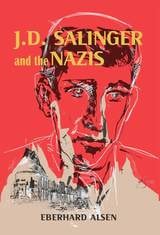
J. D. Salinger and the Nazis
Eberhard Alsen
University of Wisconsin Press, 2018
Alsen, a longtime Salinger scholar who witnessed the Nazi regime firsthand as a child in Germany, tracks Salinger's prewar experiences in the army, his work for the CIC during significant military campaigns, and his reactions to three military disasters that killed more than a thousand fellow soldiers in his Fourth Infantry Division. Alsen also identifies the Nazi death camp where Salinger saw mounds of recently burned bodies. Revealing details shed light on Salinger's outspoken disgust for American military leaders, the personality changes that others saw in him after the war, and his avoidance of topics related to the Holocaust.
JOAN
Jake Rose
University of Chicago Press, 2026
Longlisted for the 2026 National Book Award for Poetry. A narrative sequence of lyric poems reimagining Joan of Arc as a framework for queer identity, transformation, and poetic voice.
Collapsing biography and autobiography, the poetry of Jake Rose’s debut explores queer identity, grief, and desire through the historical framework of Joan of Arc’s life. Moving through rural landscapes of the speaker’s youth, contradictions of faith, consequences of desire, and fragmentations of trauma, JOAN is structured as an excavation of the speaker’s most intimate moments, combining poetry with historical quotations, visual collage, and a sequence of film stills. Through vivid lyric moments, the poems construct a speaker and world both intimate and charged—“I have to touch my farthest feeling,” “the sapphire dusk draping its lace arias”—with clarity and vibrant intensity. Refusing resolution, these poems dwell in rupture, reinvention, and fluid forms of gender that come to life outside of inherited boundaries. This collection speaks from the margins, searching for a body the self might inhabit and asking what it means to transform through language, gender, and desire.
JOAN is the winner of the Phoenix Emerging Poet Book Prize.
Jab
Mark Halliday
University of Chicago Press, 2002
Halliday has whacked Death and Mutabilitie before, but this time . . . this time he whacks them again. After this Jab, the world will never be the same. Or at least, a few hundred conversations, here and there, will be somewhat affected. Roll over Death, and tell Mutabilitie the news.
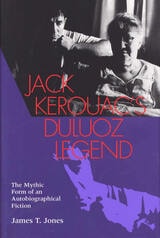
Jack Kerouac's Duluoz Legend
The Mythic Form of an Autobiographical FictionJames T. Jones
Southern Illinois University Press, 1999
In the only critical examination of all of Jack Kerouac's published prose, James T. Jones turns to Freud to show how the great Beat writer used the Oedipus myth to shape not only his individual works but also the entire body of his writing.
Like Balzac, Jones explains, Kerouac conceived an overall plan for his total writing corpus, which he called the Duluoz Legend after Jack Duluoz, his fictional alter ego. While Kerouac's work attracts biographical treatment—the ninth full-length biography was published in 1998—Jones takes a Freudian approach to focus on the form of the work. Noting that even casual readers recognize family relationships as the basis for Kerouac's autobiographical prose, Jones discusses these relationships in terms of Freud's notion of the Oedipus complex.
After establishing the basic biographical facts and explaining Freud's application of the Oedipus myth, Jones explicates Kerouac's novels of childhood and adolescence, focusing on sibling rivalry. Supporting his contention that the Beat writer worked according to a plan, Jones then shows how Kerouac revised The Town and the City (1950), his first published novel, in Vanity of Duluoz, the last novel published in his lifetime, to de-emphasize the death of the father. He treats three versions of Kerouac's road novel—including On the Road—as versions of Oedipus's fateful journey from Corinth to Thebes. And he argues that Pic, often considered peripheral to the Duluoz Legend, replicates the Oedipal themes.
Jones demonstrates that Maggie Cassidy, The Subterraneans, and Tristessa share a form that results from Kerouac's unresolved rivalry with his father for the love of his mother. He discusses Kerouac's replacement of the destructive brother figures in On the Road and Visions of Cody with the constructive hero of The Dharma Bums. He also shows how the Oedipal structure of the Duluoz Legend applies to Kerouac's nonfiction.
In the penultimate chapter, Jones explains how Big Sur, Kerouac's story of his alcohol-induced nervous breakdown, actually marks the climax of the Duluoz Legend. The alcoholism, Jones insists, is not the cause but a symptom of a breakdown brought on by his attachment to his mother. He shows how Kerouac's obsession with his family repeats Oedipal themes throughout the Duluoz Legend. Finally, he deals with Oedipal themes in Kerouac's nonnarrative work, including Old Angel Midnight, Some of the Dharma, The Scripture of the Golden Eternity, and several poems.
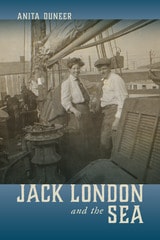
Jack London and the Sea
Anita Duneer
University of Alabama Press, 2022
The first book-length study of London as a maritime writer
Jack London’s fiction has been studied previously for its thematic connections to the ocean, but Jack London and the Sea marks the first time that his life as a writer has been considered extensively in relationship to his own sailing history and interests. In this new study, Anita Duneer claims a central place for London in the maritime literary tradition, arguing that for him romance and nostalgia for the Age of Sail work with and against the portrayal of a gritty social realism associated with American naturalism in urban or rural settings. The sea provides a dynamic setting for London’s navigation of romance, naturalism, and realism to interrogate key social and philosophical dilemmas of modernity: race, class, and gender. Furthermore, the maritime tradition spills over into texts that are not set at sea.
Jack London and the Sea does not address all of London’s sea stories, but rather identifies key maritime motifs that influenced his creative process. Duneer’s critical methodology employs techniques of literary and cultural analysis, drawing on extensive archival research from a wealth of previously unpublished biographical materials and other sources. Duneer explores London’s immersion in the lore and literature of the sea, revealing the extent to which his writing is informed by travel narratives, sensational sea yarns, and the history of exploration, as well as firsthand experiences as a sailor in the San Francisco Bay and Pacific Ocean.
Organized thematically, chapters address topics that interested London: labor abuses on “Hell-ships” and copra plantations, predatory and survival cannibalism, strong seafaring women, and environmental issues and property rights from San Francisco oyster beds to pearl diving in the Paumotos. Through its examination of the intersections of race, class, and gender in London’s writing, Jack London and the Sea plumbs the often-troubled waters of his representations of the racial Other and positions of capitalist and colonial privilege. We can see the manifestation of these socioeconomic hierarchies in London’s depiction of imperialist exploitation of labor and the environment, inequities that continue to reverberate in our current age of global capitalism.
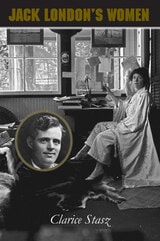
Jack London's Women
Clarice Stasz
University of Massachusetts Press, 2001
Using newly available letters and diaries from private collections, Stasz brings this diverse constellation of women to life. London was the son of freethinking Flora Wellman, yet found more maternal comfort from freed slave Jennie Prentiss and his stepsister Eliza. His early loves included a British-born consumptive, a Jewish socialist, and an African American. His first wife, Bess Maddern, was a teacher and devoted mother to daughters Bess and Joan, while his second wife, Charmian Kittredge, shared his passion for adventure and served as a model for many characters in his writings. Following his death, the various women who survived him both promoted his legacy and suffered the consequences of being constantly identified with a famous man.
In recasting London's life through the eyes of three generations of women, Stasz manages to untangle his seemingly contradictory attitudes and actions. She also reveals the struggle that ensued, after his death, among family members and scholars over how he should be remembered. What emerges from this well-researched book is a new understanding of London and a compelling portrayal of the women who knew him best.
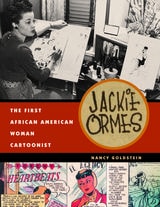
Jackie Ormes
The First African American Woman CartoonistNancy Goldstein
University of Michigan Press, 2008
At a time of few opportunities for women in general and even fewer for African American women, Jackie Ormes (1911–85) blazed a trail as a popular cartoonist with the major black newspapers of the day. Her cartoon characters (including Torchy Brown, Candy, Patty-Jo, and Ginger) delighted readers and spawned other products, including an elegant doll with a stylish wardrobe and “Torchy Togs” paper dolls. Ormes was a member of Chicago’s black elite, with a social circle that included the leading political figures and entertainers of the day. Her cartoons and comic strips provide an invaluable glimpse into American culture and history, with topics that include racial segregation, U.S. foreign policy, educational equality, the atom bomb, and environmental pollution, among other pressing issues of the times—and of today’s world as well. This celebrated biography features a large sampling of Ormes’s cartoons and comic strips, and a new preface.
Jagged with Love
Susanna Childress
University of Wisconsin Press, 2005
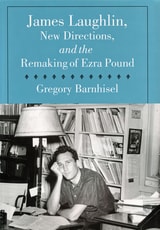
James Laughlin, New Directions Press, and the Remaking of Ezra Pound
Greg Barnhisel
University of Massachusetts Press, 2005
For much of the 1930s prior to World War II, Laughlin and Pound were friends, business associates, collaborators, student and teacher, and even at times son and surrogate father. But Laughlin's investment in Pound—and their friendship—was severely tested by Pound's wartime propaganda broadcasts for Italian state radio, his capture and abortive trial for treason, and his thirteen-year stay as a mental patient in St. Elizabeth's Hospital. Following this scandal and disgrace, the reading public no longer wanted to buy Pound's books, and the critical establishment dismissed him as a Fascist crank.
Laughlin and New Directions responded by marketing Pound in such a way as to convince consumers that the poet's importance needed to be judged solely on aesthetic grounds, and that his political beliefs were irrelevant to his accomplishments as a pioneering literary artist. With Pound's encouragement, and despite the poet's oft-expressed opposition to the mixture of commerce and art, Laughlin used such marketing tools as advertising, the cultivation of friendly critics, and the development of the trade paperback to enhance Pound's reputation.
Drawing on a wide range of sources—including interviews with Laughlin and other New Directions staffers and published materials from numerous literary archives—Gregory Barnhisel tells the story of the personal and professional relationship between one of the twentieth century's most controversial writers and his loyal and innovative American publisher—a relationship that eventually helped remake literary history and continues to shape our understanding of modernism itself
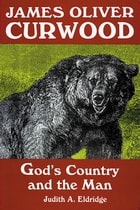
James Oliver Curwood
God's Country and the ManJudith A. Eldridge
University of Wisconsin Press, 1993
When the wounded bear he faced on a mountain ledge that day turned aside, James Curwood felt that he had been spared. From this encounter he became an avid conservationist. He wrote relentlessly—magazine stories and books and then for the new medium of motion pictures. Like many authors of his time, he was actively involved in movie-making until the plight of the forests and wildlife in his home state of Michigan turned his energies toward conservation.
A man ahead of his time, and quickly forgotten after his death in 1927, his gift of himself to his readers and to nature has finally come to be appreciated again two generations later.

James Wright
The Poetry of a Grown Man; Constancy and Transition in the Work of James WrightKevin Stein
Ohio University Press, 1988
Stein locates Wright in the Emersonian tradition which sees struggle with language as a struggle with the self -- a locating and defining of the self within a world of natural facts. Language, then, becomes a means of self-definition, and to be frivolous or irresponsible with language becomes a negation of the self and the world it inhabits. For Wright, “the poetry of a grown man” issues from this understanding. Because Wright joins the act of language with the act of selfhood, it is not surprising that the mode and tenor of his work would alter as the self redefines its values and goals, its very identity. In fact, Stein divides Wright’s career into three interrelated stages of development: “containment,” in which he relies on traditional religious and rhetorical measures to distance himself from a world of experience; “vulnerability,” in which he enters the experiential world where the self is rewarded and equally threatened; and “integration,” in which he accepts and balances the necessary combination of beauty and horror inherent in being human within a natural world.
Stein shows that throughout his career Wright’s presiding concern is to discover a way of writing and a way of life that might overcome the effects of an individual’s separation from the human community, the natural world, and the spiritual presence in the universe. In Wright’s world, to do less is to betray one’s language -- and one’s self.
James the Minimalist
An Essay on the Late NovelsJohn Brenkman
University of Chicago Press, 2026
An experiment in criticism that explores Henry James’s late works through the lens of minimalism.
Henry James’s last completed novels—The Ambassadors, The Wings of the Dove, and The Golden Bowl—are among the greatest and most demanding achievements of modern fiction. The stories they tell are perverse: characters are compelling even at their most cruel, their actions often calculating and loving at the same time. The novels draw on deep-seated myths but end with an unsettling lack of finality. And their dense, involuted language tracks the movements of consciousness with uncompromising artistry—the ultimate flowering of the late James style.
In this work of experimental criticism, John Brenkman is concerned with minimalism in two senses. First, with James’s own minimalism—his intense scrutiny of couples and their erotic energies to the exclusion of so much else. And second, through a kind of minimalization in literary critical reading, Brenkman cuts through James’s amplifications to find the essence that churns beneath the intricate prose of the late novels. Showing how James evokes not only protagonists’ subjectivity but more importantly what only exists in between—that is, between lovers, between spouses, between rivals—Brenkman reveals James’s transformation of the marriage novel and excavation of the couple form itself.
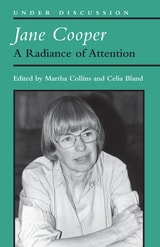
Jane Cooper
A Radiance of AttentionMartha Collins and Celia Bland, editors
University of Michigan Press, 2019
Martha Collins and Celia Bland bring together several decades’ worth of essential writing on Cooper’s poetry. While some pieces offer close examination of Cooper’s process or thoughtful consideration of the craft of a single poem, the volume also features reviews of her collections, including a previously unpublished piece on her first book, The Weather of Six Mornings (1969), by James Wright, a lifelong champion of her work. Marie Howe, Jan Heller Levi, and Thomas Lux, among others, share personal remembrances of Cooper as a teacher, colleague, and inspiration. L. R. Berger’s moving tribute to Cooper’s final days closes the volume. This book has much to offer for both readers who already love Cooper’s work and new readers, especially among younger poets, just discovering her enduring poems.
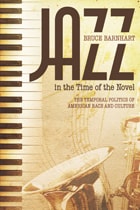
Jazz in the Time of the Novel
The Temporal Politics of American Race and CultureBruce Evan Barnhart
University of Alabama Press, 2013
WINNER OF THE ELIZABETH AGEE PRIZE IN AMERICAN LITERATURE
Jazz in the Time of the Novel argues that a culture’s understanding of the concept of time plays a central role in its economic, social, and aesthetic affairs and that a culture arrives at its conception of time through its artistic practices.
Bruce Barnhart, in Jazz in the Time of the Novel, shows that American culture of the first three decades of the twentieth century was shaped by the kindred rhythms and movements of two particular art forms: jazz and fiction. At the beginning of the twentieth century, widespread changes in America’s social, demographic, and economic norms threatened longstanding faith in a unified and inevitable movement towards a better future. As Barnhart shows both jazz and novels of the period address these temporal uncertainties, inserting themselves into arguments about the proper unfolding of an affirmative American future. Barnhart proposes that these two aesthetic forms can be viewed as co-participants in an ongoing discussion about the way in which the future should be imagined and experienced—a discussion symptomatic of the broader exchanges taking place within the many trajectories comprising early twentieth-century American culture.
This book includes in-depth approaches to numerous examples of jazz and the novel, including performances by James P. Johnson, Louis Armstrong, Bessie Smith, Duke Ellington, and Ethel Waters, and novels by James Weldon Johnson, F. Scott Fitzgerald, Ernest Hemingway, Gertrude Stein, and Nella Larsen, among others. In addition to the details of specific musical and literary works, Jazz in the Time of the Novel offers careful consideration as to how these works impact their social context.
Jericho
By Charles Bowden, Foreword by Charles D'Ambrosio
University of Texas Press, 2020
When Charles Bowden died in 2014, he left behind an archive of unpublished manuscripts. Jericho marks the fifth installment in his venerable “Unnatural History of America” sextet. In it he invokes the cycles of destruction and rebirth that have defined the ancient biblical city over millennia. From the ruins of Jericho’s walls Bowden reflects on the continuum of war and violence—the many conquests of the Americas; the US-Mexican War; the Vietnam War; and the ongoing militarization of our southern border—to argue against the false promise of security that is offered when men “build that wall.” Walls—both real and imagined—will always come tumbling down.
Along the way, Bowden tells stories of loss and violence, like that of David Hartley, who mysteriously vanishes on Falcon Lake; of murdered drug runners and their cartel bosses; and of a haunted sicario, or hitman, who is running from his past and compulsively confesses his sins as he searches for an absolution that will never come. Set against these scenes of trauma and violence are Bowden’s gorgeous meditations on nature: dancing cranes, soaring eagles, winding paths that traverse mountains, lakes, and deserts. And threaded throughout are the heroic narratives of men like Martin Luther King Jr., who defied the boundaries that surrounded him and was able to reshape the arc of history. Jericho is a remarkable affirmation of our shared humanity and a timely rejection of violence and nationalism by one of our most prophetic writers working at the height of his powers.
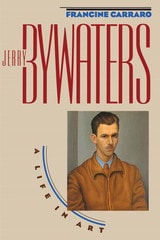
Jerry Bywaters
A Life in ArtBy Francine Carraro
University of Texas Press, 1994
As an artist, art critic, museum director, and art educator, Jerry Bywaters reshaped the Texas art world and attracted national recognition for Texas artists. This first full-scale biography explores his life and work in the context of twentieth-century American art, revealing Bywaters' important role in the development of regionalist painting.
Francine Carraro delves into all aspects of Bywaters' career. As an artist, Bywaters became a central figure and spokesman for a group of young, energetic painters known as the Dallas Nine (Alexandre Hogue, Everett Spruce, Otis Dozier, William Lester, and others) who broke out of the limitations of provincialism and attained national recognition beginning in the 1930s.
As director of the Dallas Museum of Fine Arts, art critic for the Dallas Morning News, and professor of art and art history at Southern Methodist University, Bywaters became a champion of the arts in Texas. Carraro traces his strong supporting role in professionalizing art institutions in Texas and defendlng the right to display art considered "subversive" in the McCarthy era.
From these discussions emerges a finely drawn portrait of an artist who used a vocabulary of regional images to explore universal themes. It will be of interest to all students of American studies, national and regional art history, and twentieth-century biography.

Jewish Gangsters of Modern Literature
Rachel Rubin
University of Illinois Press, 2000
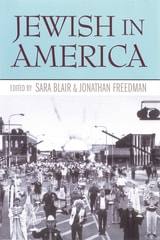
Jewish in America
Sara Blair and Jonathan Freedman, Editors
University of Michigan Press, 2004
-From the Introduction
This rare and original work of cultural studies offers uncommon and engaging perspectives-as well as provocative and humorous insights-on what it means to be Jewish in America.
Jewish in America features poetry, art, essays, and stories from an impressive and respected list of contributors, including among others Stephen Greenblatt, Richard Kostelanetz, Jacqueline Osherow, Robert Pinsky, Sharon Pomerantz, Nancy Reisman, Grace Schulman, Louis Simpson, Alisa Solomon, and Stephen J. Whitfield.
In addition to pieces by some of the country's leading writers, the book features a stunning gallery of original photographs that transport the viewer from the crowded Coney Island beaches of the 1940s to the landscapes of Oaxaca, Mexico in the 1990s.
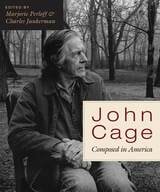
John Cage
Composed in AmericaEdited by Marjorie Perloff and Charles Junkerman
University of Chicago Press, 1994
John Cage: Composed in America is the first book-length work to address the "other" John Cage, a revisionist treatment of the way Cage himself has composed and been "composed" in America. Cage, as these original essays testify, is a contradictory figure. A disciple of Duchamp and Schoenberg, Satie and Joyce, he created compositions that undercut some of these artists' central principles and then attributed his own compositional theories to their "tradition." An American in the Emerson-Thoreau mold, he paradoxically won his biggest audience in Europe. A freewheeling, Californian artist, Cage was committed to a severe work ethic and a firm discipline, especially the discipline of Zen Buddhism.
Following the text of Cage's lecture-poem "Overpopulation and Art," delivered at Stanford shortly before his death and published here for the first time, ten critics respond to the challenge of the complexity and contradiction exhibited in his varied work. In keeping with Cage's own interdisciplinarity, the critics approach that work from a variety of disciplines: philosophy (Daniel Herwitz, Gerald L. Bruns), biography and cultural history (Thomas S. Hines), game and chaos theory (N. Katherine Hayles), music culture (Jann Pasler), opera history (Herbert Lindenberger), literary and art criticism (Marjorie Perloff), cultural poetics (Gordana P. Crnkovic, Charles Junkerman), and poetic practice (Joan Retallack). But such labels are themselves confining: each of the essays sets up boundaries only to cross them at key points. The book thus represents, to use Cage's own phrase, a much needed "beginning with ideas."
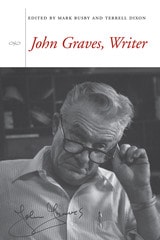
John Graves, Writer
Edited by Mark Busby and Terrell Dixon
University of Texas Press, 2007
Runner-up, Violet Crown Award, Writer's League of Texas, 2008
Renowned for Goodbye to a River, his now-classic meditation on the natural and human history of Texas, as well as for his masterful ability as a prose stylist, John Graves has become the dean of Texas letters for a legion of admiring readers and fellow writers. Yet apart from his own largely autobiographical works, including Hard Scrabble, From a Limestone Ledge, and Myself and Strangers, surprisingly little has been written about Graves's life or his work. John Graves, Writer seeks to fill that gap with interviews, appreciations, and critical essays that offer many new insights into the man himself, as well as the themes and concerns that animate his writing.
The volume opens with the transcript of a revealing, often humorous symposium session in which Graves responds to comments and stories from his old friend Sam Hynes, his former student and contemporary art critic Dave Hickey, and co-editor Mark Busby. Following this is a more formal interview of Graves by Dave Hamrick, who draws the author out on issues relating to each of his major works. John Graves's friends Bill Wittliff, Rick Bass, Bill Broyles, John R. Erickson, Bill Harvey, and James Ward Lee speak to the powerful influence that Graves has had on fellow writers.
In addition to these personal observations, nine scholars analyze essential aspects of Graves's work. These include the place of Goodbye to a River within environmental literature and how its writing was a rite of passage for its author; Graves as a prose stylist and a literary, rather than polemical, writer; the ways in which Graves's major works present different aspects of a single narrative about our relationship to the land; the question of gender in Graves's work; and Graves's sometimes contentious relationship with Texas Monthly magazine. Mark Busby introduces the volume with a critical overview of Graves's life and work, and Don Graham concludes it with a discussion of Graves's reception and literary reputation. A bibliography of works by and about Graves rounds out the book.
John Graves, Writer confirms Graves's stature not only within Texas letters, but also within American environmental writing, where Graves deserves to be more widely known.
John Reed and the Writing of Revolution
Daniel W. Lehman
Ohio University Press, 2002
John Reed (1887-1920) is best known as the author of Ten Days That Shook the World and as champion of the communist movement in the United States. Still, Reed remains a writer almost systematically ignored by the literary critical establishment, even if alternately vilified and lionized by historians and by films like Warren Beatty’s Reds.
John Reed and the Writing of Revolution examines Reed’s writing from a different critical perspective—one informed by a theoretical and practical understanding of literary nonfiction. In both politics and writing, John Reed defied fashion. In his short career, Reed transcended the traditional creative arts of fiction, poetry, and drama in favor of deeply researched histories composed with the cadence of fiction and the power of fact. Reed thereby alienated literary critics who had idealized timeless artistry against the rough-and-tumble world of historical details and political implications.
Working from a close investigation of rare articles, manuscripts, and the Reed papers at Harvard as well as from Reed’s published work, Daniel W. Lehman offers the first detailed literary study of the man who followed Pancho Villa into battle; wrote literary profiles of such characters as Henry Ford, William Jennings Bryan, and Billy Sunday; explicated the Byzantine factionalism of Eastern Europe; and witnessed the storming of the Winter Palace and the birth of Soviet Russia.
John Steinbeck Goes to War
The Moon is Down as PropagandaDonald V. Coers
University of Alabama Press, 2005
WINNER OF THE ELIZABETH AGEE PRIZE IN AMERICAN LITERATURE
When words became weapons—Steinbeck’s novel and the underground war for freedom.
In March 1942, a desperate period for the allies in World War II, John Steinbeck published his propaganda novel The Moon is Down—the story of ruthless invaders who overrun a militarily helpless country. Throughout the novel, Steinbeck underscored both the fatal weakness of the “invincible” unnamed aggressors and the inherent power of the human values shard by the “conquered” people.
The Moon is Down created an immediate sensation among American literary critics; fierce debate erupted over Steinbeck’s uncommonly sympathetic portrayal of the enemy and the novel’s power as a vehicle for propaganda. Fifty years later, Coers continues the debate, relying heavily on unpublished letters and personal interviews with the lawyers, book dealers, actors, publishers, and housewives associated with the resistance movements in Western Europe. Clandestine translations of The Moon Is Down quickly appeared and were widely circulated under the noses of the Gestapo. Coers documents the fate of Steinbeck’s novel in the hands of World War II resistance fighters and deepens our appreciation of Steinbeck’s unique ability to express the feelings of oppressed peoples.
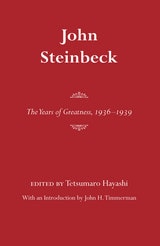
John Steinbeck
The Years of Greatness, 1936-1939Tetsumaro Hayashi
University of Alabama Press, 1993
Revisiting the remarkable years that produced Steinbeck's greatest literary achievements.
John Steinbeck: The Years of Greatness, 1936–1939, edited by Tetsumaro Hayashi, offers a compelling scholarly exploration of the brief but extraordinary period during which John Steinbeck produced some of the most influential works in American literary history. Drawn from papers presented at the Third International Steinbeck Congress, this collection of essays examines the creative, intellectual, and social forces that shaped Steinbeck's remarkable achievements during the late 1930s.
The contributors investigate Steinbeck's major works of the period, including In Dubious Battle, Of Mice and Men, and The Grapes of Wrath, situating them within the social and economic realities of the Great Depression and the evolving landscape of twentieth-century American literature. Particular attention is given to Steinbeck's portrayal of labor, migration, community, social justice, and the experiences of working-class Americans. The volume also presents innovative studies of female characters and relationships in Steinbeck's fiction, drawing on newly available research materials and correspondence to illuminate previously overlooked dimensions of his work.
By combining historical context, literary analysis, and fresh critical perspectives, this collection deepens appreciation for Steinbeck's artistry and enduring cultural significance. An essential resource for scholars and students alike, it offers valuable insights into the years that established Steinbeck as one of America's most important and widely studied authors.
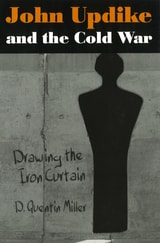
John Updike and the Cold War
Drawing the Iron CurtainD. Quentin Miller
University of Missouri Press, 2001
One of the most enduring and prolific American authors of the latter half of the twentieth century, John Updike has long been recognized by critics for his importance as a social commentator. Yet, John Updike and the Cold War is the first work to examine how Updike's views grew out of the defining context of American culture in his time—the Cold War. Quentin Miller argues that because Updike's career began as the Cold War was taking shape in the mid-1950s, the world he creates in his entire literary oeuvre—fiction, poetry, and nonfiction prose—reflects the optimism and the anxiety of that decade.
Miller asserts that Updike's frequent use of Cold War tension as a metaphor for domestic life and as a cultural reality that affects the psychological security of his characters reveals the inherent conflict of his fictional world. Consequently, this conflict helps explain some of the problematic relationships and aimless behavior of Updike's characters, as well as their struggles to attain spiritual meaning.
By examining Updike's entire career in light of the historical events that coincide with it, Miller shows how important the early Cold War mind-set was to Updike's thinking and to the development of his fiction. The changes in Updike's writing after the 1950s confirm the early Cold War era's influence on his ideology and on his celebrated style. By the Cold War's end in the late 1980s, Updike's characters look back fondly to the Eisenhower years, when their national identity seemed so easy to define in contrast to the Soviet Union. This nostalgia begins as early as his writings in the 1960s, when the breakdown of an American consensus disillusions Updike's characters and leaves them yearning for the less divisive 1950s.
While underscoring how essential history is to the study of literature, Miller demonstrates that Updike's writing relies considerably on the growth of the global conflict that defined his time. Cogent and highly readable, John Updike and the Cold War makes an important contribution to Updike scholarship.
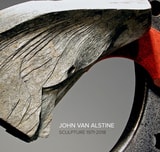
John Van Alstine
Sculpture, 1971–2018John Van Alstine
The Artist Book Foundation, 2019
For nearly fifty years, John Van Alstine has created abstract sculptures forged from steel and stone. In John Van Alstine: Sculpture, 1971–2018, three notable essayists explore the sculptor's abstract landscapes that reveal the complex synergy between natural foces and man-made elements; by grappling with the challenges of balancing stone and steel, Van Alstine's indoor, outdoor, and site-specific sculptures are measured and calculated, yet simultaneously poetic; their swooping angular lines create expansive spaces beyond the limits of their stone-and-steel frames to unveil our collective history and imagination, illuminating a deft interplay of natural energies and the human experience.
The artist weaves into his works elements of mythology, celestial navigation, implements, human figures, movement, urban forms, and found objects, while using motion, balance, and intertia to incorporate the eternal forces of gravity, tension, and erosion. In an essay on his drawings, Van Alstine details the critical role they play in the initiation and planning of his projects, offering the reader a firsthand perspective on the artist's creative process. The Artist Book Foundation is gratified to publish this lavishly illustrated monograph on an esteemed and prolific contemporary artist.
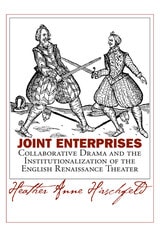
Joint Enterprises
Collaborative Drama and the Institutionalization of the English Renaissance TheaterHeather Anne Hirschfeld
University of Massachusetts Press, 2004
Drawing on a range of documentary and literary sources as well as recent methodological advances in theater history, the book presents a sequence of case studies designed to accommodate both the larger cultural setting of the early modern theater and the localized, idiosyncratic factors influencing discrete literary productions. Each chapter chronicles the professional setting of a particular joint work and then investigates its rhetorical or linguistic traces in the resultant text. This approach allows Hirschfeld to locate specific links between modes of collaborative production and forms of dramatic representation and then explicate the literary and political implications of these connections.
Hirschfeld's case studies provide a fresh account of the institutionalization—the steady growth, organization, and incorporation—of the professional drama in sixteenth- and seventeenth-century English cultural life. By attending to the changing shapes and stakes of joint enterprises, she shows that dramatists did not unconsciously absorb the practice of collaborative writing from general social discourses, but rather were aware of the material and symbolic significances of their work, meanings structured by the traditions of the developing professional theater and by the cultural pressures and anxieties attendant upon a new and often fragile institution.

Jonathan Edwards and the Gospel of Love
Ronald Story
University of Massachusetts Press, 2012
Jonathan Edwards has long epitomized the Puritan preacher as fiery scold, fixated on the inner struggle of the soul and the eternal flames of hell. In this book, Ronald Story offers a fundamentally different view of Edwards, revealing a profoundly social minister who preached a gospel of charity and community bound by love.
The first chapters trace Edwards's life and impact, examine his reputation as an intellectual, Calvinist, and revivalist, and highlight the importance for him of the gentler, more compassionate concepts of light, harmony, beauty, and sweetness. Story then explains what Edwards means by the “Gospel of Love”—a Christian faith that is less individual than interpersonal, and whose central feature is the practice of charity to the poor and the quest for loving community in this world, the chief signs of true salvation. As Edwards preached in his sermon “Heaven Is a World of Love,” the afterlife itself is social in nature because love is social.
Drawing on Edwards's own sermons and notebooks, Story reveals the minister's belief that divine love expressed in the human family should take us beyond tribalism, sectarianism, provincialism, and nationality. Edwards offers hope, in the manner of Walter Rauschenbusch, Karl Barth, Martin Luther King Jr., and other great “improvers,” for the coming of a world without want and war. Gracefully and compellingly written, this book represents a new departure in Edwards studies, revising the long-standing yet misleading stereotype of a man whose lessons of charity, community, and love we need now more than ever.
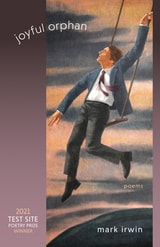
Joyful Orphan
PoemsMark Irwin
University of Nevada Press, 2023
Through poems of witness, species and habitat extinction, war, pandemic, technology, history, and race, Mark Irwin’s elegant collection of poetry explores the collision between metropolis and wilderness, and engages with forms of spirit that cannot be bound. With the incursion of electronic communication, our connections with one another have been radically distorted. Irwin’s poems confront what it means to be human, and how conflict, along with the interface between technology and humanity, can cause us to become orphaned in many different ways. But it is our decision to be joyful.
Excerpt from “Letter”
Times when we touch hope like the hem of a cloud
just as when we touch a body or door, or think
of the dead come back, romancing
us through the warp of memory, lighting a way
by luring . . .

June in Eden
Rosalie Moffett
The Ohio State University Press, 2017
A sharp, darkly funny, and tender debut that exposes the fractures in our language, our technologies, and our attempts to call the world by its right name.
In June in Eden, Rosalie Ruth Moffett leads us through terrains that shift between the mythic and the modern. Sometimes the garden is wild and blooming; other times, the coveted tree is only hiding a cell tower, lungs become ATMs, and prayers travel by text message. This is a book for an age when “new kinds of war…keep / changing the maps,” and when even small slips—preying or praying—reveal the instability of the words we rely on.
At the heart of the collection lies an obsession with language: its power, its failures, and what remains when it falters. “Ruth,” our speaker notes, is “a kind of compassion / nobody wants anymore—the surviving half / of the pair of words is ruthless.” Throughout these poems, dark humor coexists with deep tenderness, reminding us of the human urge to “love the world / we made and all its shadows.
Moffett offers a speaker bewildered and awestruck by the world’s contradictions—its technological miracles, its medical uncertainties, its imaginative leaps. These poems, equal parts grief and wonder, give us a landscape that from some angles resembles paradise, and from others, something far stranger.

Junot Díaz and the Decolonial Imagination
Monica Hanna, Jennifer Harford Vargas, José David Saldívar, editors
Duke University Press, 2016