4413 books match the query 'Anthropology' and 57 start with j
cover of Jacques Lacan: A Critical Introduction

Jacques Lacan

A Critical Introduction

Martin Murray

Pluto Press, 2016

 
French psychoanalyst Jacques Lacan has been a major influence on a wide range of twentieth-century thought, even as the breadth, complexity, and obscurity of his work has intimidated students and deterred casual readers. That situation hasn’t been helped by uneven translations into English that have led to a popular conception of his intellectual enterprise that can at times be profoundly mistaken.
 
In this brief, clearly written introduction to Lacan and his work, Martin Murray presents an up-to-date survey of his key concepts, their development, and their influence on fields such as anthropology, linguistics, and philosophy. Arguing strongly that we should move beyond the traditional focus on Lacan’s early work, which favored a linguistic approach, Murray offers instead a more comprehensive overview of the whole arc of Lacan’s thought. The result is a rigorous, yet accessible, account of one of the key intellectual figures of the twentieth century.

[more]
cover of Jaguar: A Story of Africans in America

Jaguar

A Story of Africans in America

Paul Stoller

University of Chicago Press, 1999

Issa Boureima is a young, hip African street vendor who sells knock-off designer bags and hats in an open-air market on 125th street in Harlem. His goal is to become a "Jaguar"—a West African term for a keen entrepreneur able to spot trends and turn a profit in any marketplace. This dynamic world, largely invisible to mainstream culture, is the backdrop of this timely novel.

Faced with economic hardship in Africa, Issa has left his home in Niger and his new wife, Khadija, to seek his fortune in America. Devout Muslims, the couple has entered into a "modern" marriage: Khadija is permitted to run her own business, and Issa has agreed not to take additional wives. Issa quickly adapts to his new surroundings, however, and soon attracts several girlfriends. Aided by a network of immigrants, he easily slips through gaps in the "system" and extends his stay in America indefinitely. Following a circuit of African-American cultural festivals across America, he marvels at African-Americans' attitudes toward Africa, and wonders if he'll ever return to Niger. Meanwhile, Khadija also struggles to make it—to become a "Jaguar"—as she combats loneliness, hostile in-laws, and a traditional, male-dominated society. The eventual success of her dry goods shop and her growing affection for a helpful Arab merchant make her wonder if she'll ever join Issa in America.

Drawing on his own decades of experience among Africans both in Niger and in New York, Paul Stoller offers enormous insight into the complexities of contemporary Africa. Alive with detail, Jaguar is a story of triumph and disappointment, of dislocation and longing, and of life lived in a world that no longer recognizes boundaries.
[more]
cover of Jamaica Genesis: Religion and the Politics of Moral Orders

Jamaica Genesis

Religion and the Politics of Moral Orders

Diane J. Austin-Broos

University of Chicago Press, 1997

How has Pentecostalism, a decidedly American form of Christian revivalism, managed to achieve such phenomenal religious ascendancy in a former British colony among people of predominately African descent? According to Diane J. Austin-Broos, Pentecostalism has flourished because it successfully mediates between two historically central yet often oppositional themes in Jamaican religious life—the characteristically African striving for personal freedom and happiness, and the Protestant struggle for atonement and salvation through rigorous ethical piety. With its emphasis on the individual experience of grace and on the ritual efficacy of spiritual healing, and with its vibrantly expressive worship, Jamaican Pentecostalism has become a powerful and compelling vehicle for the negotiation of such fundamental issues as gender, sexuality, race, and class. Jamaica Genesis is a work of signal importance to all those concerned not simply with Caribbean studies but with the ongoing transformation of religion andculture.
[more]
cover of Japanese American Millennials: Rethinking Generation, Community, and Diversity

Japanese American Millennials

Rethinking Generation, Community, and Diversity

Michael Omi

Temple University Press, 2019

Whereas most scholarship on Japanese Americans looks at historical case studies or the 1.5 generation assimilating, this pioneering anthology, Japanese American Millennials, captures theexperiences, perspectives, and aspirations of Asian Americans born between 1980 and 2000. The editors and contributors present multiple perspectives on who Japanese Americans are, how they think about notions of community and culture, and how they engage and negotiate multiple social identities.

The essays by scholars both in the United States and Japan draw upon the Japanese American millennial experience to examine how they find self-expression in Youth Basketball Leagues or Christian youth camps as well as how they grapple with being mixed-race, bicultural, or queer. Featuring compelling interviews and observations, Japanese American Millennials dislodges the dominant generational framework toaddress absences in the current literature and suggests how we might alternatively study Japanese Americans as a whole.

[more]
cover of Japanese Brazilian Saudades: Diasporic Identities and Cultural Production

Japanese Brazilian Saudades

Diasporic Identities and Cultural Production

Ignacio López-Calvo

University Press of Colorado, 2019

Japanese Brazilian Saudades explores the self-definition of Nikkei discourse in Portuguese-language cultural production by Brazilian authors of Japanese ancestry. Ignacio López-Calvo uses books and films by twentieth-century Nikkei authors as case studies to redefine the ideas of Brazilianness and Japaneseness from both a national and a transnational perspective. The result suggests an alternative model of postcoloniality, particularly as it pertains to the post–World War II experience of Nikkei people in Brazil.
 
López-Calvo addresses the complex creation of Japanese Brazilian identities and the history of immigration, showing how the community has used writing as a form of reconciliation and affirmation of their competing identities as Japanese, Brazilian, and Japanese Brazilian. Japanese in Brazil have employed a twofold strategic, rhetorical engineering: the affirmation of ethno-cultural difference on the one hand, and the collective assertion of citizenship and belonging to the Brazilian nation on the other. López-Calvo also grapples with the community’s inclusion and exclusion in Brazilian history and literature, using the concept of “epistemicide” to refer to the government’s attempt to impose a Western value system, Brazilian culture, and Portuguese language on the Nikkeijin, while at the same time trying to destroy Japanese language and culture in Brazil by prohibiting Japanese language instruction in schools, Japanese-language publications, and even speaking Japanese in public.
 
Japanese Brazilian Saudades contributes to the literature criticizing the “cognitive injustice” that fails to acknowledge the value of the global South and non-Western ways of knowing and being in the world. With important implications for both Latin American studies and Nikkei studies, it expands discourses of race, ethnicity, nationality, and communal belonging through art and narrative.

 
[more]
cover of Japanese Civilization: A Comparative View

Japanese Civilization

A Comparative View

S. N. Eisenstadt

University of Chicago Press, 1996
S. N. Eisenstadt, one of the world's leading social theorists, provides a monumental synthesis of Japanese history, religion, culture, and social organization. Equipped with a thorough command of the literature, Eisenstadt explores the Japanese historical legacy and its impact on the Japanese experience of modernity. Eschewing the polemicism of structuralist or culturalist approaches, he expands his investigative framework to include a keenly systematic, broadly comparative analysis. What emerges is an innovative new construction, focusing on the nonideological character of Japanese civilization as well as its infinite capacity to recreate community through an ongoing past.

[more]
cover of Japanese Foodways, Past and Present

Japanese Foodways, Past and Present

Edited by Eric C. Rath and Stephanie Assmann

University of Illinois Press, 2010

Spanning nearly six hundred years of Japanese food culture, Japanese Foodways, Past and Present considers the production, consumption, and circulation of Japanese foods from the mid-fifteenth century to the present day in contexts that are political, economic, cultural, social, and religious. Diverse contributors--including anthropologists, historians, sociologists, a tea master, and a chef--address a range of issues such as medieval banquet cuisine, the tea ceremony, table manners, cookbooks in modern times, food during the U.S. occupation period, eating and dining out during wartimes, the role of heirloom vegetables in the revitalization of rural areas, children's lunches, and the gentrification of blue-collar foods.
 
Framed by two reoccurring themes--food in relation to place and food in relation to status--the collection considers the complicated relationships between the globalization of foodways and the integrity of national identity through eating habits. Focusing on the consumption of Western foods, heirloom foods, once-taboo foods, and contemporary Japanese cuisines, Japanese Foodways, Past and Present shows how Japanese concerns for and consumption of food has relevance and resonance with other foodways around the world.
 
Contributors are Stephanie Assmann, Gary Soka Cadwallader, Katarzyna Cwiertka, Satomi Fukutomi, Shoko Higashiyotsuyanagi, Joseph R. Justice, Michael Kinski, Barak Kushner, Bridget Love, Joji Nozawa, Tomoko Onabe, Eric C. Rath, Akira Shimizu, George Solt, David E. Wells, and Miho Yasuhara.
[more]
cover of Japanese and Americans: Cultural Parallels and Paradoxes

Japanese and Americans

Cultural Parallels and Paradoxes

Charles Cleaver

University of Minnesota Press, 1976

Japanese and Americans was first published in 1976.Long periods of residence, study, and teaching in Japan have given Professor Cleaver an opportunity to observe its culture and to compare it with that of the United States, where he is a specialist in American studies. He reaches the conclusion that differences in the two cultures have been emphasized so much that similarities have been overlooked. Further, he points out, when differences have been discovered, a moral judgment has often been implied. In this book he provides a balanced view which will, it is hoped, contribute to a better understanding between the two countries.Since an exhaustive comparison of the two cultures is out of the question within the limits of a single volume, he has chosen the method of an oil prospector, drilling down here and there, where science or hunch suggests there might be a payoff. In his study he uses the word culture in the manner of the anthropologist as meaning the whole way of life. He places more emphasis, however, than the ordinary anthropologist does on the clues which the arts provide. Thus, among the subjects he discusses at some length are fictional writing and architecture. Among his other subjects are political and military nationalism, international economic reputations of the two countries, attitudes toward nature, and the organization of work and leisure. In his concluding chapter he discusses current tendencies toward local and international loyalties as opposed to those which are national, and the growing interest in cultural nationalism which accompanies a distrust of political and military nationalism. Finally, he makes a plea for an international community with cultural diversity.
[more]
cover of Japanoise: Music at the Edge of Circulation

Japanoise

Music at the Edge of Circulation

David Novak

Duke University Press, 2013

Noise, an underground music made through an amalgam of feedback, distortion, and electronic effects, first emerged as a genre in the 1980s, circulating on cassette tapes traded between fans in Japan, Europe, and North America. With its cultivated obscurity, ear-shattering sound, and over-the-top performances, Noise has captured the imagination of a small but passionate transnational audience.

For its scattered listeners, Noise always seems to be new and to come from somewhere else: in North America, it was called "Japanoise." But does Noise really belong to Japan? Is it even music at all? And why has Noise become such a compelling metaphor for the complexities of globalization and participatory media at the turn of the millennium?

In Japanoise, David Novak draws on more than a decade of research in Japan and the United States to trace the "cultural feedback" that generates and sustains Noise. He provides a rich ethnographic account of live performances, the circulation of recordings, and the lives and creative practices of musicians and listeners. He explores the technologies of Noise and the productive distortions of its networks. Capturing the textures of feedback—its sonic and cultural layers and vibrations—Novak describes musical circulation through sound and listening, recording and performance, international exchange, and the social interpretations of media.

[more]
cover of Java Man: How Two Geologists Changed Our Understanding of Human Evolution

Java Man

How Two Geologists Changed Our Understanding of Human Evolution

Carl C. Swisher III, Garniss H. Curtis, and Roger Lewin

University of Chicago Press, 2001

"'Garniss, lend me your knife for a second, will you,' I whispered." So begins Java Man, the inside story of how one discovery—a human skull found on the island of Java—by two geologists shook the foundations of science. By uncovering new evidence about the hominid known as Java man, Carl C. Swisher and Garniss H. Curtis were able to date his fossil remains at 1.7 million years, an age that stunned the scientific community because it pushed back the time when humans migrating out of Africa first reached Eurasia by nearly one million years. Cowritten by the popular science writer Roger Lewin, this is a gripping and informative account of the discovery that breathed new life into the human origins debate.

Originally published by Scribner
2000 ISBN: 0-684-80000-4
[more]
cover of Javanese Lives: Women and Men in Modern Indonesian Society

Javanese Lives

Women and Men in Modern Indonesian Society

Williams, Walter L.

Rutgers University Press, 1991

Java is the most populous island of Indonesia, the fifth largest nation in the world. Yet despite its importance, outsiders know little about the country or its people. With the help of Indonesian students and scholars, Walter L. Williams has collected and translated the life histories of twenty-seven Javanese women and men. The people interviewed tell how they have coped with rapid social and economic change, and the transformation of their traditions. Williams has carefully selected the individuals he includes to represent a wide diversity of Java's people. We hear from fascinating men and women of various religions, from the rich and the poor, and from different ethnic backgrounds. Diversity is a constant theme, as evidenced by a poor pedicab driver who can barely scrape along, by a rich businesswoman who explains how she balances her professional and domestic roles, by an educated and respected homosexual school principal, and by an illiterate mother of fourteen children. All of them present in their lives a unique Javanese approach to living.

These oral histories were derived from elderly people, who have a larger perspective on the changes they have seen in their lifetimes. The focus of the first section of the book is the way people have adapted in their daily lives to massive social and economic changes. In the middle section, we hear from the Javanese who represent traditional values in the midst of change. Finally, we hear from educators and parents who tell us of their concerns for Indonesian youth and the future of Indonesia.

[more]
cover of Jazz Cosmopolitanism in Accra: Five Musical Years in Ghana

Jazz Cosmopolitanism in Accra

Five Musical Years in Ghana

Steven Feld

Duke University Press, 2012

In this remarkable book, Steven Feld, pioneer of the anthropology of sound, listens to the vernacular cosmopolitanism of jazz players in Ghana. Some have traveled widely, played with American jazz greats, and blended the innovations of John Coltrane with local instruments and worldviews. Combining memoir, biography, ethnography, and history, Feld conveys a diasporic intimacy and dialogue that contests American nationalist and Afrocentric narratives of jazz history. His stories of Accra's jazz cosmopolitanism feature Ghanaba/Guy Warren (1923–2008), the eccentric drummer who befriended the likes of Charlie Parker, Max Roach, and Thelonious Monk in the United States in the 1950s, only to return, embittered, to Ghana, where he became the country's leading experimentalist. Others whose stories figure prominently are Nii Noi Nortey, who fuses the legacies of the black avant-gardes of the 1960s and 1970s with pan-African philosophy in sculptural shrines to Coltrane and musical improvisations inspired by his work; the percussionist Nii Otoo Annan, a traditional master inspired by Coltrane's drummers Elvin Jones and Rashied Ali; and a union of Accra truck and minibus drivers whose squeeze-bulb honk-horn music for drivers' funerals recalls the jazz funerals of New Orleans. Feld describes these artists' cosmopolitan outlook as an "acoustemology," a way of knowing the world through sound.
[more]
cover of Jesus and the Gang: Youth Violence and Christianity in Urban Honduras

Jesus and the Gang

Youth Violence and Christianity in Urban Honduras

Jon Wolseth

University of Arizona Press, 2011

In urban Honduras, gun violence and assault form the pulsing backdrop of everyday life. This book examines the ways that young men and women in working-class neighborhoods of El Progreso, Honduras, understand and respond to gang and gun violence in their communities. Because residents rely on gangs and Catholic and Evangelical Protestant churches to mediate violence in their neighborhoods, these institutions form the fabric of society.

While only a small fraction of youths in a neighborhood are active members of a gang, most young men must learn the styles, ways of communicating, and local geography of gangs in order to survive. Due to the absence of gang prevention programs sponsored by the government or outside non-governmental organizations, Catholic and Pentecostal churches have developed their own ways to confront gang violence in their communities. Youths who participate in church organizations do so not only to alter and improve their communities but also to gain emotional and institutional support.

Offering firsthand accounts of these youths and how they make use of religious discourse, narrative practices, or the inscription of tattooed images and words on the body to navigate dangerous social settings, Jesus and the Gang is an unflinching look at how these young men turn away from perpetuating the cycle of violence and how Christianity serves a society where belonging is surviving.

This book will appeal to readers with an interest in Latin American studies, urban anthropology, and youth studies. With its focus on the lives of young men and women, it’s also a compelling read for anyone interested in the plight of urban youth trying to escape the gang life.

[more]
cover of Jesus in America and Other Stories from the Field

Jesus in America and Other Stories from the Field

Claudia Gould

Utah State University Press, 2009

Drawing on ethnographic field work she conducted among Christians in her home state of North Carolina, Claudia Gould crafts stories that lay open the human heart and social complications of fundamentalist belief. These stories and the compelling characters who inhabit them draw us into the complex essence of religious experience among southern American Christians.

[more]
cover of Jewish Budapest: Monuments, Rites, History

Jewish Budapest

Monuments, Rites, History

Géza Komoróczy

Central European University Press, 1999

As a painting by Chagall unfolds layer upon layer when viewed carefully, so does the city in Jewish Budapest. Neither a guidebook or a history in the traditional sense, this book is about the Jewish face of Budapest from medieval times to the present. To get the broadest possible perspective, this book is not only about the Hungarian capital as a Jewish city but, as befits a cosmopolitan metropolis, delves into its myriad elements. There was and is, as Jewish Budapest strikingly reveals, a Roman and a Greek – Catholic Budapest, a Lutheran and a Calvinist Budapest, a German, a Serbian and a Gypsy Budapest. All these are brought into play as backdrop to the main narrative about the history of Jews in Buda, Obuda, and Pest. Past and present Jewish life as an organic part of the life of the Hungarian capital Budapest – be it memory or living reality. Richly illustrated with wonderfully evocative literary line drawings and photos, the book includes a lavish, full-colour section of artwork that enhances the text. Here is a book at once personal and universal. It is about everyday Jewish life, the humor, the pathos, the human condition, which is the same or very similar anywhere in the Diaspora. Every image and incident, every happening is filtered through the strong sensibilities of the key citizens of the city throughout the past few centuries. Remarkable citizens personified by the likes of Theodor Herzl and Joseph Pulitzer. The city is itself the central character of this book. The authors write only about those parts where there is a story to tell. They talk about places where history is still visible, where it can be located, where its traces still exist, where it can be tasted, savoured, and where it surrounds us as part of life in Budapest today. Jewish Budapest amasses huge amounts of lore about the city, its monuments and relics, its language and scholarship, its cultural heart, and its intellectual core. Jewish Budapest proceeds according to the chronological sequence of the birth of the Jewish quarters in the city, focusing on patterns of settlement and occupation, and demography, and unfolds finally into a vision of the future of Jewish life in this remarkably vibrant, venerable city. The book includes a section of detailed comments on the illustrations with an explanation of the abbreviations throughout as well as a bibliography, an index of personal names, an index of cities and towns, and an index of Budapest street addresses.
[more]
cover of Jewish Cuisine in Hungary: A Cultural History with 83 Authentic Recipes

Jewish Cuisine in Hungary

A Cultural History with 83 Authentic Recipes

András Koerner

Central European University Press, 2020

Winner of the 2019 National Jewish Book Award in the category of Food Writing & Cookbooks.

The author refuses to accept that the world of pre-Shoah Hungarian Jewry and its cuisine should disappear almost without a trace and feels compelled to reconstruct its culinary culture. His book―with a preface by Barbara Kirshenblatt-Gimblett―presents eating habits not as isolated acts, divorced from their social and religious contexts, but as an organic part of a way of life.

According to Kirshenblatt-Gimblett: “While cookbooks abound, there is no other study that can compare with this book. It is simply the most comprehensive account of a Jewish food culture to date.” Indeed, no comparable study exists about the Jewish cuisine of any country, or―for that matter―about Hungarian cuisine. It describes the extraordinary diversity that characterized the world of Hungarian Jews, in which what could or could not be eaten was determined not only by absolute rules, but also by dietary traditions of particular religious movements or particular communities. 

Ten chapters cover the culinary culture and eating habits of Hungarian Jewry up to the 1940s, ranging from kashrut (the system of keeping the kitchen kosher) through the history of cookbooks, the food traditions of weekdays and holidays, the diversity of households, and descriptions of food and hospitality industries to the history of some typical dishes. Although this book is primarily a cultural history and not a cookbook, it includes 83 recipes, as well as nearly 200 fascinating pictures of daily life and documents.i

[more]
cover of Jewish Families

Jewish Families

Boyarin, Jonathan

Rutgers University Press, 2013

From stories of biblical patriarchs and matriarchs and their children, through the Gospel’s Holy Family of Jesus, Mary, and Joseph, and to modern Jewish families in fiction, film, and everyday life, the family has been considered key to transmitting Jewish identity. Current discussions about the Jewish family’s supposed traditional character and its alleged contemporary crisis tend to assume that the dynamics of Jewish family life have remained constant from the days of Abraham and Sarah to those of Tevye and Golde in Fiddler on the Roof and on to Philip Roth’s Portnoy’s Complaint.

Jonathan Boyarin explores a wide range of scholarship in Jewish studies to argue instead that Jewish family forms and ideologies have varied greatly throughout the times and places where Jewish families have found themselves. He considers a range of family configurations from biblical times to the twenty-first century, including strictly Orthodox communities and new forms of family, including same-sex parents. The book shows the vast canvas of history and culture as well as the social pressures and strategies that have helped shape Jewish families, and suggests productive ways to think about possible futures for Jewish family forms.

[more]
cover of Jewish Life in Austria and Germany Since 1945: Identity and Communal Reconstruction

Jewish Life in Austria and Germany Since 1945

Identity and Communal Reconstruction

Susanne Cohen-Weisz

Central European University Press, 2016

Based on published primary and secondary materials and oral interviews with some eighty communal and organizational leaders, experts and scholars, this book provides a comparative account of the reconstruction of Jewish communal life in both Germany and in Austria (where 98% live in the capital, Vienna) after 1945. The author explains the process of reconstruction over the next six decades, and its results in each country. The monograph focuses on the variety of prevailing perceptions about topics such as: the state of Israel, one’s relationship to the country of residence, the Jewish religion, the aftermath of the Holocaust, and the influx of post-soviet immigrants. Cohen-Weisz examines the changes in Jewish group identity and its impact on the development of communities. The study analyzes the similarities and differences in regard to the political, social, institutional and identity developments within the two countries, and their changing attitudes and relationships with surrounding societies; it seeks to show the evolution of these two country’s Jewish communities in diverse national political circumstances and varying post-war governmental policies.
[more]
cover of Jewish Life in Belarus: The Final Decade of the Stalin Regime, 1944-1953

Jewish Life in Belarus

The Final Decade of the Stalin Regime, 1944-1953

Leonid Smilovitsky

Central European University Press, 2014

Jewish life in Belarus in the years after World War II was long an enigma. Officially it was held to be as being non-existent, and in the ideological atmosphere of the time research on the matter was impossible. Jewish community life had been wiped out by the Nazis, and information on its revival was suppressed by the communists. For more than half a century the truth about Jewish life during this period was sealed in inaccessible archives. The Jews of Belarus preferred to keep silent rather than expose themselves to the animosity of the authorities. Although the fate of Belarusian Jews before and during the war has now been amply studied, this book is one of the first attempts to study Jewish life in Belarus during the last decade of Stalin's rule. In addition to archival materials, the present research is based on a questionnaire submitted to former residents of Belarus in Israel, as well as information from periodicals, collections of documents, statistical reports and monographs.
[more]
cover of Jewish Roots in Southern Soil: A New History

Jewish Roots in Southern Soil

A New History

Edited by Marcie Ferris and Mark I. Greenberg

Brandeis University Press, 2006

Jews have long been a presence in the American South, first arriving in the late seventeenth century as part of exploratory voyages from Europe to the New World. Two of the nation’s earliest Jewish communities were founded in Savannah in 1733 and Charleston in 1749. By 1800, more Jews lived in Charleston than in New York City. Today, Jews comprise less than one half of one percent of the southern population but provide critical sustenance and support for their communities. Nonetheless, southern Jews have perplexed scholars. For more than a century, historians have wrestled with various questions. Why study southern Jewish history? What is the southern Jewish experience? Is southern Jewish culture distinctive from that of other regions of the country, and if so, why? Jewish Roots in Southern Soil: A New History addresses these questions through the voices of a new generation of scholars of the Jewish South. Each of this book’s thirteen chapters reflects a response with particular attention paid to new studies on women and gender; black/Jewish relations and the role of race, politics, and economic life; popular and material culture; and the changes wrought by industrialization and urbanization in the twentieth century. Essays address historical issues from the colonial era to the present and in every region of the South. Topics include assimilation and American Jewish identity, southern Jewish women writers, the Jewish Confederacy, Jewish peddlers, southern Jewish racial identity, black/Jewish relations, demographic change, the rise of American Reform Judaism, and Jews in southern literature.
[more]
cover of Jewish and Romani Families in the Holocaust and its Aftermath

Jewish and Romani Families in the Holocaust and its Aftermath

Eliyana R. Adler

Rutgers University Press, 2021

Diaries, testimonies and memoirs of the Holocaust often include at least as much on the family as on the individual. Victims of the Nazi regime experienced oppression and made decisions embedded within families. Even after the war, sole survivors often described their losses and rebuilt their lives with a distinct focus on family. Yet this perspective is lacking in academic analyses.
 
In this work, scholars from the United States, Israel, and across Europe bring a variety of backgrounds and disciplines to their study of the Holocaust and its aftermath from the family perspective. Drawing on research from Belarus to Great Britain, and examining both Jewish and Romani families, they demonstrate the importance of recognizing how people continued to function within family units—broadly defined—throughout the war and afterward.

[more]
cover of Jews and Other Differences: The New Jewish Cultural Studies

Jews and Other Differences

The New Jewish Cultural Studies

Jonathan Boyarin

University of Minnesota Press, 1997
[more]
cover of Journal of Anthropological Research, volume 77 number 4 (Winter 2021)

Journal of Anthropological Research, volume 77 number 4 (Winter 2021)

The University of Chicago Press

University of Chicago Press Journals, 2021
This is volume 77 issue 4 of Journal of Anthropological Research. The Journal of Anthropological Research publishes diverse, high-quality, peer-reviewed articles on anthropological research of substance and broad significance, as well as about 100–120 timely book reviews annually. The journal reaches out to anthropologists of all specialties and theoretical perspectives both in the United States and around the world, with special emphasis given to the detailed presentation and rigorous analysis of primary research.
[more]
cover of Journal of Anthropological Research, volume 78 number 1 (Spring 2022)

Journal of Anthropological Research, volume 78 number 1 (Spring 2022)

The University of Chicago Press

University of Chicago Press Journals, 2022
This is volume 78 issue 1 of Journal of Anthropological Research. The Journal of Anthropological Research publishes diverse, high-quality, peer-reviewed articles on anthropological research of substance and broad significance, as well as about 100–120 timely book reviews annually. The journal reaches out to anthropologists of all specialties and theoretical perspectives both in the United States and around the world, with special emphasis given to the detailed presentation and rigorous analysis of primary research.
[more]
cover of Journal of Anthropological Research, volume 78 number 2 (Summer 2022)

Journal of Anthropological Research, volume 78 number 2 (Summer 2022)

The University of Chicago Press

University of Chicago Press Journals, 2022
This is volume 78 issue 2 of Journal of Anthropological Research. The Journal of Anthropological Research publishes diverse, high-quality, peer-reviewed articles on anthropological research of substance and broad significance, as well as about 100–120 timely book reviews annually. The journal reaches out to anthropologists of all specialties and theoretical perspectives both in the United States and around the world, with special emphasis given to the detailed presentation and rigorous analysis of primary research.
[more]
cover of Journal of Anthropological Research, volume 78 number 3 (Fall 2022)

Journal of Anthropological Research, volume 78 number 3 (Fall 2022)

The University of Chicago Press

University of Chicago Press Journals, 2022
This is volume 78 issue 3 of Journal of Anthropological Research. The Journal of Anthropological Research publishes diverse, high-quality, peer-reviewed articles on anthropological research of substance and broad significance, as well as about 100–120 timely book reviews annually. The journal reaches out to anthropologists of all specialties and theoretical perspectives both in the United States and around the world, with special emphasis given to the detailed presentation and rigorous analysis of primary research.
[more]
cover of Journal of Anthropological Research, volume 78 number 4 (Winter 2022)

Journal of Anthropological Research, volume 78 number 4 (Winter 2022)

The University of Chicago Press

University of Chicago Press Journals, 2022
This is volume 78 issue 4 of Journal of Anthropological Research. The Journal of Anthropological Research publishes diverse, high-quality, peer-reviewed articles on anthropological research of substance and broad significance, as well as about 100–120 timely book reviews annually. The journal reaches out to anthropologists of all specialties and theoretical perspectives both in the United States and around the world, with special emphasis given to the detailed presentation and rigorous analysis of primary research.
[more]
cover of Journal of Anthropological Research, volume 79 number 1 (Spring 2023)

Journal of Anthropological Research, volume 79 number 1 (Spring 2023)

The University of Chicago Press

University of Chicago Press Journals, 2023

This is volume 79 issue 1 of Journal of Anthropological Research. The Journal of Anthropological Research publishes diverse, high-quality, peer-reviewed articles on anthropological research of substance and broad significance, as well as about 100–120 timely book reviews annually. The journal reaches out to anthropologists of all specialties and theoretical perspectives both in the United States and around the world, with special emphasis given to the detailed presentation and rigorous analysis of primary research.
[more]
cover of Journal of Anthropological Research, volume 79 number 2 (Summer 2023)

Journal of Anthropological Research, volume 79 number 2 (Summer 2023)

The University of Chicago Press

University of Chicago Press Journals, 2023
This is volume 79 issue 2 of Journal of Anthropological Research. The Journal of Anthropological Research publishes diverse, high-quality, peer-reviewed articles on anthropological research of substance and broad significance, as well as about 100–120 timely book reviews annually. The journal reaches out to anthropologists of all specialties and theoretical perspectives both in the United States and around the world, with special emphasis given to the detailed presentation and rigorous analysis of primary research.
[more]
cover of Journal of Anthropological Research, volume 79 number 3 (Fall 2023)

Journal of Anthropological Research, volume 79 number 3 (Fall 2023)

The University of Chicago Press

University of Chicago Press Journals, 2023
This is volume 79 issue 3 of Journal of Anthropological Research. The Journal of Anthropological Research publishes diverse, high-quality, peer-reviewed articles on anthropological research of substance and broad significance, as well as about 100–120 timely book reviews annually. The journal reaches out to anthropologists of all specialties and theoretical perspectives both in the United States and around the world, with special emphasis given to the detailed presentation and rigorous analysis of primary research.
[more]
cover of Journal of Anthropological Research, volume 79 number 4 (Winter 2023)

Journal of Anthropological Research, volume 79 number 4 (Winter 2023)

The University of Chicago Press

University of Chicago Press Journals, 2023
This is volume 79 issue 4 of Journal of Anthropological Research. The Journal of Anthropological Research publishes diverse, high-quality, peer-reviewed articles on anthropological research of substance and broad significance, as well as about 100–120 timely book reviews annually. The journal reaches out to anthropologists of all specialties and theoretical perspectives both in the United States and around the world, with special emphasis given to the detailed presentation and rigorous analysis of primary research.
[more]
cover of Journal of Anthropological Research, volume 80 number 1 (Spring 2024)

Journal of Anthropological Research, volume 80 number 1 (Spring 2024)

The University of Chicago Press

University of Chicago Press Journals, 2024
This is volume 80 issue 1 of Journal of Anthropological Research. The Journal of Anthropological Research publishes diverse, high-quality, peer-reviewed articles on anthropological research of substance and broad significance, as well as about 100–120 timely book reviews annually. The journal reaches out to anthropologists of all specialties and theoretical perspectives both in the United States and around the world, with special emphasis given to the detailed presentation and rigorous analysis of primary research.
[more]
cover of Journal of Anthropological Research, volume 80 number 2 (Summer 2024)

Journal of Anthropological Research, volume 80 number 2 (Summer 2024)

The University of Chicago Press

University of Chicago Press Journals, 2024
This is volume 80 issue 2 of Journal of Anthropological Research. The Journal of Anthropological Research publishes diverse, high-quality, peer-reviewed articles on anthropological research of substance and broad significance, as well as about 100–120 timely book reviews annually. The journal reaches out to anthropologists of all specialties and theoretical perspectives both in the United States and around the world, with special emphasis given to the detailed presentation and rigorous analysis of primary research.
[more]
cover of Journal of Anthropological Research, volume 80 number 3 (Fall 2024)

Journal of Anthropological Research, volume 80 number 3 (Fall 2024)

The University of Chicago Press

University of Chicago Press Journals, 2024

This is volume 80 issue 3 of Journal of Anthropological Research. The Journal of Anthropological Research publishes diverse, high-quality, peer-reviewed articles on anthropological research of substance and broad significance, as well as about 100–120 timely book reviews annually. The journal reaches out to anthropologists of all specialties and theoretical perspectives both in the United States and around the world, with special emphasis given to the detailed presentation and rigorous analysis of primary research.
[more]
cover of Journal of Anthropological Research, volume 80 number 4 (Winter 2024)

Journal of Anthropological Research, volume 80 number 4 (Winter 2024)

The University of Chicago Press

University of Chicago Press Journals, 2024
This is volume 80 issue 4 of Journal of Anthropological Research. The Journal of Anthropological Research publishes diverse, high-quality, peer-reviewed articles on anthropological research of substance and broad significance, as well as about 100–120 timely book reviews annually. The journal reaches out to anthropologists of all specialties and theoretical perspectives both in the United States and around the world, with special emphasis given to the detailed presentation and rigorous analysis of primary research.
[more]
cover of Journal of Anthropological Research, volume 81 number 1 (Spring 2025)

Journal of Anthropological Research, volume 81 number 1 (Spring 2025)

The University of Chicago Press

University of Chicago Press Journals, 2025
This is volume 81 issue 1 of Journal of Anthropological Research. The Journal of Anthropological Research publishes diverse, high-quality, peer-reviewed articles on anthropological research of substance and broad significance, as well as about 100–120 timely book reviews annually. The journal reaches out to anthropologists of all specialties and theoretical perspectives both in the United States and around the world, with special emphasis given to the detailed presentation and rigorous analysis of primary research.
[more]
cover of Journal of Anthropological Research, volume 81 number 2 (Summer 2025)

Journal of Anthropological Research, volume 81 number 2 (Summer 2025)

The University of Chicago Press

University of Chicago Press Journals, 2025
This is volume 81 issue 2 of Journal of Anthropological Research. The Journal of Anthropological Research publishes diverse, high-quality, peer-reviewed articles on anthropological research of substance and broad significance, as well as about 100–120 timely book reviews annually. The journal reaches out to anthropologists of all specialties and theoretical perspectives both in the United States and around the world, with special emphasis given to the detailed presentation and rigorous analysis of primary research.
[more]
cover of Journal of Anthropological Research, volume 81 number 3 (Fall 2025)

Journal of Anthropological Research, volume 81 number 3 (Fall 2025)

The University of Chicago Press

University of Chicago Press Journals, 2025
This is volume 81 issue 3 of Journal of Anthropological Research. The Journal of Anthropological Research publishes diverse, high-quality, peer-reviewed articles on anthropological research of substance and broad significance, as well as about 100–120 timely book reviews annually. The journal reaches out to anthropologists of all specialties and theoretical perspectives both in the United States and around the world, with special emphasis given to the detailed presentation and rigorous analysis of primary research.
[more]
cover of Journal of Anthropological Research, volume 81 number 4 (Winter 2025)

Journal of Anthropological Research, volume 81 number 4 (Winter 2025)

The University of Chicago Press

University of Chicago Press Journals, 2025
This is volume 81 issue 4 of Journal of Anthropological Research. The Journal of Anthropological Research publishes diverse, high-quality, peer-reviewed articles on anthropological research of substance and broad significance, as well as about 100–120 timely book reviews annually. The journal reaches out to anthropologists of all specialties and theoretical perspectives both in the United States and around the world, with special emphasis given to the detailed presentation and rigorous analysis of primary research.
[more]
cover of Journal of Anthropological Research, volume 82 number 1 (Spring 2026)

Journal of Anthropological Research, volume 82 number 1 (Spring 2026)

The University of Chicago Press

University of Chicago Press Journals, 2026
This is volume 82 issue 1 of Journal of Anthropological Research. The Journal of Anthropological Research publishes diverse, high-quality, peer-reviewed articles on anthropological research of substance and broad significance, as well as about 100–120 timely book reviews annually. The journal reaches out to anthropologists of all specialties and theoretical perspectives both in the United States and around the world, with special emphasis given to the detailed presentation and rigorous analysis of primary research.
[more]
cover of Journal of Anthropological Research, volume 82 number 2 (Summer 2026)

Journal of Anthropological Research, volume 82 number 2 (Summer 2026)

The University of Chicago Press

University of Chicago Press Journals, 2026
This is volume 82 issue 2 of Journal of Anthropological Research. The Journal of Anthropological Research publishes diverse, high-quality, peer-reviewed articles on anthropological research of substance and broad significance, as well as about 100–120 timely book reviews annually. The journal reaches out to anthropologists of all specialties and theoretical perspectives both in the United States and around the world, with special emphasis given to the detailed presentation and rigorous analysis of primary research.
[more]
cover of Journal of Anthropological Research, volume 82 number 3 (Fall 2026)

Journal of Anthropological Research, volume 82 number 3 (Fall 2026)

The University of Chicago Press

University of Chicago Press Journals, 2026
This is volume 82 issue 3 of Journal of Anthropological Research. The Journal of Anthropological Research publishes diverse, high-quality, peer-reviewed articles on anthropological research of substance and broad significance, as well as about 100–120 timely book reviews annually. The journal reaches out to anthropologists of all specialties and theoretical perspectives both in the United States and around the world, with special emphasis given to the detailed presentation and rigorous analysis of primary research.
[more]
cover of Journey without End: Migration from the Global South through the Americas

Journey without End

Migration from the Global South through the Americas

Rob Curran and Andrew Nelson

Vanderbilt University Press, 2022

Journey without End chronicles the years-long journey of "extracontinentales"—African and South Asian migrants moving through Latin America toward the United States. Based on five years of collaborative research between a journalist and an anthropologist, this book makes an engrossing, sometimes surreal, narrative-driven critique of how state-level immigration policy fails extracontinental migrants.

The book begins with Kidane, an Eritrean migrant who has left his pregnant wife behind to make the four-year trip to North America; it then picks up the natural disaster–riddled voyage of Roshan and Kamala Dhakal from Nepal to Ecuador; and it continues to the trials of Cameroonian exile Jane Mtebe, who becomes trapped in a bizarre beachside resort town on the edge of the Darién Gap—the gateway from South to Central America.

Journey without End follows these migrants as their fitful voyages put them in a semi-permanent state of legal and existential liminality. Mercurial policy creates profit opportunities that transform migration bottlenecks—Quito's tourist district, a Colombian beachside resort, Panama's Darién Gap, and a Mexican border town—into spontaneous migration-oriented spaces rife with racial, gender, and class exploitation. Throughout this struggle, migrant solidarity allows for occasional glimpses of subaltern cosmopolitanism and the possibility of mobile futures.

[more]
cover of Journeys into the Invisible: Shamanic Technologies of the Imagination

Journeys into the Invisible

Shamanic Technologies of the Imagination

Charles Stépanoff

HAU, 2025

A lively exploration of the Indigenous traditions of shamanism in the Far North of Eurasia and North America.

Charles Stépanoff draws on ethnographic literature and his fieldwork in Siberia to reveal the immense contribution to the scope of human imagination made by shamans and the cognitive techniques they developed over the centuries.

Northern Shamans travel in mind in ways that appear mysterious to Westerners, but which rely on the human capacity of imagination. They perceive themselves simultaneously in two types of space—one visible, the other invisible—putting them in contact and establishing links with non-human beings in their surroundings. Shamans share their experience of mind travel with their patients, families, or the wider community, allowing them to participate in their odyssey through the invisible. Stépanoff offers an anthropological reflection on the relationships between our uses of the imagination, our relationships with the environment, and the emergence of social hierarchies.

This work will appeal to anthropologists as well as to anyone interested in learning about the power of imagination from the masters of the invisible, the shamans of the Far North.
[more]
cover of Journeys of Love: Kashmiris, Music, and the Poetics of Migration

Journeys of Love

Kashmiris, Music, and the Poetics of Migration

Thomas Hodgson

University of Chicago Press, 2025

An empathetic and eye-opening portrait of Muslim migrants in England that debunks many misperceptions about their music and poetry.
 
In Journeys of Love, ethnomusicologist Thomas Hodgson offers a sensitive corrective to harmful portrayals of immigrants—specifically, Pakistanis living in England—as a self-segregating group prohibited from making music, a stereotype that has often resulted in violent Islamophobia. He argues that, in practice, these migrants—many of whom come from the Mirpur area of Azad Kashmir—occupy rich musical worlds, full of poetic metaphors, that are central to surviving migration and its attendant losses.
 
Hodgson shows how Mirpuris in England, as well as those who remain in Pakistan, carry on traditions of reciting a collection of poetry by the nineteenth-century Sufi saint Mian Muhammad Bakhsh, translated by Hodgson here as Journeys of Love. With its themes of remaining true to one’s home, the oppressed being saved, having patience, and keeping faith in God, this work has become the story of movement and displacement in its narrative arc, as well as through the way it provides spiritual and ethical frameworks for settling in new lands. These hidden poetics of migration transform across generations as young Mirpuris develop new expressions of the connections across continents. These poetics reveal the connections between Kashmir’s rural village life and urban centers abroad, offering a sensitive and illuminating portrait of migration and multiculturalism in Britain and beyond. 

[more]
cover of Journeys to the Edge: In the Footsteps of an Anthropologist

Journeys to the Edge

In the Footsteps of an Anthropologist

Peter M. Gardner

University of Missouri Press, 2013

In this fascinating and vivid account, Peter M. Gardner takes us along with him on his anthropological field research trips. Usually, the author’s family is there, too, either with him in the field or somewhere nearby. Family adventures are part of it all. Travel into the unknown can be terrifying yet stimulating, and Gardner describes his own adventures, sharing medical and travel emergencies, magical fights, natural dangers, playful friends, and satisfying scientific discoveries. Along the way, we also learn how Gardner adapted to the isolation he sometimes faced and how he coped with the numerous crises that arose during his travels, including his tiny son’s bout with cholera.

Because Gardner’s primary research since 1962 has been with hunter-gatherers, much of his story transpires either in the equatorial jungle of south India or more than one hundred miles beyond the end of the road in Canada’s Northwest Territories. Other ventures transport readers to Japan and back to India, allowing them to savor ancient sights and sounds. Gardner closes the book with a journey of quite another sort, as he takes us into the world of nature, Taoist philosophy, and the experimental treatment of advanced cancer.

Throughout this fast-moving book, Gardner deftly describes the goals and techniques of his research, as well as his growing understanding of the cultures to which he was exposed. Few personal accounts of fieldwork describe enough of the research to give a complete sense of the experience in the way this book does. Anyone with an interest in travel and adventure, including the student of anthropology as well as the general reader, will be totally intrigued by Gardner’s story, one of a daily existence so very different from our own.
[more]
cover of Journeys with Flies

Journeys with Flies

Edwin N. Wilmsen

University of Chicago Press, 1999

From 1973 to 1994, anthropologist Edwin Wilmsen lived and worked among the Zhu, Mbanduru, and Tswana people of the Kalahari desert in southern Africa. Thousands of miles from his home, immersed in what first seemed a radically different place, and operating in languages he initially did not understand, he began a record of his impressions and reflections as a complement to his scientific fieldwork. Journeys with Flies weaves together the multilayered experiences of his life among these Kalahari people, capturing at once the intellectual challenges an anthropologist faces in the field and the myriad and strange ways that unfamiliar experiences come to resonate with deeply personal thoughts and recollections.

Combining biography, poetry, and anthropology, Wilmsen vividly portrays the intense realities of life in the Kalahari and carries the reader across space and time as events in the present trigger emotions and memories. Images of apartheid, for example, evoke memories of Wilmsen's childhood in the segregated South. Poems, journal entries, and moving accounts of deepening personal relationships all intertwine as Wilmsen conveys the experiences he shares with his "subjects" in spite of vast differences in their backgrounds—extreme thirst under the desert sun, grief over the death of a child, and the constant irritation of ubiquitous flies.

"Our understanding of other peoples," he writes, "lies not in themselves or in anything that they do but in our experience of them. Experience that is lived partly in their world and partly in a shell of our world that we wear when we meet them."

Sophisticated, lyrical, and passionately written, Journeys with Flies will inspire all those who travel to places far from home.
[more]
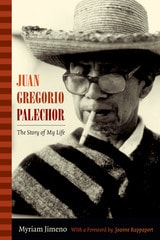
cover of Juan Gregorio Palechor: The Story of My Life

Juan Gregorio Palechor

The Story of My Life

Myriam Jimeno Translated by Andy Klatt

Duke University Press, 2014

The Colombian activist Juan Gregorio Palechor (1923–1992) dedicated his life to championing indigenous rights in Cauca, a department in the southwest of Colombia, where he helped found the Regional Indigenous Council of Cauca. Recounting his life story in collaboration with the Colombian anthropologist Myriam Jimeno, Palechor traces his political awakening, his experiences in national politics, the disillusionment that resulted, and his turn to a more radical activism aimed at confronting ethnic discrimination and fighting for indigenous territorial and political sovereignty.

Palechor's lively memoir is complemented by Jimeno's reflections on autobiography as an anthropological tool and on the oppressive social and political conditions faced by Colombia's indigenous peoples. A faithful and fluent transcription of Palechor's life story, this work is a uniquely valuable resource for understanding the contemporary indigenous rights movements in Colombia.
[more]
cover of Judges and the Cities: Interpreting Local Autonomy

Judges and the Cities

Interpreting Local Autonomy

Gordon L. Clark

University of Chicago Press, 1985

In this remarkable inquiry into the bases of social theory, Gordon L. Clark argues that the heterogeneous nature of our society, with its pluralism of values, causes the rules of social conduct to be constantly made and remade. Examining the role of the courts in structuring and achieving social discourse, he contends that legal doctrine is no different from other social theories: judicial interpretations are constructed out of specific circumstances and conflicting values, not deduced from neutral and logical principles. There is, he asserts, no final arbiter somehow unaffected by our controversies and schisms.

As concrete examples, Clark analyzes four court disputes in depth, showing that the concept of local autonomy has very different meanings and implications in each of them. These cases—Boston's defense of resident-preference hiring policies, conflict over urban land-use zoning in Toronto, a Chicago's suburb's fight against a sewage treatment plant, and the evolution of the City of Denver's power since 1900—demonstrate that legal reasoning is not impervious to other kinds of reasoning, and the solutions provided by the courts are not unique. To ground his explorations, Clark investigates both liberalism and structuralism, showing that both are inadequate bases for determining social policy. He mounts provocative critiques of the works of de Tocqueville, Nozick, Tiebout, and Posner on the one hand and Castells and Poulantzas on the other. 

This ambitious and important work will command the interest of geographers, political scientists, economists, sociologists, and legal scholars.
[more]