490 books match the query 'Asian' and 8 start with j

cover of Jallad: Death Squads and State Terror in South Asia

Jallad

Death Squads and State Terror in South Asia

Tasneem Khalil

Pluto Press, 2015

Throughout South Asia, people live in fear of death squads, from the Rapid Action Battalion of Bangladesh to the “encounter specialists” of India, army units in Nepal, the Frontier Corps of Pakistan, and the “men in white vans” of Sri Lanka. Their tools are disappearance, torture, and summary execution, and their supporters, Tasneem Khalil shows in Jallad, are the governments of these nations—and their patrons, like the United States, the United Kingdom, China, and Israel.
 
An unsparing indictment of an international system of terror that is fully countenanced by the West, Jallad presents close-up, detailed accounts of incidents of state terror and targeted violence throughout South Asia. Khalil, a reporter who himself endured torture at the hands of agents in Bangladesh, and whose remarkable story was featured in the New York Times, draws on countless hours of on-the-ground reporting and a broad network of activists and human rights advocates to build an undeniable portrait of the domination and repression that lies at the very core of statecraft in South Asia. Shielded by their protectors in the developed world, the perpetrators of these abuses deploy them strategically to silence dissent and crush opposition.
 
A brave, essential work of reporting and investigation, Jallad brings these horrific acts to prominence in order to make it impossible for Western governments to continue turning a blind eye to the human rights violations of their erstwhile allies.
[more]
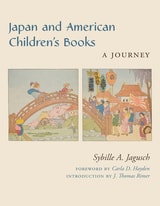
cover of Japan and American Children's Books: A Journey

Japan and American Children's Books

A Journey

Sybille Jagusch

Rutgers University Press, 2021

For generations, children’s books provided American readers with their first impressions of Japan. Seemingly authoritative, and full of fascinating details about daily life in a distant land, these publications often presented a mixture of facts, stereotypes, and complete fabrications. 
 
This volume takes readers on a journey through nearly 200 years of American children’s books depicting Japanese culture, starting with the illustrated journal of a boy who accompanied Commodore Matthew Perry on his historic voyage in the 1850s. Along the way, it traces the important role that representations of Japan played in the evolution of children’s literature, including the early works of Edward Stratemeyer, who went on to create such iconic characters as Nancy Drew. It also considers how American children’s books about Japan have gradually become more realistic with more Japanese-American authors entering the field, and with texts grappling with such serious subjects as internment camps and the bombing of Hiroshima and Nagasaki.
 
Drawing from the Library of Congress’s massive collection, Sybille A. Jagusch presents long passages from many different types of Japanese-themed children’s books and periodicals—including travelogues, histories, rare picture books, folktale collections, and boys’ adventure stories—to give readers a fascinating look at these striking texts.

Published by Rutgers University Press, in association with the Library of Congress.

[more]
cover of Japanese Counterculture: The Antiestablishment Art of Terayama Shuji

Japanese Counterculture

The Antiestablishment Art of Terayama Shuji

Steven C. Ridgely

University of Minnesota Press, 2010

Terayama Shuji (1935-1983) was an avant-garde Japanese poet, dramatist, film director, and photographer known for his highly provocative work. In this inventive and revealing work, Steven Ridgely examines Terayama's life and art to show that a conventional notion of him does not do full justice to the meaning and importance of his wide-ranging, often playful body of work.

Ridgely places Terayama at the center of Japanese and global counterculture and finds in his work a larger story about the history of postwar Japanese art and culture. He sees Terayama as reflecting the most significant events of his day: young poets seizing control of haiku and tanka in the 1950s, radio drama experimenting with form and content after the cultural shift to television around 1960, young assistant directors given free rein in the New Wave as cinema combated television, underground theatre in the politicized late 1960s, and experimental short film through the 1970s after both the studio system and art house cinema had collapsed.

Featuring close readings of Terayama's art, Ridgely demonstrates how across his oeuvre there are patterns that sidestep existing power structures, never offering direct opposition but nevertheless making the opposition plain. And, he claims, there is always in Terayama's work a broad call for seeking out or creating pockets of fiction-where we are made aware that things are not what they seem-and to use otherness in those spaces to take a clearer view of reality.
[more]
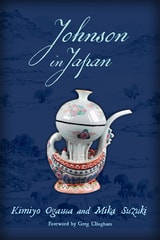
cover of Johnson in Japan

Johnson in Japan

Kimiyo Ogawa

Bucknell University Press, 2021

The study and reception of Samuel Johnson’s work has long been embedded in Japanese literary culture. The essays in this collection reflect that history and influence, underscoring the richness of Johnson scholarship in Japan, while exploring broader conditions in Japanese academia today. In examining Johnson’s works such as the Rambler (1750-52), Rasselas (1759), Lives of the Most Eminent English Poets (1779-81), and Journey to the Western Islands of Scotland (1775), the contributors—all members of the half-century-old Johnson Society of Japan—also engage with the work of other important English writers, namely Shakespeare, Mary Shelley, Jane Austen, and Matthew Arnold, and later Japanese writers, including Natsume Soseki (1867-1916). If the state of Johnson studies in Japan is unfamiliar to Western academics, this volume offers a unique opportunity to appreciate Johnson’s centrality to Japanese education and intellectual life, and to reassess how he may be perceived in a different cultural context.

Published by Bucknell University Press. Distributed worldwide by Rutgers University Press.
[more]
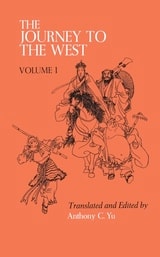
cover of Journey to the West, Volume 1

Journey to the West, Volume 1

Translated by Anthony C. Yu

University of Chicago Press, 1977
First published in 1952, The Journey to the West, volume I, comprises the first twenty-five chapters of Anthony C. Yu's four-volume translation of Hsi-yu Chi, one of the most beloved classics of Chinese literature. The fantastic tale recounts the sixteen-year pilgrimage of the monk Hsüan-tsang (596-664), one of China's most illustrious religious heroes, who journeyed to India with four animal disciples in quest of Buddhist scriptures. For nearly a thousand years, his exploits were celebrated and embellished in various accounts, culminating in the hundred-chapter Journey to the West, which combines religious allegory with romance, fantasy, humor, and satire.
[more]
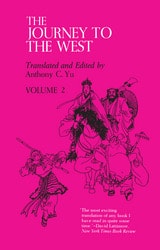
cover of Journey to the West, Volume 2

Journey to the West, Volume 2

Translated by Anthony C. Yu

University of Chicago Press, 1978
The Journey to the West, volume 2, comprises the second twenty-five chapters of Anthony C. Yu's four-volume translation of Hsi-yu Chi, one of the most beloved classics of Chinese literature. The fantastic tale recounts the sixteen-year pilgrimage of the monk Hsüan-tsang (596-664), one of China's most illustrious religious heroes, who journeyed to India with four animal disciples in quest of Buddhist scriptures. For nearly a thousand years, his exploits were celebrated and embellished in various accounts, culminating in the hundred-chapter Journey to the West, which combines religious allegory with romance, fantasy, humor, and satire.
[more]
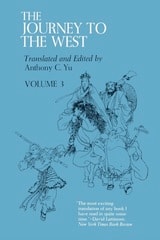
cover of Journey to the West, Volume 3

Journey to the West, Volume 3

Translated by Anthony C. Yu

University of Chicago Press, 1980
The Journey to the West, volume 3, comprises the third twenty-five chapters of Anthony C. Yu's four-volume translation of Hsi-yu Chi, one of the most beloved classics of Chinese literature. The fantastic tale recounts the sixteen-year pilgrimage of the monk Hsüan-tsang (596-664), one of China's most illustrious religious heroes, who journeyed to India with four animal disciples in quest of Buddhist scriptures. For nearly a thousand years, his exploits were celebrated and embellished in various accounts, culminating in the hundred-chapter Journey to the West, which combines religious allegory with romance, fantasy, humor, and satire.
[more]
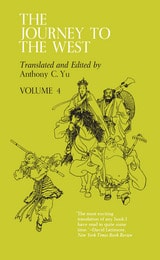
cover of Journey to the West, Volume 4

Journey to the West, Volume 4

Translated by Anthony C. Yu

University of Chicago Press, 1983

The Journey to the West, volume 4, comprises the last twenty-five chapters of Anthony C. Yu's four-volume translation of Hsi-yu Chi, one of the most beloved classics of Chinese literature. The fantastic tale recounts the sixteen-year pilgrimage of the monk Hsüan-tsang (596-664), one of China's most illustrious religious heroes, who journeyed to India with four animal disciples in quest of Buddhist scriptures. For nearly a thousand years, his exploits were celebrated and embellished in various accounts, culminating in the hundred-chapter Journey to the West, which combines religious allegory with romance, fantasy, humor, and satire.
[more]