Results by title
159 books match the query 'Change' and 2 start with j

Jua Kali Kenya
Change and Development in an Informal Economy, 1970–1995Kenneth King
Ohio University Press, 1996
In this remarkable book Kenneth King brings the subject alive through the photographs and life histories of jua kali people. He has also revisited, twenty years later, many of the artisans whom he interviewed exhaustively in the period from 1972 to 1974 and about whom he wrote in The African Artisan, one of the first full-length studies to be published on the informal sector.
For donors, NGOs, and national governments, the book offers many relevant examples, and some cautions, about what has been achieved by ordinary Kenyans, mostly without government support. It will prove equally valuable for students and teachers of development policy, technology policy, and education and training policies not least because of its superb bibliography of over 700 entries related to small enterprise development.
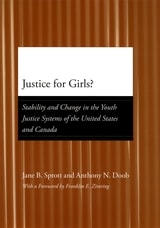
Justice for Girls?
Stability and Change in the Youth Justice Systems of the United States and CanadaJane B. Sprott and Anthony N. Doob
University of Chicago Press, 2009
For over a century, as women have fought for and won greater freedoms, concern over an epidemic of female criminality, especially among young women, has followed. Fear of this crime wave—despite a persistent lack of evidence of its existence—has played a decisive role in the development of the youth justice systems in the United States and Canada. Justice for Girls? is a comprehensive comparative study of the way these countries have responded to the hysteria over “girl crime” and how it has affected the treatment of both girls and boys.
Tackling a century of historical evidence and crime statistics, Jane B. Sprott and Anthony N. Doob carefully trace the evolution of approaches to the treatment of young offenders. Seeking to keep youths out of adult courts, both countries have built their systems around rehabilitation. But, as Sprott and Doob reveal, the myth of the “girl crime wave” led to a punitive system where young people are dragged into court for minor offenses and girls are punished far more severely than boys. Thorough, timely, and persuasive, Justice for Girls? will be vital to anyone working with troubled youths.