Results by title
77 books match the query 'Characters' and 4 start with j
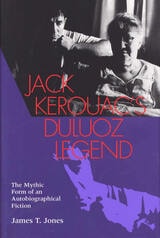
Jack Kerouac's Duluoz Legend
The Mythic Form of an Autobiographical FictionJames T. Jones
Southern Illinois University Press, 1999
In the only critical examination of all of Jack Kerouac's published prose, James T. Jones turns to Freud to show how the great Beat writer used the Oedipus myth to shape not only his individual works but also the entire body of his writing.
Like Balzac, Jones explains, Kerouac conceived an overall plan for his total writing corpus, which he called the Duluoz Legend after Jack Duluoz, his fictional alter ego. While Kerouac's work attracts biographical treatment—the ninth full-length biography was published in 1998—Jones takes a Freudian approach to focus on the form of the work. Noting that even casual readers recognize family relationships as the basis for Kerouac's autobiographical prose, Jones discusses these relationships in terms of Freud's notion of the Oedipus complex.
After establishing the basic biographical facts and explaining Freud's application of the Oedipus myth, Jones explicates Kerouac's novels of childhood and adolescence, focusing on sibling rivalry. Supporting his contention that the Beat writer worked according to a plan, Jones then shows how Kerouac revised The Town and the City (1950), his first published novel, in Vanity of Duluoz, the last novel published in his lifetime, to de-emphasize the death of the father. He treats three versions of Kerouac's road novel—including On the Road—as versions of Oedipus's fateful journey from Corinth to Thebes. And he argues that Pic, often considered peripheral to the Duluoz Legend, replicates the Oedipal themes.
Jones demonstrates that Maggie Cassidy, The Subterraneans, and Tristessa share a form that results from Kerouac's unresolved rivalry with his father for the love of his mother. He discusses Kerouac's replacement of the destructive brother figures in On the Road and Visions of Cody with the constructive hero of The Dharma Bums. He also shows how the Oedipal structure of the Duluoz Legend applies to Kerouac's nonfiction.
In the penultimate chapter, Jones explains how Big Sur, Kerouac's story of his alcohol-induced nervous breakdown, actually marks the climax of the Duluoz Legend. The alcoholism, Jones insists, is not the cause but a symptom of a breakdown brought on by his attachment to his mother. He shows how Kerouac's obsession with his family repeats Oedipal themes throughout the Duluoz Legend. Finally, he deals with Oedipal themes in Kerouac's nonnarrative work, including Old Angel Midnight, Some of the Dharma, The Scripture of the Golden Eternity, and several poems.

Jewish Gangsters of Modern Literature
Rachel Rubin
University of Illinois Press, 2000
John Updike's Rabbit Tetralogy
Mastered Irony in MotionMarshall Boswell
University of Missouri Press, 2001
Early in his career, John Updike announced his affinity with the Christian existentialism of Soren Kierkegaard, Paul Tillich, Karl Barth, and others. Because of this, many of Updike's critics have interpreted his work from within a Christian existentialist context. Yet Kierkegaard and Barth provide Updike with much more than a mere context, for their dialectical thinking serves as the springboard for Updike's own unique dialectical vision, a complex matrix of ethical precepts, theological beliefs, and aesthetic principles that governs nearly all of his literary output. Nowhere else in his immense corpus is this vision more clearly and thoroughly expressed than in his four Rabbit novels, which were gathered into the single volume Rabbit Angstrom in 1995. However, because Updike's critics have chosen to read the Rabbit novels as discrete, freestanding texts, they have by and large failed to extract the precepts of this private vision.
In John Updike's Rabbit Tetralogy, Marshall Boswell redresses this imbalance by treating the Rabbit tetralogy as a single, unified "mega-novel." He demonstrates that, taken together as a single work, the four discrete sections of the tetralogy not only provide a coherent and complete articulation of Updike's unique existential vision but also compose a unified work of remarkable formal complexity. Boswell brings to Updike's work the concept of "mastered irony," a term coined by Kierkegaard to describe the presentation of two legitimate but contradictory sides of an issue. In the Rabbit novels, these issues range from adultery to drug addiction, from race to redemption, with each issue examined through the refracting lens of Updike's own ironic method. Boswell shows that although each of the four individual Rabbit novels confirms this dialectical strategy in a unique way, the completed tetralogy comprises an additional series of dialectical pairs that sustain, rather than resolve, thematic and formal tension. Ultimately, the structure of the finished "mega-novel" echoes the work's thematic rationale.
To help readers who are interested in a particular Rabbit novel, Boswell devotes a chapter to each individual section of the tetralogy. At the same time, he treats each novel as an integral part of the more comprehensive whole. Honoring the full complexity of Updike's provocative thinking without losing sight of the tetralogy's popular appeal, John Updike's Rabbit Tetralogy makes a valuable addition to the study of Updike's work.
Joyce and the Two Irelands
By Willard Potts
University of Texas Press, 2001
Uniting Catholic Ireland and Protestant Ireland was a central idea of the "Irish Revival," a literary and cultural manifestation of Irish nationalism that began in the 1890s and continued into the early twentieth century. Yet many of the Revival's Protestant leaders, including W. B. Yeats, Lady Gregory, and John Synge, failed to address the profound cultural differences that made uniting the two Irelands so problematic, while Catholic leaders of the Revival, particularly the journalist D. P. Moran, turned the movement into a struggle for greater Catholic power.
This book fully explores James Joyce's complex response to the Irish Revival and his extensive treatment of the relationship between the "two Irelands" in his letters, essays, book reviews, and fiction up to Finnegans Wake. Willard Potts skillfully demonstrates that, despite his pretense of being an aloof onlooker, Joyce was very much a part of the Revival. He shows how deeply Joyce was steeped in his whole Catholic culture and how, regardless of the harsh way he treats the Catholic characters in his works, he almost always portrays them as superior to any Protestants with whom they appear. This research recovers the historical and cultural roots of a writer who is too often studied in isolation from the Irish world that formed him.