53 books match the query 'Christianity and other religions' and 6 start with j
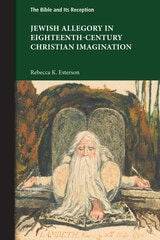
cover of Jewish Allegory in Eighteenth-Century Christian Imagination

Jewish Allegory in Eighteenth-Century Christian Imagination

Rebecca K. Esterson

SBL Press, 2023

Rebecca K. Esterson explores how Christian methods of biblical interpretation shifted during the eighteenth century, producing a rhetorical rejection of allegory while embracing literalism. Under the influence of Enlightenment concepts of human reason and advances in the experimental sciences, Christian interpreters began casting Jewish biblical interpretation as allegorical, while presenting Christian interpretation as literal. This shift in self-understanding allowed Christians to portray their own interpretations as scientifically, philosophically, and historically superior, resulting in a new way of othering the Jewish people. This study of biblical exegesis, theology, philosophy, and the arts in English, Swedish, and German contexts is an essential resource for scholars interested in biblical reception history and the history of Jewish-Christian relations.
[more]
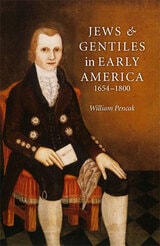
cover of Jews and Gentiles in Early America: 1654-1800

Jews and Gentiles in Early America

1654-1800

William Pencak

University of Michigan Press, 2005
"Jews and Gentiles in Early America is the best account I have seen about Jews in America in this era. William Pencak's research is extensive and the informative depth with which he addresses important political issues is unsurpassed. His analysis is unfailingly sophisticated and virtually unchallengeable. He paints with a broad stroke, putting his narrative and interpretations not only in a wide American context, but also in an international scope. . . . [A]n exceptional contribution to American Jewish history and colonial history in general." -Frederic Cople Jaher, University of Illinois at Champaign-Urbana "Bill Pencak is no stranger either to novel topics or unconventional ideas. In this eminently readable and substantive contribution to the history of Jews in early America, Pencak has once again pushed the boundaries of debate in original and constructive ways." ---Edith Gelles, Stanford University "William Pencak has produced a learned and informative volume on the nature of Jewish-Gentile relations in colonial America. The book's reconstruction of Jewish life in colonial New York, Newport, Charleston, Savannah, and Philadelphia is based on a broad array of primary and secondary source materials that persuasively demonstrate the fact that, despite a truly remarkable level of social acceptance, colonial Jews simultaneously encountered bouts of rejection. Scholars and general readers alike will be indebted to Dr. Pencak for deepening our understanding of the complex and often contradictory ways in which non-Jews related to their Jewish neighbors during this formative period in the nation's history." ---Dr. Gary P. Zola, Executive Director of The Jacob Rader Marcus Center of the American Jewish Archives and Associate Professor of the American Jewish Experience at Hebrew Union College-Jewish Institute of Religion Jews and Gentiles in Early America offers a uniquely detailed picture of Jewish life from the mid-seventeenth century through the opening decades of the new republic. Though the first national census in 1790 counted barely three thousand Jews, the Jewish community was nevertheless far more important in the history of early America than their numbers suggest, author William Pencak reveals in this fascinating chronicle of an often-overlooked aspect of American Jewish history. Pencak approaches his topic from the perspective of early American, rather than strictly Jewish, history. Rich in colorful narrative and animated with scenes of early American life, Jews and Gentiles in Early America tells the story of the five communities-New York, Newport, Charleston, Savannah, and Philadelphia-where most of colonial America's small Jewish population lived. How did these communities rise and fall? How did they interact with the larger gentile population? Pencak's exploration of popular anti-semitism in the pre-Revolutionary era describes the persistence of prejudices derived from traditional European society, and his abundantly detailed community studies explore the forms these prejudices took in colonial America, some of which continue to this day.
[more]
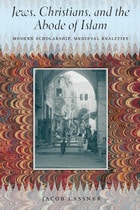
cover of Jews, Christians, and the Abode of Islam: Modern Scholarship, Medieval Realities

Jews, Christians, and the Abode of Islam

Modern Scholarship, Medieval Realities

Jacob Lassner

University of Chicago Press, 2012
In Jews, Christians, and the Abode of Islam, Jacob Lassner examines the triangular relationship that during the Middle Ages defined—and continues to define today—the political and cultural interaction among the three Abrahamic faiths. Lassner looks closely at the debates occasioned by modern Western scholarship on Islam to throw new light on the social and political status of medieval Jews and Christians in various Islamic lands from the seventh to the thirteenth century. Utilizing a vast array of primary sources, Lassner balances the rhetoric of literary and legal texts from the Middle Ages with other, newly discovered medieval sources that describe life as it was actually lived among the three faith communities. Lassner shows just what medieval Muslims meant when they spoke of tolerance, and how that abstract concept played out at different times and places in the real world of Christian and Jewish communities under Islamic rule. Finally, he considers what a more informed picture of the relationship among the Abrahamic faiths in the medieval Islamic world might mean for modern scholarship on medieval Islamic civilization and, not the least, for the highly contentious global environment of today.
[more]
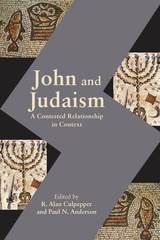
cover of John and Judaism: A Contested Relationship in Context

John and Judaism

A Contested Relationship in Context

R. Alan Culpepper

SBL Press, 2017

A window into early Judaism and Christianity

The Gospel of John was written during the period of the emergence of Christianity and its separation from Judaism and bears witness to their contested relationship. This volume contains eighteen cutting-edge essays written by an international group of scholars who interpret for students and general readers what the book tells us about first-century Judaism, the separation of the church from Judaism, and how John's anti-Jewish references are being interpreted today.

Features:

  • A debate over the process that led to the separation of the church from Judaism, and John's place in that process
  • A review of recent interpretations of John's anti-Jewish references
  • An assessment of the current status of Jewish Christian relations
[more]
cover of Judaism Despite Christianity: The 1916 Wartime Correspondence Between Eugen Rosenstock-Huessy and Franz Rosenzweig

Judaism Despite Christianity

The 1916 Wartime Correspondence Between Eugen Rosenstock-Huessy and Franz Rosenzweig

Edited by Eugen Rosenstock-Huessy

University of Chicago Press, 2011
Before they were both internationally renowned philosophers, Eugen Rosenstock-Huessy and Franz Rosenzweig were young German soldiers fighting in World War I corresponding by letter and forming the foundation of their deep intellectual friendship. Collected here, this correspondence provides an intimate portrait of their views on history, philosophy, rhetoric, and religion as well as on their writings and professors. Most centrally, Rosenstock-Huessy and Rosenzweig discuss, frankly but respectfully, the differences between Judaism and Chiristianity and the reasons they have chosen their respective faiths.
 
This edition includes a new foreword by Paul Mendes-Flohr, a new preface by Harold Stahmer along with his original introduction, and essays by Dorothy Emmet and Alexander Altmann, who calls this correspondence “one of the most important religious documents of our age” and “the most perfect example of a human approach to the Jewish-Christian problem.”
[more]
cover of Judaism and Christianity in the Age of Constantine: History, Messiah, Israel, and the Initial Confrontation

Judaism and Christianity in the Age of Constantine

History, Messiah, Israel, and the Initial Confrontation

Jacob Neusner

University of Chicago Press, 1987

With the conversion of Constantine in 312, Christianity began a period of political and cultural dominance that it would enjoy until the twentieth century. Jacob Neusner contradicts the prevailing view that following Christianity's ascendancy, Judaism continued to evolve in isolation. He argues that because of the political need to defend its claims to religious authenticity, Judaism was forced to review itself in the context of a triumphant Christianity. The definition of issues long discussed in Judaism—the meaning of history, the coming of the Messiah, and the political identity of Israel—became of immediate and urgent concern to both parties. What emerged was a polemical dialogue between Christian and Jewish teachers that was unprecedented.

In a close analysis of texts by the Christian theologians Eusebius, Aphrahat, and Chrysostom on one hand, and of the central Jewish works the Talmud of the Land of Israel, the Genesis Rabbah, and the Leviticus Rabbah on the other, Neusner finds that both religious groups turned to the same corpus of Hebrew scripture to examine the same fundamental issues. Eusebius and Genesis Rabbah both address the issue of history, Chrysostom and the Talmud the issue of the Messiah, and Aphrahat and Leviticus Rabbah the issue of Israel. As Neusner demonstrates, the conclusions drawn shaped the dialogue between the two religions for the rest of their shared history in the West.
[more]