Results by title
303 books match the query 'Church history' and 3 start with j
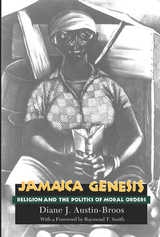
Jamaica Genesis
Religion and the Politics of Moral OrdersDiane J. Austin-Broos
University of Chicago Press, 1997
How has Pentecostalism, a decidedly American form of Christian revivalism, managed to achieve such phenomenal religious ascendancy in a former British colony among people of predominately African descent? According to Diane J. Austin-Broos, Pentecostalism has flourished because it successfully mediates between two historically central yet often oppositional themes in Jamaican religious life—the characteristically African striving for personal freedom and happiness, and the Protestant struggle for atonement and salvation through rigorous ethical piety. With its emphasis on the individual experience of grace and on the ritual efficacy of spiritual healing, and with its vibrantly expressive worship, Jamaican Pentecostalism has become a powerful and compelling vehicle for the negotiation of such fundamental issues as gender, sexuality, race, and class. Jamaica Genesis is a work of signal importance to all those concerned not simply with Caribbean studies but with the ongoing transformation of religion andculture.
[more]
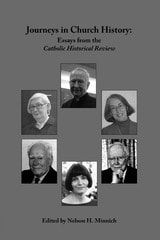
Journeys in Church History
Nelson Minnich
Catholic University of America Press, 2015
This collection of essays is taken from the pages of The Catholic Historical Review, the official organ of the American Catholic Historical Association and the only scholarly journal under Catholic auspices in the English-speaking world devoted to the history of the Universal Church. Journeys in Church History offers reflections from six leading contemporary church historians, who describe in their own words how they have come to practice their craft. They trace their family and educational backgrounds, the themes that attracted their attention, the challenges they encountered in researching them, the new methodologies they adopted to answer questions, and the reception given to their findings. They also tell of their experiences in the classroom, both as students and teachers, the difficulties they encountered in their careers due to prejudices based on gender or religion, and how the discipline of church history has changed over their lifetimes. Their often entertaining accounts will serve to inform and inspire fellow historians, both young and old.
The contributors to this volume are: Elizabeth Clark, who pioneered studies of the role of women in the early Church. Caroline Bynum showed how Christians viewed gender and the human body. Jean Delumeau studies the religious attitudes (mentalité) of the ordinary faithful and how these were shaped during the medieval and early modern periods. John W. O'Mally documents that Renaissance humanism was not pagan but profoundly Christian. The promotion of institutions of higher education under the auspices of the Catholic Church in America has been studied by J. Philip Gleason. Margaret Lavinia Anderson was among the first to use computers to analyze voting patterns in modern Germany and thus determine the influence of the Center Party.
The contributors to this volume are: Elizabeth Clark, who pioneered studies of the role of women in the early Church. Caroline Bynum showed how Christians viewed gender and the human body. Jean Delumeau studies the religious attitudes (mentalité) of the ordinary faithful and how these were shaped during the medieval and early modern periods. John W. O'Mally documents that Renaissance humanism was not pagan but profoundly Christian. The promotion of institutions of higher education under the auspices of the Catholic Church in America has been studied by J. Philip Gleason. Margaret Lavinia Anderson was among the first to use computers to analyze voting patterns in modern Germany and thus determine the influence of the Center Party.
[more]
Judaism and Christianity in the Age of Constantine
History, Messiah, Israel, and the Initial ConfrontationJacob Neusner
University of Chicago Press, 1987
With the conversion of Constantine in 312, Christianity began a period of political and cultural dominance that it would enjoy until the twentieth century. Jacob Neusner contradicts the prevailing view that following Christianity's ascendancy, Judaism continued to evolve in isolation. He argues that because of the political need to defend its claims to religious authenticity, Judaism was forced to review itself in the context of a triumphant Christianity. The definition of issues long discussed in Judaism—the meaning of history, the coming of the Messiah, and the political identity of Israel—became of immediate and urgent concern to both parties. What emerged was a polemical dialogue between Christian and Jewish teachers that was unprecedented.
In a close analysis of texts by the Christian theologians Eusebius, Aphrahat, and Chrysostom on one hand, and of the central Jewish works the Talmud of the Land of Israel, the Genesis Rabbah, and the Leviticus Rabbah on the other, Neusner finds that both religious groups turned to the same corpus of Hebrew scripture to examine the same fundamental issues. Eusebius and Genesis Rabbah both address the issue of history, Chrysostom and the Talmud the issue of the Messiah, and Aphrahat and Leviticus Rabbah the issue of Israel. As Neusner demonstrates, the conclusions drawn shaped the dialogue between the two religions for the rest of their shared history in the West.
In a close analysis of texts by the Christian theologians Eusebius, Aphrahat, and Chrysostom on one hand, and of the central Jewish works the Talmud of the Land of Israel, the Genesis Rabbah, and the Leviticus Rabbah on the other, Neusner finds that both religious groups turned to the same corpus of Hebrew scripture to examine the same fundamental issues. Eusebius and Genesis Rabbah both address the issue of history, Chrysostom and the Talmud the issue of the Messiah, and Aphrahat and Leviticus Rabbah the issue of Israel. As Neusner demonstrates, the conclusions drawn shaped the dialogue between the two religions for the rest of their shared history in the West.
[more]