Results by title
3785 books match the query 'Poetry' and 303 start with a
A Beat Beyond
Selected Prose of Major JacksonEdited by Amor Kohli
University of Michigan Press, 2022
In this collection of essays, talks, and reviews, Major Jackson revels in the work of poetry not only to limn and assess the intellectual and spiritual dimensions of poets, but to amplify the controversies and inner conflicts that define our age: political unrest, climate crises, the fallout from bewildering traumas, and the social function of the art of poetry itself. Accessible and critically minded, Jackson returns to the poem as an unparalleled source of linguistic pleasure that structures a multilayered “lyric self.” In his interviews, Jackson illustrates poetry’s distinct ability to mediate the inexplicable while foregrounding the possibilities of human song.
Collected over several decades, these essays find Jackson praising mythmaking in Frank Bidart and Ai’s poetry, expressing bafflement at the silence of white-identified poets in the cause of social and racial justice, unearthing the politics behind Gwendolyn Brooks’s Pulitzer Prize, and marveling at the “hallucinatory speed of thought” in a diverse range of poets including Mei-mei Berssenbrugge, Brenda Hillman, Afaa Michael Weaver, Forrest Gander, and Terrance Hayes. This collection passionately surveys the radical shifts of the art and notes poetry as a necessity for a modern sensibility.
A Bit of Air
By Walid Taher
University of Texas Press, 2012
Award-winning Egyptian children’s author and illustrator Walid Taher targets a wider audience with A Bit of Air. Inspired by the long tradition of Egyptian colloquial poetry and its relation to social and political movements in Egypt, Taher creates a unique blend of visual art, poetry, and architecture. These darkly humorous poems and their accompanying images are snapshots of a state of mind and a space of fantasy that convey the absurd, the comical, the profound, and the idiosyncratic.
This illustrated, bilingual edition comes at a time of political and literary upheaval. An unprecedented number of Arab authors are producing new and noteworthy works by appropriating the language of blogs, poetry, comic strips, and film, to name a few. This mixing of media gives shape to new experiences emerging from and redefining a rapidly changing social and political reality. A new generation is ushering in a new language, a new literature, and a new Arab world.
A Black Bridge
PoemsRalph Tejeda Wilson
University of Nevada Press, 2001

A Boundless Field
American Poetry at LargeStephen Yenser
University of Michigan Press, 2002
A Boundless Field takes its title from Walt Whitman's sanguine view of the future of American poetry as he expressed it in "Democratic Vistas," a view that seems all the more pertinent today. During the later twentieth century, poetry in the United States branched out in many directions, ranging from a formalism influenced by New Criticism and a subsequent Neo-Formalism through the New York School and Language Poetry to a postmodern maximalism too diverse to categorize. The essays and reviews collected in this volume take up the work of poets writing in these different areas and writing into the twenty-first century.
Yenser's constant criteria for worthiness of attention include an alertness to the long tradition of English and American poetry, a consistent awareness of the integrity of the poetic line, a simultaneous commitment to verbal play and verbal work, and an implicit acknowledgment of two of Wallace Stevens's declarations: first that all admirable poetry is experimental poetry, and second that at first blush all good poems put up a certain resistance to the reader. Hence the usefulness of "criticism."
Stephen Yenser is Professor of English, University of California, Los Angeles. His poetry has appeared in many publications and to wide acclaim, including the Walt Whitman Award of the American Academy of Poets for his book The Fire in All Things. He is also author of The Consuming Myth: The Work of James Merrill and Circle to Circle: The Poetry of Robert Lowell.
A Braided Heart
Essays on Writing and FormBrenda Miller
University of Michigan Press, 2021
A Braided Heart provides a friendly, personal, and smart guide to the writing life. It also offers clear and original instruction on craft elements at the forefront of today’s emerging forms in creative nonfiction: from the short-short, to the braided form, to the hermit crab essay. An acknowledged expert in these forms, Brenda Miller gives writers practical advice on how to sustain and invigorate their writing practice, while also encouraging readers to explore their own writing lives.
A Broken Thing
Poets on the LineEmily Rosko and Anton Vander Zee
University of Iowa Press, 2011
In the arena of poetry and poetics over the past century, no idea has been more alive and contentious than the idea of form, and no aspect of form has more emphatically sponsored this marked formal concern than the line. But what, exactly, is the line? Emily Rosko and Anton Vander Zee’s anthology gives seventy original answers that lead us deeper into the world of poetry, but also far out into the world at large: its people, its politics, its ecology. The authors included here, emerging and established alike, write from a range of perspectives, in terms of both aesthetics and identity. Together, they offer a dynamic hybrid collection that captures a broad spectrum of poetic practice in the twenty-first century.
A Calligraphy of Days
Selected PoemsKrzysztof Siwczyk
Seagull Books, 2024
The sixty-four poems in A Calligraphy of Days reflect Krzysztof Siwczyk’s wide-ranging and variegated style. Born in 1977, Siwczyk has lived most of his life in the Silesian city of Gliwice. In 1995, he became a wunderkind of the Polish poetry scene with his debut volume Wild Kids, an edgy and unsentimental narrative of youthful tribulations and urban malaise during Poland’s transition from communism to capitalism. Siwczyk’s poems careen down the page at great speed, relying on clever turns of phrase or an idea that illuminates a larger meaning. As in calligraphy, a meandering subterranean process connects meaning and memory, thought and verse. Teased to the surface, words and images emerge in rapid, terse, and precise bursts.
Throughout his career, Siwczyk has never ceased to challenge our sense of who we are—changing course multiple times in the process. Following several volumes full of expansive lines, his most recent works offer spare meditations on illness and grief. Clipped and understated, these post-Holocaust poems address our inability to speak of death and tragedy.
A Camouflage of Specimens and Garments
Jennifer Militello
Tupelo Press, 2016
A Cappella
Mennonite Voices in PoetryAnn Hostetler
University of Iowa Press, 2003

A Certain Roughness in Their Syntax
Poems by Jorge AulicinoJorge Aulicino
Tupelo Press, 2017

A Chorus for Peace
A Global Anthology of Poetry by WomenMarilyn Arnold
University of Iowa Press, 2002
Women poets from around the world are gathered here to raise their voices together, to speak out against violence and its calamitous effect upon the human soul. Yet there is also a thread of resilience here, an undercurrent of hope that points to the human ability to move on, to build a new life out of a shattered past.
Each poem addresses difficult issues concerning conflict and the lives of women. Some are spirited statements that demonstrate courage even in brutal circumstances; others rage at the perpetrators of war or simply mourn their losses. Together, these works reveal a deep consciousness of both the effects of violence and the human ability to move forward.
The women whose poems appear in this collection stand for peace. Many of them have seen war and strife on fronts both national and domestic; and they write graphically and poignantly, and sometimes ironically, about conflicts external and internal that tear up their lives and the lives of their families and neighbors. They write about the victims of war and oppression: bewildered and brutalized children, bereft wives and mothers, raped and mutilated women, tormented prisoners and soldiers. And they write about victims of a seemingly failed society and victims of struggling or failed human relationships.
At the same time, these writers are also crying for peace, searching for peace, and occasionally finding peace. In their search, they point the way for the rest of us.
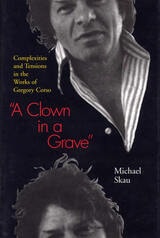
A Clown in a Grave
Complexities and Tensions in the Works of Gregory CorsoMichael Skau
Southern Illinois University Press, 1999
Using a number of critical approaches, Michael Skau examines Gregory Corso's complex imagination, his humor, and his poetic techniques in dealing with America, the Beat generation, and death.
Skau covers the complete works of Corso, one of the four major Beat Generation writers (with Jack Kerouac, Allen Ginsberg, and William S. Burroughs) who attempted to provide an alternative to what they saw as the academic forms of literature dominating American writing through the 1940s and 1950s. The Beat option focused on ordinary people, spurning the cultural pretensions of the intelligentsia and using common language as well as the rhythms of actual speech. Corso, abandoned as a child by his mother, subjected to a variety of foster homes, and imprisoned as an adolescent, became an authentic voice of America's neglected streetwise youth. He embodies much of the tension, confusion, and rebellion that emerged in America after World War II and eventually crested in the 1960s.
Corso emphasizes social issues, yet risks undermining this significance by using wit, wordplay, and humor. While conceding mortality, he is adamant in refusing to acknowledge death's power. Even as he rebels against conventional literature, he still is enchanted by classicism and romanticism, often borrowing their techniques and idioms. Skau examines these complexities and seeming contradictions throughout Corso's career, showing that Corso finds value in inconsistency and vacillation. For him, as illustrated in the poems "Hair" and "Marriage," contradiction and ambivalence suggest the foundations of freedom of imagination.
In spite of Corso's significance as an American poet, Skau's is the first extensive study of his work, including his fiction. Skau also provides the first complete bibliography of Corso's published work in more than thirty years.
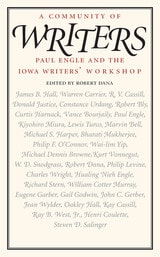
A Community of Writers
Paul Engle and the Iowa Writers' WorkshopDana, Robert
University of Iowa Press, 1999
With these words, written long before his Iowa Writers' Workshop became world famous, much imitated, and academically rich, Paul Engle captured the spirit behind his beloved workshop. Now, in this collection of essays by and about those writers who shared the energetic early years, Robert Dana presents a dynamic, informative tribute to Engle and his world.
The book's three sections mingle myth and history with style and grace and no small amount of humor. The beginning essays are given over to memories of Paul Engle in his heyday. The second group focuses particularly on those teachers—Robert Lowell, John Berryman, Kurt Vonnegut, for example—who made the workshop hum on a day-to-day basis. Finally, the third section is devoted to storytelling: tall tales, vignettes, surprises, sober and not-so-sober moments. Engle's own essay, "The Writer and the Place," describes his "simple, and yet how reckless" conviction that "the creative imagination in all of the arts is as important, as congenial, and as necessary, as the historical study of all the arts."
Today, of course, there are hundreds of writers' workshops, many of them founded and directed by graduates of the original Iowa workshop. But when Paul Engle arrived in Iowa there were exactly two. His indomitable nature and great persuasive powers, combined with his distinguished reputation as a poet, loomed large behind the enhancement of the Iowa Writers' Workshop. This volume of fine and witty essays reveals the enthusiasm and drive and sheer pleasure that went into Iowa's renowned workshop.
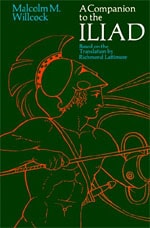
A Companion to The Iliad of Homer
Malcolm M. Willcock
University of Chicago Press, 1976
Those who are able to read Homer in Greek have ample recourse to commentaries, but the vast majority who read the Iliad in translation have not been so well served—the many available translations contain few, if any, notes. For these readers, Malcolm M. Willcock provides a line-by-line commentary that explains the many factual details, mythological allusions, and Homeric conventions that a student or general reader could not be expected to bring to an initial encounter with the Iliad.
The notes, which always relate to particular lines in the text, have as their prime aim the simple, factual explanation of things the inexperienced reader would be unlikely to have at his or her command (What is a hecatomb? Who is Atreus' son?). Second, they enhance an appreciation of the Iliad by illuminating epic style, Homer's methods of composition, the structure of the work, and the characterization of the major heroes. The "Homeric Question," concerning the origin and authorship of the Iliad, is also discussed.
The book's accessible commentary can be used with any translation of the poem, though it is based on Richmond Lattimore's landmark translation, which is regarded as the outstanding English-language version. This clearly written commentary, which includes an excellent select bibliography, makes of the touchstones of Western culture accessible to a wider audience.
A Company of Poets
Louis Simpson
University of Michigan Press, 1981
A Conjoined Book
Aftermath and Become Tree, Become BirdKarla Kelsey
Omnidawn, 2014
A Crown of Hornets
Marcia Pelletiere
Four Way Books, 2019
A Cry in the Snow
and Other PoemsStella Vinitchi Radulescu
Seagull Books, 2018
A Deed to the Light
Poems by Jeanne Murray Walker
University of Illinois Press, 2004
A Double Garland
Poetry and Art-Song in Early Nineteenth Century RussiaThomas P. Hodge
Northwestern University Press, 1999

A FIELD Guide to Contemporary Poetry and Poetics
Edited by Stuart Friebert, David Walker, andDavid Young
Oberlin College Press, 1997
A Face Out of Clay
Brent Ameneyro
University Press of Colorado, 2024
A Field Guide to the Heavens
Frank X. Gaspar
University of Wisconsin Press, 1999
Frank X. Gaspar’s collection of poems is haunted by the presence of mystics and visionaries: Mohammed, Buddha, St. Paul, Augustine, George Herbert, Emily Dickinson, Blake, Milton, Rilke. A Field Guide to the Heavens is punctuated with designs of science, the wondering and rapt observations of the sky made at the eyepiece of a backyard telescope. We come to know Gaspar’s city streets, the neighbors and strangers that walk them, the wreckage of past lives, the ocean, the gardens, the orchards and alleys and parking lots, all spread out under the vast sky.
A Field Guide to the Poetry of Theodore Roethke
William Barillas
Ohio University Press, 2021
This volume is the first to reconsider Roethke’s work in terms of the expanded critical approaches to literature that have emerged since his death in 1963. Editor William Barillas and over forty contributors, including highly respected literary scholars, critics, and writers such as Peter Balakian, Camille Paglia, Jay Parini, and David Wojahn, collectively make a case for Roethke’s poetry as a complete, unified, and evolving body of work. The accessible essays employ a number of approaches, including formalism, ecocriticism, reader-response, and feminist critique to explicate the poetics, themes, and the biographical, historical, cultural, and literary contexts of Roethke’s work.
Contributors
Borja Aguiló Obrador
Peter Balakian
William Barillas
Don Bogen
Neal Bowers
Nicholas Bradley
Luke Brekke
Russell Brickey
Katharine Bubel
Norman Chaney
Jeffrey Clapp
Lyn Coffin
Kristin M. Distel
Carrie Duke
Laura Duncan
Laura Gill
Patrick Gill
Christopher Giroux
William Heyen
Trenton Hickman
Michael Hinds
Edward Hirsch
Brooke Horvath
Marcel Inhoff
Walter Kalaidjian
Frank J. Kearful
Andrew David King
Marc Malandra
John J. McKenna
Aaron M. Moe
Sarah Kathryn Moore
Edward Morin
Marcia Noe
Camille Paglia
Jay Parini
Rod Phillips
Ronald Primeau
Adam Putz
Bernard Quetchenbach
David Radavich
John Rohrkemper
Brandon Rushton
Joseph T. Thomas Jr.
Jeff Vande Zande
David Wojahn
A Fine Yellow Dust
Laura Apol
Michigan State University Press, 2021
A Fly in the Soup
MemoirsCharles Simic
University of Michigan Press, 2003
A Gallery of Harlem Portraits
Melvin B. Tolson, Edited & Afterword by Robert M. Farnsworth
University of Missouri Press, 1979
Tolson eventually attempted to incorporate the technical achievements of T.S. Eliot and the New Criticism into a complex modern poetry which would accurately represent the extraordinary tensions, paradoxes, and sophistication, both highbrow and lowbrow, of modern Harlem. As a consequence his position in literary history is problematical. The publication of this earliest of his manuscripts will help clarify Tolson's achievement and surprise many of his readers with its readily accessible, warmly human poetic portraiture.
A Garland of Many Years
Donald Davie
Vanderbilt University Press, 2005
To some readers the poems will seem unusual as love poems because they do not idealize love and marriage. Their strength lies in their honesty and intimacy and in the openness to the pain and self-understanding that both ardor and conflict ("We, we throve on friction") can produce. This is a relationship in which each knows the other too well to be assuaged by a sentimental lyricism.
For this special edition, twelve of Doreen's photographs from their travels together have been included, so that her sensibility may be present, too, as an artist in her own right. Donald's handwritten poems are reproduced both in facsimile and in type.
A Gathering of Ways
John Matthias
Ohio University Press, 1991
A Gift of Presence
The Theology and Poetry of the Eucharist in Thomas AquinasJan Heiner Tück
Catholic University of America Press, 2018
A God in the House
Poets Talk About FaithEdited by Ilya Kaminsky and Katherine Towler
Tupelo Press, 2012
A Grain of Sand in Lambeth
PoemsGeoffrey Babbitt
University of Nevada Press, 2025
Each poem in this collection inhabits a moment of Blake’s life, offering a vivid glimpse into his unique perspective—a perspective that rejected the normative for the transformative power of imagination. From his visionary watercolors to his provocative views on oil painting, these poems draw readers into Blake’s world, where reality and the unseen converge in prismatic intensity.
A Grain of Sand in Lambeth is an invitation to experience the world through Blake’s eyes—a world where imagination reigns supreme and art is a living force.
A History of Clouds
99 MeditationsHans Magnus Enzensberger
Seagull Books, 2010
In these 99 meditations, poet and novelist Hans Magnus Enzensberger celebrates the tenacity of the normal and routine in everyday life, where the survival of the objects we use without thinking—a pair of scissors, perhaps—is both a small, human victory and a quiet reminder of our own ephemeral nature. He sets his quotidian reflections against a broad historical and political backdrop: the cold war and its accompanying atomic threat; the German student revolt; would-be socialism in Cuba, China, and Africa; and World War II as experienced by the youthful poet.
Enzensberger’s poems are conversational, skeptical, and serene; they culminate in the extended set of observations that gives the collection its title. Clouds, alien and yet symbols of human life, are for Enzensberger at once a central metaphor of the Western poetic tradition and “the most fleeting of all masterpieces.” “Cloud archaeology,” writes Enzensberger, is “a science for angels.”
Praise for the German edition
“After reading this wonderful volume of poetry one would like to call Enzensberger simply the lyric voice of transience.”— Sueddeutsche Zeitung
“With this book Enzensberger reveals himself both as a spokesman of persistence and as a decelerator.”—Neue Zuercher Zeitung
A History of Free Verse
Chris Beyers
University of Arkansas Press, 2001
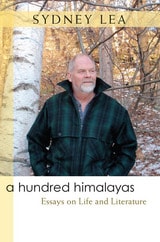
A Hundred Himalayas
Essays on Life and LiteratureSydney Lea
University of Michigan Press, 2012
In A Hundred Himalayas, Sydney Lea has collected a group of essays written over 30 years, representing what he refers to as the persistence of preoccupations and the absence of theory---a group of speculations, each one a single Himalaya, together a great elevation achieved in small increments. His musings on his own "favored genius," Robert Frost, his own approach to literary criticism, imagination, the American nature essay, rural life, the process of writing a poem, and fitting writing into everyday life all combine to create a picture of the things that interest Lea. "If there is grandeur at all in this volume," he says, "then, it must come in small increments." All of his small increments of gentle and insightful writing combine to create a collection that is, indeed, grand.
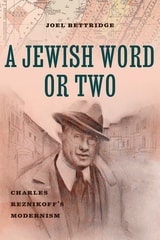
A Jewish Word or Two
Charles Reznikoff's ModernismJoel Bettridge
University of Iowa Press, 2026
The son of Jewish immigrants from Russia to New York, Charles Reznikoff found himself at the intersection of modernist innovation, ethnic otherness, and economic hardship. He both appreciated the modernists’ formal radicalism and critiqued their political failings—a task he accomplished by writing short lyric poems depicting the hardship and charm of urban life, as well as long poems presenting histories of horrific violence, from factory accidents to the Holocaust. But despite his contributions to American poetry, Reznikoff has remained a somewhat secondary figure, in part because his work—at times—is painful to read.
A Jewish Word or Two recasts Reznikoff ’s poetry as pleasurable and masterful even when disturbing. In their humor, their encounters with Jewish history, holiness, and identity, as well as their use of drama, horror, joy, and beauty, Reznikoff ’s poems help us celebrate what is simultaneously strange, surprising, lovely, and uncanny in our everyday lives.
A Kiss from Thermopylae
Emily Dickinson and LawJames R. Guthrie
University of Massachusetts Press, 2015
Yet Dickinson was also capable of criticizing, even satirizing, law and lawyers. Her poetic personae inhabit various legal roles including those of jurymen, judges, and attorneys, and some poems simulate courtroom contests pitting the rights of individuals against the power of the state. She was keenly interested in legal matters pertaining to women, such as breach of promise, dower, and trusts. With her tone ranging from subservient to domineering, from reverential to ridiculing, Dickinson's writings reflect an abiding concern with philosophic and political principles underpinning the law, as well as an identification with the plight of individuals who dared confront authority.
A Kiss from Thermopylae reveals a new dimension of Dickinson's writing and thinking, one indicating that she was thoroughly familiar with the legal community's idiomatic language, actively engaged with contemporary political and ethical questions, and skilled at deploying a poetic register ranging from high romanticism to low humor.
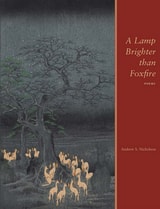
A Lamp Brighter than Foxfire
Andrew S. Nicholson
University Press of Colorado, 2015
"In Andrew S. Nicholson’s A Lamp Brighter than Foxfire, what is most alive is color, that which gives itself freely, generously: ‘Follow the hopeful as they green the day’ (‘My Garage Fills with an Ever-Increasing Number of Dandelions’). Threaded throughout with Genesis, wherein Jacob wrestles an angel, this gorgeous debut collection builds a ladder firmly rooted here: in sun and earth; in varying and multiple shades of orange; in trials of father and son; in books and paintings; in abandoned casinos; in countries far from home; and/or in the sound of a door closing. Nicholson’s poems come from a man standing by himself, in what George Oppen called the ‘shipwreck of the singular,’ which includes everybody. I’m moved by the luminous generosity, the moral clarity of this work. A Lamp Brighter than Foxfire is news that will stay news.”
—Claudia Keelan, author of The Devotion Field, Missing Her, and O, Heart
"'Who doesn’t nurse a secret love?' asks Andrew S. Nicholson in visionary poems that reveal secret worlds cradled inside this one. Whether considering the casinos of Las Vegas, a fresco in Pompeii, or scenes from the Hebrew Bible, the poet endures one of desire’s more fraught paradoxes: its unchanging ability to bring change, to turn the known into the unknown. These poems bravely attend to such transformations the way Jacob—the book’s patron saint—wrestles with the angel, 'lifting all the flesh / that he can lose.' I admire this poet who knows that blessing doesn’t arrive without loss, who remembers 'I was loved once. / Beneath that love, a kindness took root.' The same sweet feeling lingers long after this book is closed. Dear reader: savor it."
—Brian Teare
"Andrew S. Nicholson’s A Lamp Brighter than Foxfire is a gorgeous book. His graceful, playful poems enchant us ('I try to make out the stranger’s face, but he’s shrinking: / a melting gray blur, an ever-smaller thorn.') and transform us ('Sink into the bathwater, any way is a way / to journey toward that joining'). Nicholson has become one of the great poets of a new and radical kind of pastoral."
—Joseph Lease
Opening the space between the ordinary and the visionary, the poems in A Lamp Brighter than Foxfire uncover an intimate relationship with the world, from Las Vegas to Italy to the American Midwest. From a lime glowing in an orchard to a miraculous childhood attempt at levitation, Andrew S. Nicholson’s poems ground themselves in the commonplace and leap for the luminous. Central to this collection are poems that retell stories of Jacob from the Old Testament, relocated behind casinos, glimpsed in miniature on kitchen floors, and heard speaking in a moment of decay. Through these retellings, Nicholson examines the creation of self, family relationships, and a generative sense of the divine.
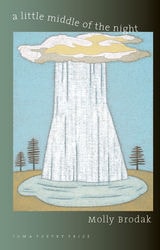
A Little Middle of the Night
Molly Brodak
University of Iowa Press, 2010
The language of Molly Brodak’s first full-length collection, A Little Middle of the Night, is ever shifting, brightly sonic, and disarming while exploring the margin between nature and art, darkness and beauty, dreams and awakenings. As echoed in one epigraph from Emerson, these poems capture “the Exact and the Vast” of consciousness in intense lyric verse with an angular and almost scientific sensitivity. Here is a speaker intent on discovery: “Oh whole world, we choose / another.”
This award-winning collection simmers with wit as Brodak confronts tragedy, childhood losses, transcendent love, and the question of art itself. Tinged with a suffering—“I was the littlest wastebasket. / I was my own church. Except— / scared, scared”—that rises above personal sorrow, her fierce and painterly poems redefine nature and art and what exists between: “Lately, there is spangled shade in my space / and a cold apple orchard to tend in place of consciousness.” As Reginald Shepherd said about the poems in Brodak’s first collection, the chapbook Instructions for a Painting, her world is “‘small enough / to sing in all directions,’ and large enough to take us there.”
A Long Essay on the Long Poem
Modern and Contemporary Poetics and PracticesRachel Blau DuPlessis
University of Alabama Press, 2023
A masterful meditation on our most mercurial and abiding of poetic forms—the long poem
For decades, Rachel Blau DuPlessis has shown readers how genres, forms, and the literal acts of writing and reception can be understood as sites of struggle. In her own words, “writing is . . . a praxis . . . in which the author disappears into a process, into a community, into discontinuities, and into a desire for discovery.” It is cause for celebration, then, that we have another work of warm, incisive, exploratory writing from DuPlessis in A Long Essay on the Long Poem.
Long poems, DuPlessis notes, are elusive, particularly in the slippery forms that have emerged in the postmodern mode. She cites both Nathaniel Mackey and Anne Waldman in thinking of the poem as a “box,” both in the sense of a vessel that contains and as a machine that processes, an instrument on which language is played. This study’s central attention is on the long poem as a sociocultural Book, distinctively envisioned by a range of authors.
To reckon with these shifting and evolving forms, DuPlessis works in a polyvalent mode, a hybrid of critical analysis and speculative essay. She divides the long poem and the long poets into three genres: epics, quests, and a composite she terms “assemblages.” The poets she surveys include T. S. Eliot, Ezra Pound, H.D., Louis Zukofsky, Gwendolyn Brooks, Charles Olson, Alice Notley, Nathaniel Mackey, Ron Silliman, Robert Duncan, Kamau Brathwaite, and, finally, Mallarmé and Dante. Instead of a traditional lineage, she deliberately seeks intersecting patterns of connection between poems and projects, a nexus rather than a family tree. In doing so she navigates both some challenges of long poems and her own attempt to “essay” them. The result is a fascinating and generous work that defies categorization as anything other than essential.
A Magnificent Loneliness
Allison Benis White
Four Way Books, 2025
“I remember // once, turning to leave, a black purse over her shoulder. . .” Oneiric and surreal as always, Allison Benis White attempts to mediate, if not make sense of, inconceivable bereavement in her fifth collection of poetry. “A black purse, / over her living shoulder, Love said nothing to me.”
Ethereal, airy, and spare at once, A Magnificent Loneliness is a dialogue with ghosts. White, whose previous work won the Rilke Prize and the Four Way Books Levis Prize judged by Claudia Rankine, assembles these pages as an ekphrastic and epistolary record of her solitary journey through loss. These poems relate to artwork, the history of artistic practice, and inherited lore to broker an oblique and piecewise conversation concerning pain too vast to articulate all at once. “I don’t know how to love the world but to love / her leaving.” These lyrical iterations represent White’s attempts to comprehend the individual suffering of being alive, and to metabolize the grief of women’s epidemic disappearance, literal and spiritual, through sickness and despair. Through those efforts, she illuminates a magnificent loneliness—the privilege of being alive to our anguish, of missing someone dearly because someone dear existed—and a reason for not yet departing that struggle. “How to leave / the world but to turn to leave her— / but to turn my head back / to see her.”
A Map of Mexico City Blues
Jack Kerouac as PoetJames T. Jones
Southern Illinois University Press, 1992
In this pioneering critical study of Jack Kerouac’s book-length poem, Mexico City Blues—apoetic parallel to the writer’s fictional saga, the Duluoz Legend—James T. Jones uses a rich and flexible neoformalist approach to argue his case for the importance of Kerouac’s rarely studied poem.
After a brief summary of Kerouac’s poetic career, Jones embarks on a thorough reading of Mexico City Blues from several different perspectives: he first focuses on Kerouac’s use of autobiography in the poem and then discusses how Kerouac’s various trips to Mexico, his conversion to Buddhism, his theory of spontaneous poetics, and his attraction to blues and jazz influenced the theme, structure, and sound of Mexico City Blues.
A Map of Signs and Scents
New and Selected Poems, 1979–2014Amjad Nasser / Translated from the Arabic by Fady Joudah and Khaled Mattawa
Northwestern University Press, 2016
Featuring poems from earlier collections of Amjad Nasser’s work and many newer uncollected poems never made available in English, A Map of Signs and Scents introduces the work of an important Arabic poet to a broader contemporary Anglophone readership. This special annotation edition helps readers view the multifaceted contexts within which Nasser has created his award-winning poems.
A Map of the Night
David Wagoner
University of Illinois Press, 2008
A Martian Muse
Further Essays on Identity, Politics, and the Freedom of PoetryReginald Shepherd
University of Michigan Press, 2010
Those who have read Orpheus in the Bronx, Reginald Shepherd's previous collection of essays about the act of creating poetry, and those who take on the task, can immediately understand why it was a national finalist for a prestigious National Book Critics Circle Award. Shepherd was candid and disarming, practical and funny, able to mix thoughts about the Transformers with meditations on the realities of growing up poor.
This is Reginald Shepherd's final opportunity to speak his mind about the craft he loved, the art of using words to express the soul and the wit of every person's experience. Edited by Shepherd's longtime partner and intellectual confidant, Robert Philen, A Martian Muse stands as a final monument to a master in the craft, but is also a readable, important work in its own right.
"Reginald Shepherd died September 10, 2008, after a hard struggle with cancer. While he had completed the essays presented here and had selected them from his available essays to form a collection, he didn't have time to organize the presentation of the essays within the collection.
"The task of editing this collection has been a daunting challenge as I struggle to live up to the level of intellectual engagement, clarity, and coherence that Reginald always expected. While daunting, it has also been a labor of love and a compulsion for me, based on the many years I spent with him as a partner, friend, lover, intellectual companion, and sharer of common passions."
---Robert Philen, from the Introduction
Reginald Shepherd was the editor of The Iowa Anthology of New American Poetries and Lyric Postmodernisms: An Anthology of Contemporary Innovative Poetries and the author of five books of poetry. He was a finalist for the 2009 National Book Critics Circle Award and was the recipient of grants from the NEA, the Illinois Arts Council, the Saltonstall Foundation, the Florida Arts Council, and the Vogelstein Foundation, among many other awards and honors.
A Menorah for Athena
Charles Reznikoff and the Jewish Dilemmas of Objectivist PoetryStephen Fredman
University of Chicago Press, 2001
Stephen Fredman illuminates the relationship of Jewish intellectuals to modernity through a close look at Reznikoff's life and writing. He shows that when we regard the Objectivists as modern Jewish poets, we can see more clearly their distinctiveness as modernists and the reasons for their profound impact upon later poets, such as Allen Ginsberg and Charles Bernstein. Fredman also argues that to understand Reznikoff's work more completely, we must see it in the context of early, nonsectarian attempts to make the study of Jewish culture a force in the construction of a more pluralistic society. According to Fredman, then, the indelible images in Reznikoff's poetry open a window onto the vexed but ultimately successful entry of Jewish immigrants and their children into the mainstream of American intellectual life.
A More Beautiful Question
The Spiritual in Poetry and ArtGlenn Hughes
University of Missouri Press, 2011
Hughes offers the idea that the modern “crisis of faith” is not a matter of vanishing spiritual concerns and energy but rather of their disorientation, even as they remain pervasive forces in human affairs. And because art is the most effective medium for spiritually evocation, it is our most significant touchstone for examining this spiritual disorientation, just as it remains a primary source of inspiration for spiritual experience.
A More Beautiful Question is concerned with how art, and especially poetry, functions as a vehicle of spiritual expression in today’s modern cultures. The book considers the meeting points of art, poetry, religion, and philosophy, in part through examining the treatments of consciousness, transcendence, and art in the writings of twentieth-century philosophers Eric Voegelin and Bernard Lonergan. A major portion of A More Beautiful Question is devoted to detailed “case studies” of three influential modern poets: Gerard Manley Hopkins, Emily Dickinson, and T. S. Eliot. In these and its other chapters, the book examines the human need for artistic symbols that evoke the mystery of transcendence, the ways in which poetry and art illuminate the spiritual meanings of freedom, and the benefits of an individual’s loving study of great literature and art.
A More Beautiful Question has a distinctive aim—to clarify the spiritual functions of art and poetry in relation to contemporary confusion about transcendent reality—and it meets that goal in a manner accessible by the layperson as well as the scholar. By examining how the best art and poetry address our need for spiritual orientation, this book makes a valuable contribution to the philosophies of art, literature, and religion, and brings deserved attention to the significance of the “spiritual” in the study of these disciplines.
A Murmuration of Starlings
Jake Adam York
Southern Illinois University Press, 2008
A Murmuration of Starlings elegizes the martyrs of the civil rights movement, whose names are inscribed on the stone table of the Civil Rights Memorial in Montgomery, Alabama. Individually, Jake Adam York’s poems are elegies for individuals; collectively, they consider the violence of a racist culture and the determination to resist that racism.
York follows Sun Ra, a Birmingham jazz musician whose response to racial violence was to secede from planet Earth, considers the testimony in the trial of J. W. Milam and Roy Bryant for the murder of Emmet Till in 1955, and recreates events of Selma, Alabama, in 1965. Throughout the collection, an invasion of starlings imagesthe racial hatred and bloodshed. While the 1950s spawned violence, the movement in the early 1960s transformed the language of brutality and turned the violence against the violent, says York. So, the starlings, first produced by violence, become instruments of resistance.
York’s collection responds to and participates inrecent movements to find and punish the perpetrators of the crimes that defined the civil rights movement. A Murmuration of Starlings participates in the search for justice, satisfaction, and closure.
A Necklace of Bees
PoemsDannye Romine Powell
University of Arkansas Press, 2008
A New Divan
A Lyrical Dialogue between East and WestEdited by Barbara Schwepcke and Bill Swainson
Gingko, 2019
Reaching through time, language, and poetic history, A New Divan offers a lyrical conversation and opens paths of connection across cultures.