Results by title
718 books match the query 'Civil rights' and 8 start with j
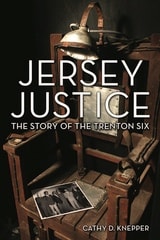
Jersey Justice
The Story of the Trenton SixCathy D. Knepper
Rutgers University Press, 2011
The case of the Trenton Six attracted international attention in its time (1948–1952) and was once known as the “northern Scottsboro Boys case.” Yet, there is no memory of it. The shame of racism evident in the case has been nearly erased from the public record. Now, historian Cathy D. Knepper takes us back to the courtroom to make us aware of this shocking chapter in American history.
Jersey Justice: The Story of the Trenton Six begins in 1948 when William Horner, an elderly junk dealer, was murdered in his downtown Trenton shop. Over a two-week period, six local African American men were arrested and charged with collectively killing Horner. Violating every rule in the book, the Trenton police held the six men in incommunicado detention, without warrants, and threatened them until they confessed. At the end of the trial the all-white jury sentenced the six men to die in the electric chair.
That might have been the end of the story were it not for the tireless efforts of Bessie Mitchell, the sister of one of the accused men. Undaunted by the refusal of the NAACP and the ACLU to help appeal the conviction of the Trenton Six, Mitchell enlisted the aid of the Civil Rights Congress, ultimately taking the case as far as the New Jersey Supreme Court. Along the way, the Trenton Six garnered the attention and involvement of many prominent activists, politicians, and artists, including Paul Robeson, Thurgood Marshall, Eleanor Roosevelt, Pete Seeger, Arthur Miller, and Albert Einstein. Jersey Justice brings to light a shameful moment in our nation’s history, but it also tells the story of a personal battle for social justice that changed America.
Jim Crow America
A Documentary HistoryCatherine M. Lewis
University of Arkansas Press, 2009
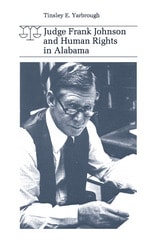
Judge Frank Johnson and Human Rights in Alabama
Tinsley E. Yarbrough
University of Alabama Press, 1981
Where courage meets the gavel: One judge’s relentless fight for justice and human rights in Alabama.
Judge Frank M. Johnson, Jr., Chief Judge of the United States District Court for the Middle District of Alabama until his elevation to the Court of Appeals for the Fifth Circuit in 1979, was perhaps President Dwight D. Eisenhower’s most significant appointment to a lower court. His selection to the bench in 1955 followed by only a few months the Supreme Court’s historic decision in Brown vs. Board of Education.
During Judge Johnson’s tenure, his court invalidated segregation and other forms of racial discrimination in Alabama’s transportation facilities, voter registration processes, school and colleges, administrative agencies, system of jury selection, prisons, mental institutions, political parties, and government grant programs. In fact, most of the state’s major racial crises were resolved in his courtroom. However, his impact on human rights policy in Alabama was not confined to a racial context. Among other significant developments, the Middle District Court ordered reapportionment of the state’s governing bodies and invalidated its grossly inequitable property tax systems.
Judge Johnson’s decisions made him one of the most widely respected and controversial trial judges in the country. Until recently, however, his name was anathema to many white Alabamians, and he and his family were subject to ostracism, threats, violence, and verbal abuse.
Yarbrough examines Judge Johnson’s life through the end of the Wallace era and the Judge’s appointment to the Fifth Circuit Court. More broadly, the book is a history of modern human rights reform in Alabama, cast in the biographical idiom. For, in a real sense, the history of the reform and of Judge Johnson’s judicial career have been synonymous.
Judicial Rhapsodies
Rhetoric and Fundamental Rights in the Supreme CourtDoug Coulson
Amherst College Press, 2023
First examining the classical origins of divisions between law and rhetoric, Coulson tracks what he calls an epideictic register—highly affective forms of expression that utilize hyperbole, amplification, and vocabularies of praise—through a surprising number of landmark Supreme Court opinions. Judicial Rhapsodies recovers and revalues these instances as significant to establishing and maintaining shared perspectives that form the basis for common experience and cooperation.
“Judicial Rhapsodies is both compelling and important. Coulson brings his well-developed knowledge of rhetoric to bear on one of the most central (and most democratically fraught) means of governance in the United States: the Supreme Court opinion. He demonstrates that the epideictic, far from being a dispensable or detestable element of judicial rhetoric, is an essential feature of how the Court operates and seeks to persuade.” —Keith Bybee, Syracuse University
Jump for Joy
Jazz, Basketball, and Black Culture in 1930s AmericaGena Caponi-Tabery
University of Massachusetts Press, 2008
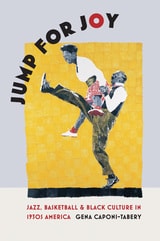
If the 1930s was the Swing Era, then the years from 1937 on might well be called the Jump Era. That summer Count Basie recorded “Jumping at the Woodside,” and suddenly jump tunes seemed to be everywhere. Along with the bouncy beat came a new dance step—the high-flying aerials of the jitterbuggers—and the basketball games that took place in the dance halls of African America became faster, higher, and flashier. Duke Ellington and a cast of hundreds put the buoyant spirit of the era on stage with their 1941 musical revue, Jump for Joy, a title that captured the momentum and direction of the new culture of exuberance.
Several high-profile public victories accompanied this increasing optimism: the spectacular successes of African American athletes at the 1936 Olympics, the 1937 union victory of the Brotherhood of Sleeping Car Porters, and Joe Louis's 1937 and 1938 heavyweight championship fights. For the first time in history, Black Americans emerged as cultural heroes and ambassadors, and many felt a new pride in citizenship.
In this book, Gena Caponi-Tabery chronicles these triumphs and shows how they shaped American music, sports, and dance of the 1930s and beyond. But she also shows how they emboldened ordinary African Americans to push for greater recognition and civil liberties—how cultural change preceded and catalyzed political action.
Tracing the path of one symbolic gesture—the jump—across cultural and disciplinary boundaries, Caponi-Tabery provides a unique political, intellectual, and artistic analysis of the years immediately preceding World War II.
Junctures in Women's Leadership
Social MovementsTrigg, Mary K
Rutgers University Press, 2016
From Eleanor Roosevelt to feminist icon Gloria Steinem to HIV/AIDS activist Dazon Dixon Diallo, women have assumed leadership roles in struggles for social justice. How did these remarkable women ascend to positions of influence? And once in power, what leadership strategies did they use to deal with various challenges?
Just and Righteous Causes
Rabbi Ira Sanders and the Fight for Racial and Social Justice in Arkansas, 1926-1963James L. Moses
University of Arkansas Press, 2018
Winner, 2019 Booker Worthen Prize from the Central Arkansas Library System.
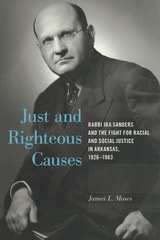
A dedicated advocate for social justice long before the term entered everyday usage, Rabbi Ira Sanders began striving against the Jim Crow system soon after he arrived in Little Rock from New York in 1926. Sanders, who led Little Rock’s Temple B’nai Israel for nearly forty years, was a trained social worker as well as a rabbi and his career as a dynamic religious and community leader in Little Rock spanned the traumas of the Great Depression, World War II and the Holocaust, and the social and racial struggles of the 1950s and 1960s.
Just and Righteous Causes—a full biographical study of this bold social-activist rabbi—examines how Sanders expertly navigated the intersections of race, religion, and gender to advocate for a more just society. It joins a growing body of literature about the lives and histories of Southern rabbis, deftly balancing scholarly and narrative tones to provide a personal look into the complicated position of the Southern rabbi and the Jewish community throughout the political struggles of the twentieth-century South.
Justice for All
Selected Writings of Lloyd A. BarbeeLloyd A Barbee
Wisconsin Historical Society Press, 2017
Civil rights leader and legislator Lloyd A. Barbee frequently signed his correspondence with "Justice for All," a phrase that embodied his life’s work of fighting for equality and fairness. An attorney most remembered for the landmark case that desegregated Milwaukee Public Schools in 1972, Barbee stood up for justice throughout his career, from defending University of Wisconsin students who were expelled after pushing the school to offer black history courses, to representing a famous comedian who was arrested after stepping out of a line at a protest march. As the only African American in the Wisconsin legislature from 1965 to 1977, Barbee advocated for fair housing, criminal justice reform, equal employment opportunities, women’s rights, and access to quality education for all, as well as being an early advocate for gay rights and abortion access.
This collection features Barbee’s writings from the front lines of the civil rights movement, along with his reflections from later in life on the challenges of legislating as a minority, the logistics of coalition building, and the value of moving the needle on issues that would outlast him. Edited by his daughter, civil rights lawyer Daphne E. Barbee-Wooten, these documents are both a record of a significant period of conflict and progress, as well as a resource on issues that continue to be relevant to activists, lawmakers, and educators.