Results by title
212 books match the query 'Colonial Period (1600-1775)' and 10 start with j
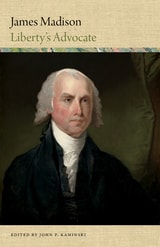
James Madison
Liberty's AdvocateJohn P. Kaminski
Wisconsin Historical Society Press, 2018
America has had few political thinkers who have rivalled James Madison. The son of a wealthy planter, Madison was an unhealthy child and was beset by physical infirmities throughout his long life, and grew into a cerebral man. Madison left Virginia to attend the College of New Jersey, but returned to his native state after completing his studies. Though he aspired to be a college professor, Madison instead went into public service and became one of the most influential, guiding voices of the Founding Era. Madison’s Virginia Plan would be used as a blueprint for the Constitutional Convention, where the Articles of Confederation would be replaced with a new Constitution that bore traces of Madison’s influence throughout.
Editor John Kaminski has gathered a remarkable collection of quotations by and about James Madison for the third installment of his Word Portraits of America’s Founders series. Through these words by and about Madison, we learn more about one of the country’s most influential Founding Fathers, who held a lifelong commitment to liberty and opposed oppression.
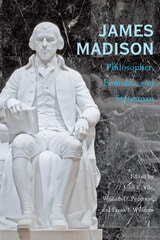
James Madison
Philosopher, Founder, and StatesmanJohn R. Vile
Ohio University Press, 2008
James Madison: Philosopher, Founder, and Statesman presents fresh scholarship on the nation’s fourth president, who is often called both the father of the U.S. Constitution and the father of the Bill of Rights. These essays by historians and political scientists from the United States and abroad focus on six distinct aspects of Madison’s life and work: his personality and development as a statesman; his work at the Constitutional Convention of 1787 and contributions to larger constitutional design; his advocacy for the adoption of the Bill of Rights; his controversial role as a party leader; his presidency; and his life after leaving office.
James Madison continues to be regarded as one of America’s great political theorists, a man who devoted his life to, and who found fulfillment in, public service. His philosophical contributions remain vital to any understanding of the modern American polity. This book will be of great interest to political scientists and theorists, as well as to historians of early American history and politics.
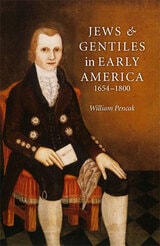
Jews and Gentiles in Early America
1654-1800William Pencak
University of Michigan Press, 2005
John Josselyn, Colonial Traveler
A Critical Edition of Two Voyages to New-England.John. Josselyn and Paul J. Lindholdt
Brandeis University Press, 1988
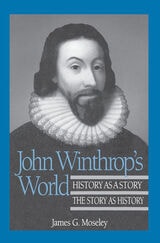
John Winthrop's World
History as a Story; The Story as HistoryJames G. Moseley
University of Wisconsin Press, 1992
In the first in-depth study of Winthrop since 1958, James G. Moseley provides a fascinating new look at this extraordinary man, paying careful attention to the connections between Winthrop’s political activity and his writing. Moseley first examines Winthrop as a writer, using the journal to analyze Winthrop as a man resolving challenges based as much on his acutely pragmatic intelligence as on his deeply felt religious convictions. Second, Moseley traces how historians have responded to Winthrop—how his famous journal has been read and misread by those who have filtered the man and his cultural context through many lenses.
By examining Winthrop’s ancestors and early life in England, especially the religious changes he experienced, Moseley removes the blinders of modernism, portraying Winthrop as never before. He shows how Winthrop’s successful struggle to accept the deaths of his first two wives led him away from moralistic views of Christianity, himself, and his world to more magnanimous views.
Arguing that writing was the medium through which Winthrop developed his capacity for leadership, Moseley shows how the journal enabled Winthrop to reflect objectively on his situation and to adjust his behavior. Winthrop was, Moseley suggests, not only a politician but a historian, and his interpretations of foundational events in American history in his journal are an invaluable resource for understanding the nature of leadership and the meaning of liberty in Puritan America.
Winthrop’s World is a very graceful, well-written, and engaging narrative that provides new insight into the Puritan way of life and into the man who provided a window between our world and his.
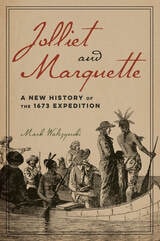
Jolliet and Marquette
A New History of the 1673 ExpeditionMark Walczynski
University of Illinois Press, 2023
A multifaceted voyage into the past, Jolliet and Marquette expands and updates the oft-told story of a pivotal event in American history.

Jonathan Edwards and the Gospel of Love
Ronald Story
University of Massachusetts Press, 2012
Jonathan Edwards has long epitomized the Puritan preacher as fiery scold, fixated on the inner struggle of the soul and the eternal flames of hell. In this book, Ronald Story offers a fundamentally different view of Edwards, revealing a profoundly social minister who preached a gospel of charity and community bound by love.
The first chapters trace Edwards's life and impact, examine his reputation as an intellectual, Calvinist, and revivalist, and highlight the importance for him of the gentler, more compassionate concepts of light, harmony, beauty, and sweetness. Story then explains what Edwards means by the “Gospel of Love”—a Christian faith that is less individual than interpersonal, and whose central feature is the practice of charity to the poor and the quest for loving community in this world, the chief signs of true salvation. As Edwards preached in his sermon “Heaven Is a World of Love,” the afterlife itself is social in nature because love is social.
Drawing on Edwards's own sermons and notebooks, Story reveals the minister's belief that divine love expressed in the human family should take us beyond tribalism, sectarianism, provincialism, and nationality. Edwards offers hope, in the manner of Walter Rauschenbusch, Karl Barth, Martin Luther King Jr., and other great “improvers,” for the coming of a world without want and war. Gracefully and compellingly written, this book represents a new departure in Edwards studies, revising the long-standing yet misleading stereotype of a man whose lessons of charity, community, and love we need now more than ever.
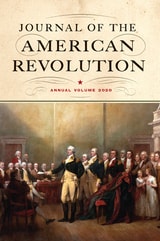
Journal of the American Revolution 2020
Annual VolumeDon N. Hagist
Westholme Publishing, 2020
The Journal of the American Revolution, Annual Volume 2020, presents the journal’s best historical research and writing over the past calendar year. The volume is designed for institutions, scholars, and enthusiasts to provide a convenient overview of the latest research and scholarship in American Revolution and Founding Era studies. The thirty-six articles in the 2020 edition include:
Bernard E. Griffiths: Trumpeter Barney of the Queen’s Rangers, Chelsea Pensioner—and Freed Slave by Todd W. Braisted
The Declaration of Independence: Did John Hancock Really Say that about his Signature?—and Other Signing Stories by J. L. Bell
Les Habitants: Collaboration and Pro-American Violence in Canada, 1774–1776 by Sebastian van Bastelaer
Misadventures in the Countryside: Escape from a British Prison Ship by Katie Turner Getty
The Revolutionary Memories of New York Loyalists: Thomas Jones and William Smith, Jr. by Cho-Chien Feng
The East India Company and Parliament’s “Fateful Decision” of 1767 by Steven Neill
Massachusetts Privateers During the Siege of Boston by Alexander Cain
The Constitution Counted Free Women and Children—And It Mattered by Andrew M. Schocket, with Kinzey M. McLaren-Czerr and Colin J. Spicer
How Magna Carta Influenced the American Revolution by Jason Yonce
Putting a Price on Loyalty: Mary Loring’s List of Losses by John Knight
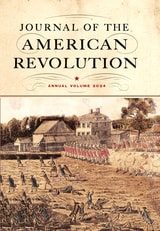
Journal of the American Revolution 2024
Annual VolumeDon N. Hagist
Westholme Publishing, 2024
The year’s best articles from the leading on-line source of new research on the Revolution and Founding eras
The Journal of the American Revolution, Annual Volume 2024, presents the journal’s best historical research and writing over the past calendar year. The volume is designed for institutions, scholars, and enthusiasts to provide a convenient overview of the latest research and scholarship in American Revolution and Founding Era studies.
ContentsBy Stratagem and Hard Fighting: The Improbable Capture of Eleven British Ships by Mark R. Anderson
Remember Baker: A Green Mountain Boy’s Controversial Death and Its Consequences by Mark R. Anderson
John Hancock’s Politics and Personality in Ten Quotes by Brooke Barbie
The Return of Samuel Dyer: An Attempted Assassination in Revolutionary Boston by J. L. Bell
The Secrets of Samuel Dyer by J. L. Bell
Two Encounters: Captain Abraham Van Dyck, the ”Negro Man,” and Prince Pitkin by Benjamin L. Carp
The French Army in Williamsburg, Virginia, 1781–1782 by Michael Cecere
The Delcastle Cannonball by Walter A. Chiquione
Thomas Paine on Popular Government in America: Evolution of a Radical’s Thinking by Jett Conner
How the (First) West Was Won: Federalist Treaties that Reshaped the Frontier by Brady J. Crytzer
George Washington’s Information War by Benjamin George
British Soldiers Wounded at Eutaw Springs by Don N. Hagist
Emily Geiger’s Fabulous Ride by C. Leon, Harris, Harriet Imrey, Conner Runyan
Thomas Jefferson and the Conditions of Good History: Writing About the American Revolution by Andrew M. Holowchak
Mercy Otis Warren: Revolutionary Propagandist by Jonathan House
Captain James Morris of the Connecticut Light Infantry by Chip Langston
Danger at the Breach by Doug MacIntyre
Attended with Disagreeable Consequences: Cross-Border Shopping for Loyalist Provisions, 1783–1784by Stuart Lyall Manson
Smallpox Threatens an American Privateer at Sea by Christian McBurney
“The Modern American Wallace:” Relics, Revolutions, and Revolutionaries by Shawn David McGhee
“Those Noble Qualities”: Classical Pseudonyms as Reflections of Divergent Republican Value Systems by Shawn David McGhee
George Washington’s “Rules of Civility”: An Early American Literary Mystery by Shawn David McGhee
Reframing George Washington’s Clothing at the Second Continental Congress by Shawn David McGhee
John Adams and Nathanael Greene Debate the Role of the Military by Curtis F. Morgan, Jr.
The Perfidious Benjamin Church and Paul Revere by Louis Arthur Norton
Algernon Sidney and the American Revolution by David Otersen
Eutaw Springs and the Ambiguity of Victory by David Price
Charles Lee—The Continental Army’s Most Prolific Essayist General by Gene Procknow
Charles Lee’s First Inklings of Fractious American Political Battles by Gene Procknow
The Highs and Lows of Ethan Allen’s Reputation as Reported by Revolutionary-Era Newspapers by Gene Procknow
“Earned By Veteran Intrepidity”: Spencer’s Ordinary, June 26, 1781 by Conor Robison
William Walker Crosses Kings Ferry by Michael J. F. Sheehan
Early Presidential Elections: The Questionable Use of Electors to Correct Voter Imbalances by Marvin L. Simner
The Purpose of the Electoral College: A Seemingly Endless Controversy by Marvin L. Simner
Captain Luke Day: A Forgotten Leader of ”Shays’s Rebellion” by Scott M. Smith
Engaging the Glasgow by Eric Sterner
Smallpox by Inoculation: The Tragedy of New York’s Rosewell Beebe by Philip D. Weaver
The “Western Forts” of the 1783 Treaty of Paris by Richard J. Werther
Clark versus Livingston: Pettiness, Paper Money, and Elections by Eric Wise
Burlington 1776: The Forgotten Opportunity by Colin Zimmerman
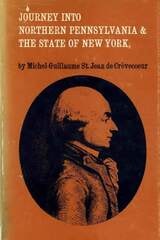
Journey into Northern Pennsylvania and the State of New York
Michel-Guillaume St. Jean de Crèvecoeur
University of Michigan Press, 1964