Results by title
214 books match the query 'Constitutional' and 4 start with j
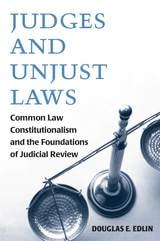
Judges and Unjust Laws
Common Law Constitutionalism and the Foundations of Judicial ReviewDouglas E. Edlin
University of Michigan Press, 2010
"With keen insight into the common law mind, Edlin argues that there are rich resources within the law for judges to ground their opposition to morally outrageous laws, and a legal obligation on them to overturn it, consequent on the general common law obligation to develop the law. Thus, seriously unjust laws pose for common law judges a dilemma within the law, not just a moral challenge to the law, a conflict of obligations, not just a crisis of conscience. While rooted firmly in the history of common law jurisprudence, Edlin offers an entirely fresh perspective on an age-old jurisprudential conundrum. Edlin's case for his thesis is compelling."
---Gerald J. Postema, Cary C. Boshamer Professor of Philosophy and Professor of Law, University of North Carolina at Chapel Hill, and author of Bentham and the Common Law Tradition
"Douglas Edlin builds a powerful historical, conceptual, and moral case for the proposition that judges on common law grounds should refuse to enforce unjust legislation. This is sure to be controversial in an age in which critics already excoriate judges for excessive activism when conducting constitutional judicial review. Edlin's challenge to conventional views is bold and compelling."
---Brian Z. Tamanaha, Chief Judge Benjamin N. Cardozo Professor of Law, St. John's University, and author of Law as a Means to an End: Threat to the Rule of Law
"Professor Edlin's fascinating and well-researched distinction between constitutional review and common law review should influence substantially both scholarship on the history of judicial power in the United States and contemporary jurisprudential debates on the appropriate use of that power."
---Mark Graber, Professor of Law and Government, University of Maryland, and author of Dred Scott and the Problem of Constitutional Evil
Is a judge legally obligated to enforce an unjust law?
In Judges and Unjust Laws, Douglas E. Edlin uses case law analysis, legal theory, constitutional history, and political philosophy to examine the power of judicial review in the common law tradition. He finds that common law tradition gives judges a dual mandate: to apply the law and to develop it. There is no conflict between their official duty and their moral responsibility. Consequently, judges have the authority---perhaps even the obligation---to refuse to enforce laws that they determine unjust. As Edlin demonstrates, exploring the problems posed by unjust laws helps to illuminate the institutional role and responsibilities of common law judges.
Douglas E. Edlin is Associate Professor of Political Science at Dickinson College.
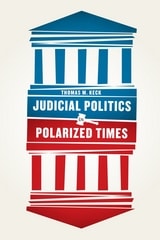
Judicial Politics in Polarized Times
Thomas M. Keck
University of Chicago Press, 2014
Drawing on a sweeping survey of litigation on abortion, affirmative action, gay rights, and gun rights across the Clinton, Bush, and Obama eras, Thomas M. Keck argues that, while each of these stories captures part of the significance of judicial politics in polarized times, each is also misleading. Despite judges’ claims, actual legal decisions are not the politically neutral products of disembodied legal texts. But neither are judges “tyrants in robes,” undermining democratic values by imposing their own preferences. Just as often, judges and the public seem to be pushing in the same direction. As for the argument that the courts are powerless institutions, Keck shows that their decisions have profound political effects. And, while advocates on both the left and right engage constantly in litigation to achieve their ends, neither side has consistently won. Ultimately, Keck argues, judges respond not simply as umpires, activists, or political actors, but in light of distinctive judicial values and practices.
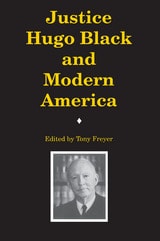
Justice Hugo Black and Modern America
Tony Freyer
University of Alabama Press, 1990
Reexamining the Justice Who Helped Shape Modern Constitutional America.
The struggle to accommodate both individual freedom and community welfare shaped modern America. American have disagreed about whether federal protection of national welfare could be reconciled with defense of individual rights; however, no public figure worked longer or more consistently to meet this challenge than Alabama’s Hugo L. Black
This collection of essays, reprints of the spring 1985 and winter 1987 issues of the Alabama Law Review with a new introduction and minor revisions, suggests that Black’s constitutional principles and personal values provided a means to achieve a balance between majority will and individual freedom. Black’s life and career are reexamined here by leading scholars and jurors in the first major study in twenty years, tracing his relationship to the South, to the development of American liberalism, and to the constitutional revolution in individual rights.
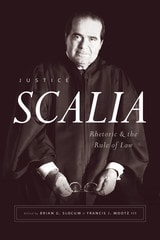
Justice Scalia
Rhetoric and the Rule of LawEdited by Brian G. Slocum and Francis J. Mootz III
University of Chicago Press, 2019
In this edited collection, leading scholars from law, political science, philosophy, rhetoric, and linguistics look at the ways Scalia framed and stated his arguments. Focusing on rhetorical strategies rather than the logic or validity of Scalia’s legal arguments, the contributors collectively reveal that Scalia enacted his rigidly conservative vision of the law through his rhetorical framing.