Results by title
1882 books match the query 'Criticism and interpretation' and 69 start with j
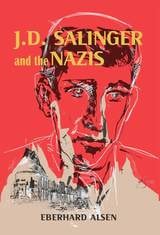
J. D. Salinger and the Nazis
Eberhard Alsen
University of Wisconsin Press, 2018
Alsen, a longtime Salinger scholar who witnessed the Nazi regime firsthand as a child in Germany, tracks Salinger's prewar experiences in the army, his work for the CIC during significant military campaigns, and his reactions to three military disasters that killed more than a thousand fellow soldiers in his Fourth Infantry Division. Alsen also identifies the Nazi death camp where Salinger saw mounds of recently burned bodies. Revealing details shed light on Salinger's outspoken disgust for American military leaders, the personality changes that others saw in him after the war, and his avoidance of topics related to the Holocaust.
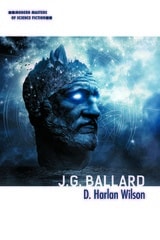
J. G. Ballard
D. Wilson
University of Illinois Press, 2017
D. Harlan Wilson offers the first career-spanning analysis of an author who helped steer SF in new, if startling, directions. Here was a writer committed to moral ambiguity, one who drowned the world and erected a London high-rise doomed to descend into savagery--and coolly picked apart the characters trapped within each story. Wilson also examines Ballard's methods, his influence on cyberpunk, and the ways his fiction operates within the sphere of our larger culture and within SF itself.
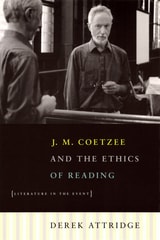
J. M. Coetzee and the Ethics of Reading
Literature in the EventDerek Attridge
University of Chicago Press, 2004
Yet it is just these features, Derek Attridge argues, that give Coetzee's work its haunting power and offer its greatest rewards. Attridge does justice to this power and these rewards in a study that serves as an introduction for readers new to Coetzee and a stimulus for thought for those who know his work well. Without overlooking the South African dimension of his fiction, Attridge treats Coetzee as a writer who raises questions of central importance to current debates both within literary studies and more widely in the ethical arena. Implicit throughout the book is Attridge's view that literature, more than philosophy, politics, or even religion, does singular justice to our ethical impulses and acts. Attridge follows Coetzee's lead in exploring a number of issues such as interpretation and literary judgment, responsibility to the other, trust and betrayal, artistic commitment, confession, and the problematic idea of truth to the self.
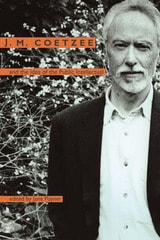
J. M. Coetzee and the Idea of the Public Intellectual
Jane Poyner
Ohio University Press, 2006
Jack Kerouac's Duluoz Legend
The Mythic Form of an Autobiographical FictionJames T. Jones
Southern Illinois University Press, 1999
In the only critical examination of all of Jack Kerouac's published prose, James T. Jones turns to Freud to show how the great Beat writer used the Oedipus myth to shape not only his individual works but also the entire body of his writing.
Like Balzac, Jones explains, Kerouac conceived an overall plan for his total writing corpus, which he called the Duluoz Legend after Jack Duluoz, his fictional alter ego. While Kerouac's work attracts biographical treatment—the ninth full-length biography was published in 1998—Jones takes a Freudian approach to focus on the form of the work. Noting that even casual readers recognize family relationships as the basis for Kerouac's autobiographical prose, Jones discusses these relationships in terms of Freud's notion of the Oedipus complex.
After establishing the basic biographical facts and explaining Freud's application of the Oedipus myth, Jones explicates Kerouac's novels of childhood and adolescence, focusing on sibling rivalry. Supporting his contention that the Beat writer worked according to a plan, Jones then shows how Kerouac revised The Town and the City (1950), his first published novel, in Vanity of Duluoz, the last novel published in his lifetime, to de-emphasize the death of the father. He treats three versions of Kerouac's road novel—including On the Road—as versions of Oedipus's fateful journey from Corinth to Thebes. And he argues that Pic, often considered peripheral to the Duluoz Legend, replicates the Oedipal themes.
Jones demonstrates that Maggie Cassidy, The Subterraneans, and Tristessa share a form that results from Kerouac's unresolved rivalry with his father for the love of his mother. He discusses Kerouac's replacement of the destructive brother figures in On the Road and Visions of Cody with the constructive hero of The Dharma Bums. He also shows how the Oedipal structure of the Duluoz Legend applies to Kerouac's nonfiction.
In the penultimate chapter, Jones explains how Big Sur, Kerouac's story of his alcohol-induced nervous breakdown, actually marks the climax of the Duluoz Legend. The alcoholism, Jones insists, is not the cause but a symptom of a breakdown brought on by his attachment to his mother. He shows how Kerouac's obsession with his family repeats Oedipal themes throughout the Duluoz Legend. Finally, he deals with Oedipal themes in Kerouac's nonnarrative work, including Old Angel Midnight, Some of the Dharma, The Scripture of the Golden Eternity, and several poems.
Jack London and the Sea
Anita Duneer
University of Alabama Press, 2022
The first book-length study of London as a maritime writer
Jack London’s fiction has been studied previously for its thematic connections to the ocean, but Jack London and the Sea marks the first time that his life as a writer has been considered extensively in relationship to his own sailing history and interests. In this new study, Anita Duneer claims a central place for London in the maritime literary tradition, arguing that for him romance and nostalgia for the Age of Sail work with and against the portrayal of a gritty social realism associated with American naturalism in urban or rural settings. The sea provides a dynamic setting for London’s navigation of romance, naturalism, and realism to interrogate key social and philosophical dilemmas of modernity: race, class, and gender. Furthermore, the maritime tradition spills over into texts that are not set at sea.
Jack London and the Sea does not address all of London’s sea stories, but rather identifies key maritime motifs that influenced his creative process. Duneer’s critical methodology employs techniques of literary and cultural analysis, drawing on extensive archival research from a wealth of previously unpublished biographical materials and other sources. Duneer explores London’s immersion in the lore and literature of the sea, revealing the extent to which his writing is informed by travel narratives, sensational sea yarns, and the history of exploration, as well as firsthand experiences as a sailor in the San Francisco Bay and Pacific Ocean.
Organized thematically, chapters address topics that interested London: labor abuses on “Hell-ships” and copra plantations, predatory and survival cannibalism, strong seafaring women, and environmental issues and property rights from San Francisco oyster beds to pearl diving in the Paumotos. Through its examination of the intersections of race, class, and gender in London’s writing, Jack London and the Sea plumbs the often-troubled waters of his representations of the racial Other and positions of capitalist and colonial privilege. We can see the manifestation of these socioeconomic hierarchies in London’s depiction of imperialist exploitation of labor and the environment, inequities that continue to reverberate in our current age of global capitalism.
Jacques Lacan
A Critical IntroductionMartin Murray
Pluto Press, 2016
French psychoanalyst Jacques Lacan has been a major influence on a wide range of twentieth-century thought, even as the breadth, complexity, and obscurity of his work has intimidated students and deterred casual readers. That situation hasn’t been helped by uneven translations into English that have led to a popular conception of his intellectual enterprise that can at times be profoundly mistaken.
In this brief, clearly written introduction to Lacan and his work, Martin Murray presents an up-to-date survey of his key concepts, their development, and their influence on fields such as anthropology, linguistics, and philosophy. Arguing strongly that we should move beyond the traditional focus on Lacan’s early work, which favored a linguistic approach, Murray offers instead a more comprehensive overview of the whole arc of Lacan’s thought. The result is a rigorous, yet accessible, account of one of the key intellectual figures of the twentieth century.
Jacques Rivette
Mary M. Wiles
University of Illinois Press, 2012
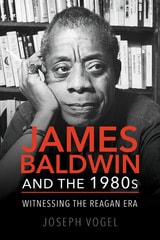
James Baldwin and the 1980s
Witnessing the Reagan EraJoseph Vogel
University of Illinois Press, 2018
Joseph Vogel offers the first in-depth look at Baldwin's dynamic final decade of work. Delving into the writer's creative endeavors, crucial essays and articles, and the impassioned polemic The Evidence of Things Not Seen, Vogel finds Baldwin as prescient and fearless as ever. Baldwin's sustained grappling with "the great transforming energy" of mass culture revealed his gifts for media and cultural criticism. It also brought him into the fray on issues ranging from the Reagan-era culture wars to the New South, from the deterioration of inner cities to the disproportionate incarceration of black youth, and from pop culture gender-bending to the evolving women's and gay rights movements.
Astute and compelling, James Baldwin and the 1980s revives and redeems the final act of a great American writer.
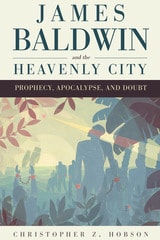
James Baldwin and the Heavenly City
Prophecy, Apocalypse, and DoubtChristopher Z. Hobson
Michigan State University Press, 2018
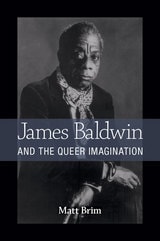
James Baldwin and the Queer Imagination
Matt Brim
University of Michigan Press, 2014
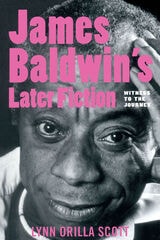
James Baldwin's Later Fiction
Witness to the JourneyLynn O. Scott
Michigan State University Press, 2002
James Baldwin’s Later Fiction examines the decline of Baldwin’s reputation after the middle 1960s, his tepid reception in mainstream and academic venues, and the ways in which critics have often mis-represented and undervalued his work. Scott develops readings of Tell Me How Long the Train’s Been Gone, If Beale Street Could Talk, and Just Above My Head that explore the interconnected themes in Baldwin’s work: the role of the family in sustaining the arts, the price of success in American society, and the struggle of black artists to change the ways that race, sex, and masculinity are represented in American culture.
Scott argues that Baldwin’s later writing crosses the cultural divide between the 1950s and 1960s in response to the civil rights and black power movements. Baldwin’s earlier works, his political activism and sexual politics, and traditions of African American autobiography and fiction all play prominent roles in Scott’s analysis.
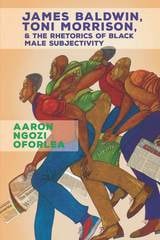
James Baldwin, Toni Morrison, and the Rhetorics of Black Male Subjectivity
Aaron Ngozi Oforlea
The Ohio State University Press, 2017
Oforlea’s book offers new analyses of the character dynamics in Baldwin’s Go Tell It on the Mountain, Tell Me How Long the Train’s Been Gone, and If Beale Street Could Talkand Morrison’s Beloved, Song of Solomon, and Tar Baby. The black male characters in these novels encounter the discursive divide, or a cultural dissonance, when they encounter dominant representations of black male identities. They use these opportunities to construct a counter-discourse about black male subjectivity. Ultimately, Oforlea argues, these characters are strategic about when and how they want to appropriate and subvert dominant ideologies. Their awareness that post-racial discourses perpetuate racial inequality serves as a gateway toward participation in collective struggles for racial justice.
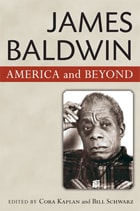
James Baldwin
America and BeyondBill Schwarz and Cora Kaplan, editors
University of Michigan Press, 2011
"This fine collection of essays represents an important contribution to the rediscovery of Baldwin's stature as essayist, novelist, black prophetic political voice, and witness to the Civil Rights era. The title provides an excellent thematic focus. He understood both the necessity, and the impossibility, of being a black 'American' writer. He took these issues 'Beyond'---Paris, Istanbul, various parts of Africa---but this formative experience only returned him to the unresolved dilemmas. He was a fine novelist and a major prophetic political voice. He produced some of the most important essays of the twentieth century and addressed in depth the complexities of the black political movement. His relative invisibility almost lost us one of the most significant voices of his generation. This welcome 'revival' retrieves it. Close call."
---Stuart Hall, Professor Emeritus, Open University
This interdisciplinary collection by leading writers in their fields brings together a discussion of the many facets of James Baldwin, both as a writer and as the prophetic conscience of a nation. The core of the volume addresses the shifting, complex relations between Baldwin as an American—“as American as any Texas GI” as he once wryly put it—and his life as an itinerant cosmopolitan. His ambivalent imaginings of America were always mediated by his conception of a world “beyond” America: a world he knew both from his travels and from his voracious reading. He was a man whose instincts were, at every turn, nurtured by America; but who at the same time developed a ferocious critique of American exceptionalism. In seeking to understand how, as an American, he could learn to live with difference—breaking the power of fundamentalisms of all stripes—he opened an urgent, timely debate that is still ours. His America was an idea fired by desire and grief in equal measure. As the authors assembled here argue, to read him now allows us to imagine new possibilities for the future.
With contributions by Kevin Birmingham, Douglas Field, Kevin Gaines, Briallen Hopper, Quentin Miller, Vaughn Rasberry, Robert Reid-Pharr, George Shulman, Hortense Spillers, Colm Tóibín, Eleanor W. Traylor, Cheryl A. Wall, and Magdalena Zaborowska.
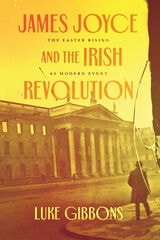
James Joyce and the Irish Revolution
The Easter Rising as Modern EventLuke Gibbons
University of Chicago Press, 2023
When revolutionaries seized Dublin during the 1916 Easter Rising, they looked back to unrequited pasts to point the way toward radical futures—transforming the Celtic Twilight into the electric light of modern Dublin in James Joyce’s Ulysses. For Luke Gibbons, the short-lived rebellion converted the Irish renaissance into the beginning of a global decolonial movement. James Joyce and the Irish Revolution maps connections between modernists and radicals, tracing not only Joyce’s projection of Ireland onto the world stage, but also how revolutionary leaders like Ernie O’Malley turned to Ulysses to make sense of their shattered worlds. Coinciding with the centenary of both Ulysses and Irish independence, this book challenges received narratives about the rebellion and the novel that left Ireland changed, changed utterly.
James Joyce and the Philosophers at Finnegans Wake
Donald Phillip Verene
Northwestern University Press, 2016
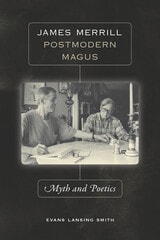
James Merrill, Postmodern Magus
Myth and PoeticsEvans Lansing Smith
University of Iowa Press, 2008
In this meticulously researched, carefully argued work, Evans Lansing Smith argues that the nekyia, the circular Homeric narrative describing the descent into the underworld and reemergence in the same or similar place, confers shape and significance upon the entirety of James Merrill’s poetry. Smith illustrates how pervasive this myth is in Merrill’s work – not just in The Changing Light at Sandover, where it naturally serves as the central premise of the entire trilogy, but in all of the poet’s books, before and after that central text.
By focusing on the details of versification and prosody, Smith demonstrates the ingenious fusion of form and content that distinguishes Merrill as a poet. Moving beyond purely literary interpretations of the poetry, Smith illuminates the numerous allusions to music, art, theology, philosophy, religion, and mythology found throughout Merrill’s work.
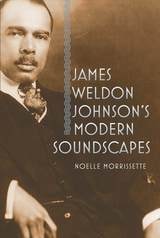
James Weldon Johnson's Modern Soundscapes
Noelle Morrissette
University of Iowa Press, 2013

James Wright
The Poetry of a Grown Man; Constancy and Transition in the Work of James WrightKevin Stein
Ohio University Press, 1988
Stein locates Wright in the Emersonian tradition which sees struggle with language as a struggle with the self -- a locating and defining of the self within a world of natural facts. Language, then, becomes a means of self-definition, and to be frivolous or irresponsible with language becomes a negation of the self and the world it inhabits. For Wright, “the poetry of a grown man” issues from this understanding. Because Wright joins the act of language with the act of selfhood, it is not surprising that the mode and tenor of his work would alter as the self redefines its values and goals, its very identity. In fact, Stein divides Wright’s career into three interrelated stages of development: “containment,” in which he relies on traditional religious and rhetorical measures to distance himself from a world of experience; “vulnerability,” in which he enters the experiential world where the self is rewarded and equally threatened; and “integration,” in which he accepts and balances the necessary combination of beauty and horror inherent in being human within a natural world.
Stein shows that throughout his career Wright’s presiding concern is to discover a way of writing and a way of life that might overcome the effects of an individual’s separation from the human community, the natural world, and the spiritual presence in the universe. In Wright’s world, to do less is to betray one’s language -- and one’s self.
James the Minimalist
An Essay on the Late NovelsJohn Brenkman
University of Chicago Press, 2026
An experiment in criticism that explores Henry James’s late works through the lens of minimalism.
Henry James’s last completed novels—The Ambassadors, The Wings of the Dove, and The Golden Bowl—are among the greatest and most demanding achievements of modern fiction. The stories they tell are perverse: characters are compelling even at their most cruel, their actions often calculating and loving at the same time. The novels draw on deep-seated myths but end with an unsettling lack of finality. And their dense, involuted language tracks the movements of consciousness with uncompromising artistry—the ultimate flowering of the late James style.
In this work of experimental criticism, John Brenkman is concerned with minimalism in two senses. First, with James’s own minimalism—his intense scrutiny of couples and their erotic energies to the exclusion of so much else. And second, through a kind of minimalization in literary critical reading, Brenkman cuts through James’s amplifications to find the essence that churns beneath the intricate prose of the late novels. Showing how James evokes not only protagonists’ subjectivity but more importantly what only exists in between—that is, between lovers, between spouses, between rivals—Brenkman reveals James’s transformation of the marriage novel and excavation of the couple form itself.
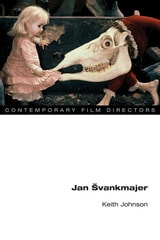
Jan Svankmajer
Keith Johnson
University of Illinois Press, 2017
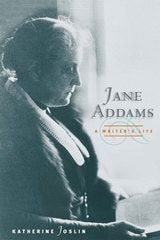
Jane Addams, a Writer's Life
Katherine Joslin
University of Illinois Press, 2003
Jane Addams, a Writer's Life is an expansive, revealing, and refreshing reexamination of the renowned reformer as an imaginative writer. Jane Addams is best known for her groundbreaking social work at Hull-House, the force of her efforts toward Progressive political and social reform, and the bravery of her commitment to pacifism, for which she received the Nobel Peace Prize. Katherine Joslin moves beyond this history to present Addams as a literary figure, one whose writing employed a synthesis of fictional and analytical prose that appealed to a wide audience.
Joslin traces Addams's style from her early works, Philanthropy and Social Progress and her contributions to Hull House Maps and Papers, influenced by Florence Kelley, to her modernist and experimental last books, The Second Twenty Years at Hull-House and My Friend, Julia Lathrop, placing Addams in the context of other Chicago writers including Theodore Dreiser, Upton Sinclair, Harriet Monroe, Frank Norris and James T. Farrell. Joslin's close readings showcase Addams's distinguishing literary devices, such as using stories about people rather than sociological argument to make moral points. As Joslin pursues the argument that Addams's power as a public figure stemmed from the success of her books and essays, Addams herself emerges as a literary woman.
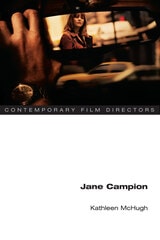
Jane Campion
Kathleen McHugh
University of Illinois Press, 2006
In considering Jane Campion's early award-winning short films on through international sensation The Piano and beyond, Kathleen McHugh traces the director's distinctive visual style as well as her commitment to consistently renovating the conventions of "women's films." By refusing to position her female protagonists as victims, McHugh argues, Campion scrupulously avoids the moral structures of melodrama, and though she often works with the narratives, mise-en-scene, and visual tropes typical of that genre, her films instead invite a distanced or even amused engagement.
Jane Campion concludes with four brief, revelatory interviews and a filmography. Campion spoke twice with Michel Ciment—after the screening of her short and medium-length films at the Cannes Film Festival 1986, and three years later, after the Cannes screening of Sweetie. Judith Lewis narrates a Beverly Hills interview with Campion that followed the release of Holy Smoke, and Lizzie Francke's interview, reprinted from Sight and Sound,centers on Campion's film In the Cut, adapted from Susanna Moore's novel.
A volume in the series Contemporary Film Directors, edited by James R. Naremore
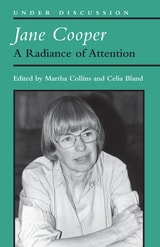
Jane Cooper
A Radiance of AttentionMartha Collins and Celia Bland, editors
University of Michigan Press, 2019
Martha Collins and Celia Bland bring together several decades’ worth of essential writing on Cooper’s poetry. While some pieces offer close examination of Cooper’s process or thoughtful consideration of the craft of a single poem, the volume also features reviews of her collections, including a previously unpublished piece on her first book, The Weather of Six Mornings (1969), by James Wright, a lifelong champion of her work. Marie Howe, Jan Heller Levi, and Thomas Lux, among others, share personal remembrances of Cooper as a teacher, colleague, and inspiration. L. R. Berger’s moving tribute to Cooper’s final days closes the volume. This book has much to offer for both readers who already love Cooper’s work and new readers, especially among younger poets, just discovering her enduring poems.
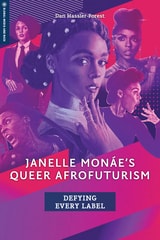
Janelle Monáe's Queer Afrofuturism
Defying Every LabelDan Hassler-Forest
Rutgers University Press, 2022
Janelle Monáe is all these things and more, making her one of the most fascinating artists to emerge in the twenty-first century. This provocative new study explores how Monáe’s work has connected different media platforms to strengthen and enhance new movements in art, theory, and politics. It considers not only Monáe’s groundbreaking albums The ArchAndroid, The Electric Lady, and Dirty Computer, but also Monáe’s work as an actress in such films as Hidden Figures and Antebellum, as well as her soundtrack appearances in socially-engaged projects ranging from I May Destroy You to Us. Examining Monáe as a cultural icon whose work is profoundly intersectional, this book maps how she is actively reshaping discourses around race, gender, sexuality, and capitalism. Tracing Monáe’s performances of joy, desire, pain, and hope across a wide range of media forms, it shows how she imagines Afrofuturist, posthumanist, and postcapitalist utopias, while remaining grounded in the realities of being a Black woman in a white-dominated industry. This is an exciting introduction to an audacious innovator whose work offers us fresh ways to talk about identity, desire, and power.
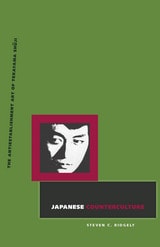
Japanese Counterculture
The Antiestablishment Art of Terayama ShujiSteven C. Ridgely
University of Minnesota Press, 2010
Ridgely places Terayama at the center of Japanese and global counterculture and finds in his work a larger story about the history of postwar Japanese art and culture. He sees Terayama as reflecting the most significant events of his day: young poets seizing control of haiku and tanka in the 1950s, radio drama experimenting with form and content after the cultural shift to television around 1960, young assistant directors given free rein in the New Wave as cinema combated television, underground theatre in the politicized late 1960s, and experimental short film through the 1970s after both the studio system and art house cinema had collapsed.
Featuring close readings of Terayama's art, Ridgely demonstrates how across his oeuvre there are patterns that sidestep existing power structures, never offering direct opposition but nevertheless making the opposition plain. And, he claims, there is always in Terayama's work a broad call for seeking out or creating pockets of fiction-where we are made aware that things are not what they seem-and to use otherness in those spaces to take a clearer view of reality.
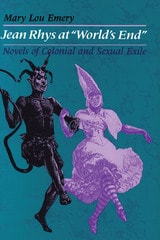
Jean Rhys at "World's End"
Novels of Colonial and Sexual ExileBy Mary Lou Emery
University of Texas Press, 1990
The Caribbean Islands have long been an uneasy meeting place among indigenous peoples, white European colonists, and black slave populations. Tense oppositions in Caribbean culture—colonial vs. native, white vs. black, male conqueror vs. female subject—supply powerful themes and spark complex narrative experiments in the fiction of Dominica-born novelist Jean Rhys. In this pathfinding study, Mary Lou Emery focuses on Rhys's handling of these oppositions, using a Caribbean cultural perspective to replace the mainly European aesthetic, moral, and psychological standards that have served to misread and sometimes devalue Rhys's writing.
Emery considers all five Rhys novels, beginning with Wide Sargasso Sea as the most explicitly Caribbean in its setting, in its participation in the culminating decades of a West Indian literary naissance, and most importantly, in its subversive transformation of European concepts of character. From a sociocultural perspective, she argues persuasively that the earlier novels—Voyage in the Dark, Quartet, After Leaving Mr. Mackenzie, and Good Morning, Midnight—should be read as emergent Caribbean fiction, written in tense dialogue with European modernism. Building on this thesis, she reveals how the apparent passivity, masochism, or silence of Rhys's female protagonists results from their doubly marginalized status as women and as subject peoples. Also, she explores how Rhys's women seek out alternative identities in dreamed of, magically realized, or chosen communities.
These discoveries offer important insights on literary modernism, Caribbean fiction, and the formation of female identity.
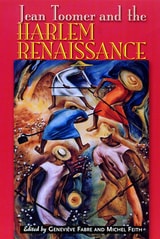
Jean Toomer & Harlem Renaissance
Edited by Geneviève Fabre and Michel Feith
Rutgers University Press, 2000
Jean Toomer's novel Cane has been hailed as the harbinger of the Harlem Renaissance and as a model for modernist writing, yet it eludes categorization and its author remains an enigmatic and controversial figure in American literature. The present collection of essays by European and American scholars gives a fresh perspective by using sources made available only in recent years, highlighting Toomer's bold experimentations, as well as his often ambiguous responses to the questions of his time.
Some of the essays achieve this through close readings of the text, leading to new and challenging interpretations of Toomer's transcendence of genres and styles. Others show how the publication of Cane and his later writings placed Toomer at the heart of contemporary ideological and artistic debates: race and identity, the negro writer and the white literary world, primitivism and modernism.
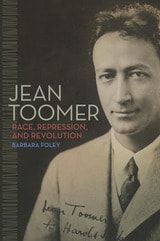
Jean Toomer
Race, Repression, and RevolutionBarbara Foley
University of Illinois Press, 2019
The 1923 publication of Cane established Jean Toomer as a modernist master and one of the key literary figures of the emerging Harlem Renaissance. Though critics and biographers alike have praised his artistic experimentation and unflinching eyewitness portraits of Jim Crow violence, few seem to recognize how much Toomer's interest in class struggle, catalyzed by the Russian Revolution and the post–World War One radical upsurge, situate his masterwork in its immediate historical context. In Jean Toomer: Race, Repression, and Revolution, Barbara Foley explores Toomer's political and intellectual connections with socialism, the New Negro movement, and the project of Young America. Examining his rarely scrutinized early creative and journalistic writings, as well as unpublished versions of his autobiography, she recreates the complex and contradictory consciousness that produced Cane. Foley's discussion of political repression runs parallel with a portrait of repression on a personal level. Examining family secrets heretofore unexplored in Toomer scholarship, she traces their sporadic surfacing in Cane. Toomer's text, she argues, exhibits a political unconscious that is at once public and private.
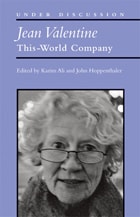
Jean Valentine
This-World CompanyKazim Ali and John Hoppenthaler, editors
University of Michigan Press, 2012
Over the course of more than four decades, contemporary American poet Jean Valentine has written eleven books of stunning, spirit-inflected poetry. This collection of essays, assembled over several years by Kazim Ali and John Hoppenthaler, brings together twenty-six pieces on all stages of Valentine's career by a range of poets, scholars, and admirers.
Valentine's poetry has long been valued for its dreamlike qualities, its touches of the personal and the political, and its mesmerizing phrasing. Valentine is a National Book Award winner and was named the State Poet of New York in 2008. She has taught a number of popular workshops and has been awarded a Bunting Institute Fellowship, a Guggenheim Foundation Fellowship, and the Shelley Memorial Prize.
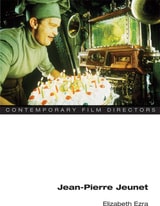
Jean-Pierre Jeunet
Elizabeth Ezra
University of Illinois Press, 2007
This is the first book on Jean-Pierre Jeunet, the popular and critically acclaimed director of films such as Amélie, Delicatessen, A Very Long Engagement, Alien Resurrection, and City of Lost Children. Jeunet's work exemplifies Europe's engagement with Hollywood, while at the same time making him a figurehead of the critically overlooked, specifically French tradition of the cinema of the fantastic.
Having garnered both commercial success and critical esteem in genres such as science fiction, fantasy, romantic comedy, and the war epic, Jeunet's work nevertheless engages with key aspects of French history and contemporary French culture. This study analyzes the director's major films, including those he made with Marc Caro, and his early short works. Elizabeth Ezra brings a new perspective to the study of Jeunet's work, uncovering instances of repressed historical trauma involving France's role in Algeria and the Second World War. The book includes a commentary by Jeunet himself on his career and corpus of films.
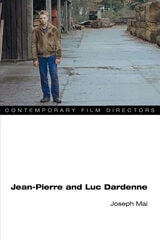
Jean-Pierre and Luc Dardenne
Joseph Mai
University of Illinois Press, 2010
For well over a decade, Jean-Pierre and Luc Dardenne have produced highly original and ethically charged films that immerse their audiences in an intense and embodied viewing experience. Their work has consistently attracted international recognition, including the rare feat of two Palmes d'Or at Cannes.
In this first book-length study of the Belgian brothers, Joseph Mai delivers sophisticated close analyses of their directorial style and explores the many philosophical issues dealt with in their films (especially the ethics of Emmanuel Levinas). Mai discusses the Dardennes' varied and searching career from its inception in the late 1970s, starting with the working-class political consciousness and lost utopias of their documentary period; passing through their transition toward fictional narrative, experimental techniques, and familial themes; and finishing with a series of in-depth and philosophically informed interpretations of the brothers' more recent work. In such highly influential films such as La promesse, Rosetta, The Son, and The Child, the brothers have recast filmmaking through what Mai calls a "sensuous realism"--realism capable of touching the audience with the most compelling problems and moral dilemmas of contemporary society. This volume also features an interview in which the Dardennes discuss their approach to film production and the direction of actors.
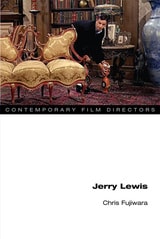
Jerry Lewis
Chris Fujiwara
University of Illinois Press, 2009
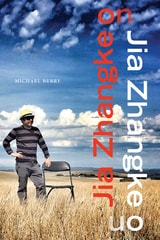
Jia Zhangke on Jia Zhangke
Michael Berry
Duke University Press, 2022
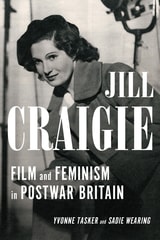
Jill Craigie
Film and Feminism in Postwar BritainYvonne Tasker and Sadie Wearing
University of Illinois Press, 2026
Tasker and Wearing reconsider Craigie’s place and reputation in the history of British Cinema. Craigie created work that showed a strong critical voice and at the same time challenged contemporary modes of filmmaking with both documentary and drama. Tasker and Wearing examine her feminist and working-class influences and also emphasize the democratic impulse that drove Craigie to include her subjects’ participation, and her commitment to representing them on screen. Throughout, Tasker and Wearing analyze Craigie’s work against the backdrop of postwar concerns and preoccupations.
Distinctive and nuanced, Jill Craigie reconsiders the career of a groundbreaking woman director.
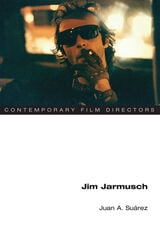
Jim Jarmusch
Juan A. Suarez
University of Illinois Press, 2006
At a time when gimmicky, action-driven blockbusters ruled Hollywood, Jim Jarmusch spearheaded a boom in independent cinema by making now-classic low-budget films like Stranger than Paradise, Down by Law, and Mystery Train. Jarmusch's films focused on intimacy, character, and new takes on classical narratives. His minimal form, peculiar pacing, wry humor, and blank affect have since been adopted by directors like Sofia Coppola, Hal Hartley, Richard Linklater, and Tsai Ming-liang.
Juan A. Suárez identifies and describes an abundance of aesthetic influences on Jarmusch, delving into the director's links to punk, Structural film, classic street photography, hip-hop, beat literature and art, and the New York pop vanguard of the late 1970s. At the same time, he analyzes Jarmusch's work from three mutually implicated perspectives: in relation to independent filmmaking from the 1980s to the present; as a form of cultural production that appropriates existing icons, genres, and motifs; and as an instance of postmodern politics.
A volume in the series Contemporary Film Directors, edited by James R. Naremore
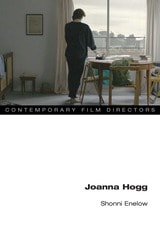
Joanna Hogg
Shonni Enelow
University of Illinois Press, 2024
Films like The Eternal Daughter and the diptych The Souvenir and The Souvenir Part II have cemented Joanna Hogg’s reputation as an original voice in contemporary cinema. Her rigorous and quiet style draws on the histories of film and art to tell stories that weave autobiography with studies in human opacity.
Shonni Enelow analyzes Hogg’s six feature films around the concepts of turning away, the reality effect, and the impossible encounter. Throughout, Enelow explores the tension between absorption, in which characters are immersed in a diegetic fiction, and self-reflexivity, as the filmmaker comments on her techniques of representation. An in-depth interview with Hogg delves into the director’s process, approach to creating character, and use of artistic and literary references.
Sophisticated and innovative, Joanna Hogg illuminates the work of one of today’s most original filmmakers.
Joanna Russ
Gwyneth Jones
University of Illinois Press, 2019
Joel and Ethan Coen
R. Barton Palmer
University of Illinois Press, 2004
R. Barton Palmer argues that the Coen oeuvre forms a central element in what might be called postmodernist filmmaking. Mixing high and low cultural sources and blurring genres like noir and comedy, the use of pastiche and anti-realist elements in films such as The Hudsucker Proxy and Barton Fink clearly fit the postmodernist paradigm. Palmer argues that for a full understanding of the Coen brothers' unique position within film culture, it is important to see how they have developed a new type of text within general postmodernist practice that Palmer terms commercial/independent. Analyzing their substantial body of work from this "generic" framework is the central focus of this book.
Johanna Beyer
Amy C. Beal
University of Illinois Press, 2015
Amy C. Beal chronicles Beyer's life from her early participation in New York's contemporary music scene through her performances at the Federal Music Project's Composers' Forum-Laboratory concerts to her unfortunate early death in 1944. This book is a portrait of a passionate and creative woman underestimated by her music community even as she tirelessly applied her gifts with compositional rigor.
The first book-length study of the composer's life and music, Johanna Beyer reclaims a uniquely innovative artist and body of work for a new generation.
John Brunner
Jad Smith
University of Illinois Press, 2012
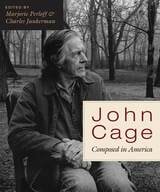
John Cage
Composed in AmericaEdited by Marjorie Perloff and Charles Junkerman
University of Chicago Press, 1994
John Cage: Composed in America is the first book-length work to address the "other" John Cage, a revisionist treatment of the way Cage himself has composed and been "composed" in America. Cage, as these original essays testify, is a contradictory figure. A disciple of Duchamp and Schoenberg, Satie and Joyce, he created compositions that undercut some of these artists' central principles and then attributed his own compositional theories to their "tradition." An American in the Emerson-Thoreau mold, he paradoxically won his biggest audience in Europe. A freewheeling, Californian artist, Cage was committed to a severe work ethic and a firm discipline, especially the discipline of Zen Buddhism.
Following the text of Cage's lecture-poem "Overpopulation and Art," delivered at Stanford shortly before his death and published here for the first time, ten critics respond to the challenge of the complexity and contradiction exhibited in his varied work. In keeping with Cage's own interdisciplinarity, the critics approach that work from a variety of disciplines: philosophy (Daniel Herwitz, Gerald L. Bruns), biography and cultural history (Thomas S. Hines), game and chaos theory (N. Katherine Hayles), music culture (Jann Pasler), opera history (Herbert Lindenberger), literary and art criticism (Marjorie Perloff), cultural poetics (Gordana P. Crnkovic, Charles Junkerman), and poetic practice (Joan Retallack). But such labels are themselves confining: each of the essays sets up boundaries only to cross them at key points. The book thus represents, to use Cage's own phrase, a much needed "beginning with ideas."
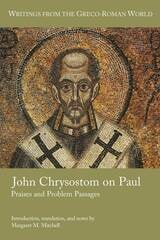
John Chrysostom on Paul
Praises and Problem PassagesMargaret M. Mitchell
SBL Press, 2022
A readily accessible text and translation for scholars and students of Paul, ancient Christian history, and biblical reception.
In this new volume in the Writings from the Greco-Roman World series, Margaret M. Mitchell collects twenty-five of John Chrysostom's lesser-known sermons on Pauline passages as well as some that focus on Paul himself. Mitchell presents the Greek text and an original translation of each of these fascinating sermons in a fresh, engaging style that seeks to recapture the vibrancy and dynamism of the live oratory behind the homilies. Extensive notes to each homily evaluate how Chrysostom dealt with some of the ethical, theological, historical, political, and literary problems present in Paul's writings. Mitchell's work on Chrysostom offers a model for scholars to explore and understand how ancient Christian interpreters found in Paul’s letters a legacy that was as problematic as it was precious.

John Dickson Carr
A Critical StudyS. T. Joshi
University of Wisconsin Press, 1990
John Donne, Body and Soul
Ramie Targoff
University of Chicago Press, 2008
For centuries readers have struggled to fuse the seemingly scattered pieces of Donne’s works into a complete image of the poet and priest. In John Donne, Body and Soul, Ramie Targoff offers a way to read Donne as a writer who returned again and again to a single great subject, one that connected to his deepest intellectual and emotional concerns.
Reappraising Donne’s oeuvre in pursuit of the struggles and commitments that connect his most disparate works, Targoff convincingly shows that Donne believed throughout his life in the mutual necessity of body and soul. In chapters that range from his earliest letters to his final sermon, Targoff reveals that Donne’s obsessive imagining of both the natural union and the inevitable division between body and soul is the most continuous and abiding subject of his writing.
“Ramie Targoff achieves the rare feat of taking early modern theology seriously, and of explaining why it matters. Her book transforms how we think about Donne.”—Helen Cooper, University of Cambridge
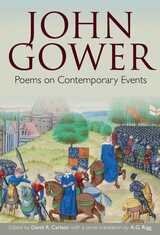
John Gower
Poems on Contemporary EventsDavid R. Carlson
Bodleian Library Publishing, 2011
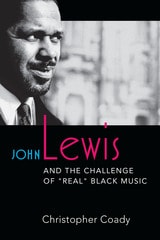
John Lewis and the Challenge of "Real" Black Music
Christopher Coady
University of Michigan Press, 2016
For critics and listeners, the reception of the 1950s jazz-classical hybrid Third Stream music has long been fraught. In John Lewis and the Challenge of “Real” Black Music, Christopher Coady explores the work of one of the form’s most vital practitioners, following Lewis from his role as an arranger for Miles Davis’s Birth of the Cool sessions to his leadership of the Modern Jazz Quartet, his tours of Europe, and his stewardship of the Lenox School of Jazz.
Along the way Coady shows how Lewis’s fusion works helped shore up a failing jazz industry in the wake of the 1940s big band decline, forging a new sound grounded in middle-class African American musical traditions. By taking into account the sociocultural milieu of the 1950s, Coady provides a wider context for understanding the music Lewis wrote for the Modern Jazz Quartet and sets up new ways of thinking about Cool Jazz and Third Stream music more broadly.
John Reed and the Writing of Revolution
Daniel W. Lehman
Ohio University Press, 2002
John Reed (1887-1920) is best known as the author of Ten Days That Shook the World and as champion of the communist movement in the United States. Still, Reed remains a writer almost systematically ignored by the literary critical establishment, even if alternately vilified and lionized by historians and by films like Warren Beatty’s Reds.
John Reed and the Writing of Revolution examines Reed’s writing from a different critical perspective—one informed by a theoretical and practical understanding of literary nonfiction. In both politics and writing, John Reed defied fashion. In his short career, Reed transcended the traditional creative arts of fiction, poetry, and drama in favor of deeply researched histories composed with the cadence of fiction and the power of fact. Reed thereby alienated literary critics who had idealized timeless artistry against the rough-and-tumble world of historical details and political implications.
Working from a close investigation of rare articles, manuscripts, and the Reed papers at Harvard as well as from Reed’s published work, Daniel W. Lehman offers the first detailed literary study of the man who followed Pancho Villa into battle; wrote literary profiles of such characters as Henry Ford, William Jennings Bryan, and Billy Sunday; explicated the Byzantine factionalism of Eastern Europe; and witnessed the storming of the Winter Palace and the birth of Soviet Russia.
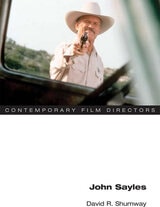
John Sayles
David R. Shumway
University of Illinois Press, 2012
John Steinbeck
The Years of Greatness, 1936-1939Tetsumaro Hayashi
University of Alabama Press, 1993