Results by title
230 books match the query 'Doctrines' and 4 start with j
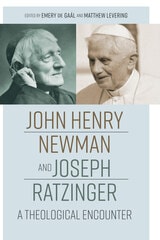
John Henry Newman and Joseph Ratzinger
A Theological EncounterEmery de Gaal
Catholic University of America Press, 2024
This book brings the thought of John Henry Newman into conversation with that of Joseph Ratzinger/Benedict XVI on a number of crucial theological themes. The book begins with a programmatic essay by Tracey Rowland connecting Newman’s approach with that of Ratzinger’s doktorvater Gottlieb Söhngen, along seven instructive paths. The book then delves into central themes of both Newman’s and Ratzinger’s thought, with essays that treat dogmatic development, the relationship of faith and reason, biblical inspiration, mystery, conscience, attentiveness to the “signs of the times,” interculturality and revelation, the Church as the Mystical Body, ecclesial authority, the relationship of faith and natural science, and deification. The essays in the volume come from many of the world’s leading Newman and Ratzinger scholars, with Ratzinger being represented by such experts as Rowland, Emery de Gaál, Aaron Pidel, SJ, Jacob Phillips, Matthew Ramage, and Jeremy Pilch; and Newman by such experts as Frederick D. Aquino, Andrew Meszaros, Marial Corona, Ryan Marr, and Elizabeth A. Huddleston. The Introduction briefly sets the scene for the encounter by describing the German reception of Newman during Ratzinger’s youth in comparison with the much less robust situation in German Newman scholarship today. It is the hope of the editors that this theological encounter will serve to promote and advance both Newman studies and Ratzinger studies in English- and German-speaking lands today.
[more]
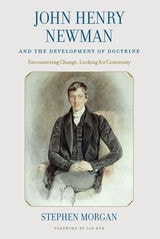
John Henry Newman and the Development of Doctrine
Encountering Change, Looking for ContinuityStephen Morgan
Catholic University of America Press, 2022
John Henry Newman and the Development of Doctrine provides an analysis of the attempts by John Henry Newman to account for the historical reality of doctrinal change within Christianity in the light of his lasting conviction that the idea of Christianity is fixed by reference to the dogmatic content of the deposit of faith. It argues that Newman proposed a series of hypotheses to account for the apparent contradiction between change and continuity, that this series begins much earlier than is generally recognized and that the final hypothesis he was to propose, contained in An Essay on the Development of Christian Doctrine, provides a methodology of lasting theological value and contemporary relevance.
Stephen Morgan establishes the centrality of the problem of change and continuity in theology, to Newman's theological work as an Anglican, its part in his conversion to Catholicism and its contemporary relevance to Catholic theology. It also surveys the major secondary literature relating to the question, with particular reference to those works published within the last fifty years. Additionally, Morgan considers the legacy of the Essay as a tool in Newman’s theology and in the work of later theologians, finally suggesting that it may offer a useful methodological contribution to the contemporary Catholic debate about hermeneutical approaches to the Second Vatican Council and post-conciliar developments in doctrine.
[more]
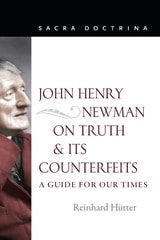
John Henry Newman on Truth and its Counterfeits
A Guide for Our TimesReinhard Hutter
Catholic University of America Press, 2020
Reinhard Hütter’s main thesis in this third volume of the Sacra Doctrina series is that John Henry Newman, in his own context of the nineteenth century, a century far from being a foreign one to our own, faced the same challenges as we do today; the problems then and now differ in degree, not in kind. Hence, Newman's engagement with these problems offers us a prescient and indeed prophetic diagnosis of what these problems or errors, if not corrected, will lead to—consequences which have more or less come to pass—and, furthermore, an alternative way which is at once thoroughly Catholic and holds contemporary relevance.
The introduction offers a survey of Newman’s life and works and each of the subsequent four chapters addresses one significant aspect of Christianity that is not only contested or rejected by secular unbelief, but also has a counterfeit for which not only Christians, but even Catholics have fallen. The counterfeit of conscience is the “conscience” of the sovereign subject (Ch. 1); the counterfeit of faith is the “faith” of one who does not submit to the living authority through which God communicates but rather adheres to the principle of private judgment in matters of revealed religion(Ch.2); the counterfeit of doctrinal development is twofold: (i) paying lip service to development while only selectively accepting its consequences on the grounds of a specious antiquarianism and (ii) invoking development theory to justify all sorts of contemporary changes according to the present Zeitgeist (Ch. 3). Finally, the counterfeit of the university are all those “universities” whose end is not to educate and thereby to perfect the intellect, but rather to feed more efficiently the empire of desire that is informed by the techno-consumerism of today (Ch. 4). The book concludes with an epilogue on Hütter’s journey to Catholicism.
[more]
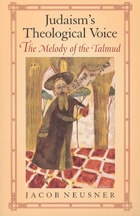
Judaism's Theological Voice
The Melody of the TalmudJacob Neusner
University of Chicago Press, 1995
Distinguished historian of Judaism Jacob Neusner here ventures for the first time into constructive theology. Taking the everyday life of contemporary Judaism as his beginning, Neusner asks when in the life of the living faith of the Torah does Israel, the holy community, meet God? Where does the meeting take place? What is the medium of the encounter?
In his attempt to answer these questions, Neusner sets forth the character and the form of the Torah as sung theology. Israel, the holy community, meets God in the synagogue, while at prayer, and in the yeshiva, when studying the Torah—at the moment in each setting when the Torah is received. In both circumstances people do not read but sing out its words. With the written part of the Torah sung in the synagogue, and the oral part declaimed in centers of sacred learning, music provides the medium for Judaism's theological voice.
Neusner identifies a reciprocal exchange between the holy community Israel and God: Israel sings to God when the Torah is studied, and God sings to Israel when the Torah is declaimed. Through the metaphor of music, Neusner offers an account of how he believes those faithful to the Torah meet God in the Torah, and how they should listen to the melody of God's self-revelation. The result is an original theological reflection that will interest all students of Judaism.
[more]