Results by title
808 books match the query 'Drama' and 10 start with j

JARMAN (all this maddening beauty) and other plays
Caridad Svich
Intellect Books, 2016
“Svich is one of the finest poet/playwrights of this generation. . . . She is a playwright whose plays perform like dramatic poems that are wondrous to the ear and moving to the heart.”—Seth Gordon, Repertory Theatre of St. Louis

Jagadamba
The Kasturba StoryRamdas Bhatkal
Seagull Books, 2016
Originally conceived in the Marathi language for actress Rohini Hattangadi, who received an Academy Award nomination for her portrayal of Kasturba in Richard Attenborough’s classic biopic Gandhi, this play charts the journey of a simple girl who went on to become “Jagadamba,” or the “Universal Mother,” as the wife of the Mahatma.
As Shanta Ghokale writes in her introduction: “Wives of great men have hard lives, often lived in negation of values they hold most dear. Jagadamba is the personal feelings of a devoted wife who had held her own in a life made mentally, physically, and morally turbulent by her husband’s ideas and political work.”
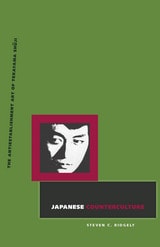
Japanese Counterculture
The Antiestablishment Art of Terayama ShujiSteven C. Ridgely
University of Minnesota Press, 2010
Ridgely places Terayama at the center of Japanese and global counterculture and finds in his work a larger story about the history of postwar Japanese art and culture. He sees Terayama as reflecting the most significant events of his day: young poets seizing control of haiku and tanka in the 1950s, radio drama experimenting with form and content after the cultural shift to television around 1960, young assistant directors given free rein in the New Wave as cinema combated television, underground theatre in the politicized late 1960s, and experimental short film through the 1970s after both the studio system and art house cinema had collapsed.
Featuring close readings of Terayama's art, Ridgely demonstrates how across his oeuvre there are patterns that sidestep existing power structures, never offering direct opposition but nevertheless making the opposition plain. And, he claims, there is always in Terayama's work a broad call for seeking out or creating pockets of fiction-where we are made aware that things are not what they seem-and to use otherness in those spaces to take a clearer view of reality.
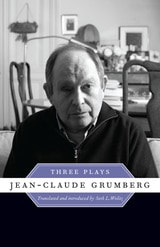
Jean-Claude Grumberg
Three PlaysBy Jean-Claude Grumberg and Seth Wolitz
University of Texas Press, 2014
Winner of seven Molières, the Pulitzer Prize of France, Jean-Claude Grumberg is one of France’s leading dramatists and a distinguished voice of modern European Jewry after the Shoah. His success in portraying contemporary Parisian Jews on the stage represents a new development in European theater and a new aesthetic expression of European Jewish experience and sensibility of the Holocaust and its aftermath, a perspective quite different from either the American or the Israeli one. Grumberg’s Jews are French to their fingertips, yet they have been made more consciously Jewish by the war and the difficulties of reintegrating into a society in which too many neighbors denounced them or ignored their pleas to save their children. Affirming the new status of Jewish culture, Grumberg’s plays insist on the recognition of Jewish identity and uniqueness within the majority societies of Europe.
This volume offers the first English translation of three of Grumberg’s prize-winning plays: The Workplace (L’Atelier, 1979), On the Way to the Promised Land (Vers toi Terre promise, 2006) and Mama’s Coming Back, Poor Orphan (Maman revient, pauvre orphelin, 1994). Presented in the order of the history they record and steeped in Grumberg’s personal experience and insights into contemporary Parisian life, these plays serve as documentary witnesses that begin with the immediate postwar reality and continue up to the end of the twentieth century. Seth Wolitz provides notes on the plays’ themes, structures, characters, and settings, along with an introduction that discusses Grumberg’s place within the emergence of French-Jewish drama and a translation of an interview with the playwright himself.
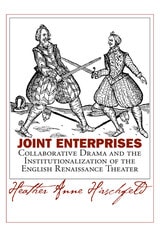
Joint Enterprises
Collaborative Drama and the Institutionalization of the English Renaissance TheaterHeather Anne Hirschfeld
University of Massachusetts Press, 2004
Drawing on a range of documentary and literary sources as well as recent methodological advances in theater history, the book presents a sequence of case studies designed to accommodate both the larger cultural setting of the early modern theater and the localized, idiosyncratic factors influencing discrete literary productions. Each chapter chronicles the professional setting of a particular joint work and then investigates its rhetorical or linguistic traces in the resultant text. This approach allows Hirschfeld to locate specific links between modes of collaborative production and forms of dramatic representation and then explicate the literary and political implications of these connections.
Hirschfeld's case studies provide a fresh account of the institutionalization—the steady growth, organization, and incorporation—of the professional drama in sixteenth- and seventeenth-century English cultural life. By attending to the changing shapes and stakes of joint enterprises, she shows that dramatists did not unconsciously absorb the practice of collaborative writing from general social discourses, but rather were aware of the material and symbolic significances of their work, meanings structured by the traditions of the developing professional theater and by the cultural pressures and anxieties attendant upon a new and often fragile institution.
Jonson's Moral Comedy
Alan C. Dessen
Northwestern University Press, 1971
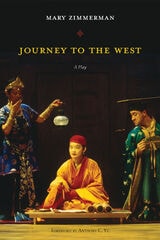
Journey to the West
A PlayMary Zimmerman
Northwestern University Press, 2011
Journey
The Gateway Theatre Building and Company, 1884-1965Ian Brown
Intellect Books, 2013
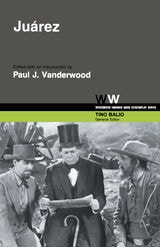
Juarez
Edited, with an introduction by Paul J. Vanderwood; Tino T. Balio, Series Editor
University of Wisconsin Press, 1983
Juárez was Warner Brothers' cinematic attempt to answer the major international question of the 1930s: would democracy or dictatorship prevail? Eager to further the foreign policy objectives of its friend Franklin Delano Roosevelt and equally willing to add to its prestigious and profitable biography series, the stuido set a record high budget and assembled special film stock, extensive scholarly research, a loose time schedule, a renowned director, and a stellar cast that included Paul Muni, Brian Aherne, and Bette Davis. The film was meant to be an ideologically clear-cut statement against fascism. The ways in which this artistic propaganda backfired make Juárez a significant historical document for students of film, Latin American history, and U.S. foreign relations.
Julius Caesar
William Shakespeare
Arizona Center for Medieval and Renaissance Studies, 2022
Julius Caesar, Shakespeare’s famous Roman tragedy, chronicles the chaos leading up to the fateful murder of Caesar and the ensuing political fallout upon his death. Shishir Kurup’s translation updates Shakespeare’s language to allow more of the playwright’s ideas to come through; it opens the wonders and blazing relevance of the play’s rhetorical brilliance to the twenty-first century.
This translation of Julius Caesar was written as part of the Oregon Shakespeare Festival’s Play On! project, which commissioned new translations of thirty-nine Shakespeare plays. These translations present the work of “The Bard” in language accessible to modern audiences while never losing the beauty of Shakespeare’s verse. Enlisting the talents of a diverse group of contemporary playwrights, screenwriters, and dramaturges from diverse backgrounds, this project reenvisions Shakespeare for the twenty-first century. These volumes make these works available for the first time in print—a new First Folio for a new era.