Results by title
475 books match the query 'Environmental' and 2 start with j
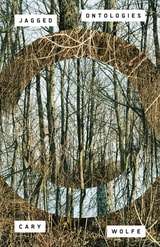
Jagged Ontologies
Cary Wolfe
University of Minnesota Press, 2026
Rethinking life, justice, and the biosphere through the sharp edges of jagged ontology
In this groundbreaking book, Cary Wolfe dismantles some of the most entrenched assumptions in contemporary interdisciplinary thought, foremost among them the idea that “flat” ontologies are adequate to the challenge of a robust, posthumanist pluralism. Against the fantasy of nature as an interconnected, egalitarian web, Wolfe proposes a “jagged ontology” in which species and systems intersect not through seamless cooperation but through friction, contestation, and uneven exchange. Wolfe pushes back equally, however, against the reductive tendencies of neo-Darwinian competitive individualism, insisting that what separates us from the world is also what binds us to it—a paradox at the core of all living systems, where autopoietic closure unexpectedly creates environmental openness.
Through a combination of systems theory, deconstruction, theoretical biology, and biopolitical philosophy, Wolfe develops a radically posthumanist framework for addressing the ethical, social, and political stakes of life in the biosphere. Extending his approach across disciplines and practices—from ecological theory and continental philosophy to law, public policy, and contemporary art—he lays bare the contradictions embedded in even the most progressive attempts to account for the imbrication of the human and the more-than-human. Through a detailed and long-overdue examination of the popular notion of sympoiesis and a skeptical reading of the anthropomorphism of the “new forestry,” Wolfe reveals how well-intentioned theories can undermine the very posthumanist pluralism that they claim to champion.
More than a critique, Jagged Ontologies opens onto new philosophical terrain for understanding multispecies justice, environmental responsibility, and the structural dynamics of individuation and creativity in the biosphere. Here, Wolfe offers a crucial rethinking of what it means to live and think ethically in a shared yet jagged world.
Retail e-book files for this title are screen-reader friendly with images accompanied by short alt text and/or extended descriptions.
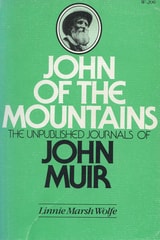
John of the Mountains
The Unpublished Journals of John MuirEdited by Linnie Marsh Wolfe
University of Wisconsin Press, 1979
The sixty extant journals and numerous notes in this volume were written from 1867 to 1911. They start seven years after the time covered in The Story of My Boyhood and Youth, Muir’s uncompleted autobiography. The earlier journals capture the essence of the Sierra Nevada and Alaska landscapes. The changing appearance of the Sierras from Sequoia north and beyond the Yosemites enthralled Muir, and the first four years of the journals reveal his dominating concern with glacial action. The later notebooks reflect his changes over the years, showing a mellowing of spirit and a deep concern for human rights.
Like all his writings, the journals concentrate on his observations in the wilderness. His devotion to his family, his many warm friendships, and his many-sided public life are hardly mentioned. Very little is said about the quarter-century battle for national parks and forest reserves. The notebooks record, in language fuller and freer than his more formal writings, the depth of his love and transcendental feeling for the wilderness. The rich heritage of his native Scotland and the unconscious music of the poetry of Burns, Milton, and the King James Bible permeate the language of his poetic fancy.
In his later life, Muir attempted to sort out these journals and, at the request of friends, published a few extracts. A year after his death in 1914, his literary executor and biographer, William Frederick Badè, also published episodes from the journals. Linnie Marsh Wolfe set out to salvage the best of his writings still left unpublished in 1938 and has thus added to our understanding of the life and thought of a complex and fascinating American figure.