Results by title
1832 books match the query 'Essays' and 21 start with j
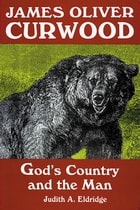
James Oliver Curwood
God's Country and the ManJudith A. Eldridge
University of Wisconsin Press, 1993
When the wounded bear he faced on a mountain ledge that day turned aside, James Curwood felt that he had been spared. From this encounter he became an avid conservationist. He wrote relentlessly—magazine stories and books and then for the new medium of motion pictures. Like many authors of his time, he was actively involved in movie-making until the plight of the forests and wildlife in his home state of Michigan turned his energies toward conservation.
A man ahead of his time, and quickly forgotten after his death in 1927, his gift of himself to his readers and to nature has finally come to be appreciated again two generations later.
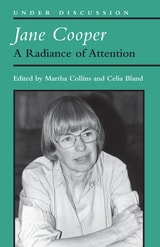
Jane Cooper
A Radiance of AttentionMartha Collins and Celia Bland, editors
University of Michigan Press, 2019
Martha Collins and Celia Bland bring together several decades’ worth of essential writing on Cooper’s poetry. While some pieces offer close examination of Cooper’s process or thoughtful consideration of the craft of a single poem, the volume also features reviews of her collections, including a previously unpublished piece on her first book, The Weather of Six Mornings (1969), by James Wright, a lifelong champion of her work. Marie Howe, Jan Heller Levi, and Thomas Lux, among others, share personal remembrances of Cooper as a teacher, colleague, and inspiration. L. R. Berger’s moving tribute to Cooper’s final days closes the volume. This book has much to offer for both readers who already love Cooper’s work and new readers, especially among younger poets, just discovering her enduring poems.
Janus's Gaze
Essays on Carl SchmittCarlo Galli
Duke University Press, 2015
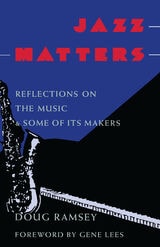
Jazz Matters
Reflections on the Music & Some of Its MakersDoug Ramsey
University of Arkansas Press, 1989
Rich in anecdote and insight, Jazz Matters is a collection of essays, profiles, and reviews by Doug Ramsey, and observer and chronicler of jazz and its musicians for more than thirty years. It stirs the reader to discover or rediscover the music and performers Ramsey describes. His accounts of recording sessions and live performances enhance this excellent review of the history, variety, and artistic depth that make jazz so profound an element in modern culture.
Jazz Matters gives the reader a basis for understanding jazz improvisation Ramsey’s sensitive, straightforward, and entertaining pieces promote appreciation of the accomplishment of artists from Louis Armstrong to John Coltrane and Ornette Coleman.
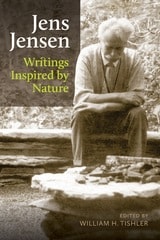
Jens Jensen
Writings Inspired by NatureWilliam H. Tishler
Wisconsin Historical Society Press, 2012
Today, Jensen is perhaps best remembered for establishing The Clearing on Wisconsin's Door County Peninsula. But the outspoken views in his writings - many of which were included in ephemeral planning reports, early newspapers, and now out-of-print journals - are virtually forgotten, with the exception of his two small books. "Jens Jensen: Writings Inspired by Nature" is an anthology of Jensen's most significant yet lesser-known articles, including a "Saturday Evening Post" piece that enabled him to reach the largest audience of his publishing career. The scope of Jensen's thoughts represented in this collection will further solidify his legacy and rightful place alongside conservation leaders such as John Muir and Aldo Leopold.
Jin Ping Mei – A Wild Horse in Chinese Literature
Essays on Texts, Illustrations and Translations of a Late Sixteenth-Century MasterpieceEdited by Vibeke Børdahl and Lintao Qi
National University of Singapore Press, 2022
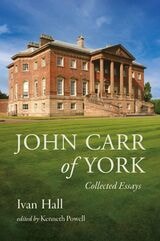
John Carr of York
Collected EssaysIvan Hall
Paul Holberton Publishing, 2023
John Carr of York (1723–1807) was one of the most prolific and significant architects of the eighteenth century, with an output of more than four hundred designs, which range from simple gateways to the grandest schemes. Highly successful in his day, he had a recognizable style that was sensitive to the latest fashions as they continued to change. His ability to create beautiful buildings and marry this with a practical approach to both the purpose of the building and the budget of his clients won him many commissions.
Carr was born in Yorkshire in the North of England and remained there for the duration of his career. Because of this, he has often been overlooked as an architect, and his extensive output has defeated many attempts to write a complete study of his work. Although not a comprehensive review, John Carr of York seeks to situate Carr as an architect of national significance. It includes photographs and covers overarching themes such as landscape and color and some commissions in more detail.
John Dewey and Continental Philosophy
Edited by Paul Fairfield
Southern Illinois University Press, 2010
“These essays build a valuable, if virtual, bridge between the thought of John Dewey and that of a host of modern European philosophers. They invite us to entertain a set of imagined conversations among the mighty dead that no doubt would have intrigued Dewey and each of the interlocutors gathered here.”—Robert Westbrook, author of John Dewey and American Democracy and/or Democratic Hope: Pragmatism and the Politics of Truth.
John Dewey and Continental Philosophy provides a rich sampling of exchanges that could have taken place long ago between the traditions of American pragmatism and continental philosophy had the lines of communication been more open between Dewey and his European contemporaries. Since they were not, Paul Fairfield and thirteen of his colleagues seek to remedy the situation by bringing the philosophy of Dewey into conversation with several currents in continental philosophical thought, from post-Kantian idealism and the work of Friedrich Nietzsche to twentieth-century phenomenology, hermeneutics, and poststructuralism.
John Dewey and Continental Philosophy demonstrates some of the many connections and opportunities for cross-traditional thinking that have long existed between Dewey and continental thought, but have been under-explored. The intersection presented here between Dewey’s pragmatism and the European traditions makes a significant contribution to continental and American philosophy and will spur new and important developments in the American philosophical debate.
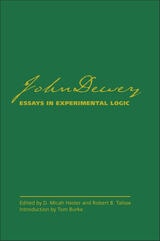
John Dewey's Essays in Experimental Logic
John Dewey. Edited by D. Micah Hester, and Robert B. Talisse. Introduction by Tom Burke
Southern Illinois University Press, 2007
Offering a new edition of Dewey’s 1916 collection of essays
This critical edition of John Dewey’s 1916 collection of writings on logic, Essays in Experimental Logic—in which Dewey presents his concept of logic as the theory of inquiry and his unique and innovative development of the relationship of inquiry to experience—is the first scholarly reprint of the work in one volume since 1954. Essays in Experimental Logic, edited by D. Micah Hester and Robert B. Talisse, uses the authoritative texts from the Collected Works of John Dewey, 1882–1953 (published by Southern Illinois University Press) and includes as well articles from leading journals representing various contemporary schools of philosophy that criticized Dewey’s experimentalism.
Culling materials from six volumes of the chronologically arranged Collected Works, this single-volume edition of Essays marks a crucial point in Dewey’s intellectual development: one in which Dewey critically engages idealistic and intuitionist theorists and lays the groundwork for his mature theory of inquiry. The text includes a new introduction by renowned Dewey scholar Tom Burke that places Essays in philosophical and historical context. In addition to the original essays, Essays in Experimental Logic also features five critical essays by Dewey’s contemporaries, including Bertrand Russell, Wendell T. Bush, R. F. Alfred Hoernlé, H. T. Costello, and C. S. Peirce.
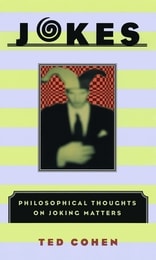
Jokes
Philosophical Thoughts on Joking MattersTed Cohen
University of Chicago Press, 1999
Sol sits on the sidewalk bench and waits patiently for nearly half an hour. Finally, Abe reappears.
"Well," asks Sol, "what are they up to? Who are they trying to convert? Why do they care? Did you get the $1,000?"
Indignantly Abe replies, "Money. That's all you people care about."
Ted Cohen thinks that's not a bad joke. But he also doesn't think it's an easy joke. For a listener or reader to laugh at Abe's conversion, a complicated set of conditions must be met. First, a listener has to recognize that Abe and Sol are Jewish names. Second, that listener has to be familiar with the widespread idea that Jews are more interested in money than anything else. And finally, the listener needs to know this information in advance of the joke, and without anyone telling him or her. Jokes, in short, are complicated transactions in which communities are forged, intimacy is offered, and otherwise offensive stereotypes and cliches lose their sting—at least sometimes.
Jokes is a book of jokes and a book about them. Cohen loves a good laugh, but as a philosopher, he is also interested in how jokes work, why they work, and when they don't. The delight at the end of a joke is the result of a complex set of conditions and processes, and Cohen takes us through these conditions in a philosophical exploration of humor. He considers questions of audience, selection of joke topics, the ethnic character of jokes, and their morality, all with plenty of examples that will make you either chuckle or wince. Jokes: more humorous than other philosophy books, more philosophical than other humor books.
"Befitting its subject, this study of jokes is . . . light, funny, and thought-provoking. . . . [T]he method fits the material, allowing the author to pepper the book with a diversity of jokes without flattening their humor as a steamroller theory might. Such a book is only as good as its jokes, and most of his are good. . . . [E]ntertainment and ideas in one gossamer package."—Kirkus Reviews
"One of the many triumphs of Ted Cohen's Jokes-apart from the not incidental fact that the jokes are so good that he doesn't bother to compete with them-is that it never tries to sound more profound than the jokes it tells. . . . [H]e makes you feel he is doing an unusual kind of philosophy. As though he has managed to turn J. L. Austin into one of the Marx Brothers. . . . Reading Jokes makes you feel that being genial is the most profound thing we ever do-which is something jokes also make us feel-and that doing philosophy is as natural as being amused."—Adam Phillips, London Review of Books
"[A] lucid and jargon-free study of the remarkable fact that we divert each other with stories meant to make us laugh. . . . An illuminating study, replete with killer jokes."—Kevin McCardle, The Herald (Glasgow)
"Cohen is an ardent joke-maker, keen to offer us a glimpse of how jokes are crafted and to have us dwell rather longer on their effects."—Barry C. Smith, Times Literary Supplement
"Because Ted Cohen loves jokes, we come to appreciate them more, and perhaps think further about the quality of good humor and the appropriateness of laughter in our lives."—Steve Carlson, Christian Science Monitor
Jorie Graham
Essays on the PoetryEdited by Thomas Gardner
University of Wisconsin Press, 2005
These essays identify three broad concerns that run through each of her strikingly different volumes of poems: the movement of the mind in action, the role of the body in experiencing the world, and the pressures of material conditions on mind and body alike. Gardner both shows how Graham is being read at the moment and charts new areas of investigation likely to dominate thinking about her over the next decade. This collection is sure to become the crucial first step for all future work on Graham and on American poetry of the last two decades.
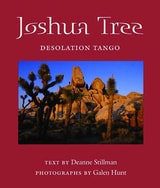
Joshua Tree
Desolation TangoText by Deanne Stillman; Photographs by Galen Hunt
University of Arizona Press, 2006
Additional Information and Publicity
Electric Politics Review
World Hum Excerpt
Arroyo Monthly
San Bernardino Sun Christmas Pick
Los Angeles Times Profile
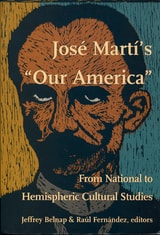
José Martí's Our America
From National to Hemispheric Cultural StudiesJeffrey Belnap and Raúl Fernández, eds.
Duke University Press, 1998
A Cuban exile from 1881 to 1895, Martí was a correspondent writing in New York for various Latin American newspapers. Grasping the significance of rising U.S. imperial power, he came to understand the Americas as a complex system of kindred—but not equal—national formations whose cultural and political integrity was threatened by the overbearing aggressiveness of the United States. This collection explores how in his journalistic work Martí critiques U.S. racism, imperialism, and capitalism; warns Latin America of impending U.S. geographical, cultural, and economic annexation; and calls for recognition of the diversity of America’s cultural voices. Reinforcing Martí’s hemispheric vision with essays by a wide range of scholars who investigate his analysis of the United States, his significance as a Latino outsider, and his analyses of Latin American cultural politics, this volume explores the affinities between Martí’s thought and current reexaminations of what it means to study America.
José Martí’s Our America offers a new understanding of Martí’s ambiguous and problematic relation with the United States and will engage scholars and students in American, Latin American, and Latino studies as well as those interested in cultural, postcolonial, gender, and ethnic studies.
Contributors. Jeffrey Belnap, Raúl Fernández, Ada Ferrer, Susan Gillman, George Lipsitz, Oscar Martí, David Noble, Donald E. Pease, Beatrice Pita, Brenda Gayle Plummer, Susana Rotker, José David Saldívar, Rosaura Sánchez, Enrico Mario Santí, Doris Sommer, Brook Thomas
Journal of the Fictive Life
Howard Nemerov
University of Chicago Press, 1981
"He often shows bravery and shrewdness; the book is full of fine criticism and psychological insight. As always, his prose has that ease and transparency that make one forget one is reading; one seems simply to hear a voice speaking. Nemerov's improvised self-analysis has weaknesses, but few that he himself doesn't eventually recognize."—New York Times Book Review
"In an age of explicitness, Nemerov's Journal of the Fictive Life is explicitly without vulgarity; in an age of revelation, it reveals only what counts. More then a book about creativity, it is a beautiful creation."—Richard G. Stern
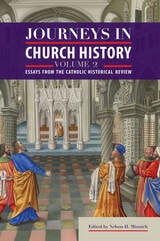
Journeys in Church History Volume 2
Essays from the <i>Catholic Historical Review</i>Nelson H. Minnich
Catholic University of America Press, 2025
Joy (Or Something Darker, but Like It)
poetry & parentingNathaniel Perry
University of Michigan Press, 2024
Each of the twelve essays considers a different poet—Edward Thomas, Henry W. Longfellow, George Scarbrough, Elizabeth Bishop, Geoffrey Hill, Primus St. John, Robert Hayden, Elizabeth Coatsworth, Gwendolyn Brooks, Robert Frost, E.A. Robinson, and Belle Randall—and, alongside them, different concerns of parenting and living. Organized in chronological order, they track the growth of Nathaniel Perry’s own children who pop up from time to time in a believable way. Essays consider the idea of devotion and belief, the idea of imperfection, the small details we can focus on as parents, and the conceptions of the world we pass along to our children. Together these essays not only represent the author's personal canon of poets who have been important to him in his life and work, but also present a diverse slice of American poetry, in voice, form, identity, origin, and time period.
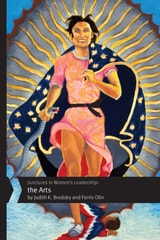
Junctures in Women's Leadership
The ArtsBrodsky, Judith K
Rutgers University Press, 2018
Amongst the women discussed are Bertha Honoré Palmer, Louise Noun, Samella Lewis, Julia Miles, Miriam Colón, Jaune Quick-To-See Smith, Bernice Steinbaum, Anne d’Harnoncourt, Martha Wilson, Jawole Willa Jo Zollar, Kim Berman, Gilane Tawadros, Joanna Smith, and Veomanee Douangdala.
Just As We Were
A Narrow Slice of Texas WomanhoodBy Prudence Mackintosh
University of Texas Press, 1996
When a Texas debutante bows her forehead to the floor in the famous "Texas dip," society columnists all across the country speculate interminably over what it is that sets Texas women apart. But really, how could they know? Even women born and bred in Texas can't always answer that question.
Prudence Mackintosh comes very close to an answer, though, in this endlessly entertaining book. Writing with both a wry sense of humor and an insider's compassion, she offers us a fascinating look into the world of privileged, educated, well-married, well-connected, and mostly wealthy white Texas women.
What really sets these women apart, Ms. Mackintosh tells us, is the comfortable yet demanding path they follow from their idyllic girlhoods to prominent positions in society. In thirteen essays, some of which originally appeared in Texas Monthly magazine, she charts the way stations that mark this path: summer camps in the Texas Hill Country, exclusive private schools like Dallas' Hockaday, sorority membership, and acceptance into the Junior League.
Prudence Mackintosh has been both an outsider and an insider in this privileged world, and her observations are shot through with wit and real insight. Just As We Were may not be the final word on elite Texas women, but no other book has described their world with greater irony or accuracy.
Just Three Minutes, Please
Thinking Out Loud on Public RadioMichael Blumenthal
West Virginia University Press, 2014
What’s wrong with the contemporary American medical system? What does it mean when a state’s democratic presidential primary casts 40% of its votes for a felon incarcerated in another state? What’s so bad about teaching by PowerPoint? What is truly the dirtiest word in America?
These are just a few of the engaging and controversial issues that Michael Blumenthal, poet, novelist, essayist, and law professor, tackles in this collection of poignant essays commissioned by West Virginia Public Radio.
In these brief essays, Blumenthal provides unconventional insights into our contemporary political, educational, and social systems, challenging us to look beyond the headlines to the psychological and sociological realities that underlie our conventional thinking.
As a widely published poet and novelist, Blumenthal brings along a lawyer’s analytical ability with his literary sensibility, effortlessly facilitating a distinction between the clichés of today’s pallid political discourse and the deeper realities that lie beneath. This collection will captivate and provoke those with an interest in literature, politics, law, and the unwritten rules of our social and political engagements.
Just an Ordinary Woman Breathing
Julie Marie Wade
The Ohio State University Press, 2020
Finalist for the Publishing Triangle's Judy Grahn Award for Lesbian Nonfiction
You have a history, and a body. You are a history, and a body. Your body has (is) a history, too. As a girl, Julie Marie Wade was uninterested in makeup, boy-watching, and other trappings of conventional girlhood, much to her mother’s disappointment. Grace Kelly and Marilyn Monroe—movie stars immortalized as feminine ideals, even as they both died tragically and young—were lodestars that threw Wade’s own definition of beauty into relief as she stumbled into adulthood.
Now, in Just an Ordinary Woman Breathing, Wade traces the intimate story of coming of age in one particular body (as a lesbian, an only child, a Protestant attending Catholic school). She uses the language and tenets of music, math, religion, fairy tales, poetry, and art to reckon with the many facets of embodiment, sexuality, and love in our contemporary world. The diet industry, popular culture, and her own family all provide rich material for what is ultimately a lyrical and unflinching investigation into the questions that prickle deep within the human heart.
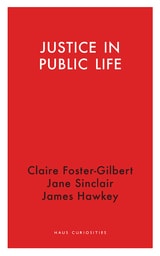
Justice in Public Life
Claire Foster-Gilbert, Jane Sinclair, and James Hawkey
Haus Publishing, 2021
The three essays in Justice in Public Life, written by Claire Foster-Gilbert, Jane Sinclair, and James Hawkey, examine the meaning of justice in the twenty-first century, asking how justice can be expressed by our public service institutions and in society more widely. They consider whether justice is tied to truth and whether our idea of justice is skewed when we conflate it with fairness. They also explore how justice as a virtue can help us navigate the complexities of life in economics, in wider society, and in righting wrongs. In addition, their essays consider the threats to a just society, including human nature itself, the inheritance of unjust structures, the wide range of views about what constitutes justice, and the difficulty of establishing it globally and between nation-states. Justice in Public Life brings an often abstract concept to life, calling on public servants to nurture justice as a virtue pursued both individually and communally.