Results by title
484 books match the query 'Foreign relations' and 8 start with j
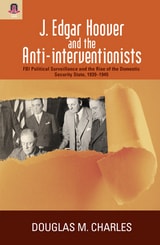
J. Edgar Hoover and the Anti-interventionists
FBI Political Surveillance and the Rise of the Domestic Security State, 1939–1945Douglas M. Charles
The Ohio State University Press, 2007
James Barbour, a Jeffersonian Repulican
Charles D. Lowery
University of Alabama Press, 1984
Barbour, a Virginia contemporary of Thomas Jefferson and James Madison, during a long public career spanning the years 1798-1842, exerted a constructive influence on the nation’s history. Active in state and national politics during the formative decades of the republic, Barbour was a political nationalist who grafted to the dominant political philosophy of the day those elements of the Hamiltonian Federalist creed necessary for governing a dynamic, changing nation.
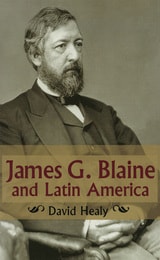
James G. Blaine and Latin America
David Healy
University of Missouri Press, 2001
James G. Blaine was one of the leading national political figures of his day, and probably the most controversial. Intensely partisan, the dominant leader of the Republican Party, and a major shaper of national politics for more than a decade, Blaine is remembered chiefly for his role as architect of the post-Civil War GOP and his two periods as secretary of state. He also was the Republican presidential candidate in the notorious mud-slinging campaign of 1884. His foreign policy was marked by its activism, its focus on Latin America, and its attempt to increase U.S. influence there.
James G. Blaine and Latin America asserts that Latin America lay at the heart of Blaine's foreign policy and his vision for America. David Healy examines seven major issues that collectively defined the secretary of state's methods, goals, and views regarding Latin America and, more broadly, the international role of the United States. Healy places his explorations within the larger context of Blaine's ongoing role as a national party leader, his relations with the presidents under whom he served, and the responses of his predecessors and successors toward the issues at hand in Latin America.
The result is a deeper understanding of Blaine's ambitious vision for his country's international role, his energy and aggressiveness in moving to achieve that vision, and his effective efforts to transmit his worldview to the public. Blaine's emphasis on the importance of Latin America to the United States and his conviction that his country should be a world power influenced a new generation of leaders who, at the end of the century, would go beyond his goals and usher in a new era.
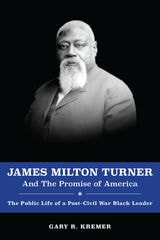
James Milton Turner and the Promise of America
The Public Life of a Post-Civil War Black LeaderGary R. Kremer
University of Missouri Press, 2020
Born a slave, Turner gained freedom when he was a child and received his education in clandestine St. Louis schools, later briefly attending Oberlin College. A self-taught lawyer, Turner earned a statewide reputation and wielded power far out of proportion to Missouri's relatively small black population.
After working nearly a decade in Liberia, Turner never regained the prominence he had enjoyed during Reconstruction.

Japan and China as Charm Rivals
Soft Power in Regional DiplomacyJing Sun
University of Michigan Press, 2013
In international relations today, influence is as essential as military and economic might. Consequently, leaders promote favorable images of the state in order to attract allies and win support for their policies. Jing Sun, an expert on international relations and a former journalist, refers to such soft power campaigns as "charm offensives."
Sun focuses on the competition between China and Japan for the allegiance of South Korea, Taiwan, and other states in the region. He finds that, instead of adopting a one-size-fits-all approach, the Chinese and the Japanese deploy customized charm campaigns for each target state, taking into consideration the target's culture, international position, and political values. He then evaluates the effectiveness of individual campaigns from the perspective of the target state, on the basis of public opinion polls, media coverage, and the response from state leaders.
A deep, comparative study, Japan and China as Charm Rivalsenriches our understanding of soft power by revealing deliberate image campaign efforts and offering a method for assessing the effectiveness of such charm offensives.

Jewish Claims Against East Germany
Angelika Timm
Central European University Press, 1998
This is the first comprehensive history of Jewish negotiations with East Germany regarding restitution and reparations for Nazi war crimes. Angelika Timm analyzes the politics of old and new anti-Semitism and the context in which they grew under the officially propagated ideology of antifascism.
Investigating the mass of unpublished, newly available archival data from the United States, Israel, and the former German Democratic Republic, and more than forty personal interviews, Timm fills a critical gap in the scholarship on postwar Germany. She analyzes the role of the Holocaust and the image of Jews in the historical consciousness and political culture of East Germany and chronicles the efforts of Jewish organizations, especially the Conference on Jewish Material Claims Against Germany, to negotiate reparations with the East German state. The unique relationship between ideology and Realpolitik defined the manner in which East Germany confronted the crimes of its past and allowed anti-Semitism to reemerge.

Johnson, Nixon, and the Doves
Small, Melvin
Rutgers University Press, 1988
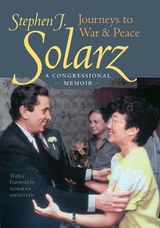
Journeys to War and Peace
A Congressional MemoirStephen J. Solarz
Brandeis University Press, 2011