Results by title
836 books match the query 'France' and 15 start with j
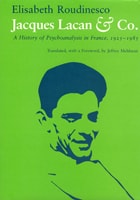
Jacques Lacan & Co
A History of Psychoanalysis in France, 1925-1985Elisabeth Roudinesco
University of Chicago Press, 1990
Jacques Lacan and the Philosophy of Psychoanalysis
Ellie Ragland-Sullivan
University of Illinois Press, 1986

Jacques Lacan
The French ContextMarini, Marcelle
Rutgers University Press, 1993
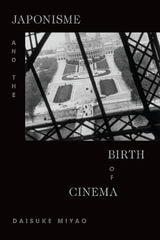
Japonisme and the Birth of Cinema
Daisuke Miyao
Duke University Press, 2020

Jazz and Machine-Age Imperialism
Music, "Race," and Intellectuals in France, 1918-1945Jeremy F. Lane
University of Michigan Press, 2014
Jeremy F. Lane’s Jazz and Machine-Age Imperialism is a bold challenge to the existing homogenous picture of the reception of American jazz in world-war era France. Lane’s book closely examines the reception of jazz among French-speaking intellectuals between 1918 and 1945 and is the first study to consider the relationships, sometimes symbiotic, sometimes antagonistic, between early white French jazz critics and those French-speaking intellectuals of color whose first encounters with the music in those years played a catalytic role in their emerging black or Creole consciousness. Jazz’s first arrival in France in 1918 coincided with a series of profound shocks to received notions of French national identity and cultural and moral superiority. These shocks, characteristic of the era of machine-age imperialism, had been provoked by the first total mechanized war, the accelerated introduction of Taylorist and Fordist production techniques into European factories, and the more frequent encounters with primitive “Others” in the imperial metropolis engendered by interwar imperialism. Through close readings of the work of early white French jazz critics, alongside the essays and poems of intellectuals of color such as the Nardal sisters, Léon-Gontran Damas, Léopold Sédar Senghor, and René Ménil, Jazz and Machine-Age Imperialism highlights the ways in which the French reception of jazz was bound up with a series of urgent contemporary debates about primitivism, imperialism, anti-imperialism, black and Creole consciousness, and the effects of American machine-age technologies on the minds and bodies of French citizens.

Jean Baudrillard
In Radical UncertaintyMike Gane
Pluto Press, 2000
Jean Paul Marat
Tribune of the French RevolutionClifford D. Conner
Pluto Press, 2012
Jean-Paul Marat’s role in the French Revolution has long been a matter of controversy among historians. Often he has been portrayed as a violent, sociopathic demagogue. This biography challenges that interpretation and argues that without Marat’s contributions as an agitator, tactician, and strategist, the pivotal social transformation that the Revolution accomplished might well not have occurred.
Clifford D. Conner argues that what was unique about Marat - which set him apart from all other major figures of the Revolution, including Danton and Robespierre - was his total identification with the struggle of the propertyless classes for social equality.
This is an essential book for anyone interested in the history of the revolutionary period and the personalities that led it.
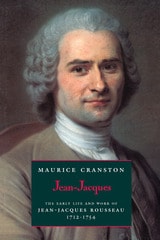
Jean-Jacques
The Early Life and Work of Jean-Jacques Rousseau, 1712-1754Maurice Cranston
University of Chicago Press, 1991
"[An] admirable biography which is as meticulous, calm, reasonable, and judicious as its subject is passionate and tumultuous."—Keith Michael Baker, Washington Post Book World
"The definitive biography, as scholarly as it is entertaining."—The Economist
"Exceptionally fresh . . . . [Cranston] seems to know exactly what his readers need to know, and thoughtfully enriches the background—both physical and intellectual—of Rousseau's youthful peregrinations . . . . He makes the first part of Rousseau's life as absorbing as a picaresque novel. His fidelity to Rousseau's ideas and to his life as it was lived is a triumph of poise."—Naomi Bliven, The New Yorker
"The most outstanding achievement of Professor Cranston's own distinguished career."—Robert Wokler, Times Literary Supplement
Maurice Cranston (1920-1993), a distinguished scholar and recipient of the James Tait Black Memorial Prize for his biography of John Locke, was professor of political science at the London School of Economics. His numerous books include The Romantic Movement and Philosophers and Pamphleteers, and translations of Rousseau's The Social Contract and Discourse on the Origins of Inequality.
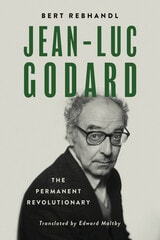
Jean-Luc Godard
The Permanent RevolutionaryBert Rebhandl, translated by Edward Maltby
University of Wisconsin Press, 2023
Rebhandl skillfully weaves together biographical details; information about the cultural, intellectual, and cinematic milieu over the decades; and descriptions of Godard’s most significant films to support his assertion that the director was a permanent revolutionary—always seeking new ways to create, understand, and comment on film within a larger context. He views Godard as an artist consistently true to himself while never ceasing to change and evolve, often in unexpected, radical, and controversial ways.
Rebhandl is known as a journalist with deep insights and lucid prose. Despite the wealth of material to analyze, he neither gets lost in the details nor offers a superficial gloss, even while directly tackling such topics as the long-standing charges of antisemitism against Godard and his oeuvre. This volume will be welcome to both casual fans and dedicated devotees.
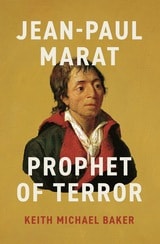
Jean-Paul Marat
Prophet of TerrorKeith Michael Baker
University of Chicago Press, 2025
Who better to pen an authoritative biography of Jean-Paul Marat (1743–93) than preeminent historian of France Keith Michael Baker? Decades in the making, this monumental work takes readers on a journey through the intriguing, sometimes shocking life of this writer and thinker.
Starting with Marat’s Swiss family and upbringing, Baker then sheds light on his early years in England, his career as an aspiring scientist in Paris, his gradual transformation from impassioned pamphleteer to revolutionary newspaperman, and, finally, his murder and martyrdom. Throughout, Baker offers readers the unique opportunity to reconsider the outbreak and development of the French Revolution through Marat’s eyes and in his own words. To help make sense of Marat’s trajectory, he shows how his violent and incendiary public calls to render unseen forces visible, to inject immediacy into an increasingly abstract modern world, would transform classical republicanism into the language of Terror.
Far beyond a standard rendering of Marat’s life and its milestones, this biography offers readers an opportunity to see the French Revolution as never before, through the perspective of one of its major figures. Baker’s book reveals how someone like Marat could go from translating Newton and engaging with Franklin to calling for an ever-growing number of heads to roll—a transformation as chilling as ever.

Jean-Paul Sartre
Hated Conscience of His Century, Volume 1: Protestant or Protester?John Gerassi
University of Chicago Press, 1989
Joining the Conversation
Dialogues by Renaissance WomenJanet Levarie Smarr
University of Michigan Press, 2005
Avoiding the male-authored model of competing orations, French and Italian women of the Renaissance framed their dialogues as informal conversations, as letters with friends that in turn became epistles to a wider audience, and even sometimes as dramas. No other study to date has provided thorough, comparative view of these works across French, Italian, and Latin. Smarr's comprehensive treatment relates these writings to classical, medieval, and Renaissance forms of dialogue, and to other genres including drama, lyric exchange, and humanist invective -- as well as to the real conversations in women's lives -- in order to show how women adapted existing models to their own needs and purposes.
Janet Levarie Smarr is Professor of Theatre and Italian Studies at the University of California, San Diego.
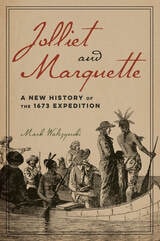
Jolliet and Marquette
A New History of the 1673 ExpeditionMark Walczynski
University of Illinois Press, 2023
A multifaceted voyage into the past, Jolliet and Marquette expands and updates the oft-told story of a pivotal event in American history.
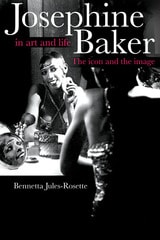
Josephine Baker in Art and Life
THE ICON AND THE IMAGEBennetta Jules-Rosette
University of Illinois Press, 2006
Josephine Baker (1906-1975) was a dancer, singer, actress, author, politician, militant, and philanthropist, whose images and cultural legacy have survived beyond the hundredth anniversary of her birth. Neither an exercise in postmodern deconstruction nor simple biography, Josephine Baker in Art and Life presents a critical cultural study of the life and art of the Franco-American performer whose appearances as the savage dancer Fatou shocked the world.
Although the study remains firmly anchored in Josephine Baker’s life and times, presenting and challenging carefully researched biographical facts, it also offers in-depth analyses of the images that she constructed and advanced. Bennetta Jules-Rosette explores Baker’s far-ranging and dynamic career from a sociological and cultural perspective, using the tools of sociosemiotics to excavate the narratives, images, and representations that trace the story of her life and fit together as a cultural production.
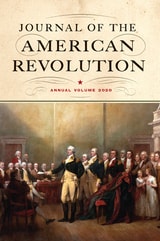
Journal of the American Revolution 2020
Annual VolumeDon N. Hagist
Westholme Publishing, 2020
The Journal of the American Revolution, Annual Volume 2020, presents the journal’s best historical research and writing over the past calendar year. The volume is designed for institutions, scholars, and enthusiasts to provide a convenient overview of the latest research and scholarship in American Revolution and Founding Era studies. The thirty-six articles in the 2020 edition include:
Bernard E. Griffiths: Trumpeter Barney of the Queen’s Rangers, Chelsea Pensioner—and Freed Slave by Todd W. Braisted
The Declaration of Independence: Did John Hancock Really Say that about his Signature?—and Other Signing Stories by J. L. Bell
Les Habitants: Collaboration and Pro-American Violence in Canada, 1774–1776 by Sebastian van Bastelaer
Misadventures in the Countryside: Escape from a British Prison Ship by Katie Turner Getty
The Revolutionary Memories of New York Loyalists: Thomas Jones and William Smith, Jr. by Cho-Chien Feng
The East India Company and Parliament’s “Fateful Decision” of 1767 by Steven Neill
Massachusetts Privateers During the Siege of Boston by Alexander Cain
The Constitution Counted Free Women and Children—And It Mattered by Andrew M. Schocket, with Kinzey M. McLaren-Czerr and Colin J. Spicer
How Magna Carta Influenced the American Revolution by Jason Yonce
Putting a Price on Loyalty: Mary Loring’s List of Losses by John Knight