Results by title
267 books match the query 'Frontier and pioneer life' and 8 start with j
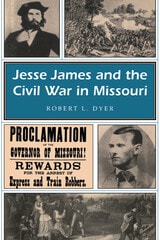
Jesse James and the Civil War in Missouri
Robert L. Dyer
University of Missouri Press, 1994
The Civil War in Missouri was a time of great confusion, violence, and destruction. Although several major battles were fought in the state between Confederate and Union forces, much of the fighting in Missouri was an ugly form of terrorism carried out by loose bands of Missouri guerrillas, by Kansas "Jayhawkers," or by marauding patrols of Union soldiers. This irregular warfare provided a training ground for people like Jesse and Frank James who, after the war, used their newly learned skills to form an outlaw band that ultimately became known all over the world.
Jesse James and the Civil War in Missouri discusses the underlying causes of the Civil War as they relate to Missouri and reveals how the war helped create both the legend and the reality of Jesse James and his gang. Written in an accessible style, this valuable little book will be welcomed by anyone with an interest in the Civil War, the legend of Jesse James, or Missouri history.

John B. Denton
The Bigger-Than-Life Story of the Fighting Parson and Texas RangerMike Cochran
University of North Texas Press, 2021

John Horry Dent
South Carolina Aristocrat On Alabama FrontierRay Mathis
University of Alabama Press, 1979
Jonah Horry Dent was born on 5 August 1815 in Newport, Rhode Island, the son of John Herbert Dent and Elizabeth Anne Horry Dent. Dent grew up in Charleston, South Carolina, and spent summers with his family on a plantation in Colleton County, South Carolina. When he was still a young child, his name was changed from “Jonah” to “John” when an older brother, named John, died, leaving little Jonah as the oldest living son. He was known as John Horry Dent the rest of his life.
Dent married Mary Elizabeth Morrison in 1835 and moved to Barbour County, Alabama, in 1836. He purchased 360 acres of land on Cowikee Creek, paying $15 an acre, and named the new plantation “Good Hope.” Dent amassed a good fortune but lost most of it after the Civil War when slavery was abolished and his slaves became freemen. In 1866 he sold his properties in Barbour County and moved to Cave Springs, Floyd County, Georgia.
Dent kept detailed records about his crops and properties until very late in life. He died in Cave Springs on 17 May 1892.
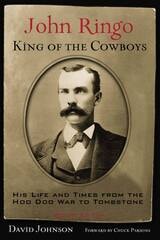
John Ringo, King of the Cowboys
His Life and Times from the Hoo Doo War to Tombstone, Second EditionDavid Johnson
University of North Texas Press, 2008
The Mason County “Hoo Doo” War in Texas began as a war over range rights, but it swiftly deteriorated into blood vengeance and spiraled out of control as the body count rose. In this charnel house Ringo gained a reputation as a dangerous gunfighter and man killer. He was proclaimed throughout the state as a daring leader, a desperate man, and a champion of the feud. Following incarceration for his role in the feud, Ringo was elected as a lawman in Mason County, the epicenter of the feud’s origin.
The reputation he earned in Texas, further inflated by his willingness to shoot it out with Victorio’s raiders during a deadly confrontation in New Mexico, preceded him to Tombstone in territorial Arizona. Ringo became immersed in the area’s partisan politics and factionalized violence. A champion of the largely Democratic ranchers, Ringo would become known as a leader of one of these elements, the Cowboys. He ran at bloody, tragic odds with the Earp brothers and Doc Holliday, finally being part of the posse that hounded these fugitives from Arizona. In the end, Ringo died mysteriously in the Arizona desert, his death welcomed by some, mourned by others, wrongly claimed by a few. Initially published in 1996, John Ringo has been updated to a second edition with much new information researched and uncovered by David Johnson and other Ringo researchers.

Jonathan Fisher of Blue Hill, Maine
Commerce, Culture, and Community on the Eastern FrontierKevin D. Murphy
University of Massachusetts Press, 2010
Murphy shows how Fisher, as pastor of the Congregational church in Blue Hill from 1796 to 1837, helped spearhead the transformation of a frontier settlement on the eastern shores of the Penobscot Bay into a thriving port community; how he used his skills as an architect, decorative painter, surveyor, and furniture maker not only to support himself and his family, but to promote the economic growth of his village; and how the fluid professional identity that enabled Fisher to prosper on the eastern frontier could only have existed in early America where economic relations were far less rigidly defined than in Europe.
Among the most important artifacts of Jonathan Fisher's life is the house he designed and built in Blue Hill. The Jonathan Fisher Memorial, as it is now known, serves as a point of departure for an examination of social, religious, and cultural life in a newly established village at the turn of the nineteenth century. Fisher's house provided a variety of spaces for agricultural and domestic work, teaching, socializing, artmaking, and more.
Through the eyes of Jonathan Fisher, we see his family grow and face the challenges of the new century, responding to religious, social, and economic change—sometimes succeeding and sometimes failing. We appreciate how an extraordinarily energetic man was able to capitalize on the wide array of opportunities offered by the frontier to give shape to his personal vision of community.

Juan Bautista de Anza
Basque Explorer in the New World, 1693-1740Donald T. Garate
University of Nevada Press, 2005
The first biography of an eighteenth-century Basque immigrant who became a silver miner, a cattle rancher, and commander of the cavalry in Sonora, Mexico. The name of Juan Bautista de Anza the younger is a fairly familiar one in the contemporary Southwest because of the various streets, schools, and other places that bear his name. Few people, however, are familiar with his father, the elder Juan Bautista de Anza, whose activities were crucial to the survival of the tenuous and far-flung settlements of Spain’s northernmost colonial frontier. For this first comprehensive biography of the elder Anza, Donald T. Garate spent more than ten years researching archives in Spain and the Americas. The result is a lively picture of the Spanish borderlands and the hardy, ambitious colonists who peopled them.

Juana Briones of Nineteenth-Century California
Jeanne Farr McDonnell
University of Arizona Press, 2008
Juana Briones was born in 1802 and spent her early youth in Santa Cruz, a community of retired soldiers who had helped found Spanish California, Native Americans, and settlers from Mexico. In 1820, she married a cavalryman at the San Francisco Presidio, Apolinario Miranda. She raised her seven surviving sons and daughters and adopted an orphaned Native American girl. Drawing on knowledge she gained about herbal medicine and other cures from her family and Native Americans, she became a highly respected curandera, or healer.
Juana set up a second home and dairy at the base of then Loma Alta, now Telegraph Hill, the first house in that area. After gaining a church-sanctioned separation from her abusive husband, she expanded her farming and cattle business in 1844 by purchasing a 4,400-acre ranch, where she built her house, located in the present city of Palo Alto. She successfully managed her extensive business interests until her death in 1889. Juana Briones witnessed extraordinary changes during her lifetime. In this fascinating book, readers will see California’s history in a new and revelatory light.
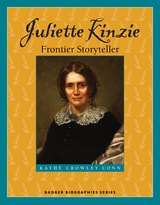
Juliette Kinzie
Frontier StorytellerKathe Crowley Conn
Wisconsin Historical Society Press, 2015
This new biography in the Badger Biographies Series turns the lens on the writer herself, detailing her life as she detailed the lives of those she encountered in the 1830s and 1840s. Juliette Kinzie: Frontier Storyteller details war, hunger, and the rapidly changing times Juliette witnessed on the Midwestern frontier, following the pioneering woman through her own changes from socialite to pioneer to famous writer and even to the work of her granddaughter, Juliette Gordon Low, who founded the Girl Scouts of the USA in 1912.