Results by title
1104 books match the query 'Gender Studies' and 9 start with j
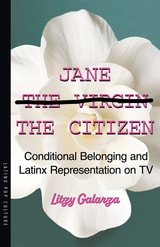
Jane the Citizen
Conditional Belonging and Latinx Representation on TVLitzy Galarza
University of Arizona Press, 2027
What does it mean to belong in the United States—and what does it cost? Jane the Citizen confronts one of the most urgent questions in contemporary cultural life by turning to an unlikely archive: the CW’s celebrated telenovela-inspired series Jane the Virgin (2014–2019).
Litzy Galarza argues that beneath the show’s warmth and wit lies a sustained interrogation of citizenship’s limits. Building on Hector Amaya’s framework of citizenship excess and extending it to theorize reproductive citizenship excess and deficit, the book exposes the widening gap between citizenship as formal legal status and citizenship as livable, protected belonging—a gap that Jane the Virgin maps with extraordinary precision.
Across five seasons and two presidential administrations, Galarza demonstrates how the series tracks the lived costs of immigration policy, racial hierarchy, and gendered control over reproduction. She shows how Latinx characters experience belonging differently as political conditions shift in real time.
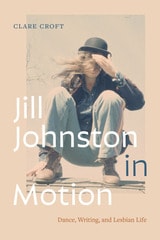
Jill Johnston in Motion
Dance, Writing, and Lesbian LifeClare Croft
Duke University Press, 2024
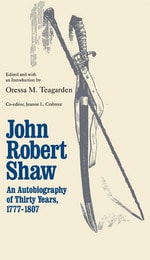
John Robert Shaw
An Autobiography of Thirty Years, 1777–1807Oressa M. Teagarden
Ohio University Press, 1992
In the summer of 1807 more than a thousand subscribers from New England to Tennessee paid for the initial printing of The Life and Travels of John Robert Shaw: A Narrative of the Life and Travels of the Well-Digger, now resident of Lexington, Kentucky, Written by Himself. Shaw had come to Rhode Island as a British redcoat to put down the colonial rebellion. Through various quirks of fate, including being taken a prisoner of war, he ended up fighting with the Americans. Shaw was an exuberant spirit whose rowdy drinking bouts and related predicaments alternated with periods of wholehearted efforts at reform. His autobiography, written while he recuperated from injuries from one of several explosions (an occupational hazard for the frontier well-digger), is an articulate and entertaining record of the Revolutionary War era.
A 1930 printing of Shaw’s autobiography was rescued from the trash by an alert librarian in Kentucky in 1950. She passed the tattered copy on to journalist Oressa M. Teagarden, who became intrigued with Shaw’s story and spent much of her free time over the next two decades finding out more about the ebullient American. On Teagarden’s death, co-editor Jeanne Crabtree assumed the task of making Shaw’s authentic and colorful view of early America available to a new generation of readers.
Joyce/Foucault
Sexual ConfessionsWolfgang Streit
University of Michigan Press, 2004
Joyce/Foucault: Sexual Confessions examines instances of sexual confession in works of James Joyce, with a special emphasis on Portrait of the Artist as a Young Man and Ulysses. Using Michel Foucault's historical analysis of Western sexuality as its theoretical underpinning, the book foregrounds the role of the Jesuit order in the spread of a confessional force, and finds this influence inscribed into Joyce's major texts. Wolfgang Streit goes on to argue that the tension between the texts' erotic passages and Joyce's criticism of even his own sexual writing energizes Joyce's narratives-and enables Joyce to develop the radical skepticism of power revealed in his work.
Wolfgang Streit is Lecturer, Ludwig Maximilians University, Munich.
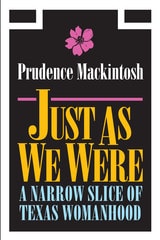
Just As We Were
A Narrow Slice of Texas WomanhoodBy Prudence Mackintosh
University of Texas Press, 1996
When a Texas debutante bows her forehead to the floor in the famous "Texas dip," society columnists all across the country speculate interminably over what it is that sets Texas women apart. But really, how could they know? Even women born and bred in Texas can't always answer that question.
Prudence Mackintosh comes very close to an answer, though, in this endlessly entertaining book. Writing with both a wry sense of humor and an insider's compassion, she offers us a fascinating look into the world of privileged, educated, well-married, well-connected, and mostly wealthy white Texas women.
What really sets these women apart, Ms. Mackintosh tells us, is the comfortable yet demanding path they follow from their idyllic girlhoods to prominent positions in society. In thirteen essays, some of which originally appeared in Texas Monthly magazine, she charts the way stations that mark this path: summer camps in the Texas Hill Country, exclusive private schools like Dallas' Hockaday, sorority membership, and acceptance into the Junior League.
Prudence Mackintosh has been both an outsider and an insider in this privileged world, and her observations are shot through with wit and real insight. Just As We Were may not be the final word on elite Texas women, but no other book has described their world with greater irony or accuracy.
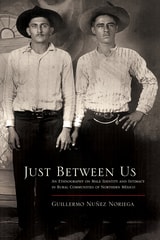
Just Between Us
An Ethnography of Male Identity and Intimacy in Rural Communities of Northern MexicoGuillermo Núñez Noriega
University of Arizona Press, 2014
Using fieldwork from rural Sonora, Mexico, Guillermo Núñez Noriega posits that men accept this intimacy outside gender categories and stereotypes, despite the traditional patriarchal society. This work contests homophobia and the heterosexual ideal of men and attempts to break down the barriers between genders.
The photograph Núñez Noriega uses to explore the shifting attitudes and perceptions of sexuality and gender provokes more questions than answers. Recognizing the societal regulations at play, the author demonstrates the existence in contemporary Mexico of an invisible regime of power that constructs and regulates the field of possibilities for men’s social actions, especially acts of friendship, affection, and eroticism with other men. The work investigates “modes of speaking” about being a man, on being gay, on the implicit meanings of the words homosexual, masculine, trade, fairy, and others—words that construct possibilities for intimacy, particularly affective and erotic intimacy among men.
Multiple variants of homoeroticism fall outside the dominant model, Núñez Noriega argues, a finding that offers many lessons on men and masculine identities. This book challenges patriarchal definitions of sex, gender, and identity; it promotes the unlearning of dominant conventions of masculinity to allow new ways of being.
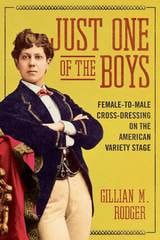
Just One of the Boys
Female-to-Male Cross-Dressing on the American Variety StageGillian Rodger
University of Illinois Press, 2018
Gillian M. Rodger uses the development of male impersonation from the early nineteenth century to the early twentieth century to illuminate the history of the variety show. Exploding notions of high- and lowbrow entertainment, Rodger looks at how both performers and forms consistently expanded upward toward respectable—and richer—audiences. At the same time, she illuminates a lost theatrical world where women made fun of middle-class restrictions even as they bumped up against rules imposed in part by audiences. Onstage, the actresses' changing performance styles reflected gender construction in the working class and shifts in class affiliation by parts of the audiences. Rodger observes how restrictive standards of femininity increasingly bound male impersonators as new gender constructions allowed women greater access to public space while tolerating less independent behavior from them.
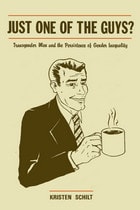
Just One of the Guys?
Transgender Men and the Persistence of Gender InequalityKristen Schilt
University of Chicago Press, 2010
The fact that men and women continue to receive unequal treatment at work is a point of contention among politicians, the media, and scholars. Common explanations for this disparity range from biological differences between the sexes to the conscious and unconscious biases that guide hiring and promotion decisions. Just One of the Guys? sheds new light on this phenomenon by analyzing the unique experiences of transgender men—people designated female at birth whose gender identity is male—on the job.
Kristen Schilt draws on in-depth interviews and observational data to show that while individual transmen have varied experiences, overall their stories are a testament to systemic gender inequality. The reactions of coworkers and employers to transmen, Schilt demonstrates, reveal the ways assumptions about innate differences between men and women serve as justification for discrimination. She finds that some transmen gain acceptance—and even privileges—by becoming “just one of the guys,” that some are coerced into working as women or marginalized for being openly transgender, and that other forms of appearance-based discrimination also influence their opportunities. Showcasing the voices of a frequently overlooked group, Just One of the Guys? lays bare the social processes that foster forms of inequality that affect us all.
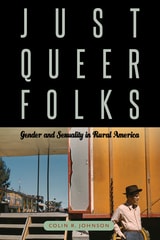
Just Queer Folks
Gender and Sexuality in Rural AmericaColin R. Johnson
Temple University Press, 2013
Most studies of lesbian and gay history focus on urban environments. Yet gender and sexual diversity were anything but rare in nonmetropolitan areas in the first half of the twentieth century. Just Queer Folks explores the seldom-discussed history of same-sex intimacy and gender nonconformity in rural and small-town America during a period when the now familiar concepts of heterosexuality and homosexuality were just beginning to take shape.
Eschewing the notion that identity is always the best measure of what can be known about gender and sexuality, Colin R. Johnson argues instead for a queer historicist approach. In so doing, he uncovers a startlingly unruly rural past in which small-town eccentrics, "mannish" farm women, and cross-dressing Civilian Conservation Corps enrollees were often just queer folks so far as their neighbors were concerned. Written with wit and verve, Just Queer Folks upsets a whole host of contemporary commonplaces, including the notion that queer history is always urban history.