Results by title
395 books match the query 'How' and 5 start with j
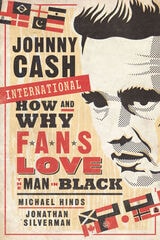
Johnny Cash International
How and Why Fans Love the Man in BlackMichael Hinds and Jonathan Silverman
University of Iowa Press, 2020
2023 Peggy O'Brien Book Prize, winner
Across all imaginable borders, Johnny Cash fans show the appeal of a thoroughly American performer who simultaneously inspires people worldwide. A young Norwegian shows off his Johnny Cash tattoo. A Canadian vlogger sings “I Walk the Line” to camel herders in Egypt’s White Desert. A shopkeeper in Northern Ireland plays Cash as his constant soundtrack. A Dutchwoman coordinates the activities of Cash fans worldwide and is subsequently offered the privilege of sleeping in Johnny’s bedroom. And on a more global scale, millions of people watch Cash’s videos online, then express themselves through commentary and debate.
In Johnny Cash International, Hinds and Silverman examine digital and real-world fan communities and the individuals who comprise them, profiling their relationships to Cash and each other. Studying Johnny Cash’s international fans and their love for the man reveals new insights about music, fandom, and the United States.
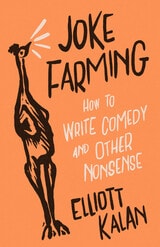
Joke Farming
How to Write Comedy and Other NonsenseElliott Kalan
University of Chicago Press, 2025
Philosophers may debate the meaning of comedy (thankfully keeping them too busy to fall into a life of crime), but the rest of us are more likely to wonder how we can make an audience laugh—or at least, how to entertain our friends and followers. According to award-winning comedy writer Elliott Kalan, we need to stop staring out the window, waiting for hilarious bits to stroll into view, fully formed. What we need is a process to plant their premises, tend to their structure and wording, and ultimately harvest them as funny material. In short, a farm. But for jokes.
In Joke Farming, Kalan explains that it’s easier to write jokes when you have a dependable method for doing so. All jokes, he argues, are built from the same elements: structure, premise, voice, tone, wording, and audience—and these elements can be applied to any comedic genre, from stand-up to sitcoms to satire. Kalan analyzes examples from his own career—including jokes that he wrote (and rewrote and rewrote and rewrote . . . ) as head writer for The Daily Show with Jon Stewart—as well as material from a diverse array of comedians, writers, and filmmakers, highlighting the phrasing, rhythm, and precise details that make their work so dang funny.
Drawing on his experiences in professional writers’ rooms as well as episodes from everyday life, Kalan’s guide to jokes will appeal to aspiring writers, their mentors, comedy fans, and anyone who has to speak at a wedding. Joke Farming points the way toward a writing process that lessens stress and agony and yields more reliable rewards: a surprising tagline, a hilarious word choice, and—most importantly—a bigger laugh from the audience, whoever they may be.
Joke Farming
How to Write Comedy and Other NonsenseElliott Kalan
University of Chicago Press, 2025
Philosophers may debate the meaning of comedy (thankfully keeping them too busy to fall into a life of crime), but the rest of us are more likely to wonder how we can make an audience laugh—or at least, how to entertain our friends and followers. According to award-winning comedy writer Elliott Kalan, we need to stop staring out the window, waiting for hilarious bits to stroll into view, fully formed. What we need is a process to plant their premises, tend to their structure and wording, and ultimately harvest them as funny material. In short, a farm. But for jokes.
In Joke Farming, Kalan explains that it’s easier to write jokes when you have a dependable method for doing so. All jokes, he argues, are built from the same elements: structure, premise, voice, tone, wording, and audience—and these elements can be applied to any comedic genre, from stand-up to sitcoms to satire. Kalan analyzes examples from his own career—including jokes that he wrote (and rewrote and rewrote and rewrote . . . ) as head writer for The Daily Show with Jon Stewart—as well as material from a diverse array of comedians, writers, and filmmakers, highlighting the phrasing, rhythm, and precise details that make their work so dang funny.
Drawing on his experiences in professional writers’ rooms as well as episodes from everyday life, Kalan’s guide to jokes will appeal to aspiring writers, their mentors, comedy fans, and anyone who has to speak at a wedding. Joke Farming points the way toward a writing process that lessens stress and agony and yields more reliable rewards: a surprising tagline, a hilarious word choice, and—most importantly—a bigger laugh from the audience, whoever they may be.
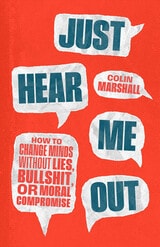
Just Hear Me Out
How to Change Minds Without Lies, Bullshit, or Moral CompromiseColin Marshall
University of Chicago Press, 2026
A guide to persuasion for people who want to change minds without manipulation or coercion.
Most of us have given up on persuasion. We say our problems are too pressing, people are too polarized, and success is too dubious—and it’s true! After all, when was the last time you heard someone actually change their mind? To improve our persuasive powers, self-help books often ask us to stoop to dishonest, manipulative tricks that rarely achieve lasting results. But perhaps there is a way to persuade people that is neither hopelessly misguided nor morally suspect.
In Just Hear Me Out, philosopher Colin Marshall describes a persuasive method that is both effective and ethical. Rather than share a flurry of tips for how to win friends and influence people, Marshall invites us to take up persuasion as fundamentally civil work, good both for our conscience and our communities. Real-world persuaders such as Jane Addams, Daryl Davis, and Fred Rogers show us an ethical route, he argues, to changing hearts through patience, respect, and compassion.
Accessible, practical, and buoyed by hope, Just Hear Me Out offers a powerful method for all who want to persuade others but aren’t interested in winning at any cost. When it works, people don’t just change their minds; they discover anew how to value our common humanity.
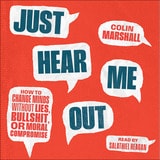
Just Hear Me Out
How to Change Minds Without Lies, Bullshit, or Moral CompromiseColin Marshall
University of Chicago Press, 2026
A guide to persuasion for people who want to change minds without manipulation or coercion.
Most of us have given up on persuasion. We say our problems are too pressing, people are too polarized, and success is too dubious—and it’s true! After all, when was the last time you heard someone actually change their mind? To improve our persuasive powers, self-help books often ask us to stoop to dishonest, manipulative tricks that rarely achieve lasting results. But perhaps there is a way to persuade people that is neither hopelessly misguided nor morally suspect.
In Just Hear Me Out, philosopher Colin Marshall describes a persuasive method that is both effective and ethical. Rather than share a flurry of tips for how to win friends and influence people, Marshall invites us to take up persuasion as fundamentally civil work, good both for our conscience and our communities. Real-world persuaders such as Jane Addams, Daryl Davis, and Fred Rogers show us an ethical route, he argues, to changing hearts through patience, respect, and compassion.
Accessible, practical, and buoyed by hope, Just Hear Me Out offers a powerful method for all who want to persuade others but aren’t interested in winning at any cost. When it works, people don’t just change their minds; they discover anew how to value our common humanity.