Results by title
366 books match the query 'International' and 5 start with j
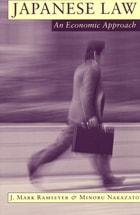
Japanese Law
An Economic ApproachJ. Mark Ramseyer and Minoru Nakazato
University of Chicago Press, 1998
"A compelling economic analysis. . . . This book remains one of the few concerning Japanese law that successfully brings to life the legal culture of Japan." —Bonnie L. Dixon, New York Law Journal

Japan’s Economy in War and Reconstruction
Jerome B. Cohen
University of Minnesota Press, 1949
Japan's Economy in War and Reconstruction was first published in 1949. Minnesota Archive Editions uses digital technology to make long-unavailable books once again accessible, and are published unaltered from the original University of Minnesota Press editions.
Dr. Cohen's substantial monograph is a carefully documented account of Japan's economic development from 1937 to 1949. It describes with much statistical evidence a remarkable experiment in planned industrial expansion prior to 1941, then continues with a survey of the war years, showing both the successes and failures of the planning, controlling, financing, and developing of Japan's war industries.
The last part of the book deals with the post-war problems of Japan from the war's end to the latter part of 1948—three years of occupation by the Allied Powers. Dr. Cohen discusses the three key economic factors: the basic reforms, the rapidly mounting inflation, and the slowly increasing, but still low level of production.
Dr. Cohen's first chapter is devoted to the careful planning of the years before the war. The next chapters discuss Japan's efforts to cope with the problems of munitions, food supply, and labor as the Allied war effort gradually wore her down. There are detailed studies of separate industries, shipping, and agriculture, and a discussion of the parts played respectively by air, sea, and land operations in the destruction of Japan's ability to wage successful war.
One of the main theses of these chapters is that the increasingly enveloping blockade of Japan shut off necessary industrial raw materials, and so brought Japanese war production to a virtual standstill before the main weight of the strategic air attack was delivered, and so made it impossible for Japan to continue the war.
The author's grim picture of inter-service quarrels and overlapping and inconsistent controls demonstrates that the Japanese army, navy, and civil service, in spite of their reputation for exact and strict organization, in practice failed to make good use of their unlimited powers.
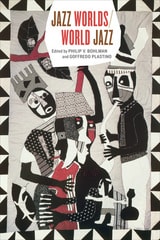
Jazz Worlds/World Jazz
Edited by Philip V. Bohlman and Goffredo Plastino
University of Chicago Press, 2016
Monumental in scope, this book explores the relationship between jazz and culture and how they influence each other across a range of themes and settings. Contributors offer an analysis of the social meaning of jazz in Iran, a look at the genesis of Ethiopian jazz and at Indian fusion, and chapters on jazz diplomacy, Balkan swing, and that French export par excellence: Django Reinhardt. Altogether the contributors approach jazz—in these global iterations—through the themes that have always characterized it at home: place, history, mobility, media, and race. The result is a first-of-its-kind map of jazz around the globe that pays tribute to the players who have given the form its seemingly infinite possibilities.
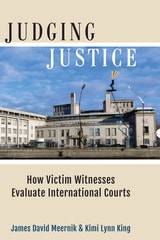
Judging Justice
How Victim Witnesses Evaluate International CourtsJames David Meernik and Kimi Lynn King
University of Michigan Press, 2019
In order to understand the meaning of justice, James David Meernik and Kimi Lynn King studied the perspective of witnesses who have testified before the International Criminal Tribunal for the Former Yugoslavia (ICTY). Using a unique survey, Meernik and King look at the identity of the victims and their perception of the fairness of ICTY. Because of the need to justify the practical and emotional difficulties involved in testifying before an international tribunal, witnesses look not just to the institution to judge its effectiveness, but also to their own contribution, by testifying effectively. The central elements of the theory Meernik and King develop—identity, fairness, and experience—transcend specific conflicts and specific countries and are of importance to people everywhere.
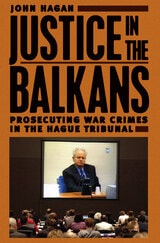
Justice in the Balkans
Prosecuting War Crimes in the Hague TribunalJohn Hagan
University of Chicago Press, 2003
Creating an institution that transcends national borders is a challenge fraught with political and organizational difficulties, yet, as Hagan describes here, the Hague tribunal has increasingly met these difficulties head-on and overcome them. The chief reason for its success, he argues, is the people who have shaped it, particularly its charismatic chief prosecutor, Louise Arbour. With drama and immediacy, Justice in the Balkans re-creates how Arbour worked with others to turn the tribunal's fortunes around, reversing its initial failure to arrest and convict significant figures and advancing the tribunal's agenda to the point at which Arbour and her colleagues, including her successor, Carla Del Ponte (nicknamed the Bulldog), were able to indict Milosevic himself. Leading readers through the investigations and criminal proceedings of the tribunal, Hagan offers the most original account of the foundation and maturity of the institution.
Justice in the Balkans brilliantly shows how an international social movement for human rights in the Balkans was transformed into a pathbreaking legal institution and a new transnational legal field. The Hague tribunal becomes, in Hagan's work, a stellar example of how individuals working with collective purpose can make a profound difference.
"The Hague tribunal reaches into only one house of horrors among many; but, within the wisely precise remit given to it, it has beamed the light of justice into the darkness of man's inhumanity, to woman as well as to man."—The Times (London)