73 books match the query 'Jazz musicians' and 7 start with j
cover of Jade Visions: The Life and Music of Scott LaFaro

Jade Visions

The Life and Music of Scott LaFaro

Helene LaFaro-Fernandez

University of North Texas Press, 2009

[more]
cover of Jazz Cosmopolitanism in Accra: Five Musical Years in Ghana

Jazz Cosmopolitanism in Accra

Five Musical Years in Ghana

Steven Feld

Duke University Press, 2012
In this remarkable book, Steven Feld, pioneer of the anthropology of sound, listens to the vernacular cosmopolitanism of jazz players in Ghana. Some have traveled widely, played with American jazz greats, and blended the innovations of John Coltrane with local instruments and worldviews. Combining memoir, biography, ethnography, and history, Feld conveys a diasporic intimacy and dialogue that contests American nationalist and Afrocentric narratives of jazz history. His stories of Accra's jazz cosmopolitanism feature Ghanaba/Guy Warren (1923–2008), the eccentric drummer who befriended the likes of Charlie Parker, Max Roach, and Thelonious Monk in the United States in the 1950s, only to return, embittered, to Ghana, where he became the country's leading experimentalist. Others whose stories figure prominently are Nii Noi Nortey, who fuses the legacies of the black avant-gardes of the 1960s and 1970s with pan-African philosophy in sculptural shrines to Coltrane and musical improvisations inspired by his work; the percussionist Nii Otoo Annan, a traditional master inspired by Coltrane's drummers Elvin Jones and Rashied Ali; and a union of Accra truck and minibus drivers whose squeeze-bulb honk-horn music for drivers' funerals recalls the jazz funerals of New Orleans. Feld describes these artists' cosmopolitan outlook as an "acoustemology," a way of knowing the world through sound.
[more]
cover of Jazz Exiles

Jazz Exiles

Bill Moody

University of Nevada Press, 2000
The Jazz Exiles chronicles the expatriate movement of American jazz musicians during the post-World War II era. While the term "exiles" normally conjures up images of ousted Third World leaders or deposed kings, it is as much a part of the jazz vocabulary as improvization or Birdland. Like the American writers of the 1920s who went to Europe and became Gertrude Stein's "lost generation", jazz musicians from the United States also made the Atlantic crossing at a steadily increasing rate until many of the major names in jazz lived or worked almost exclusively abroad. Throughout "The Jazz Exiles", the musicians speak for themselves in describing their motivation for joining the exodus to Europe which is now regarded as the third largest migration in jazz history. The exiles include many of the biggest names in jazz - Dexter Gordon, Johnny Griffin, Phil Woods, Coleman Hawkins, Louis Armstrong, Stan Getz, Benny Carter, and Bud Powell, among others. This work also assesses the impact of foreign residence on the careers of these musicians and on the history of jazz. Moody, a jazz musician himself, charts the movement of American musicians to Europe from a historical perspective and examines the exile experience from a number of sociological and economic viewpoints, all of which are factors in understanding jazz history. With stories narrated through personal interviews in the musicians' own words, "The Jazz Exiles" aims to shed new light on America's attitude toward its own original art form and examines the dilemma of the American artist both at home and abroad. Jazz aficionados, rhythm and blues fans - in fact, anyone who appreciates American music - should read the stories of these jazz exiles. "
[more]
cover of Jazz Matters: Reflections on the Music & Some of Its Makers

Jazz Matters

Reflections on the Music & Some of Its Makers

Doug Ramsey

University of Arkansas Press, 1989

Rich in anecdote and insight, Jazz Matters is a collection of essays, profiles, and reviews by Doug Ramsey, and observer and chronicler of jazz and its musicians for more than thirty years. It stirs the reader to discover or rediscover the music and performers Ramsey describes. His accounts of recording sessions and live performances enhance this excellent review of the history, variety, and artistic depth that make jazz so profound an element in modern culture.

Jazz Matters gives the reader a basis for understanding jazz improvisation Ramsey’s sensitive, straightforward, and entertaining pieces promote appreciation of the accomplishment of artists from Louis Armstrong to John Coltrane and Ornette Coleman.
[more]
cover of Jazz from Detroit

Jazz from Detroit

Mark Stryker

University of Michigan Press, 2019

Jazz from Detroit explores the city’s pivotal role in shaping the course of modern and contemporary jazz. With more than two dozen in-depth profiles of remarkable Detroit-bred musicians, complemented by a generous selection of photographs, Mark Stryker makes Detroit jazz come alive as he draws out significant connections between the players, eras, styles, and Detroit’s distinctive history.

Stryker’s story starts in the 1940s and ’50s, when the auto industry created a thriving black working and middle class in Detroit that supported a vibrant nightlife, and exceptional public school music programs and mentors in the community like pianist Barry Harris transformed the city into a jazz juggernaut. This golden age nurtured many legendary musicians—Hank, Thad, and Elvin Jones, Gerald Wilson, Milt Jackson, Yusef Lateef, Donald Byrd, Tommy Flanagan, Kenny Burrell, Ron Carter, Joe Henderson, and others. As the city’s fortunes change, Stryker turns his spotlight toward often overlooked but prescient musician-run cooperatives and self-determination groups of the 1960s and ’70s, such as the Strata Corporation and Tribe. In more recent decades, the city’s culture of mentorship, embodied by trumpeter and teacher Marcus Belgrave, ensured that Detroit continued to incubate world-class talent; Belgrave protégés like Geri Allen, Kenny Garrett, Robert Hurst, Regina Carter, Gerald Cleaver, and Karriem Riggins helped define contemporary jazz. The resilience of Detroit’s jazz tradition provides a powerful symbol of the city’s lasting cultural influence.

Stryker’s 21 years as an arts reporter and critic at the Detroit Free Press are evident in his vivid storytelling and insightful criticism. Stryker has fully updated the paperback since the publication of the hardcover. This award-winning book will appeal to jazz aficionados, casual fans, and anyone interested in the vibrant and complex history of cultural life in Detroit.
 
[more]
cover of Jazz from the Beginning

Jazz from the Beginning

Garvin Bushell

University of Michigan Press, 1990
Few musicians can boast careers as long and productive as that of jazz instrumentalist Garvin Bushell. In Jazz from the Beginning, Bushell vividly recounts his musical experiences and reflects on some of the major personalities who shaped the history of jazz. Bushell's memoir vibrates with the excitement of being a part of the evolution of jazz. He began his career as a teenager, playing clarinet in a circus band. In the 1920s, he played gigs in rowdy Harlem cabarets and was a member of the Sam Wooding ensemble, one of the first black musical groups to tour Europe, Russia, and South America. In the 1930s, he performed with the big bands of Fletcher Henderson, Cab Calloway, and Chick Webb. In the 1950s and 1960s he participated in the Dixieland revival and in the modern experiments of Eric Dolphy and John Coltrane. Bushell also recalls with candor the scarring experiences of racial prejudice he encountered while touring America and Europe.Mark Tucker has carefully compiled Bushell's memoirs from a series of thirty-one taped interviews made in the summer of 1986. His text preserves Bushell’s warmth and personality and provides scholars and music lovers alike with a critical analysis of African-American music and an important record of seventy years of American musical history.
[more]
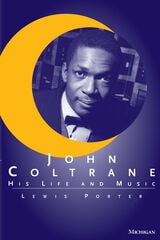
cover of John Coltrane: His Life and Music

John Coltrane

His Life and Music

Lewis Porter

University of Michigan Press, 1998

“One of the great biographies of anyone ever written.”—Steve O’Keefe, Counterpunch.org

Coltrane’s saxophonist son Ravi writes: “…[T]he most compelling and meticulously documented history of John Coltrane…This is a beautiful book.”

In honor of John Coltrane's Centennial, 1926-2026: Lewis Porter's Classic Biography Is Available for the First Time in Digital Format!

John Coltrane was a key figure in jazz, a pioneer in world music, and an intensely emotional force whose following continues to grow. This biography, the first by a professional jazz scholar and performer, presents a huge amount of never-before-published material, including interviews with Coltrane, photos, genealogical documents, and innovative musical analysis that offers a fresh view of Coltrane's genius. Compiled from scratch with the assistance of dozens of Coltrane's colleagues, friends, and family, John Coltrane: His Life and Music corrects numerous errors from previous biographies. The significant people in Coltrane's life were reinterviewed, yielding new insights; some were interviewed for the first time ever. The musical analysis, which is accessible to the nonspecialist, makes its own revelations--for example, that some of Coltrane's well-known pieces are based on previously unrecognized sources. The Appendix is the most detailed chronology of Coltrane's performing career ever compiled, listing scores of previously unknown performances from the 1940s and early 1950s. Coltrane has become a musical inspiration for thousands of fans and musicians and a personal inspiration to as many more. For all of these, Porter's book will become the definitive resource--a reliable guide to the events of Coltrane's life and an insightful look into his musical practices. With illustrations and previously unseen photographs!

[more]