56 books match the query 'Jesus Christ' and 9 start with j
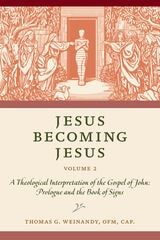
cover of Jesus Becoming Jesus, Volume 2: A Theological Interpretation of the Gospel of John: Prologue and the Book of Signs

Jesus Becoming Jesus, Volume 2

A Theological Interpretation of the Gospel of John: Prologue and the Book of Signs

Thomas G. Weinandy

Catholic University of America Press, 2021
Jesus Becoming Jesus, Volume 2: A Theological Interpretation of the Gospel of John: Prologue and the Book of Signs follows upon the first volume of this series entitled Jesus Becoming Jesus. The first volume was a theological interpretation of the Gospels of Matthew, Mark and Luke. Unlike many conventional biblical commentaries, Weinandy concentrates on the theological content contained within John’s Gospel. He does this in the light of the Church’s doctrinal and theological tradition, particularly in keeping with the Second Vatican Council’s Dogmatic Constitution, Dei Verbum. This is accomplished through a close reading of John’s Gospel, theologically interpreting each chapter of the Gospel sequentially. In so doing he also takes into account the Johannine corpus as a whole. He also relates John’s Gospel to relevant material found within the Synoptic Gospels, the Pauline Corpus and other New Testament writings. This original theological interpretation focuses primarily on the intertwining theological themes contained within John’s Gospel, specifically within the Prologue and the Book of Signs – light and darkness, the seven miracle-signs, the sacraments of baptism and the Eucharist, the seven “I Am” sayings, the contentious dialogues with the Jews, Jesus’ relationship to his Father as the Father’s incarnate Word and Son, etc. Within all of these interlocking themes one finds the importance of Jesus’ saving actions – the salvific works of his Father. The overarching theme of this book, as the title suggests, is that Jesus, being named Jesus, throughout his public ministry is enacting his name and so becoming who he is – YHWH-Saves. Weinandy offers a singular, vibrant, and luminous reading of John’s Gospel; one that reveals the Evangelist’s theological depth and doctrinal sophistication. In so doing, Weinandy makes manifest the particular beauty of the Gospel According to John.
[more]
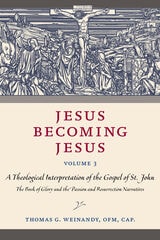
cover of Jesus Becoming Jesus, Volume 3: A Theological Interpretation of the Gospel of John: The Book of Glory and the Passion and Resurrection

Jesus Becoming Jesus, Volume 3

A Theological Interpretation of the Gospel of John: The Book of Glory and the Passion and Resurrection

Thomas G. Weinandy

Catholic University of America Press, 2022
Jesus Becoming Jesus, Volume 3 follows upon the previous two volumes of this series entitled Jesus Becoming Jesus. Volume 1 was a theological interpretation of the Gospels of Matthew, Mark and Luke, and volume 2 was a theological interpretation of the Prologue and Book of Signs of John’s Gospel (chapters 1-12). Unlike many conventional biblical commentaries, Weinandy concentrates on the theological content contained within John’s Gospel. This is accomplished through a close reading of John’s Gospel, theologically interpreting each chapter of the Gospel sequentially. In so doing he also takes into account the Johannine corpus as a whole. He also relates John’s Gospel to relevant material found within the Synoptic Gospels, the Pauline Corpus and other New Testament writings. In this present volume, Weinandy’s original theological interpretation focuses first on the Evangelist’s narrative of the Last Supper, which includes Jesus’ washing of his disciples’ feet, followed upon his lengthy farewell address and his ensuing High Priestly Prayer (chapter 13-17). Although Jesus speaks of his leaving his disciples, yet their hearts should not be troubled, for he is going to prepare a place for them in his Father’s house, and he will also send them another Counselor, the Holy Spirit. The Holy Spirit will not only convict the world sin, but he will also empower the disciples to profess their faith in Jesus as the Father’s Son, even in the midst of persecution. All that Jesus tells his disciple in his final discourse, he then prays that his Father will accomplish through his forthcoming death and resurrection – above all that his disciples will share in the same oneness of love that he and his Father possess. Weinandy masterfully treats John’s Passion and Resurrection Narratives. He not only theologically interprets the uniqueness of the Evangelist’s narratives, but also how his narratives insect with the Synoptic accounts. Moreover, Weinandy’s theological reading of Jesus’ crucifixion and resurrection weaves together John’s soteriology, ecclesiology, and sacramentality – all of which are founded upon the Incarnation, that Jesus is the Father’s Spirit-filled incarnate Son. As the title suggests, Jesus, being named Jesus, in his death and resurrection, definitively enacts his name and so becoming who he is – YHWH-Saves.
[more]
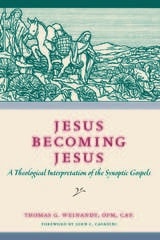
cover of Jesus Becoming Jesus: A Theological Interpretation of the Synoptic Gospels

Jesus Becoming Jesus

A Theological Interpretation of the Synoptic Gospels

Thomas Weinandy

Catholic University of America Press, 2018
Jesus Becoming Jesus presents a theological interpretation of the Gospels of Matthew, Mark and Luke. Unlike many conventional biblical commentaries, Weinandy concentrates on the theological content contained within the Synoptic Gospels. He does thi
[more]
cover of Jesus and Mary Reimagined in Early Christian Literature

Jesus and Mary Reimagined in Early Christian Literature

Vernon K. Robbins

SBL Press, 2015

Explore the diverse character of emerging Christian narratives

This book presents essays that show how prophetic and priestly emphases in Luke and Acts, and emphasis on Jesus’s existence prior to creation in the Gospel of John, are reworked in some second- and third-century Christian literature. Early Christians interpreted and expressed the storylines of Jesus, Mary, and other important figures in ways that created new images and stories. Contributors show the effect of including rhetography, the rhetoric of a text that prompts images and pictures in the mind of a hearer or reader, in interpretation of texts.

Features:

  • Readings that attempt to account for the development of richly creative and complicated early Christian traditions
  • Essays bridging New Testament studies and interpretation of Early Christian literature
  • Interpretations that integrate social and rhetorical interpretations
[more]
cover of Jesus and the Gospel Movement: Not Afraid to Be Partners

Jesus and the Gospel Movement

Not Afraid to Be Partners

William Thompson-Uberuaga

University of Missouri Press, 2006

The disciples. Mary Magdalene. Lazarus. The New Testament tells of Jesus, to be sure, but it is a Jesus depicted in interaction with many other people. Far too often, Jesus has been studied in isolation rather than as a person sharing relationships. This book seeks to rediscover Jesus in relation to the movement beginning to form around him.
            One of the few books to explore fully the political dimensions of the emerging church, Jesus and the Gospel Movement brings studies of Jesus and Christology into dialogue with today’s social and political sciences. William Thompson-Uberuaga seeks to penetrate the mist surrounding the historical Jesus by inviting readers to imagine him through the perspective of his relationships and to consider how those relationships helped shape his personality and commitments—not just the intellectual aspects but also his feelings, his affectionate bonds, and the reciprocal bonds he stimulated in others.
            This extended meditation represents the first book-length engagement with Voegelin scholarship on these issues, and scholars in Voegelin studies will find a challenging appropriation of that thinker’s political philosophy. It also draws on insights of other philosophers ranging from Nietzsche to Derrida, with a particular emphasis on Gadamer’s hermeneutical thought. Useful for courses in Jesus studies, Christology, and Christianity and politics, the text also features an Internet link to supplements accompanying each chapter, which have been written by the author especially for this book to enable students and readers to delve deeper into the thicket of scholarly debates concerning these issues.
            Thompson-Uberuaga asks readers to imagine the various beliefs about Jesus as the result of forms of participation, helping us make sense of how they emerged and offering a way of evaluating their validity—and arguing that we will form only a narrow, even lopsided view of Jesus if we consider him apart from his relationships. By daring a personal interpretation of Jesus and the Gospel movement that he and his companions originated, this book boldly challenges readers to risk their own interpretations and arrive at their own understanding of the Messiah.
[more]
cover of Jesus the Central Jew: His Times and His People

Jesus the Central Jew

His Times and His People

André LaCocque

SBL Press, 2015

Not a Jew marginally, but centrally

In this book, LaCocque presents the case that Jesus was totally and unquestionably a Jew. He lived as a Jew, thought as a Jew, debated as a Jew, acted as a Jew and died as a Jew. He had no intention of creating a new religion; rather, he was a reformer of the Judaism of his day. True, his critique went far beyond an intellectual subversion. In fact, Jesus progressively thought of himself as the “Son of Man” inaugurating the advent of the Kingdom of God on earth.

Features:

  • Focused attention given to the historical Jesus and not Christianity or Christology
  • Addresses restricted sources, namely, the Synoptic Gospels
  • Close examination of Jesus’s way of thinking, teaching, and behaving
[more]
cover of Jesus the Mediator

Jesus the Mediator

William Brownsberger

Catholic University of America Press, 2013
In Jesus the Mediator, William L. Brownsberger offers an account of the human psychology assumed by the Second Person of the Trinity in light of its salvific significance
[more]
cover of Jesus, Interpreted

Jesus, Interpreted

Matthew J. Ramage

Catholic University of America Press, 2017
In this sequel volume to his Dark Passages of the Bible (CUA Press, 2013), author Matthew Ramage turns his attention from the Old to the New Testament, now tackling truth claims bearing directly on the heart of the Christian faith cast into doubt by contemporary New Testament scholarship: Did God become man in Jesus, or did the first Christians make Jesus into God? Was Jesus' resurrection a historical event, or rather a myth fabricated by the early Church? Will Jesus indeed return to earth on the last day, or was this merely the naïve expectation of ancient believers that reasonable people today ought to abandon?
[more]
cover of Jesus-Shock

Jesus-Shock

Peter Kreeft

St. Augustine's Press, 2008

Jesus Shock is the second in a series of short works on seminal concerns of the impact that Jesus Christ made in the world. The first work, The Philosophy of Jesus (St. Augustine’s Press, 2007), explored philosophy in light of Jesus, rather than the other way around. The present work investigates the reception Jesus received both in His lifetime and continuously to the present time, not only from His enemies, but from His friends, a reception of shock, astonishment, even disgust.
  Perhaps a few remarks from the book best explains it:

The point of the book:
 The point of the title: Imagine a storm has downed a telephone wire so that everyone who touches it is shocked in every cell of his body. Well, the storm of God’s crazy love has “downed” (incarnated) Jesus, and everyone who touches this “live wire” is shocked in every cell of his soul.
 The question of the book: Why is “Jesus” the most non-neutral, the most controversial, the most embarrassing name in the world? Why is talking about Jesus like talking about sex?
 This whole book is really about a single movie line, the greatest line in the greatest movie in history. Bet you know what it is.
 Jesus-Shock is about the Real Presence of Christ in the Gospels and in the Eucharist. It
is not about the theology of the Real Presence, but about the experience of Him there, and about the experience of everyone in the Gospels who met Him.

 What was the bitterest controversy of the Protestant Reformation, both between Protestants and Catholics and between different Protestant denominations, the one that had both sides calling the other not just heretics but devils?   
 Answer: It was not Justification by Faith, the hallmark of the Reformation, even though that question is about nothing less momentous than how to be saved, how to get to Heaven. It was not the relation between religion and politics, even though that was a matter of life or death (literally, on battlefields and at guillotines and hangings) and not just a matter of truth or falsity, or of good or evil. It was not about the sufficiency of the Bible, or the corruption in the Church, or the relation between the Bible and the Church. It was not about the Pope, and the governance of the Church. It was not about Mary or saints or angels or Purgatory. It was not about the Incarnation or the Trinity or the Atonement.
 It was about the Real Presence of Christ in the Eucharist.

 Jesus-Shock, in addressing this controversy forcefully and faithfully, shows the reasons why to this day the name of “Jesus” stirs up controversy, even revulsion, in polite society. In the true spirit of ecumenism, it also points the way toward a true rapprochement among His modern-day disciples.

[more]