Results by title
622 books match the query 'Language Study' and 10 start with j
Jacy
An Implemented Grammar of JapaneseMelanie Siegel, Emily M. Bender, and Francis Bond
CSLI, 2017
Japanese/Korean Linguistics, Volume 1
Edited by Hajime Hoji
CSLI, 1990
Japanese/Korean Linguistics, Volume 2
Edited by Patricia Clancy
CSLI, 1993
Japanese/Korean Linguistics, Volume 24
Edited by Kenshi Funakoshi, et al.
CSLI, 2017
Japanese/Korean Linguistics, Volume 5
Edited by Noriko Akatsuka, Shoichi Iwasaki, and Susan Strauss
CSLI, 1996
Japanese/Korean Linguistics, Volume 6
Edited by Ho-min Sohn and John Haig
CSLI, 1997
Japanese/Korean Linguistics, Volume 7
Edited by Noriko Akatsuka, et al
CSLI, 1998
Javanese
A Cultural ApproachWard Keeler
Ohio University Press, 1984
In this text, therefore, the sociological context of Javanese is explained as thoroughly as Javanese grammar. The book presents Javanese in its full complexity and range in order to illustrate a cultural appoach to a non-Western language; it will therefore be of interest not only to language learners, but to linguists, sociologists, anthropologists, and many others.
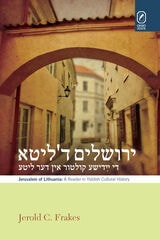
Jerusalem of Lithuania
A Reader in Yiddish Cultural HistoryJerold C. Frakes
The Ohio State University Press, 2011
Yerusholayim d’lite: di yidishe kultur in der lite (Jerusalem of Lithuania: A Reader in Yiddish Cultural History) by Jerold C. Frakes contains cultural, literary, and historical readings in Yiddish that vividly chronicle the central role Vilnius (Lithuania) played in Jewish culture throughout the past five centuries. It includes many examples of Yiddish literature, historiography, sociology, and linguistics written by and about Litvaks and includes work by prominent Yiddish poets, novelists, raconteurs, journalists, and scholars. In addition, Frakes has supplemented the primary texts with many short essays that contextualize Yiddish cultural figures, movements, and historical events.
Journal Writing in Second Language Education
Christine Pearson Casanave
University of Michigan Press, 2011
Journal writing is not new--journals have been around for centuries. More recently, journals have been viewed as a means of scaffolding reflective teaching and encouraging reflectivity in research processes. As a result, some educators may ask, “What more do we need to know?” Those likely to raise this question are probably not thinking of the explosive growth of reflective writing enabled by social networking on the Web, the blogs and other interactive e-vehicles for reflection on experiences in our literate, “real,” and virtual lives This revisiting of journal writing from a 21st century perspective, informed by relevant earlier literature, is what Christine Pearson Casanave guides readers through in this first book-length treatment of the use of journal writing in the contexts of language learning, pre and in-service teaching, and research.
Casanave has put together existing ideas that haven't been put together before and has done it not as an edited collection, but as a single-authored book. She has done it in a way that will be especially accessible to teachers in language teacher education programs and to practicing teachers and researchers of writing in both second and foreign language settings, and in a way that will inspire all of us to think about, not just do, journal writing.
Those who have never attempted to use journals in their classes and own lives, as well as others who have used it with mixed results, will probably be tempted to try it in at least some of the venues Casanave provides guidance for. Those already committed to journal writing will very likely find in this book new reasons for expanding and enhancing their use of journals.