Results by title
59 books match the query 'Lawyers & Judges' and 3 start with j
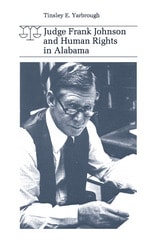
Judge Frank Johnson and Human Rights in Alabama
Tinsley E. Yarbrough
University of Alabama Press, 1981
Where courage meets the gavel: One judge’s relentless fight for justice and human rights in Alabama.
Judge Frank M. Johnson, Jr., Chief Judge of the United States District Court for the Middle District of Alabama until his elevation to the Court of Appeals for the Fifth Circuit in 1979, was perhaps President Dwight D. Eisenhower’s most significant appointment to a lower court. His selection to the bench in 1955 followed by only a few months the Supreme Court’s historic decision in Brown vs. Board of Education.
During Judge Johnson’s tenure, his court invalidated segregation and other forms of racial discrimination in Alabama’s transportation facilities, voter registration processes, school and colleges, administrative agencies, system of jury selection, prisons, mental institutions, political parties, and government grant programs. In fact, most of the state’s major racial crises were resolved in his courtroom. However, his impact on human rights policy in Alabama was not confined to a racial context. Among other significant developments, the Middle District Court ordered reapportionment of the state’s governing bodies and invalidated its grossly inequitable property tax systems.
Judge Johnson’s decisions made him one of the most widely respected and controversial trial judges in the country. Until recently, however, his name was anathema to many white Alabamians, and he and his family were subject to ostracism, threats, violence, and verbal abuse.
Yarbrough examines Judge Johnson’s life through the end of the Wallace era and the Judge’s appointment to the Fifth Circuit Court. More broadly, the book is a history of modern human rights reform in Alabama, cast in the biographical idiom. For, in a real sense, the history of the reform and of Judge Johnson’s judicial career have been synonymous.
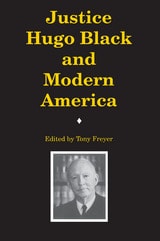
Justice Hugo Black and Modern America
Tony Freyer
University of Alabama Press, 1990
Reexamining the Justice Who Helped Shape Modern Constitutional America.
The struggle to accommodate both individual freedom and community welfare shaped modern America. American have disagreed about whether federal protection of national welfare could be reconciled with defense of individual rights; however, no public figure worked longer or more consistently to meet this challenge than Alabama’s Hugo L. Black
This collection of essays, reprints of the spring 1985 and winter 1987 issues of the Alabama Law Review with a new introduction and minor revisions, suggests that Black’s constitutional principles and personal values provided a means to achieve a balance between majority will and individual freedom. Black’s life and career are reexamined here by leading scholars and jurors in the first major study in twenty years, tracing his relationship to the South, to the development of American liberalism, and to the constitutional revolution in individual rights.
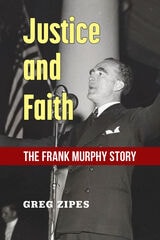
Justice and Faith
The Frank Murphy StoryGreg Zipes
University of Michigan Press, 2021
Murphy is best remembered for his immense legal contributions supporting individual liberty and fighting discrimination, particularly discrimination against the most vulnerable. Despite being a loyal ally of Franklin Delano Roosevelt, when FDR ordered the removal of Japanese Americans during World War II, Supreme Court Justice Murphy condemned the policy as “racist” in a scathing dissent to the Korematsu v. United States decision—the first use of the word in a Supreme Court opinion. Every American, whether arriving by first class or in chains in the galley of a slave ship, fell under Murphy’s definition of those entitled to the full benefits of the American dream.
Justice and Faith explores Murphy’s life and times by incorporating troves of archive materials not available to previous biographers, including local newspaper records from across the country. Frank Murphy is proof that even in dark times, the United States has extraordinary resilience and an ability to produce leaders of morality and courage.