Results by title
276 books match the query 'Legal History' and 7 start with j
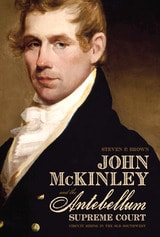
John McKinley and the Antebellum Supreme Court
Circuit Riding in the Old SouthwestSteven P. Brown
University of Alabama Press, 2012
A Southern voice on a national bench—McKinley’s legacy in antebellum law.
John McKinley and the Antebellum Supreme Court offers the first comprehensive biography of Justice John McKinley (1780–1852), a largely forgotten figure in American legal history who played a pivotal role during a formative period of the U.S. Supreme Court. Steven P. Brown rescues McKinley from historical obscurity, presenting a compelling portrait of a man deeply embedded in the political, legal, and financial life of the early 19th-century South.
Born in Kentucky and later settling in northern Alabama, McKinley served in both the U.S. Senate and House of Representatives before being appointed to the Supreme Court by President Martin Van Buren in 1837. His tenure on the bench coincided with the creation of the Ninth Circuit, a vast and challenging judicial territory encompassing Alabama, Arkansas, Louisiana, and Mississippi. Brown details McKinley’s arduous circuit-riding duties, which required extensive travel and exposed him to the legal complexities of a rapidly expanding frontier.
More than a biography, the book provides a penetrating analysis of antebellum legal culture, Alabama state politics, and the internal workings of the Supreme Court during a time of national transformation. Brown challenges the prevailing view of McKinley as a mediocre jurist, arguing instead that his contributions—particularly his dissents defending states’ rights—deserve renewed scholarly attention. With rich historical context and meticulous research, John McKinley and the Antebellum Supreme Court sheds light on the burdens of justice in a divided nation and the legacy of a justice whose career mirrored the tensions of his time.
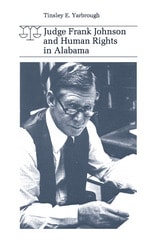
Judge Frank Johnson and Human Rights in Alabama
Tinsley E. Yarbrough
University of Alabama Press, 1981
Where courage meets the gavel: One judge’s relentless fight for justice and human rights in Alabama.
Judge Frank M. Johnson, Jr., Chief Judge of the United States District Court for the Middle District of Alabama until his elevation to the Court of Appeals for the Fifth Circuit in 1979, was perhaps President Dwight D. Eisenhower’s most significant appointment to a lower court. His selection to the bench in 1955 followed by only a few months the Supreme Court’s historic decision in Brown vs. Board of Education.
During Judge Johnson’s tenure, his court invalidated segregation and other forms of racial discrimination in Alabama’s transportation facilities, voter registration processes, school and colleges, administrative agencies, system of jury selection, prisons, mental institutions, political parties, and government grant programs. In fact, most of the state’s major racial crises were resolved in his courtroom. However, his impact on human rights policy in Alabama was not confined to a racial context. Among other significant developments, the Middle District Court ordered reapportionment of the state’s governing bodies and invalidated its grossly inequitable property tax systems.
Judge Johnson’s decisions made him one of the most widely respected and controversial trial judges in the country. Until recently, however, his name was anathema to many white Alabamians, and he and his family were subject to ostracism, threats, violence, and verbal abuse.
Yarbrough examines Judge Johnson’s life through the end of the Wallace era and the Judge’s appointment to the Fifth Circuit Court. More broadly, the book is a history of modern human rights reform in Alabama, cast in the biographical idiom. For, in a real sense, the history of the reform and of Judge Johnson’s judicial career have been synonymous.
Judicial Decisions in the Ancient Near East
Sophie Démare-Lafont
SBL Press, 2023
This volume presents the first broadly inclusive collection, with accessible text and English translation, of documents related to judicial decisions in the ancient Near East, the oldest setting for such writing in the world. The texts in this volume belong to various genres, especially legal records and letters, and span almost two thousand years. With such varied material, the work depends on the expertise of specialists in each setting, from the Sumerian of early Ur to the late Akkadian of Babylonia under the Persians. The collection brings together not only 183 transliterated texts and new translations but also introductions and commentary that place these legal documents in their historical and social contexts. A glossary of legal terms, a concordance of texts included, and an index of legal terms makes this an invaluable tool for students and scholars across disciplines. The contributors are Dominique Charpin, Sophie Démare-Lafont, Daniel E. Fleming, Francis Joannès, Bertrand Lafont, Brigitte Lion, Ignacio Márquez Rowe, Cécile Michel, and Pierre Villard.
Judicial Territory
Law, Capital, and the Expansion of American EmpireShaina Potts
Duke University Press, 2024
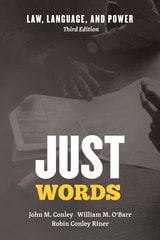
Just Words
Law, Language, and Power, Third EditionJohn M. Conley, William M. O'Barr, and Robin Conley Riner
University of Chicago Press, 2019
John M. Conley, William M. O'Barr, and Robin Conley Riner show how the microdynamics of the legal process and the largest questions of justice can be fruitfully explored through the field of linguistics. Each chapter covers a language-based approach to a different area of the law, from the cross-examinations of victims and witnesses to the inequities of divorce mediation. Combining analysis of common legal events with a broad range of scholarship on language and law, Just Words seeks the reality of power in the everyday practice and application of the law. As the only study of its type, the book is the definitive treatment of the topic and will be welcomed by students and specialists alike. This third edition brings this essential text up to date with new chapters on nonverbal, or “multimodal,” communication in legal settings and law, language, and race.
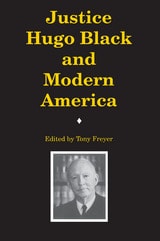
Justice Hugo Black and Modern America
Tony Freyer
University of Alabama Press, 1990
Reexamining the Justice Who Helped Shape Modern Constitutional America.
The struggle to accommodate both individual freedom and community welfare shaped modern America. American have disagreed about whether federal protection of national welfare could be reconciled with defense of individual rights; however, no public figure worked longer or more consistently to meet this challenge than Alabama’s Hugo L. Black
This collection of essays, reprints of the spring 1985 and winter 1987 issues of the Alabama Law Review with a new introduction and minor revisions, suggests that Black’s constitutional principles and personal values provided a means to achieve a balance between majority will and individual freedom. Black’s life and career are reexamined here by leading scholars and jurors in the first major study in twenty years, tracing his relationship to the South, to the development of American liberalism, and to the constitutional revolution in individual rights.
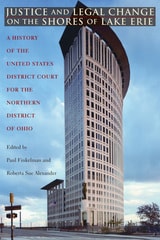
Justice and Legal Change on the Shores of Lake Erie
A History of the United States District Court for the Northern District of OhioPaul Finkelman
Ohio University Press, 2012
Justice and Legal Change on the Shores of Lake Erie explores the many ways that the United States District Court for the Northern District of Ohio has affected the region, the nation, the development of American law, and American politics.
The essays in this book, written by eminent law professors, historians, political scientists, and practicing attorneys, illustrate the range of cases and issues that have come before the court. Since the court’s inception in 1855, judges have influenced economic developments and social issues, beginning with the court’s most famous early case, involving the rescue of the fugitive slave John Price by residents of Northern Ohio. Chapters focusing on labor strikes, free speech, women’s rights, the environment, the death penalty, and immigration illustrate the impact this court and its judges have had in the development of society and the nation’s law. Some of the cases here deal with local issues with huge national implications xad—like political corruption, school desegregation, or pollution on the Cuyahoga River. But others are about major national issues that grew out of incidents, such as the prosecution of Eugene V. Debs for opposing World War I, the litigation resulting from the Kent State shootings and opposition to the Vietnam War, and the immigration status of the alleged Nazi war criminal John Demyanjuk.
This timely history confirms the significant role played by district courts in the history of the United States.