Results by title
1445 books match the query 'Life Sciences' and 5 start with j
James Sowerby
The Enlightenment's Natural HistorianPaul Henderson
Royal Botanic Gardens, Kew, 2015
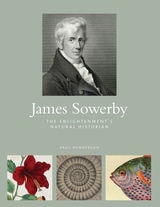
Henderson explores Sowerby’s artistic achievements as well as his place at the center of a thriving network of artists and scientists. Sowerby worked closely with key botanists of the time, influencing the likes of Sir Joseph Banks and James Smith, as well as Dawson Turner, James Dickson, Aylmer Lambert, and William Woodville. He also contributed illustrations to the earliest volumes of The Botanical Magazine (later known as Curtis's Botanical Magazine). Specimens from his collection round out the holdings of museums around the world, and he has become the paterfamilias of a talented line of botanical and natural science illustrators.
Henderson’s Sowerby’s Botany is beautifully illustrated with Sowerby’s artwork and includes extracts from letters, manuscripts, and natural history publications. It is a fascinating story of an influential artist working at the intersections of art and nature at a time of unprecedented scientific enlightenment.

Java Man
How Two Geologists Changed Our Understanding of Human EvolutionCarl C. Swisher III, Garniss H. Curtis, and Roger Lewin
University of Chicago Press, 2001
Originally published by Scribner
2000 ISBN: 0-684-80000-4
Jellyfish
A Natural HistoryLisa-ann Gershwin
University of Chicago Press, 2016
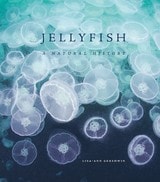
Jellyfish presents these aquarium favorites in all their extraordinary and captivating beauty. Fifty unique species, from stalked jellyfish to black sea nettles, are presented in stunning color photographs along with the most current scientific information on their anatomy, history, distribution, position in the water, and environmental status. Foremost jellyfish expert Lisa-ann Gershwin provides an insightful look at the natural history and biology of each of these spellbinding creatures, while offering a timely take on their place in the rapidly changing and deteriorating condition of the oceans. Readers will learn about immortal jellyfish who live and die and live again as well as those who camouflage themselves amid sea grasses and shells, hiding in plain sight.
Approachably written and based in the latest science and ecology, this colorful book provides an authoritative guide to these ethereal marine wonders.
Jewish Tradition and the Challenge of Darwinism
Edited by Geoffrey Cantor and Marc Swetlitz
University of Chicago Press, 2006
Darwin’s theory of evolution transformed the life sciences and made profound claims about human origins and the human condition, topics often viewed as the prerogative of religion. As a result, evolution has provoked a wide variety of religious responses, ranging from angry rejection to enthusiastic acceptance. While Christian responses to evolution have been studied extensively, little scholarly attention has been paid to Jewish reactions. Jewish Tradition and the Challenge of Darwinism is the first extended meditation on the Jewish engagement with this crucial and controversial theory.
The contributors to Jewish Tradition and the Challenge of Darwinism—from several academic disciplines and two branches of the rabbinate—present case studies showing how Jewish discussions of evolution have been shaped by the intersections of faith, science, philosophy, and ideology in specific historical contexts. Furthermore, they examine how evolutionary theory has been deployed when characterizing Jews as a race, both by Zionists and by anti-Semites. Jewish Tradition and the Challenge of Darwinism addresses historical and contemporary, as well as progressive and Orthodox, responses to evolution in America, Europe, and Israel, ultimately extending the history of Darwinism into new religious domains.
Journeys with Emperors
Tracking the World's Most Extreme PenguinGerald L. Kooyman and Jim Mastro
University of Chicago Press, 2023
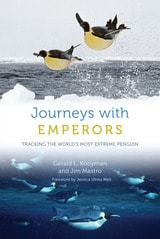
The primary mission was to record the birds’ activities at sea, and the data revealed important aspects of emperor penguin behavior and physiology: for instance, that in the course of hunting for food, some of the penguins dive to depths of greater than five hundred meters (a third of a mile, which is deeper than for any other diving bird). The researchers also discovered that, crucially, most of the emperor’s life is actually spent at sea, with fledged chicks and adults making separate, perilous journeys through icy water. When chick nurturing is complete, the fledglings abandon the colony in large groups, heading north to the Southern Ocean. The adults leave at the same time, traveling one thousand kilometers eastward across the Ross Sea to a sea-ice sanctuary for molting. During this journey, they must gain enough weight to survive the month-long molt, when every feather is replaced and the birds cannot enter the water to feed. After the molt, many if not most return to the colony to breed once again. For the males, this means another fast—this time for 120 days as they incubate their eggs. The nearness of the colony to the ice edge spared the penguins the long, energy-draining march for which other colonies are well-known. It also allowed researchers to observe the penguins’ departures to and arrivals from their foraging journeys, as well as their dangerous interactions with leopard seals and killer whales.
Featuring original color photographs and complemented with online videos, Journeys with Emperors is both an eye-opening overview of the emperor penguin’s life and a thrilling tale of scientific discovery in one of the most remote, harsh, and beautiful places on Earth.