Results by title
12 books match the query 'Bengal'

A Rule of Property for Bengal
An Essay on the Idea of Permanent SettlementRanajit Guha
Duke University Press, 1996
By proclaiming the Permanent Settlement in 1793, the British hoped to promote a prosperous capitalist agriculture of the kind that had developed in England. The act renounced for all time the state’s right to raise the assessment already made upon landowners and thus sought to establish a system of property that was, in the British view, necessary for the creation of a stable government. Guha traces the origins of the Permanent Settlement to the anti-feudal ideas of Phillip Francis and the critique of feudalism provided by physiocratic thought, the precursor of political economy. The central question the book asks is how the Permanent Settlement, founded in anti-feudalism and grafted onto India by the most advanced capitalist power of the day became instrumental in the development of a neo-feudal organization of landed property and in the absorption and reproduction of precapitalist elements in a colonial regime.
Guha’s examination of the British attempt to mold Bengal to the contours of its own society without an understanding of the traditions and obligations upon which the Indian agrarian system was based is a truly pioneering work. The implications of A Rule of Property for Bengal remain rich for the current discussions from the postcolonialist perspective on the meaning of modernity and enlightenment.

Bengal in Global Concept History
Culturalism in the Age of CapitalAndrew Sartori
University of Chicago Press, 2008
Sartori weaves the narrative of Bengal’s embrace of culturalism into a worldwide history of the concept, from its origins in eighteenth-century Germany, through its adoption in England in the early 1800s, to its appearance in distinct local guises across the non-Western world. The impetus for the concept’s dissemination was capitalism, Sartori argues, as its spread across the globe initiated the need to celebrate the local and the communal. Therefore, Sartori concludes, the use of the culture concept in non-Western sites was driven not by slavish imitation of colonizing powers, but by the same problems that repeatedly followed the advance of modern capitalism. This remarkable interdisciplinary study will be of significant interest to historians and anthropologists, as well as scholars of South Asia and colonialism.

Biting through the Skin
An Indian Kitchen in America's HeartlandNina Mukerjee Furstenau
University of Iowa Press, 2013
As a girl and a young woman, Nina traveled to her ancestral India as well as to college and to Peace Corps service in Tunisia. Through her journeys and her marriage to an American man whose grandparents hailed from Germany and Sweden, she learned that her family was not alone in being a small pocket of culture sheltered from the larger world. Biting through the Skin shows how we maintain our differences as well as how we come together through what and how we cook and eat. In mourning the partial loss of her heritage, the author finds that, ultimately, heritage always finds other ways of coming to meet us. In effect, it can be reduced to a 4 x 6-inch recipe card, something that can fit into a shirt pocket. It’s on just such tiny details of life that belonging rests.
In this book, the author shares her shirt-pocket recipes and a great deal more, inviting readers to join her on her journey toward herself and toward a vital sense of food as culture and the mortar of community.
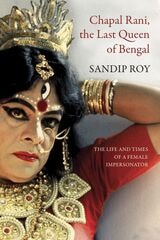
Chapal Rani, the Last Queen of Bengal
The Life and Times of a Female ImpersonatorSandip Roy
Seagull Books, 2025
As the last great female impersonator of Bengali theater, Chapal Bhaduri—known as Chapal Rani—once held audiences spellbound in the jatra tradition, where men became goddesses and heroines. But when women finally took their place on stage, Chapal found himself exiled from the world he had ruled. In this groundbreaking biography, Sandip Roy captures the rise and fall of a performer whose art was inseparable from his identity.
Told in Chapal’s own voice and interwoven with evocative fictional vignettes, Chapal Rani, the Last Queen of Bengal brings to life Kolkata’s golden age of theater and the resilience of a man who refused to disappear. Through decades of research and deeply personal interviews, Roy crafts a moving portrait of gender and belonging.
Ghostly Past, Capitalist Presence
A Social History of Fear in Colonial BengalTithi Bhattacharya
Duke University Press, 2024
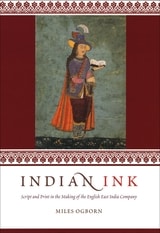
Indian Ink
Script and Print in the Making of the English East India CompanyMiles Ogborn
University of Chicago Press, 2007
A commercial company established in 1600 to monopolize trade between England and the Far East, the East India Company grew to govern an Indian empire. Exploring the relationship between power and knowledge in European engagement with Asia, Indian Ink examines the Company at work and reveals how writing and print shaped authority on a global scale in the seventeenth and eighteenth centuries.
Tracing the history of the Company from its first tentative trading voyages in the early seventeenth century to the foundation of an empire in Bengal in the late eighteenth century, Miles Ogborn takes readers into the scriptoria, ships, offices, print shops, coffeehouses, and palaces to investigate the forms of writing needed to exert power and extract profit in the mercantile and imperial worlds. Interpreting the making and use of a variety of forms of writing in script and print, Ogborn argues that material and political circumstances always undermined attempts at domination through the power of the written word.
Navigating the juncture of imperial history and the history of the book, Indian Ink uncovers the intellectual and political legacies of early modern trade and empire and charts a new understanding of the geography of print culture.
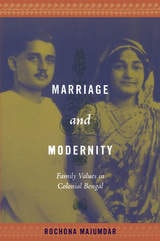
Marriage and Modernity
Family Values in Colonial BengalRochona Majumdar
Duke University Press, 2009
Majumdar examines three broad developments related to the modernity of arranged marriage: the growth of a marriage market, concomitant debates about consumption and vulgarity in the conduct of weddings, and the legal regulation of family property and marriages. Drawing on matrimonial advertisements, wedding invitations, poems, photographs, legal debates, and a vast periodical literature, she shows that the modernization of families does not necessarily imply a transition from extended kinship to nuclear family structures, or from matrimonial agreements negotiated between families to marriage contracts between individuals. Colonial Bengal tells a very different story.

Mexican Americans and Health
¡Sana! ¡Sana!Adela de la Torre and Antonia Estrada
University of Arizona Press, 2001
- how values such as machismo, familismo, and marianismo influence care-seeking decisions and treatment of illness;
- how factors such as cultural values, socioeconomic status, peer pressure, and family concerns can contribute to substance abuse;
- how cultural attitudes toward sex can heighten the risk of AIDS—and how approaches to AIDS prevention and education need to reflect core cultural values such as familismo, respeto, and confianza. The book also addresses concerns of Mexican Americans regarding the health care system. These include not only access to care and to health insurance but also the shortage of bilingual and bicultural health care professionals. This coverage stresses not only the importance of linguistic competency but also the need to understand folklore illnesses, herbal remedies, and spiritual practices that can delay the treatment of illness and either complement or compromise treatment. Of all the issues that face the contemporary Mexican American community, none is as important to its very survival as health and health care. This timely book gives readers a broad understanding of these complex issues and points the way toward a healthier future for all people of Mexican origin. Mexican Americans and Health and Chicano Popular Culture are the first volumes in the series The Mexican American Experience, a cluster of modular texts designed to provide greater flexibility in undergraduate education. Each book deals with a single topic concerning the Mexican American population. Instructors can create a semester-length course from any combination of volumes, or may choose to use one or two volumes to complement other texts.
The Feminization of Famine
Expressions of the Inexpressible?Margaret Kelleher
Duke University Press, 1997
Kelleher begins with a critical reading of the novels and short stories written about the Irish famine over the last 150 years, from the novels of William Carleton and Anthony Trollope to the writings of Liam O’Flaherty and John Banville. She then moves on to unveil a lesser-known body of literature—works written by women. This literature is read in the context of a rich variety of other sources, including eye-witness accounts, memoirs, journalistic accounts, and famine historiography. Concluding with a reading of the twentieth-century accounts of the famine in Bengal, this book reveals how gendered representations have played a crucial role in defining notions of famine.

The Madness of the Saints
Ecstatic Religion in BengalJune McDaniel
University of Chicago Press, 1989
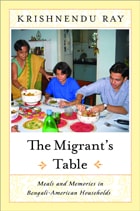
The Migrants Table
Meals And Memories InKrishnendu Ray
Temple University Press, 2004
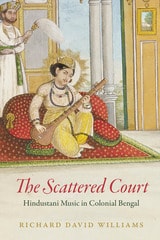
The Scattered Court
Hindustani Music in Colonial BengalRichard David Williams
University of Chicago Press, 2023
How far did colonialism transform north Indian music? In the period between the Mughal empire and the British Raj, how did the political landscape bleed into aesthetics, music, dance, and poetry? Examining musical culture through a diverse and multilingual archive, primarily using sources in Urdu, Bengali, and Hindi that have not been translated or critically examined before, The Scattered Court challenges our assumptions about the period. Richard David Williams presents a long history of interactions between northern India and Bengal, with a core focus on the two courts of Wajid Ali Shah (1822–1887), the last ruler of the kingdom of Awadh. He charts the movement of musicians and dancers between the two courts in Lucknow and Matiyaburj, as well as the transregional circulation of intellectual traditions and musical genres, and demonstrates the importance of the exile period for the rise of Calcutta as a celebrated center of Hindustani classical music. Since Lucknow is associated with late Mughal or Nawabi society and Calcutta with colonial modernity, examining the relationship between the two cities sheds light on forms of continuity and transition over the nineteenth century, as artists and their patrons navigated political ruptures and social transformations. The Scattered Court challenges the existing historiography of Hindustani music and Indian culture under colonialism by arguing that our focus on Anglophone sources and modernizing impulses has directed us away from the aesthetic subtleties, historical continuities, and emotional dimensions of nineteenth-century music.