Results by title
941 books match the query 'Military' and 16 start with j
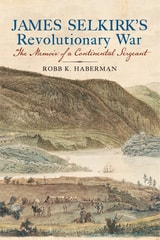
James Selkirk's Revolutionary War
The Memoir of a Continental SergeantRobb K. Haberman
Westholme Publishing, 2027
A Significant Personal Account by a Continental Soldier, in Print for the First Time
In the twilight years of his life, James Selkirk (1757–1820), a modest tailor and Revolutionary War veteran residing in Bethlehem, New York, composed a memoir about his wartime experiences in the Continental Army. Selkirk’s memoir tells the story of a young Scottish immigrant who served well and faithfully as a non-commissioned officer in three different corps from April 1776 through June 1783. During this period, Selkirk fought in several engagementsthat ranged from the wilderness of northern New York to the waters of Chesapeake Bay. In addition to chronicling his participation in these campaigns, the memoir contains Selkirk’s personal observations and anecdotes about the daily rigors and duties common to an enlisted soldier in Continental service. James Selkirk’s Revolutionary War, edited by historian Robb K. Haberman, discusses how Selkirk endured over seven years of soldiering with the Continental Army. It also explores how Selkirk’s decision to write his memoir occurred as politicians and citizens debated whether the federal government should enact a pension program in support of the nation’s aged and mostly impoverished community of Revolutionary-era veterans. Through his writing, Selkirk weighed in on this issue, drawing attention to the deserved rights and recognition due to his surviving brothers in arms. Just as he had taken up a musket in earlier decades in the struggle for national independence, Selkirk now wielded a pen on behalf of the aging cohort of American veterans who were experiencing hardship in the era of the early republic. Selkirk planned to share his recollections of the war with a broader audience, but his death in December 1820 precluded the publication of the manuscript memoir as a printed book until now. James Selkirk’s memoir ranks among the earliest known writings that reveal unique and personal assessments of a common soldier’s existence during the American Revolution, from slogging on the march and performing duties in camp to facing the terrors of the battlefield.
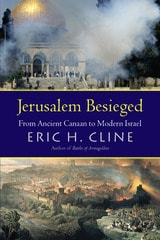
Jerusalem Besieged
From Ancient Canaan to Modern IsraelEric H. Cline
University of Michigan Press, 2005
-Victor Davis Hanson, Stanford University; author of The Other Greeks and Carnage and Culture
"A beautifully lucid presentation of four thousand years of history in a single volume. Cline writes primarily as an archaeologist-avoiding polemic and offering evidence for any religious claims-yet he has also incorporated much journalistic material into this study. Jerusalem Besieged will enlighten anyone interested in the history of military conflict in and around Jerusalem."
-Col. Rose Mary Sheldon, Virginia Military Institute
"This groundbreaking study offers a fascinating synthesis of Jerusalem's military history from its first occupation into the modern era. Cline amply deploys primary source material to investigate assaults on Jerusalem of every sort, starting at the dawn of recorded history. Jerusalem Besieged is invaluable for framing the contemporary situation in the Middle East in the context of a very long and pertinent history."
-Baruch Halpern, Pennsylvania State University
A sweeping history of four thousand years of struggle for control of one city
"[An] absorbing account of archaeological history, from the ancient Israelites' first conquest to today's second intifada. Cline clearly lays out the fascinating history behind the conflicts."
-USA Today
"A pleasure to read, this work makes this important but complicated subject fascinating."
-Jewish Book World
"Jerusalem Besieged is a fascinating account of how and why a baffling array of peoples, ideologies, and religions have fought for some four thousand years over a city without either great wealth, size, or strategic importance. Cline guides us through the baffling, but always bloody, array of Jewish, Roman, Moslem, Crusader, Ottoman, Western, Arab, and Israeli fights for possession of such a symbolic prize in a manner that is both scholarly and engaging."
-Victor Davis Hanson, Stanford University; author of The Other Greeks and Carnage and Culture
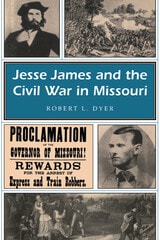
Jesse James and the Civil War in Missouri
Robert L. Dyer
University of Missouri Press, 1994
The Civil War in Missouri was a time of great confusion, violence, and destruction. Although several major battles were fought in the state between Confederate and Union forces, much of the fighting in Missouri was an ugly form of terrorism carried out by loose bands of Missouri guerrillas, by Kansas "Jayhawkers," or by marauding patrols of Union soldiers. This irregular warfare provided a training ground for people like Jesse and Frank James who, after the war, used their newly learned skills to form an outlaw band that ultimately became known all over the world.
Jesse James and the Civil War in Missouri discusses the underlying causes of the Civil War as they relate to Missouri and reveals how the war helped create both the legend and the reality of Jesse James and his gang. Written in an accessible style, this valuable little book will be welcomed by anyone with an interest in the Civil War, the legend of Jesse James, or Missouri history.
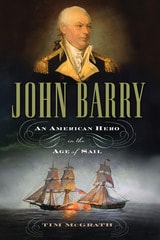
John Barry
An American Hero in the Age of SailTimothy McGrath
Westholme Publishing, 2010
The Life of the First Captain of the United States Navy
Finalist for the Rear Admiral Samuel Eliot Morison Award for Excellence in Naval Literature
“Ashore as well as at sea, Tim McGrath paints an informative, engaging and highly entertaining portrait of this worthy but neglected hero of American independence. The author shows us a man who was a magnificent embodiment of common sense—and uncommon courage and dedication. That such a work is long overdue makes its achievement all the more pleasurable.”—Wall Street Journal
“Combining sophisticated use of sources with a pleasing writing style, McGrath masterfully rescues a father of the U.S. Navy from unmerited eclipse.”—Publishers Weekly
“A nearly indispensable addition to U.S. Navy collections.”—Booklist“McGrath employs exemplary narrative style in this work. . . . In John Barry, the author adroitly juxtaposes maritime history, narratives of naval combat, and early U.S. social history.”—New England Quarterly
“McGrath is a compelling and lucid writer. He brings Barry to life, makes battles understandable, and provides the clearest description of Barry's 1778 capture of the British transport ships Mermaid and Kitty that this reviewer has seen.”—Pennsylvania Magazine of History and Biography
“A great read and an absorbing account of a drama-filled life.”—Naval History
“Well researched, well written, and a pleasure to read, this book restores John Barry to the important place he once held as one of our nation’s great heroes. It is a tale of high adventure and personal courage and you will not want to put it down.” —JAMES L. NELSON, author of George Washington’s Secret Navy
“Readers of this vivid biography will imagine they smell the ocean’s salt air and the sulfurous fumes of gunpowder as they navigate these action-packed pages. Fans of Horatio Hornblower and Lucky Jack Aubrey will rejoice in discovering their real-life American counterpart.”—GREGORY J. URWIN, author of Facing Fearful Odds: The Siege of Wake Island
The man regarded as “the Father of the American Navy” returns to the quarterdeck in John Barry: An American Hero in the Age of Sail, the first comprehensive biography of this legendary officer in generations. Son of a hardscrabble Irish farmer from County Wexford, Barry was sent to sea as a child, arriving in Philadelphia during the restless decade before the American Revolution. Brave and ambitious, he ascended the ratlines to become a successful merchant captain at a young age, commanding the most prestigious ship in the colonies and recording the fastest known day of sail in the century.
Volunteering to fight for the Continental cause, Barry saw his star rise during the War for Independence. As captain of the Lexington, Raleigh, and Alliance, Barry faced down broadsides, mutinies, and even a fleet of icebergs. He captured the first enemy warship taken by a Continental vessel and fought the last battle of the American Revolution. His hard-won victory over two British warships simultaneously garnered him international notoriety, while his skill as a seafarer and cool temper established Barry as a worthy foe among British captains. Without a ship during the winter of 1776-77, the ever resourceful Barry lead a battery of naval artillery at the battle of Princeton. With peace came a historic voyage to China, where Barry helped open trade with that reclusive empire. In 1794, President Washington named Barry as the first commissioned officer in the new United States Navy. Given the title of commodore, Barry ended his career during America’s naval war with France, teaching the ropes to a new generation of officers, most notably Stephen Decatur.
Drawn from primary source documents from around the world, John Barry: An American Hero in the Age of Sail by Tim McGrath brings the story of this self-made American back to life in a major new biography.
John Dooley, Confederate Soldier
His War JournalJohn Dooley
University of Alabama Press, 2005
One of the best primary accounts of the Civil War by a Confederate.
John Dooley was the youngest son of Irish immigrants to Richmond, Virginia, where his father prospered, and the family took a leading position among Richmond’s sizeable Irish community. Early in 1862, John left his studies at Georgetown University to serve in the First Virginia Infantry Regiment, in which his father John and brother James also served. John’s service took him to Second Manassas, South Mountain, Sharpsburg (Antietam), Fredericksburg, and Gettysburg; before that last battle, Dooley was elected a lieutenant. On the third day at Gettysburg, Dooley swept up the hill in Pickett’s charge, where he was shot through both legs and lay all night on the field, to be made a POW the next day. Held until February 27, 1865, Dooley made his way back south to arrive home very near the Confederacy’s final collapse.
Dooley’s account is valuable for the content of his service and because most of the material came from his diary, with some interpolations (which are indicated as such) that he made shortly after the war’s end when his memory was still fresh. Dooley’s health seems to have been permanently compromised by his wounds; he entered a Roman Catholic seminary after the war and died in 1873 several months before his ordination was to take place.
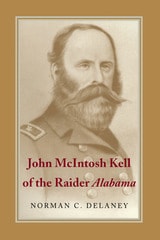
John McIntosh Kell of the Raider Alabama
Norman C. Delaney
University of Alabama Press, 2003
A vivid portrait of the man credited as a driving force behind the most successful of the Confederate raiders, the legendary C.S.S. Alabama.
John McIntosh Kell was an experienced, proven military man, a graduate of Annapolis, a veteran of the Mexican War and of Admiral Perry’s voyage to Japan. As a Confederate officer, Kell served first on the raider Sumter and then on the Alabama. At sea for only 22 months, the Alabama engaged nearly 300 northern merchant vessels, burning 55 of these transport ships along with their million-dollar cargoes.
Though First Lieutenant ("Luff") Kell was apparently content to let his captain, Raphael Semmes, take credit for their accomplishments, Semmes acknowledged that his successes were due largely to the energy and resourcefulness of his second in command. Life on the commerce cruisers was hard and tedious, and much of the responsibility for running the day-to-day operations, including the disciplining of a largely mercenary crew, rested on Kell, whose sense of duty and loyalty did not waver.
Norman C. Delaney bases his account of this remarkable naval officer’s experiences on the interviews Kell granted to news reporters during the 1880s and 1890s (previously neglected by historians) and his memoirs, published in 1900 as Recollections of a Naval Life. He supplements these materials with records from Kell’s earlier years, including letters, journals, diaries, and contemporary observations. First published in 1973 by The University of Alabama Press, this new edition of an award-winning biography will be welcomed by Civil War historians and enthusiasts around the world, naval institutions and museums, and general readers alike.
John Robert Shaw
An Autobiography of Thirty Years, 1777–1807Oressa M. Teagarden
Ohio University Press, 1992
In the summer of 1807 more than a thousand subscribers from New England to Tennessee paid for the initial printing of The Life and Travels of John Robert Shaw: A Narrative of the Life and Travels of the Well-Digger, now resident of Lexington, Kentucky, Written by Himself. Shaw had come to Rhode Island as a British redcoat to put down the colonial rebellion. Through various quirks of fate, including being taken a prisoner of war, he ended up fighting with the Americans. Shaw was an exuberant spirit whose rowdy drinking bouts and related predicaments alternated with periods of wholehearted efforts at reform. His autobiography, written while he recuperated from injuries from one of several explosions (an occupational hazard for the frontier well-digger), is an articulate and entertaining record of the Revolutionary War era.
A 1930 printing of Shaw’s autobiography was rescued from the trash by an alert librarian in Kentucky in 1950. She passed the tattered copy on to journalist Oressa M. Teagarden, who became intrigued with Shaw’s story and spent much of her free time over the next two decades finding out more about the ebullient American. On Teagarden’s death, co-editor Jeanne Crabtree assumed the task of making Shaw’s authentic and colorful view of early America available to a new generation of readers.
John Steinbeck Goes to War
The Moon is Down as PropagandaDonald V. Coers
University of Alabama Press, 2005
WINNER OF THE ELIZABETH AGEE PRIZE IN AMERICAN LITERATURE
When words became weapons—Steinbeck’s novel and the underground war for freedom.
In March 1942, a desperate period for the allies in World War II, John Steinbeck published his propaganda novel The Moon is Down—the story of ruthless invaders who overrun a militarily helpless country. Throughout the novel, Steinbeck underscored both the fatal weakness of the “invincible” unnamed aggressors and the inherent power of the human values shard by the “conquered” people.
The Moon is Down created an immediate sensation among American literary critics; fierce debate erupted over Steinbeck’s uncommonly sympathetic portrayal of the enemy and the novel’s power as a vehicle for propaganda. Fifty years later, Coers continues the debate, relying heavily on unpublished letters and personal interviews with the lawyers, book dealers, actors, publishers, and housewives associated with the resistance movements in Western Europe. Clandestine translations of The Moon Is Down quickly appeared and were widely circulated under the noses of the Gestapo. Coers documents the fate of Steinbeck’s novel in the hands of World War II resistance fighters and deepens our appreciation of Steinbeck’s unique ability to express the feelings of oppressed peoples.
Journal of the American Revolution 2015
Annual VolumeTodd Andrlik
Westholme Publishing, 2015
The Journal of the American Revolution, Annual Volume 2015, presents the journal’s best historical research and writing over the past calendar year. The volume is designed for institutions, scholars, and enthusiasts to provide a convenient overview of the latest research and scholarship in American Revolution studies. The sixty articles in the 2015 edition include:
How Samuel Adams Recruited Sons of Liberty by J. L. Bell
A Patriot–Loyalist: Playing Both Sides by Todd W. Braisted
How Old Were Redcoats? Age and Experience of British Soldiers in America by Don N. Hagist
The Great West Point Chain by Hugh T. Harrington
Raid Across the Ice: The British Operation to Capture Washington by Benjamin Huggins
So Heavy a Trial: The Burning of New York’s First Capital by Jack Kelly
An Elegant Dinner with General Washington at Valley Forge Headquarters by Nancy K. Loane
Mount Vernon: A Landscape for the New Cincinnatus by Joseph Manca
The British Spy Plot to Capture Fort Ticonderoga by John A. Nagy
The Top Ten British Losers by Andrew O’Shaughnessy
Honorable Lords and Pretend Barons: Sorting Out the Noblemen of the American Revolution by Jim Piecuch
Paul Revere’s Other Riders and Rides by Ray Raphael
William Lee and Oney Judge: A Look at George Washington and Slavery by Mary V. Thompson.
Journal of the American Revolution 2016
Annual VolumeTodd Andrlik
Westholme Publishing, 2016
Journal of the American Revolution 2017
Annual VolumeTodd Andrlik
Westholme Publishing, 2017
The forty-six articles in the 2017 edition include:
Why the British Lost the Battle of Sullivan’s Island by C. L. Bragg
The Tiger Aids the Eaglet: How India Secured America’s Independence by Richard Sambasivam
How Yorktown Almost Couldn’t Afford to Happen by John Smith
Was Richard Stockton a Hero? by Christian M. McBurney
The Southern Expedition of 1776: The American Revolution’s Best Kept Secret by Roger Smith
Religious Liberty and Its Virginia Roots by Alex Colvin
Mount Vernon During the American Revolution by Mary V. Thompson
Why God is in the Declaration but not the Constitution by Anthony J. Minna
Colonel Tench Tilghman: George Washington’s Eyes and Ears by Jeff Dacus
The Stockbridge-Mohican Community, 1775–1783 by Bryan Rindfleisch
Two Years Aboard the Welcome: The American Revolution on Lake Huron by Tyler Rudd Putman
Journal of the American Revolution 2018
Annual VolumeDon N. Hagist
Westholme Publishing, 2018
The Journal of the American Revolution, Annual Volume 2018, presents the journal’s best historical research and writing over the past calendar year. The volume is designed for institutions, scholars, and enthusiasts to provide a convenient overview of the latest research and scholarship in American Revolution studies. The forty-one articles in the 2018 edition include:
Anti-Indian Radicalization in the Early American West, 1774–1795 by Darren R. Reid
The Setauket Raid, December 1777 by Phillip R. Giffin
The 3rd New Jersey Regiment’s Plundering of Johnson Hall by Philip D. Weaver
A Proposed Alliance of the Knights of Malta and the United States of America by Bruce Ware Allen
Country Crowds in Revolutionary Massachusetts: Mobs and Militia by Ray Raphael
Lafayette: An Acerbic Tongue or an Incisive Judge of Character? by Gene Procknow
Admiral Rodney Ousts the Jews from St. Eustatius by Louis Arthur Norton
Preventing Slave Insurrection in South Carolina & Georgia, 1775–1776 by Jim Piecuch
The “P” is for Profit: Revolutionary War Privateers and the Slave Trade by Michael Thomin
The Remarkable Spanish Pilgrimage of John Adams by John L. Smith, Jr.
Thomas Paine, Deism, and the Masonic Fraternity by Shai Afsai
A Fresh Look at Major Patrick Ferguson by Wayne Lynch
Displaced: The Donation People of 1775 by Katie Turner Getty
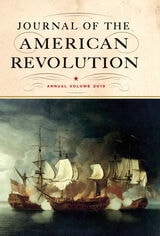
Journal of the American Revolution 2019
Annual VolumeDon N. Hagist
Westholme Publishing, 2019
The Journal of the American Revolution, Annual Volume 2019, presents the journal’s best historical research and writing over the past calendar year. The volume is designed for institutions, scholars, and enthusiasts to provide a convenient overview of the latest research and scholarship in American Revolution and Founding Era studies. The thirty-eight articles in the 2019 edition include:
Join, or Die: Political and Religious Controversy Over Franklin’s Snake Cartoon by Daniel P. Stone
The Connecticut Captivity of William Franklin, Loyalist by Louis Arthur Norton
Revisiting the Prayer at Valley Forge by Blake McGready
John the Painter: Terrorist for America by Lars Hedbor
Who Picked the Committees at the Constitutional Convention? by David O. Stewart
Norfolk, Virginia, Sacked by North Carolina and Virginia Troops by Patrick H. Hannum
Elias Hasket Derby: The Privateer Who Pioneered the Russian Trade by Nick Deluca
Benedict Arnold’s Master Plan (for British) Victory by John Knight
China and the American Revolution by Simon Hill
Moravians in the Middle: The Gnadenhutten Massacre by Eric Sterner
Slavery Through the Eyes of Revolutionary Generals by Gene Procknow
Our Man in Minorca: Lewis Littlepage, American Volunteer with the Spanish Armed Forces by Larrie D. Ferreiro
Patrick Tonyn: Britain’s Most Effective Revolutionary-Era Royal Governor by Jim Piecuch
Jefferson’s Reckoning: The Sage of Monticello’s Haunting Final Years by Geoff Smock
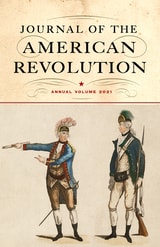
Journal of the American Revolution 2021
Annual VolumeDon N. Hagist
Westholme Publishing, 2021
The Journal of the American Revolution, Annual Volume 2021, presents the journal’s best historical research and writing over the past calendar year. The volume is designed for institutions, scholars, and enthusiasts to provide a convenient overview of the latest research and scholarship in American Revolution and Founding Era studies. The thirty-four articles in the 2021 edition include:
Alexander Hamilton’s Missing Years: New Discoveries and Insights into the Little Lion’s Caribbean Childhood by Ruud Stelten and Alexandre Hinton
The Lenape Origins of an Independent America: The Catalyst of Pontiac’s War, 1763–1765 by Kevin A. Conn
Impeachment: The Framers Debate and Discuss by Ray Raphael
The First Efforts to Limit the African Slave Trade by Christian M. McBurney
What Killed Prisoners of War?—A Medical Investigation by Brian Patrick O'Malley
The Mysterious March of Horatio Gates by Andrew Waters
Minorcans, New Smyrna, and the American Revolution in East Florida by George Kotlik
Stony Point: The Second Occupation, July–October 1779 by Michael J. F. Sheehan
A Demographic View of North Carolina Militia and State Troops, 1775–1783 by Douglas R. Dorney, Jr.
The Revolutionary War Origin of the Whistleblower Law by Louis Arthur Norton
Mapping the Battle of Eutaw Springs: Modern GIS Solves a Historic Mystery by Stephen John Katzberg
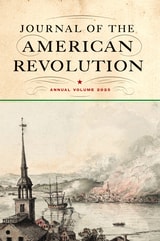
Journal of the American Revolution 2025
Annual VolumeDon N. Hagist
Westholme Publishing, 2025
The year’s best articles from the leading on-line source of new research on the Revolution and Founding eras
The Journal of the American Revolution, Annual Volume 2025, presents the journal’s best historical research and writing over the past calendar year. The volume of thirty-five articles is designed for institutions, scholars, and enthusiasts to provide a convenient overview of the latest research and scholarship in American Revolution and Founding Era studies.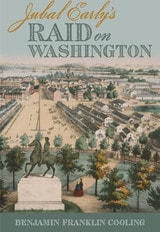
Jubal Early's Raid on Washington
Benjamin Franklin Cooling
University of Alabama Press, 2008
The raid that exposed the Union capital’s greatest danger.
The definitive description of the last Confederate invasion of the Union in 1864. The Civil War was in its fourth year, and the Union’s victory was not at all certain. The Lincoln administration seemed weak as the autumn election approached. Lee’s army remained strong in Virginia while Johnston’s forces feinted and dodged in north Georgia to shield Atlanta. The Union army and navy grew in strength, but Confederate forces continued to fight tenaciously.
Amid an air of stalemate, the Confederates planned a bold move to strike at Washington, DC and capture or scatter Lincoln and his cabinet. In command of the operation was the colorful and unpredictable Jubal “Old Jube” Anderson Early, brought in to replace the fallen Stonewall Jackson. Less well known than the bloodier Antietam and Gettysburg, Early's campaign, Cooling argues, had greater significance.
In addition to the persnickety bachelor Anderson, this account introduces many colorful participants, including railroad president John W. Garrett, the politically influential Blair family, and Elizabeth “Aunt Betty” Thomas, a free Black woman, who was said to have saved Lincoln’s life by shouting at him: “Get down, you fool!” when he came under fire at Fort Stevens. Exciting and comprehensive, Civil War scholars and readers will delight in this masterful account.