Results by title
491 books match the query 'Moral and ethical aspects' and 4 start with j
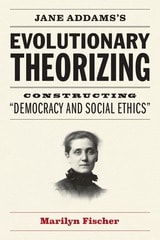
Jane Addams's Evolutionary Theorizing
Constructing “Democracy and Social Ethics”Marilyn Fischer
University of Chicago Press, 2019
Examining essays Addams wrote in the 1890s and showing how they were revised for Democracy and Social Ethics, Fischer draws from philosophy, history, literature, rhetoric, and more to uncover the array of social evolutionary thought Addams engaged with in her texts—from British socialist writings on the evolution of democracy to British and German anthropological accounts of the evolution of morality. By excavating Addams’s evolutionary reasoning and rhetorical strategies, Fischer reveals the depth, subtlety, and richness of Addams’s thought.
Just Care
Messy Entanglements of Disability, Dependency, and DesireAkemi Nishida
Temple University Press, 2022
Just Care is Akemi Nishida’s thoughtful examination of care injustice and social justice enabled through care. The current neoliberal political economy has turned care into a business opportunity for the healthcare industrial complex and a mechanism of social oppression and control. Nishida analyzes the challenges people negotiate whether they are situated as caregivers, receivers, or both. Also illuminated is how people with disabilities come together to assemble community care collectives and bed activism (resistance and visions emerging from the space of bed) to reimagine care as a key element for social change.
The structure of care, Nishida writes, is deeply embedded in and embodies the cruel social order—based on disability, race, gender, migration status, and wealth—that determines who survives or deteriorates. Simultaneously, many marginalized communities treat care as the foundation of activism. Using interviews, focus groups, and participant observation with care workers and people with disabilities, Just Care looks into lives unfolding in the assemblage of Medicaid long-term care programs, community-based care collectives, and bed activism. Just Care identifies what care does, and asks: How can we activate care justice or just care where people feel cared affirmatively and care being used for the wellbeing of community and for just world making?
Just Vibrations
The Purpose of Sounding GoodWilliam Cheng
University of Michigan Press, 2016
Modern academic criticism bursts with what Eve Kosofsky Sedgwick once termed paranoid readings—interpretative feats that aim to prove a point, persuade an audience, and subtly denigrate anyone who disagrees. Driven by strategies of negation and suspicion, such rhetoric tends to drown out softer-spoken reparative efforts, which forego forceful argument in favor of ruminations on pleasure, love, sentiment, reform, care, and accessibility.
Just Vibrations: The Purpose of Sounding Good calls for a time-out in our serious games of critical exchange. Charting the divergent paths of paranoid and reparative affects through illness narratives, academic work, queer life, noise pollution, sonic torture, and other touchy subjects, William Cheng exposes a host of stubborn norms in our daily orientations toward scholarship, self, and sound. How we choose to think about the perpetration and tolerance of critical and acoustic offenses may ultimately lead us down avenues of ethical ruin—or, if we choose, repair. With recourse to experimental rhetoric, interdisciplinary discretion, and the playful wisdoms of childhood, Cheng contends that reparative attitudes toward music and musicology can serve as barometers of better worlds.
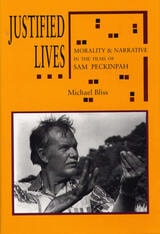
Justified Lives
Morality and Narrative in the Films of Sam PeckinpahMichael Bliss
Southern Illinois University Press, 1993
In the first book to critically examine each of the fourteen feature films Sam Peckinpah directed during his career, Michael Bliss stresses the persistent moral and structural elements that permeate Peckinpah’s work.
By examining the films in great detail, Bliss makes clear the moral framework of temptation and redemption with which Peckinpah was concerned while revealing the director’s attention to narrative. Bliss shows that each of Peckinpah’s protagonists is involved with attempting, in the words of Ridethe High Country’s Steve Judd, "to enter my house justified."
The validity of this systematic method is clearly demonstrated in the chapter devoted to The Wild Bunch. Byenumerating the doublings and triplings of action and dialogue found in the film, Bliss underscores its symbolic and structural complexity. Beginning the chapters treating Junior Bonner and The Getaway with analyses of their important title sequences, Bliss shows how these frequently disregarded pieces present in miniature the major moral and narrative concerns of the films. In his chapter on The Osterman Weekend, Bliss makes apparent Peckinpahs awareness of and concern with the self-reflexive nature of filmmaking itself.
Bliss shows that like John Ford, Peckinpah moved from optimism to pessimism. The films of the director’s early period, from The Deadly Companions to Cable Hogue, support the romantic ideals of adventure and camaraderie and affirm a potential for goodness in America. In his second group of films, which begins with Straw Dogs and ends with Bring Me the Head of Alfredo Garcia, both heroes and hope have vanished. It is only in The Osterman Weekend that Peckinpah appears finally to have renewed his capacity for hope, allowing his career to close in a positive way.