Results by title
99 books match the query 'National' and 4 start with j
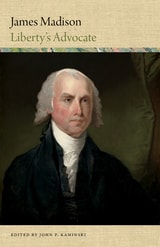
James Madison
Liberty's AdvocateJohn P. Kaminski
Wisconsin Historical Society Press, 2018
A Word Portrait of an American Founder.
America has had few political thinkers who have rivalled James Madison. The son of a wealthy planter, Madison was an unhealthy child and was beset by physical infirmities throughout his long life, and grew into a cerebral man. Madison left Virginia to attend the College of New Jersey, but returned to his native state after completing his studies. Though he aspired to be a college professor, Madison instead went into public service and became one of the most influential, guiding voices of the Founding Era. Madison’s Virginia Plan would be used as a blueprint for the Constitutional Convention, where the Articles of Confederation would be replaced with a new Constitution that bore traces of Madison’s influence throughout.
Editor John Kaminski has gathered a remarkable collection of quotations by and about James Madison for the third installment of his Word Portraits of America’s Founders series. Through these words by and about Madison, we learn more about one of the country’s most influential Founding Fathers, who held a lifelong commitment to liberty and opposed oppression.
[more]
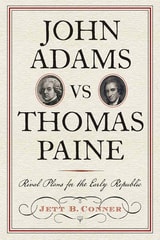
John Adams vs Thomas Paine
Rival Plans for the Early RepublicJett B. Conner
Westholme Publishing, 2018
How Paine’s Common Sense and Adams’s Thoughts on Government Shaped Our Modern Political Institutions
Initially admiring Thomas Paine’s efforts for independence, John Adams nevertheless was rattled by the political philosophy of Common Sense and responded to it by publishing his Thoughts on Government to counteract Paine’s proposals, which Adams said were far too “democratical.” Although John Adams is given credit for his substantive contributions to American constitutionalism, especially his notions of separation of powers, checks and balances, and representation, in John Adams vs Thomas Paine: Rival Plans for the Early Republic, historian Jett B. Conner makes the case that Thomas Paine was more than just a revolutionary figure who spurred Americans toward declaring independence. Common Sense made important contributions to American constitutional thought, too, particularly its call for more equal representation, popular sovereignty, a constitutional convention, and a federal system of governance with a strong central government. The book explores how the two rivals helped shape America’s first constitutions—the Articles of Confederation and those of several states— and how they continued contributing to American political thought as it developed during the so-called “critical period” between the adoption of the Articles of Confederation and the start of the Constitutional Convention of 1787. It also focuses on the creation of our democratic republic and compares Paine’s and Adams’s approaches to structuring constitutions to ensure free government while guarding against abuses of power and the excesses of democratic majorities. An abridged version of Common Sense and the short but complete Thoughts on Government are included in an appendix for easy reader reference.
Initially admiring Thomas Paine’s efforts for independence, John Adams nevertheless was rattled by the political philosophy of Common Sense and responded to it by publishing his Thoughts on Government to counteract Paine’s proposals, which Adams said were far too “democratical.” Although John Adams is given credit for his substantive contributions to American constitutionalism, especially his notions of separation of powers, checks and balances, and representation, in John Adams vs Thomas Paine: Rival Plans for the Early Republic, historian Jett B. Conner makes the case that Thomas Paine was more than just a revolutionary figure who spurred Americans toward declaring independence. Common Sense made important contributions to American constitutional thought, too, particularly its call for more equal representation, popular sovereignty, a constitutional convention, and a federal system of governance with a strong central government. The book explores how the two rivals helped shape America’s first constitutions—the Articles of Confederation and those of several states— and how they continued contributing to American political thought as it developed during the so-called “critical period” between the adoption of the Articles of Confederation and the start of the Constitutional Convention of 1787. It also focuses on the creation of our democratic republic and compares Paine’s and Adams’s approaches to structuring constitutions to ensure free government while guarding against abuses of power and the excesses of democratic majorities. An abridged version of Common Sense and the short but complete Thoughts on Government are included in an appendix for easy reader reference.
[more]
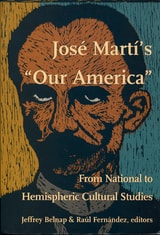
José Martí's Our America
From National to Hemispheric Cultural StudiesJeffrey Belnap and Raúl Fernández, eds.
Duke University Press, 1998
Considerable attention has been given to Cuban poet, essayist, and activist José Martí’s 1891 essay “Nuestra América,” but relatively little has been paid to the rest of the journalistic work that Martí produced during his fourteen-year exile in the United States. In José Martí’s Our America, Jeffrey Belnap and Raúl Fernández present essays from Latin American, Caribbean, and U.S.-based scholars who consider Martí’s rich and underexplored body of work and position Martí as an emblem of New American studies.
A Cuban exile from 1881 to 1895, Martí was a correspondent writing in New York for various Latin American newspapers. Grasping the significance of rising U.S. imperial power, he came to understand the Americas as a complex system of kindred—but not equal—national formations whose cultural and political integrity was threatened by the overbearing aggressiveness of the United States. This collection explores how in his journalistic work Martí critiques U.S. racism, imperialism, and capitalism; warns Latin America of impending U.S. geographical, cultural, and economic annexation; and calls for recognition of the diversity of America’s cultural voices. Reinforcing Martí’s hemispheric vision with essays by a wide range of scholars who investigate his analysis of the United States, his significance as a Latino outsider, and his analyses of Latin American cultural politics, this volume explores the affinities between Martí’s thought and current reexaminations of what it means to study America.
José Martí’s Our America offers a new understanding of Martí’s ambiguous and problematic relation with the United States and will engage scholars and students in American, Latin American, and Latino studies as well as those interested in cultural, postcolonial, gender, and ethnic studies.
Contributors. Jeffrey Belnap, Raúl Fernández, Ada Ferrer, Susan Gillman, George Lipsitz, Oscar Martí, David Noble, Donald E. Pease, Beatrice Pita, Brenda Gayle Plummer, Susana Rotker, José David Saldívar, Rosaura Sánchez, Enrico Mario Santí, Doris Sommer, Brook Thomas
[more]
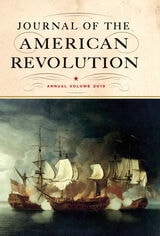
Journal of the American Revolution 2019
Annual VolumeDon N. Hagist
Westholme Publishing, 2019
The Year’s Best Articles from the Leading On-Line Source of New Research on the American Revolution and Founding Eras
The Journal of the American Revolution, Annual Volume 2019, presents the journal’s best historical research and writing over the past calendar year. The volume is designed for institutions, scholars, and enthusiasts to provide a convenient overview of the latest research and scholarship in American Revolution and Founding Era studies. The thirty-eight articles in the 2019 edition include:
Join, or Die: Political and Religious Controversy Over Franklin’s Snake Cartoon by Daniel P. Stone
The Connecticut Captivity of William Franklin, Loyalist by Louis Arthur Norton
Revisiting the Prayer at Valley Forge by Blake McGready
John the Painter: Terrorist for America by Lars Hedbor
Who Picked the Committees at the Constitutional Convention? by David O. Stewart
Norfolk, Virginia, Sacked by North Carolina and Virginia Troops by Patrick H. Hannum
Elias Hasket Derby: The Privateer Who Pioneered the Russian Trade by Nick Deluca
Benedict Arnold’s Master Plan (for British) Victory by John Knight
China and the American Revolution by Simon Hill
Moravians in the Middle: The Gnadenhutten Massacre by Eric Sterner
Slavery Through the Eyes of Revolutionary Generals by Gene Procknow
Our Man in Minorca: Lewis Littlepage, American Volunteer with the Spanish Armed Forces by Larrie D. Ferreiro
Patrick Tonyn: Britain’s Most Effective Revolutionary-Era Royal Governor by Jim Piecuch
Jefferson’s Reckoning: The Sage of Monticello’s Haunting Final Years by Geoff Smock
[more]