Results by title
58 books match the query 'Novelists, American' and 4 start with j
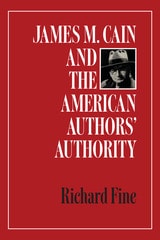
James M. Cain and the American Authors' Authority
By Richard Fine
University of Texas Press, 1992
The 1940s offered ever-increasing outlets for writers in book publishing, magazines, radio, film, and the nascent television industry, but the standard rights arrangements often prevented writers from collecting a fair share of the profits made from their work. To remedy this situation, novelist and screenwriter James M. Cain (The Postman Always Rings Twice,Double Indemnity, Mildred Pierce) proposed that all professional writers, including novelists, playwrights, poets, and screenwriters, should organize into a single cartel that would secure a fairer return on their work from publishers and producers. This organization, conceived and rejected within one turbulent year (1946), was the American Authors' Authority (AAA).
In this groundbreaking work, Richard Fine traces the history of the AAA within the cultural context of the 1940s. After discussing the profession of authorship as it had developed in England and the United States, Fine describes how the AAA, which was to be a central copyright repository, was designed to improve the bargaining position of writers in the literary marketplace, keep track of all rights and royalty arrangements, protect writers' interests in the courts, and lobby for more favorable copyright and tax legislation.
Although simple enough in its design, the AAA proposal ignited a firestorm of controversy, and a major part of Fine's study explores its impact in literary and political circles. Among writers, the AAA exacerbated a split between East and West Coast writers, who disagreed over whether writing should be treated as a money-making business or as an artistic (and poorly paid) calling. Among politicians, a move to unite all writers into a single organization smacked of communism and sowed seeds of distrust that later flowered in the Hollywood blacklists of the McCarthy era.
Drawing insights from the fields of American studies, literature, and Cold War history, Fine's book offers a comprehensive picture of the development of the modern American literary marketplace from the professional writer's perspective. It uncovers the effect of national politics on the affairs of writers, thus illuminating the cultural context in which literature is produced and the institutional forces that affect its production.

John Steinbeck - American Writers 94
University of Minnesota Pamphlets on American WritersJames Gray
University of Minnesota Press, 1971
John Steinbeck - American Writers 94 was first published in 1971. Minnesota Archive Editions uses digital technology to make long-unavailable books once again accessible, and are published unaltered from the original University of Minnesota Press editions.
Journals
Volume FifteenHerman Melville
Northwestern University Press, 1989
The editors supply full annotations of Melville's allusions and terse entries and an exhaustive index makes available the range of his acquaintance with people, places, and works of art. Also included are related documents, illustrations, maps, and many pages and passages reproduced from the journals. This scholarly edition aims to present a text as close to the author's intention as his difficult handwriting permits. It is an Approved Text of the Center for Editions of American Authors (Modern Language Association of America).
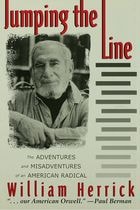
Jumping the Line
The Adventures and Misadventures of an American RadicalWilliam Herrick
University of Wisconsin Press, 1998
An eye-opening account of time served in the great battles of our century— for workers’ rights, against Fascism, Communism, and racism—Jumping the Line is the life story of an American original. William Herrick chronicles his adventures and misadventures on the front lines of the Spanish Civil War, in (and very much out of) the Communist Party, driving a tractor on a communal farm in Michigan, jumping the line as a hobo, organizing African American sharecroppers in Georgia, at work with Orson Welles, and immersed in his own writing.
Herrick chronicles a life of great conviction and great disillusion. He went to Spain in 1936 to fight against the Fascists and there witnessed the horrifying acts that Fascists and Communists alike committed, before he was felled by a near-fatal wound. Here he tells about the life that led him, a working-class Jewish kid from New York, into the idealism and then the murky politics of this internecine conflict. From the bloody fight in Spain he takes us to the battlefields of the Communist movement in the U.S., where he found himself parading up and down the garment district of Manhattan, denouncing his former comrades.
When Paul Berman interviewed Herrick in the Village Voice in 1986, for the fiftieth anniversary of the Spanish Civil War, Herrick’s remarks so incensed other veterans of the Abraham Lincoln battalion that they picketed the paper. What William Herrick has to say doesn’t always go down easily. But for those who like the truth, with a dash of wit and a healthy dose of history, it can be exhilarating.