Results by title
704 books match the query 'Political Process' and 3 start with j
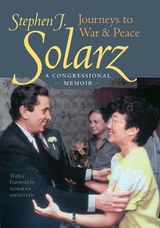
Journeys to War and Peace
A Congressional MemoirStephen J. Solarz
Brandeis University Press, 2011
In this remarkable book, recounting his long, influential career as a congressman from New York, Stephen Solarz gives an insider’s view of the life of a hard-working legislator in the forefront of democracy movements and human rights during a tumultuous time in our nation’s history. A member of the class of 1974, the so-called “Watergate” class, when 75 freshman Democrats were elected to the Congress, Solarz was part of the group that brought about a power shift in the House from an inner circle of senior committee chairs to a much larger group of subcommittee leaders. Early on he sought and won a seat on the House Foreign Affairs Committee, where he earned a reputation as an expert in international relations, traveling to more than 100 countries and meeting the likes of Anwar Sadat, Menachem Begin, Nelson Mandela, Indira Gandhi, Saddam Hussein, Kim Il Sung, and Robert Mugabe. Solarz gives fascinating, detailed descriptions of his role in bringing democracy to South Korea and Taiwan, the triumph of people power in the Philippines, the peace agreement in Cambodia, the abolition of apartheid in South Africa, and the adoption of the resolution authorizing the use of force in the first Gulf War. Written in an engaging style, Journeys to War and Peace will appeal to all who value the struggle for human rights and seek a better understanding between differing cultures and peoples.
[more]
Just Elections
Creating a Fair Electoral Process in the United StatesDennis F. Thompson
University of Chicago Press, 2002
The 2000 election showed that the mechanics of voting such as ballot design, can make a critical difference in the accuracy and fairness of our elections. But as Dennis F. Thompson shows, even more fundamental issues must be addressed to insure that our electoral system is just.
Thompson argues that three central democratic principles—equal respect, free choice, and popular sovereignty—underlie our electoral institutions, and should inform any assessment of the justice of elections. Although we may all endorse these principles in theory, Thompson shows that in practice we disagree about their meaning and application. He shows how they create conflicts among basic values across a broad spectrum of electoral controversies, from disagreements about term limits and primaries to disputes about recounts and presidential electors.
To create a fair electoral system, Thompson argues, we must deliberate together about these principles and take greater control of the procedures that govern our elections. He demonstrates how applying the principles of justice to electoral practices can help us answer questions that our electoral system poses: Should race count in redistricting? Should the media call elections before the polls close? How should we limit the power of money in elections?
Accessible and wide ranging, Just Elections masterfully weaves together the philosophical, legal, and political aspects of the electoral process. Anyone who wants to understand the deeper issues at stake in American elections and the consequences that follow them will need to read it.
In answering these and other questions, Thompson examines the arguments that citizens and their representatives actually use in political forums, congressional debates and hearings, state legislative proceedings, and meetings of commissions and local councils. In addition, the book draws on a broad range of literature: democratic theory, including writings by Madison, Hamilton, and Tocqueville, and contemporary philosophers, as well as recent studies in political science, and work in election law.
[more]
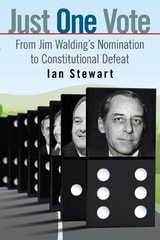
Just One Vote
From Jim Walding's Nomination to Constitutional DefeatIan Stewart
University of Manitoba Press, 2009
On January 12, 1986, Jim Walding was nominated as the New Democratic Party candidate for the Manitoba constituency of St. Vital. Although Walding had been an MLA for fifteen years, he had fallen out of favour with key elements in his party, and won the nomination by only a single vote. Walding went on, in turn, to bring down his own government by a single vote, marking the only time in the history of Canadian politics that a majority government was brought down from within. Combining data drawn from archives, interviews, and the media, Just One Vote is a vivid and exceptionally detailed study of the nomination process. Ian Stewart outlines the geographic, social, and political backdrop behind Walding’s contested party nomination, the unusual chain of events triggered by the contestation, including the fall of the Pawley government and the NDP’s defeat in the 1988 provincial election, and examines the fallout from these events on Manitobans and Canadians.
[more]