4743 books match the query 'Religion' and 124 start with j
cover of Jairus’s Daughter and the Female Body in Mark

Jairus’s Daughter and the Female Body in Mark

Janine E. Luttick

SBL Press, 2023

Jairus’s Daughter and the Female Body in Mark demonstrates that ubiquitous and significant depictions of children in the literature and material culture of the first century CE shaped the mindsets of the Gospel of Mark’s original audience. Through a detailed analysis of the story of Jairus’s daughter in Mark 5 and of the archaeological remains depicting female children, Janine E. Luttick reveals how ancient hearers of this story encountered an image of a female child that communicated ideas of hope to Jesus’s followers and in turn how readers today can understand the authority of Jesus, the domestic structures of early Christianity, and the suffering and loss experienced by some early Christians.
[more]
cover of Jamaica Genesis: Religion and the Politics of Moral Orders

Jamaica Genesis

Religion and the Politics of Moral Orders

Diane J. Austin-Broos

University of Chicago Press, 1997
How has Pentecostalism, a decidedly American form of Christian revivalism, managed to achieve such phenomenal religious ascendancy in a former British colony among people of predominately African descent? According to Diane J. Austin-Broos, Pentecostalism has flourished because it successfully mediates between two historically central yet often oppositional themes in Jamaican religious life—the characteristically African striving for personal freedom and happiness, and the Protestant struggle for atonement and salvation through rigorous ethical piety. With its emphasis on the individual experience of grace and on the ritual efficacy of spiritual healing, and with its vibrantly expressive worship, Jamaican Pentecostalism has become a powerful and compelling vehicle for the negotiation of such fundamental issues as gender, sexuality, race, and class. Jamaica Genesis is a work of signal importance to all those concerned not simply with Caribbean studies but with the ongoing transformation of religion andculture.
[more]
cover of James Baldwin and the Heavenly City: Prophecy, Apocalypse, and Doubt

James Baldwin and the Heavenly City

Prophecy, Apocalypse, and Doubt

Christopher Z. Hobson

Michigan State University Press, 2018
Behind James Baldwin’s uncanny ability to evoke a nation’s crisis and potential hope lies his use of religious language to describe social and sexual transformation. The first study of its kind, James Baldwin and the Heavenly City shows that Baldwin’s novels use biblical ideas in partly but not fully secularized ways to express the possible human attainment of a new life embodying a real but undefinable holiness. Focusing on Baldwin’s six novels, along with essays, stories, and drama, the book first shows Baldwin’s method of recasting biblical and African American prophetic traditions to reveal their liberating core. It then examines several key themes: the prophet’s selection, seen in Baldwin’s debut novel, Go Tell It on the Mountain; the three linked ideas of prophetic art, the “apocalyptic body,” and the “apocalyptic city,” as presented in all his novels; and the polarity between prophecy and doubt, the subject of his last novel, Just Above My Head. This important work provides new readings of Baldwin’s novels, reassesses his once-neglected later fiction, and shows Gospel music’s centrality (with blues) in his fictional imagination.
 
[more]
cover of James Jesse Strang: The Rise and Fall of Michigan's Mormon King

James Jesse Strang

The Rise and Fall of Michigan's Mormon King

Don Faber

University of Michigan Press, 2016

Few lives experience a meteoric rise and fall like that of James Jesse Strang’s. An unsuccessful lawyer from upstate New York, he converted to Mormonism in 1844 and quickly entered the inner circle of the controversial new faith’s founder, Joseph Smith Jr. Upon Smith’s assassination, Strang sought to be named his successor as leader of the Mormons. Instead, Strang was excommunicated in 1850, though not before gathering a group of followers, who settled with him on remote Beaver Island in northern Lake Michigan and ordained Strang king of the small enclave. King Strang elicited both ire and stubborn admiration from an ever-growing list of opponents, his actions closely monitored by President Millard Fillmore himself. In 1866, Strang was assassinated, seemingly with the assistance of federal authorities.

This captivating new biography by Don Faber recounts the fascinating story of Strang’s path from impoverished New York farm boy to one of the most colorful and contentious personalities in Michigan history. Avoiding the nonsense, misinformation, and twisted facts so prevalent about the man, readers meet the historical Strang stripped of myth, demonization, and popular fancy—a true celebrity of the mid-nineteenth century who both shaped and was shaped by the colorful times in which he lived. This book will appeal to readers interested in the history of Michigan, the nineteenth century, and the Second Great Awakening.
[more]
cover of James and Dewey on Belief and Experience

James and Dewey on Belief and Experience

Edited by John M. Capps and Donald Capps

University of Illinois Press, 2010

Donald Capps and John Capps's James and Dewey on Belief and Experience juxtaposes the key writings of two philosophical superstars. As fathers of Pragmatism, America's unique contribution to world philosophy, their work has been enormously influential, and remains essential to any understanding of American intellectual history.
 
In these essays, you'll find William James deeply embroiled in debates between religion and science. Combining philosophical charity with logical clarity, he defended the validity of religious experience against crass forms of scientism. Dewey identified the myriad ways in which supernatural concerns distract religious adherents from pressing social concerns, and sought to reconcile the tensions inherent in science's dual embrace of common sense and the aesthetic.
                       
James and Dewey on Belief and Experience is divided into two sections: the former showcases James, the latter is devoted to Dewey. Two transitional passages in which each reflects on the work of the other bridge these two main segments. Together, the sections offer a unique perspective on the philosophers' complex relationship of influence and interdependence. An editors' introduction provides biographical information about both men, an overview of their respective philosophical orientations, a discussion of the editorial process, and a brief commentary on each of the selections.
 
Comparing what these foremost pragmatists wrote on both themes illumines their common convictions regarding the nature of philosophical inquiry and simultaneously reveals what made each a distinctive thinker. 
 
[more]
cover of Jamón and Halal: Lessons in Tolerance from Rural Andalucía

Jamón and Halal

Lessons in Tolerance from Rural Andalucía

Christina Civantos

Amherst College Press, 2022

Contemporary Spain reflects broader patterns of globalization and has been the site of tensions between nationalists and immigrants. This case study examines a rural town in Spain’s Andalucía in order to shed light on the workings of coexistence. The town of Órgiva’s diverse population includes hippies from across Europe, European converts to Sufi Islam, and immigrants from North Africa. Christina Civantos combines the analysis of written and visual cultural texts with oral narratives from residents. In this book, we see that although written and especially televisual narratives about the town highlight tolerance and multiculturalism, they mask tensions and power differentials. Toleration is an ongoing negotiation, and this book shows us how we can identify the points of contact that create robust, respect-based tolerance.

“This is a book that is both a personal account and a rigorous academic study. It is a model for the kind of engaged humanistic work we are now beginning to see as a hallmark of the post-theory moment, and one that remembers the hard lessons of ethnographic fieldwork as well as the challenging foundational work from philosophically-tinged theory.” —Debra A. Castillo, Cornell University

“Filled with rich descriptions and interwoven personal anecdotes of both Civantos and her interlocuters that complement scholarly analysis.” —Jessica R. Boll, Carroll University
[more]
cover of Jansenism: An International Anthology

Jansenism

An International Anthology

Shaun Blanchard

Catholic University of America Press, 2024
Jansenism: An International Anthology is the first comprehensive anthology of Jansenist texts in English translation. Covering the full sweep of the Jansenist movement from the 1630s until the early nineteenth century, this anthology is a major asset to historians of early modernity, theologians, advanced and beginner students, and interested non-specialists. Readers of English can now directly hear the voices of the women and men, nuns and priests, and politicians and pamphleteers embroiled in some of the most dynamic controversies of early modern Christianity. While giving due attention to France, the anthology showcases the geographic breadth of Jansenism, from Portugal to Lebanon. Consequently, a team of translators have provided texts translated not just from French and Latin; selections from German, Spanish, Portuguese, Italian, and Arabic also appear here. Blanchard and Yoder present a diverse range of texts, including letters, tracts, periodical excerpts, books, treatises, and synodal documents. These readings cover the controversies over divine grace and penance for which Jansenism is infamous, but they also show the widening scope of Jansenists’ reformist concerns as the movement developed and changed. They address issues such as liturgical reform, devotion to Mary and the saints, politics, religious toleration, prayer, gender and the role of women in the Church, polemics, and ecclesiastical reform. The whole volume is introduced by an essay introducing Jansenism, exposing the important themes, summarizing the relevant scholarship, and contextualizing the content that will follow. Jansenism: An International Anthology provides the first port-of-call for the study of Jansenism in English. The anthology presents a diverse and rich selection of primary source texts and draws on the best recent research into the fascinating and controversial transnational phenomena called “Jansenism.”
[more]
cover of Jerome, Epistle 106 (On the Psalms)

Jerome, Epistle 106 (On the Psalms)

Michael Graves

SBL Press, 2022

A fresh interpretation of the nature, purpose, and date of Jerome’s Epistle 106

In this volume of the Writings from the Greco-Roman World series, Michael Graves offers the first accessible English translation and commentary on Jerome’s Epistle 106, an important work of patristic biblical interpretation. In his treatise Jerome discusses different textual and exegetical options according to various Greek and Latin copies of the Psalms with input from the Hebrew. Epistle 106 provides insightful commentary on the Gallican Psalter, Jerome’s translation of Origen’s hexaplaric edition. Jerome’s work offers a unique window into the complex textual state of the Psalter in the late fourth century and serves as an outstanding example of ancient philological scholarship on the Bible. Graves’s translation and commentary is an essential resource for scholars and students of patristic exegesis, biblical textual criticism, and late antique Christianity.
[more]
cover of Jerusalem 1900: The Holy City in the Age of Possibilities

Jerusalem 1900

The Holy City in the Age of Possibilities

Vincent Lemire

University of Chicago Press, 2017

Perhaps the most contested patch of earth in the world, Jerusalem’s Old City experiences consistent violent unrest between Israeli and Palestinian residents, with seemingly no end in sight. Today, Jerusalem’s endless cycle of riots and arrests appears intractable—even unavoidable—and it looks unlikely that harmony will ever be achieved in the city. But with Jerusalem 1900, historian Vincent Lemire shows us that it wasn’t always that way, undoing the familiar notion of Jerusalem as a lost cause and revealing a unique moment in history when a more peaceful future seemed possible.
 
In this masterly history, Lemire uses newly opened archives to explore how Jerusalem’s elite residents of differing faiths cooperated through an intercommunity municipal council they created in the mid-1860s to administer the affairs of all inhabitants and improve their shared city. These residents embraced a spirit of modern urbanism and cultivated a civic identity that transcended religion and reflected the relatively secular and cosmopolitan way of life of Jerusalem at the time. These few years would turn out to be a tipping point in the city’s history—a pivotal moment when the horizon of possibility was still open, before the council broke up in 1934, under British rule, into separate Jewish and Arab factions. Uncovering this often overlooked diplomatic period, Lemire reveals that the struggle over Jerusalem was not historically inevitable—and therefore is not necessarily intractable. Jerusalem 1900 sheds light on how the Holy City once functioned peacefully and illustrates how it might one day do so again.
[more]
cover of Jerusalem of Lithuania: A Reader in Yiddish Cultural History

Jerusalem of Lithuania

A Reader in Yiddish Cultural History

Jerold C. Frakes

The Ohio State University Press, 2011

Yerusholayim d’lite: di yidishe kultur in der lite (Jerusalem of Lithuania: A Reader in Yiddish Cultural History) by Jerold C. Frakes contains cultural, literary, and historical readings in Yiddish that vividly chronicle the central role Vilnius (Lithuania) played in Jewish culture throughout the past five centuries. It includes many examples of Yiddish literature, historiography, sociology, and linguistics written by and about Litvaks and includes work by prominent Yiddish poets, novelists, raconteurs, journalists, and scholars. In addition, Frakes has supplemented the primary texts with many short essays that contextualize Yiddish cultural figures, movements, and historical events.
 
Designed especially for intermediate and advanced readers of Yiddish (from the second-year of instruction), each text is individually glossed, including not only English definitions, but also basic grammatical information that will enable intermediate readers to progress to an advanced reading ability.
 
Because of its unique content, Yerusholayim d’lite will be of interest not only to university students of Yiddish language, literature, and culture, but it will be an invaluable resource for scholars and Yiddish reading groups and clubs worldwide, as well as for all general readers interested in Yiddish-language culture.
 
[more]
cover of Jerusalem the Center of the Universe: Its Archaeology and History (1800–100 BCE)

Jerusalem the Center of the Universe

Its Archaeology and History (1800–100 BCE)

Israel Finkelstein

SBL Press, 2024

Jerusalem is the center of the universe, the hub of the three great monotheistic religions, yet how did a city located on the desert fringe, in the semi-arid southern highlands of Israel with little tillable land achieve such dominance? To provide answers to this enduring riddle, Israel Finkelstein has collected twenty-four of his best articles and essays covering the Middle Bronze Age to the late Hellenistic period. With critical and well-informed care, he analyzes archaeological evidence that often stands in tension with the biblical text. Topics of particular interest include the archaeology of the tenth century BCE; Saul, David, and Solomon in the Bible and archaeology; the first expansion of the city in the ninth century; its full growth in the late eighth to seventh centuries; Jerusalem and Judah under the Assyrian Empire; the days of King Josiah; and transformations in the Persian-Hellenistic era. Short addenda update the reader on recent developments.
[more]
cover of Jerusalem: Or on Religious Power and Judaism

Jerusalem

Or on Religious Power and Judaism

Moses Mendelssohn

Brandeis University Press, 1983
A classic text of enduring significance, Moses Mendelssohn’s Jerusalem (1783) stands as a powerful plea for the separation of church and state and also as the first attempt to present Judaism as a religion eminently compatible with the ideas of the Enlightenment. Allan Arkush’s new translation, drawing upon the great strides made by Mendelssohn research in recent decades, does full justice to contemporary insights into the subject while authentically reflecting a distinguished eighteenth-century text. Alexander Altmann’s learned introduction opens up the complex structure and background of Mendelssohn’s ideas. His detailed commentary, keyed to the text, provides references to literary sources and interpretations of the philosopher’s intent.
[more]
cover of Jesuit Colleges and Universities in the United States: A History

Jesuit Colleges and Universities in the United States

A History

Michael T. Rizzi

Catholic University of America Press, 2022
Jesuit Colleges and Universities in the United States provides a comprehensive history of Jesuit higher education in the United States, weaving together the stories of the fifty-four colleges and universities that the Jesuits have operated (successfully and unsuccessfully) since 1789. It emphasizes the connections among the institutions, exploring how certain Jesuit schools like Georgetown University gave birth to others like Boston College by sharing faculty, financial resources, accreditation, and even presidents throughout their history. The book also explores how the colleges responded to common challenges – including anti-Catholic prejudice in the United States, the push from government authorities to modernize their shared curriculum, and the pull from Roman authorities to remain loyal to Catholic tradition. The story is comprehensive, covering the colonial era to the present, and takes a fresh look at themes like the rise of the research university in the 1880s and the administrative reforms of the 1960s. It also provides a modern and timely perspective on the role of Jesuit colleges in racial justice, women’s education, and other civil rights issues, drawing attention to underappreciated Jesuit contributions in these areas. It draws from both published and archival sources on the history of each institution to construct a single narrative, identifying common themes, challenges, and trends. Through the eyes of Jesuit colleges, it traces the evolution of American higher education and the role of Catholics in the United States over more than two centuries.
[more]
cover of Jesus Becoming Jesus, Volume 2: A Theological Interpretation of the Gospel of John: Prologue and the Book of Signs

Jesus Becoming Jesus, Volume 2

A Theological Interpretation of the Gospel of John: Prologue and the Book of Signs

Thomas G. Weinandy

Catholic University of America Press, 2021
Jesus Becoming Jesus, Volume 2: A Theological Interpretation of the Gospel of John: Prologue and the Book of Signs follows upon the first volume of this series entitled Jesus Becoming Jesus. The first volume was a theological interpretation of the Gospels of Matthew, Mark and Luke. Unlike many conventional biblical commentaries, Weinandy concentrates on the theological content contained within John’s Gospel. He does this in the light of the Church’s doctrinal and theological tradition, particularly in keeping with the Second Vatican Council’s Dogmatic Constitution, Dei Verbum. This is accomplished through a close reading of John’s Gospel, theologically interpreting each chapter of the Gospel sequentially. In so doing he also takes into account the Johannine corpus as a whole. He also relates John’s Gospel to relevant material found within the Synoptic Gospels, the Pauline Corpus and other New Testament writings. This original theological interpretation focuses primarily on the intertwining theological themes contained within John’s Gospel, specifically within the Prologue and the Book of Signs – light and darkness, the seven miracle-signs, the sacraments of baptism and the Eucharist, the seven “I Am” sayings, the contentious dialogues with the Jews, Jesus’ relationship to his Father as the Father’s incarnate Word and Son, etc. Within all of these interlocking themes one finds the importance of Jesus’ saving actions – the salvific works of his Father. The overarching theme of this book, as the title suggests, is that Jesus, being named Jesus, throughout his public ministry is enacting his name and so becoming who he is – YHWH-Saves. Weinandy offers a singular, vibrant, and luminous reading of John’s Gospel; one that reveals the Evangelist’s theological depth and doctrinal sophistication. In so doing, Weinandy makes manifest the particular beauty of the Gospel According to John.
[more]
cover of Jesus Becoming Jesus, Volume 3: A Theological Interpretation of the Gospel of John: The Book of Glory and the Passion and Resurrection

Jesus Becoming Jesus, Volume 3

A Theological Interpretation of the Gospel of John: The Book of Glory and the Passion and Resurrection

Thomas G. Weinandy

Catholic University of America Press, 2022
Jesus Becoming Jesus, Volume 3 follows upon the previous two volumes of this series entitled Jesus Becoming Jesus. Volume 1 was a theological interpretation of the Gospels of Matthew, Mark and Luke, and volume 2 was a theological interpretation of the Prologue and Book of Signs of John’s Gospel (chapters 1-12). Unlike many conventional biblical commentaries, Weinandy concentrates on the theological content contained within John’s Gospel. This is accomplished through a close reading of John’s Gospel, theologically interpreting each chapter of the Gospel sequentially. In so doing he also takes into account the Johannine corpus as a whole. He also relates John’s Gospel to relevant material found within the Synoptic Gospels, the Pauline Corpus and other New Testament writings. In this present volume, Weinandy’s original theological interpretation focuses first on the Evangelist’s narrative of the Last Supper, which includes Jesus’ washing of his disciples’ feet, followed upon his lengthy farewell address and his ensuing High Priestly Prayer (chapter 13-17). Although Jesus speaks of his leaving his disciples, yet their hearts should not be troubled, for he is going to prepare a place for them in his Father’s house, and he will also send them another Counselor, the Holy Spirit. The Holy Spirit will not only convict the world sin, but he will also empower the disciples to profess their faith in Jesus as the Father’s Son, even in the midst of persecution. All that Jesus tells his disciple in his final discourse, he then prays that his Father will accomplish through his forthcoming death and resurrection – above all that his disciples will share in the same oneness of love that he and his Father possess. Weinandy masterfully treats John’s Passion and Resurrection Narratives. He not only theologically interprets the uniqueness of the Evangelist’s narratives, but also how his narratives insect with the Synoptic accounts. Moreover, Weinandy’s theological reading of Jesus’ crucifixion and resurrection weaves together John’s soteriology, ecclesiology, and sacramentality – all of which are founded upon the Incarnation, that Jesus is the Father’s Spirit-filled incarnate Son. As the title suggests, Jesus, being named Jesus, in his death and resurrection, definitively enacts his name and so becoming who he is – YHWH-Saves.
[more]
cover of Jesus Becoming Jesus: A Theological Interpretation of the Synoptic Gospels

Jesus Becoming Jesus

A Theological Interpretation of the Synoptic Gospels

Thomas Weinandy

Catholic University of America Press, 2018
Jesus Becoming Jesus presents a theological interpretation of the Gospels of Matthew, Mark and Luke. Unlike many conventional biblical commentaries, Weinandy concentrates on the theological content contained within the Synoptic Gospels. He does thi
[more]
cover of Jesus Being Jesus: A Theological Interpretation of the Acts of the Apostles, Volume 2: Chapters 15-28

Jesus Being Jesus

A Theological Interpretation of the Acts of the Apostles, Volume 2: Chapters 15-28

Thomas G. Weinandy

Catholic University of America Press, 2026
Luke was a Gentile and physician. Though not one of Jesus’ initial Jewish disciples, Luke was a traveling companion of Paul. As with the Old Testament and the Gospels, Luke provides the theological and ecclesial significance of the historical events he is narrating. In so doing, he accentuates what the risen and ascended Jesus is doing through the Holy Spirit by means of the nascent church, primarily through Peter and Paul. Although the book is entitled the Acts of the Apostles, the Holy Spirit is the primary actor throughout its entirety. Luke is traditionally believed to be the author of both the third Gospel as well as the Acts of the Apostles. As Luke, in his Gospel, first wrote “an orderly account for you, most excellent Theophilus, concerning the truth of the gospel,” so he now writes what has taken place after Jesus’ departure. Thus, the Acts of the Apostles is a continuation of a historical narrative. The Gospel contains what Jesus historically said and did until his Ascension into Heaven. Acts is the historical narrative of what followed upon Jesus’ ascension and the pouring out of the Holy Spirit at Pentecost that gave birth of the Church, and the first preaching of the Good News. If in Luke’s gospel account one finds Jesus becoming Jesus through his saving actions which culminate in his death and resurrection, in the Acts of the Apostles, one finds the risen Jesus being Jesus through the preaching and actions of the apostolic church. Jesus continues to enact his name, YHWH-Saves. In this second volume on Acts, such saving words and actions are particularly found within Paul’s preaching of the gospel in course of his missionary journeys.
[more]
cover of Jesus Being Jesus: A Theological Interpretation of the Acts of the Apostles: Volume 1: Chapters 1-14

Jesus Being Jesus

A Theological Interpretation of the Acts of the Apostles: Volume 1: Chapters 1-14

Thomas G. Weinandy

Catholic University of America Press, 2026
Luke was a Gentile and physician. Though not one of Jesus’ initial Jewish dis­ciples, Luke was a traveling companion of Paul. As with the Old Testament and the Gospels, Luke provides the theological and ecclesial significance of the historical events he is narrating. In so doing, he accentuates what the risen and ascended Jesus is doing through the Holy Spirit by means of the na­scent church, primarily through Peter and Paul. Although the book is entitled the Acts of the Apostles, the Holy Spirit is the primary actor throughout its entirety. Luke is traditionally believed to be the author of both the third Gospel as well as the Acts of the Apostles. As Luke, in his Gospel, first wrote “an or­derly account for you, most excellent Theophilus, concerning the truth of the gospel,” so he now writes what has taken place after Jesus’ departure. Thus, the Acts of the Apostles is a continuation of a historical narrative. The Gospel contains what Jesus historically said and did until his Ascension into Heaven. Acts is the historical narrative of what followed upon Jesus’ ascen­sion and the pouring out of the Holy Spirit at Pentecost that gave birth to the Church, and the first preaching of the Good News. If in Luke’s gospel account one finds Jesus becoming Jesus through his sav­ing actions which culminate in his death and resurrection, in the Acts of the Apostles, one finds the risen Jesus being Jesus through the preaching and actions of the apostolic church. Jesus continues to enact his name, YH­WH-Saves. Such saving words and actions are particularly within the evan­gelistic ministry of Peter and Paul.
[more]
cover of Jesus and Mary Reimagined in Early Christian Literature

Jesus and Mary Reimagined in Early Christian Literature

Vernon K. Robbins

SBL Press, 2015

Explore the diverse character of emerging Christian narratives

This book presents essays that show how prophetic and priestly emphases in Luke and Acts, and emphasis on Jesus’s existence prior to creation in the Gospel of John, are reworked in some second- and third-century Christian literature. Early Christians interpreted and expressed the storylines of Jesus, Mary, and other important figures in ways that created new images and stories. Contributors show the effect of including rhetography, the rhetoric of a text that prompts images and pictures in the mind of a hearer or reader, in interpretation of texts.

Features:

  • Readings that attempt to account for the development of richly creative and complicated early Christian traditions
  • Essays bridging New Testament studies and interpretation of Early Christian literature
  • Interpretations that integrate social and rhetorical interpretations
[more]
cover of Jesus and the Gospel Movement: Not Afraid to Be Partners

Jesus and the Gospel Movement

Not Afraid to Be Partners

William Thompson-Uberuaga

University of Missouri Press, 2006
The disciples. Mary Magdalene. Lazarus. The New Testament tells of Jesus, to be sure, but it is a Jesus depicted in interaction with many other people. Far too often, Jesus has been studied in isolation rather than as a person sharing relationships. This book seeks to rediscover Jesus in relation to the movement beginning to form around him.
            One of the few books to explore fully the political dimensions of the emerging church, Jesus and the Gospel Movement brings studies of Jesus and Christology into dialogue with today’s social and political sciences. William Thompson-Uberuaga seeks to penetrate the mist surrounding the historical Jesus by inviting readers to imagine him through the perspective of his relationships and to consider how those relationships helped shape his personality and commitments—not just the intellectual aspects but also his feelings, his affectionate bonds, and the reciprocal bonds he stimulated in others.
            This extended meditation represents the first book-length engagement with Voegelin scholarship on these issues, and scholars in Voegelin studies will find a challenging appropriation of that thinker’s political philosophy. It also draws on insights of other philosophers ranging from Nietzsche to Derrida, with a particular emphasis on Gadamer’s hermeneutical thought. Useful for courses in Jesus studies, Christology, and Christianity and politics, the text also features an Internet link to supplements accompanying each chapter, which have been written by the author especially for this book to enable students and readers to delve deeper into the thicket of scholarly debates concerning these issues.
            Thompson-Uberuaga asks readers to imagine the various beliefs about Jesus as the result of forms of participation, helping us make sense of how they emerged and offering a way of evaluating their validity—and arguing that we will form only a narrow, even lopsided view of Jesus if we consider him apart from his relationships. By daring a personal interpretation of Jesus and the Gospel movement that he and his companions originated, this book boldly challenges readers to risk their own interpretations and arrive at their own understanding of the Messiah.
[more]
cover of Jesus the Central Jew: His Times and His People

Jesus the Central Jew

His Times and His People

André LaCocque

SBL Press, 2015

Not a Jew marginally, but centrally

In this book, LaCocque presents the case that Jesus was totally and unquestionably a Jew. He lived as a Jew, thought as a Jew, debated as a Jew, acted as a Jew and died as a Jew. He had no intention of creating a new religion; rather, he was a reformer of the Judaism of his day. True, his critique went far beyond an intellectual subversion. In fact, Jesus progressively thought of himself as the “Son of Man” inaugurating the advent of the Kingdom of God on earth.

Features:

  • Focused attention given to the historical Jesus and not Christianity or Christology
  • Addresses restricted sources, namely, the Synoptic Gospels
  • Close examination of Jesus’s way of thinking, teaching, and behaving
[more]
cover of Jesus the Mediator

Jesus the Mediator

William Brownsberger

Catholic University of America Press, 2013
In Jesus the Mediator, William L. Brownsberger offers an account of the human psychology assumed by the Second Person of the Trinity in light of its salvific significance
[more]
cover of Jesus, Interpreted

Jesus, Interpreted

Matthew J. Ramage

Catholic University of America Press, 2017
In this sequel volume to his Dark Passages of the Bible (CUA Press, 2013), author Matthew Ramage turns his attention from the Old to the New Testament, now tackling truth claims bearing directly on the heart of the Christian faith cast into doubt by contemporary New Testament scholarship: Did God become man in Jesus, or did the first Christians make Jesus into God? Was Jesus' resurrection a historical event, or rather a myth fabricated by the early Church? Will Jesus indeed return to earth on the last day, or was this merely the naïve expectation of ancient believers that reasonable people today ought to abandon?
[more]
cover of Jesus, Jobs, and Justice: African American Women and Religion

Jesus, Jobs, and Justice

African American Women and Religion

Bettye Collier-Thomas

Temple University Press, 2013
Bettye Collier-Thomas’s groundbreaking book, Jesus, Jobs, and Justice—now available for the first time in paperback—provides a remarkable account of the religious faith, social and political activism, and extraordinary resilience of black women during the centuries of American growth and change. As co-creators of churches, women were a central factor in their development. However, women often had to cope with sexism in black churches, as well as racism in mostly white denominations.
 
Collier-Thomas skillfully shows how black church women created national organizations such as the National Association of Colored Women, the National League of Colored Republican Women, and the National Council of Negro Women to fight for civil rights and combat discrimination. She also examines how black women missionaries sacrificed their lives in service to their African sisters whose destiny they believed was tied to theirs.
 
While religion has been a guiding force in the lives of most African Americans, for black women it has been essential. Jesus, Jobs, and Justice restores black women to their rightful place in American and black history and demonstrates their faith in themselves, their race, and their God.
[more]
cover of Jesus, Son of Mary, in Muslim Thought

Jesus, Son of Mary, in Muslim Thought

S. R. Burge

SBL Press, 2026
Although Jesus is not considered the Son of God in Islam, he is still considered to be a prophet, a bringer of Scripture, a teacher and wise man, and one of the figures who will return before the last day, heralding the end of time. In this collection of essays, scholars explore the life of Jesus in Muslim sources and the variety of ways that he is represented and discussed in different genres of Muslim writing. Contributors include Halla Attallah, Helen Blatherwick, S. R. Burge, Ryann Elizabeth Craig, Maha El Kaisy-Friemuth, Abdulla Galadari, Fatih Harpci, Fitzroy Morrissey, and Rebecca Williams. Accessibly written for specialists and nonspecialists alike, this is an essential collection for those interested in a deeper understanding of the figure of Jesus in Islam.
[more]
cover of Jesus-Shock

Jesus-Shock

Peter Kreeft

St. Augustine's Press, 2008

Jesus Shock is the second in a series of short works on seminal concerns of the impact that Jesus Christ made in the world. The first work, The Philosophy of Jesus (St. Augustine’s Press, 2007), explored philosophy in light of Jesus, rather than the other way around. The present work investigates the reception Jesus received both in His lifetime and continuously to the present time, not only from His enemies, but from His friends, a reception of shock, astonishment, even disgust.
  Perhaps a few remarks from the book best explains it:

The point of the book:
 The point of the title: Imagine a storm has downed a telephone wire so that everyone who touches it is shocked in every cell of his body. Well, the storm of God’s crazy love has “downed” (incarnated) Jesus, and everyone who touches this “live wire” is shocked in every cell of his soul.
 The question of the book: Why is “Jesus” the most non-neutral, the most controversial, the most embarrassing name in the world? Why is talking about Jesus like talking about sex?
 This whole book is really about a single movie line, the greatest line in the greatest movie in history. Bet you know what it is.
 Jesus-Shock is about the Real Presence of Christ in the Gospels and in the Eucharist. It
is not about the theology of the Real Presence, but about the experience of Him there, and about the experience of everyone in the Gospels who met Him.

 What was the bitterest controversy of the Protestant Reformation, both between Protestants and Catholics and between different Protestant denominations, the one that had both sides calling the other not just heretics but devils?   
 Answer: It was not Justification by Faith, the hallmark of the Reformation, even though that question is about nothing less momentous than how to be saved, how to get to Heaven. It was not the relation between religion and politics, even though that was a matter of life or death (literally, on battlefields and at guillotines and hangings) and not just a matter of truth or falsity, or of good or evil. It was not about the sufficiency of the Bible, or the corruption in the Church, or the relation between the Bible and the Church. It was not about the Pope, and the governance of the Church. It was not about Mary or saints or angels or Purgatory. It was not about the Incarnation or the Trinity or the Atonement.
 It was about the Real Presence of Christ in the Eucharist.

 Jesus-Shock, in addressing this controversy forcefully and faithfully, shows the reasons why to this day the name of “Jesus” stirs up controversy, even revulsion, in polite society. In the true spirit of ecumenism, it also points the way toward a true rapprochement among His modern-day disciples.

[more]
cover of Jew

Jew

Baker, Cynthia M

Rutgers University Press, 2017
Jew.  The word possesses an uncanny power to provoke and unsettle. For millennia, Jew has signified the consummate Other, a persistent fly in the ointment of Western civilization’s grand narratives and cultural projects. Only very recently, however, has Jew been reclaimed as a term of self-identification and pride.  
 
With these insights as a point of departure, this book offers a wide-ranging exploration of the key word Jew—a term that lies not only at the heart of Jewish experience, but indeed at the core of Western civilization. Examining scholarly debates about the origins and early meanings of Jew, Cynthia M. Baker interrogates categories like “ethnicity,” “race,” and “religion” that inevitably feature in attempts to define the word. Tracing the term’s evolution, she also illuminates its many contradictions, revealing how Jew has served as a marker of materialism and intellectualism, socialism and capitalism, worldly cosmopolitanism and clannish parochialism, chosen status, and accursed stigma.
 
Baker proceeds to explore the complex challenges that attend the modern appropriation of Jew as a term of self-identification, with forays into Yiddish language and culture, as well as meditations on Jew-as-identity by contemporary public intellectuals. Finally, by tracing the phrase new Jews through a range of contexts—including the early Zionist movement, current debates about Muslim immigration to Europe, and recent sociological studies in the United States—the book provides a glimpse of what the word Jew is coming to mean in an era of Internet cultures, genetic sequencing, precarious nationalisms, and proliferating identities.
 
[more]
cover of Jewish Allegory in Eighteenth-Century Christian Imagination

Jewish Allegory in Eighteenth-Century Christian Imagination

Rebecca K. Esterson

SBL Press, 2023

Rebecca K. Esterson explores how Christian methods of biblical interpretation shifted during the eighteenth century, producing a rhetorical rejection of allegory while embracing literalism. Under the influence of Enlightenment concepts of human reason and advances in the experimental sciences, Christian interpreters began casting Jewish biblical interpretation as allegorical, while presenting Christian interpretation as literal. This shift in self-understanding allowed Christians to portray their own interpretations as scientifically, philosophically, and historically superior, resulting in a new way of othering the Jewish people. This study of biblical exegesis, theology, philosophy, and the arts in English, Swedish, and German contexts is an essential resource for scholars interested in biblical reception history and the history of Jewish-Christian relations.
[more]
cover of Jewish Biblical Exegesis from Islamic Lands: The Medieval Period

Jewish Biblical Exegesis from Islamic Lands

The Medieval Period

Meira Polliack

SBL Press, 2019

An accessible point of entry into the rich medieval religious landscape of Jewish biblical exegesis s

Medieval Judeo-Arabic translations of the Hebrew Bible and their commentaries provide a rich source for understanding a formative period in the intellectual, literary, and cultural history and heritage of Jews in Islamic lands. The carefully selected texts in this volume offer intriguing insight into Arabic translations and commentaries by Rabbanite and Karaite Jewish exegetes from the tenth to the twelfth centuries CE, arranged according to the three divisions of the Torah, the Former and Latter Prophets, and the Writings. Each text is embedded within an essay discussing its exegetical context, reception, and contribution.

Features:

  • Focus on underrepresented medieval Jewish commentators of the Eastern world
  • A list of additional resources, including major Judeo-Arabic commentators in the medieval period
  • Previously unpublished texts from the Cairo Geniza
[more]
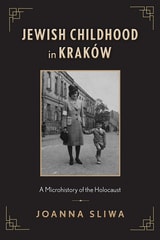
cover of Jewish Childhood in Kraków: A Microhistory of the Holocaust

Jewish Childhood in Kraków

A Microhistory of the Holocaust

Joanna Sliwa

Rutgers University Press, 2021

Winner of the 2020 Ernst Fraenkel Prize from the Wiener Holocaust Library​

Jewish Childhood in Kraków is the first book to tell the history of Kraków in the second World War through the lens of Jewish children’s experiences. Here, children assume center stage as historical actors whose recollections and experiences deserve to be told, analyzed, and treated seriously.

Sliwa scours archives to tell their story, gleaning evidence from the records of the German authorities, Polish neighbors, Jewish community and family, and the children themselves to explore the Holocaust in German-occupied Poland and in Kraków in particular. A microhistory of a place, a people, and daily life, this book plumbs the decisions and behaviors of ordinary people in extraordinary times.

Offering a window onto human relations and ethnic tensions in times of rampant violence, Jewish Childhood in Kraków is an effort both to understand the past and to reflect on the position of young people during humanitarian crises.
[more]
cover of Jewish Continuity in America: Creative Survival in a Free Society

Jewish Continuity in America

Creative Survival in a Free Society

Abraham J. Karp

University of Alabama Press, 1998

Presents an overview of a life's work by a preeminent scholar and brings new insight to the challenge of American Jewish continuity

Jews have historically lived within a paradox of faith and fear: faith that they are an eternal people and fear that their generation may be the last. In the United States, the Jewish community has faced to a heightened degree the enduring question of identity and assimilation: How does the Jewish community in this free, open, pluralistic society discover or create factors-both ideological and existential-that make group survival beneficial to the larger society and rewarding to the individual Jew?

Abraham J. Karp's Jewish Continuity in America focuses on the three major sources of American Judaism's continuing vitality: the synagogue, the rabbinate, and Jewish religious pluralism. Particularly illuminating is Karp's examination of the coexistence and unity-in-diversity of American religious Jewry's three divisions-Orthodox, Reform, and Conservative-and of how this Jewish religious pluralism fits into the larger picture of American religious pluralism.

Informing the larger enterprise through sharp and full delineation of discrete endeavors, the essays collected in Jewish Continuity in America-some already acknowledged as classics, some appearing here for the first time-describe creative individual and communal responses to the challenge of Jewish survival. As the title suggests, this book argues that continuity in a free and open society demands a high order of creativity, a creativity that, to be viable, must be anchored in institutions wholly pledged to continuity.


[more]
cover of Jewish Education

Jewish Education

Ari Y Kelman

Rutgers University Press, 2024

Most writing about Jewish education has been preoccupied with two questions: What ought to be taught? And what is the best way to teach it? Ari Y Kelman upends these conventional approaches by asking a different question: How do people learn to engage in Jewish life? This book, by centering learning, provides an innovative way of approaching the questions that are central to Jewish education specifically and to religious education more generally.

At the heart of Jewish Education is an innovative alphabetical primer of Jewish educational values, qualities, frameworks, catalysts, and technologies which explore the historical ways in which Jewish communities have produced and transmitted knowledge. The book examines the tension between Jewish education and Jewish Studies to argue that shifting the locus of inquiry from “what people ought to know” to “how do people learn” can provide an understanding of Jewish education that both draws on historical precedent and points to the future of Jewish knowledge.
[more]
cover of Jewish Fictional Letters from Hellenistic Egypt: The Epistle of Aristeas and Related Literature

Jewish Fictional Letters from Hellenistic Egypt

The Epistle of Aristeas and Related Literature

L. Michael White

SBL Press, 2017

The first Greek text of the Epistle of Aristeas published in more than a century

The Greek text Epistle of Aristeas is a Jewish work of the late Hellenistic period that recounts the origins of the Septuagint. Long recognized as a literary fiction, the Epistle of Aristeas has been variously dated from the third century BCE to the first century CE. As a result, its epistolary features, and especially those in which the putative author, Aristeas, addresses his brother and correspondent, Philocrates, have largely been ignored. In light of more recent scholarship on epistolary literature in the Greco-Roman world, however, this volume presents for the first time a complete Greek text and English Translation with introduction, notes, and commentary of the Epistle of Aristeas with key testimonia from Philo, Josephus, and Eusebius, as well as other related examples of Jewish fictional letters from the Apocrypha and Pseudepigrapha.

Features

  • Relevant excerpts from Eupolemus, 2 Maccabees, 3 Maccabees, and the Greek Additions to Esther with translations and introductions
  • A critical introduction to ancient Greek letter-writing
  • An outline of epistolary features in the text
[more]
cover of Jewish History, Jewish Religion: The Weight of Three Thousand Years

Jewish History, Jewish Religion

The Weight of Three Thousand Years

Israel Shahak

Pluto Press, 2008

Israel Shahak was a remarkable man. Born in the Warsaw ghetto and a survivor of Belsen, Shahak arrived in Israel in 1945. Brought up under Jewish Orthodoxy and Hebrew culture, he consistently opposed the expansion of the borders of Israel from 1967.

In this extraordinary and highly acclaimed book, Shahak embarks on a provocative study of the extent to which the secular state of Israel has been shaped by religious orthodoxies of an invidious and potentially lethal nature. Drawing on the Talmud and rabbinical laws, Shahak argues that the roots of Jewish chauvinism and religious fanaticism must be understood before it is too late.

Written from a humanitarian viewpoint by a Jewish scholar, this is a rare and highly controversial criticism of Israel that will both excite and disturb readers worldwide.
[more]
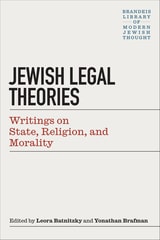
cover of Jewish Legal Theories: Writings on State, Religion, and Morality

Jewish Legal Theories

Writings on State, Religion, and Morality

Edited by Leora Batnitzky and Yonatan Brafman

Brandeis University Press, 2018
Contemporary arguments about Jewish law uniquely reflect both the story of Jewish modernity and a crucial premise of modern conceptions of law generally: the claim of autonomy for the intellectual subject and practical sphere of the law. Jewish Legal Theories collects representative modern Jewish writings on law and provides short commentaries and annotations on these writings that situate them within Jewish thought and history, as well as within modern legal theory. The topics addressed by these documents include Jewish legal theory from the modern nation-state to its adumbration in the forms of Orthodox, Conservative, and Reform Judaism in the German-Jewish context; the development of Jewish legal philosophy in Eastern Europe beginning in the eighteenth century; Ultra-Orthodox views of Jewish law premised on the rejection of the modern nation-state; the role of Jewish law in Israel; and contemporary feminist legal theory.
[more]
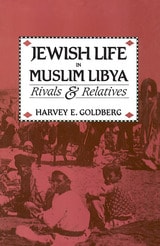
cover of Jewish Life in Muslim Libya: Rivals and Relatives

Jewish Life in Muslim Libya

Rivals and Relatives

Harvey E. Goldberg

University of Chicago Press, 1990

In 1949 more than 35,000 Jews lived in Libya, but close to ninety percent had left before Libya attained its independence in 1952. Jewish Life in Muslim Libya combines historical and anthropological perspectives in depicting the changing relations between Muslims and Jews in Libya from the early nineteenth century up to the middle of the twentieth century.

Harvey E. Goldberg shows that the cultural and religious worlds of the Jewish and Muslim communities in Libya were deeply intertwined in daily life and largely remained so despite political and social changes under successive Ottoman and Italian rule. He documents the intricate symbolic linkages of Jews and Muslims in different periods and in a variety of settings. His accounts of traditional Jewish weddings, of mock fights between Jewish teams that took place in early nineteenth-century Tripoli, and of the profession of street peddling demonstrate that, despite age-old images of Jews as outsiders or infidels, Jews were also an essential and familiar part of the local Islamic society.

Goldberg's narrative continues through the British Military Administration in Libya, a period which saw growing Libyan nationalism and, in 1945, three days of riots in which more than 130 Jews were killed. Goldberg reflects on how these events both expressed and exacerbated a rupture in the social fabric linking Muslims and Jews, setting the scene for the mass emigration of Libyan Jews from their homeland.
[more]
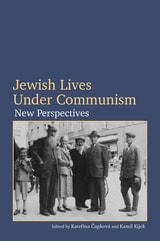
cover of Jewish Lives under Communism: New Perspectives

Jewish Lives under Communism

New Perspectives

Katerina Capková

Rutgers University Press, 2022
This volume provides new, groundbreaking views of Jewish life in various countries of the pro-Soviet bloc from the end of the Second World War until the collapse of Communism in late 1989. The authors, twelve leading historians and anthropologists from Europe, Israel and the United States, look at the experience of Jews under Communism  by digging beyond formal state policy and instead examining the ways in which Jews creatively seized opportunities to develop and express their identities, religious and secular, even under great duress. The volume shifts the focus from Jews being objects of Communist state policy (and from anti-Jewish prejudices in Communist societies) to the agency of Jews and their creativity in Communist Europe after the Holocaust. The examination of Jewish history from a transnational vantage point challenges a dominant strand in history writing today, by showing instead the wide variety of Jewish experiences in law, traditions and institutional frameworks as conceived from one Communist country to another and even within a single country, such as Poland, Czechoslovakia, Hungary, East Germany, and the Soviet Union. By focusing on networks across east-central Europe and beyond and on the forms of identity open to Jews in this important period, the volume begins a crucial rethinking of social and cultural life under Communist regimes.
 
[more]
cover of Jewish Musical Modernism, Old and New

Jewish Musical Modernism, Old and New

Edited by Philip V. Bohlman

University of Chicago Press, 2009

Tackling the myriad issues raised by Sander Gilman’s provocative opening salvo—”Are Jews Musical?”—this volume’s distinguished contributors present a series of essays that trace the intersections of Jewish history and music from the late nineteenth century to the present.

Covering the sacred and the secular, the European and the non-European, and all the arenas where these realms converge, these essays recast the established history of Jewish culture and its influences on modernity. Mitchell Ash explores the relationship of Jewish scientists to modernist artists and musicians, while Edwin Seroussi looks at the creation of Jewish sacred music in nineteenth-century Vienna. Discussing Jewish musicologists in Austria and Germany, Pamela Potter details their contributions to the “science of music” as a modern phenomenon. Kay Kaufman Shelemay investigates European influence in the music of an Ethiopian Jewish community, and Michael P. Steinberg traces the life and works of Charlotte Salomon, whose paintings staged the destruction of the Holocaust. Bolstered by Philip V. Bohlman’s wide-ranging introduction and epilogue, and featuring lush color illustrations and a complementary CD of the period’s music, this volume is a lavish tribute to Jewish contributions to modernity.
[more]
cover of Jewish Peoplehood: An American Innovation

Jewish Peoplehood

An American Innovation

Pianko, Noam

Rutgers University Press, 2015

Winner of the 2017 Saul Viener Book Prize from the American Jewish Historical Society​

Although fewer American Jews today describe themselves as religious, they overwhelmingly report a strong sense of belonging to the Jewish people. Indeed, Jewish peoplehood has eclipsed religion—as well as ethnicity and nationality—as the essence of what binds Jews around the globe to one another. In Jewish Peoplehood, Noam Pianko highlights the current significance and future relevance of “peoplehood” by tracing the rise, transformation, and return of this novel term. 
 
The book tells the surprising story of peoplehood. Though it evokes a sense of timelessness, the term actually emerged in the United States in the 1930s, where it was introduced by American Jewish leaders, most notably Rabbi Stephen Wise and Rabbi Mordecai Kaplan, with close ties to the Zionist movement. It engendered a sense of unity that transcended religious differences, cultural practices, geographic distance, economic disparity, and political divides, fostering solidarity with other Jews facing common existential threats, including the Holocaust, and establishing a closer connection to the Jewish homeland. But today, Pianko points out, as globalization erodes the dominance of nationalism in shaping collective identity, Jewish peoplehood risks becoming an outdated paradigm. He explains why popular models of peoplehood fail to address emerging conceptions of ethnicity, nationalism, and race, and he concludes with a much-needed roadmap for a radical reconfiguration of Jewish collectivity in an increasingly global era.
 
Innovative and provocative, Jewish Peoplehood provides fascinating insight into a term that assumes an increasingly important position at the heart of American Jewish and Israeli life.
 
[more]
cover of Jewish Poet and Intellectual in Seventeenth-Century Venice: The Works of Sarra Copia Sulam in Verse and Prose Along with Writings of Her Contemporaries in Her Praise, Condemnation, or Defense

Jewish Poet and Intellectual in Seventeenth-Century Venice

The Works of Sarra Copia Sulam in Verse and Prose Along with Writings of Her Contemporaries in Her Praise, Condemnation, or Defense

Sarra Copia Sulam

University of Chicago Press, 2009

The first Jewish woman to leave her mark as a writer and intellectual, Sarra Copia Sulam (1600?–41) was doubly tainted in the eyes of early modern society by her religion and her gender. This remarkable woman, who until now has been relatively neglected by modern scholarship, was a unique figure in Italian cultural life, opening her home, in the Venetian ghetto, to Jews and Christians alike as a literary salon.

For this bilingual edition, Don Harrán has collected all of Sulam’s previously scattered writings—letters, sonnets, a Manifesto—into a single volume. Harrán has also assembled all extant correspondence and poetry that was addressed to Sulam, as well as all known contemporary references to her, making them available to Anglophone readers for the first time. Featuring rich biographical and historical notes that place Sulam in her cultural context, this volume will provide readers with insight into the thought and creativity of a woman who dared to express herself in the male-dominated, overwhelmingly Catholic Venice of her time.
[more]
cover of Jewish Prince in Moslem Spain: Selected Poems of Samuel Ibn Nagrela

Jewish Prince in Moslem Spain

Selected Poems of Samuel Ibn Nagrela

Samuel Ibn Nagrela

University of Alabama Press, 2005

Translated by Leon J. Weinberger

Of all the Hebrew poets of the 'Golden Age' in Spain, Samuel Ibn Nagrela (993-1056 A.D.) remains perhaps the most fascinating personality. A leading statesman in the kingdom of Granada, he was as successful in court as on the battlefield, maintaining a position of power for several decades while walking a political tightrope. Endowed with great literary talents, he opened up new paths in Hebrew poetry, and his mastery of its metrical intricacies was as consummate as his political and military skill.

[more]
cover of Jewish Scholarship and Culture in Nineteenth-Century Germany: Between History and Faith

Jewish Scholarship and Culture in Nineteenth-Century Germany

Between History and Faith

Nils Roemer

University of Wisconsin Press, 2005

    German Jews were fully assimilated and secularized in the nineteenth century—or so it is commonly assumed. In Jewish Scholarship and Culture in the Nineteenth Century, Nils Roemer challenges this assumption, finding that religious sentiments, concepts, and rhetoric found expression through a newly emerging theological historicism at the center of modern German Jewish culture.
    Modern German Jewish identity developed during the struggle for emancipation, debates about religious and cultural renewal, and battles against anti-Semitism. A key component of this identity was historical memory, which Jewish scholars had begun to infuse with theological perspectives beginning in the 1850s. After German reunification in the early 1870s, Jewish intellectuals reevaluated their enthusiastic embrace of liberalism and secularism. Without abandoning the ideal of tolerance, they asserted a right to cultural religious difference for themselves--an ideal they held to even more tightly in the face of growing anti-Semitism. This newly re-theologized Jewish history, Roemer argues, helped German Jews fend off anti-Semitic attacks by strengthening their own sense of their culture and tradition.
[more]
cover of Jewish Soul Food: Traditional Fare and What It Means

Jewish Soul Food

Traditional Fare and What It Means

Carol Ungar

Brandeis University Press, 2015
Jewish traditional foods often have symbolic meanings. A Passover matzo is a taste of Egyptian slavery. The Hanukkah latke reminds us of the little jug of oil that burned, miraculously, for eight nights. Noshing hamentaschen at Purim, we remember the villain Haman, and his thwarted plan to destroy the Jews. Even more than in the synagogue, Jewish life takes place around the dining table. Jewish sages compare the dining table to an altar, and that isn’t an exaggeration. Jewish meals are ceremonies and celebrations that forge a pathway between body and soul. In this unique cookbook, Carol Ungar links the cultural and religious symbolism of Jewish foods to more than one hundred recipes drawn from international Jewish cultures and traditions. She offers easy-to-follow recipes for Shabbat meals and all the Jewish holidays, from Rosh Hashana to the nine days before Tisha b’Av, along with fascinating briefs on how many Jewish foods—challah, kreplach, farfel, and more—express core Jewish beliefs. With ingredients that can be found in any supermarket, and recipes adapted for the time- and health-conscious cook, this volume is for anyone who wishes to flavor Shabbat and holiday meals with Jewish soul.
[more]
cover of Jewish Studies: A Theoretical Introduction

Jewish Studies

A Theoretical Introduction

Bush, Andrew

Rutgers University Press, 2011

Jewish Studies, the first volume in a groundbreaking new series, Key Words in Jewish Studies, introduces the basic approach of the series by organizing discussion around key concepts in the field that have emerged over the last two centuries: history and science, race and religion, self and community, identity and memory. The book is oriented by contemporary critical theory, especially feminist and postcolonial studies, and the multidisciplinary approaches of cultural studies.

By looking backward and forward—and across continents and disciplines—to unearth the evolution of the scholarly study of Jews, Andrew Bush provides a comprehensive introduction to the development of Jewish studies from the turn of the nineteenth century to the present. In the course of engaging scholarship on periods from the classical to the contemporary and from the disciplines of history, philosophy, sociology, anthropology, psychology, and literary studies, Bush questions male-dominated and Ashkenazi-centric visions of the field. He concludes with an experimental exposition of a new Jewish studies for a time where attention to difference has overtaken the security of canons and commonalities.
[more]
cover of Jewish Temple Theology and the Mystery of the Cross: Atonement and the Two Goats of Yom Kippur

Jewish Temple Theology and the Mystery of the Cross

Atonement and the Two Goats of Yom Kippur

Richard J. Barry IV

Catholic University of America Press, 2023
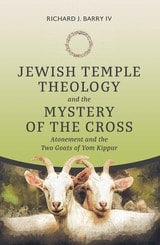
On the Day of Atonement, two goats were brought before the high priest at the temple. One was chosen as the goat for the Lord, a spotless sacrifice, and the other was set aside for Azazel, doomed to bear sins into the wilderness. Jewish Temple Theology and the Mystery of the Cross shows how a theological appreciation for the two movements of Yom Kippur makes it possible to identify the paradox at the heart of Christian soteriology: in his single atoning act, Jesus Christ fulfills the work of both goats, without confusion, without division. Appreciation for this paradox helps illuminate many of the doctrinal debates in the history of Christian soteriology and offers a compelling way forward. Jewish Temple Theology and the Mystery of the Cross begins with a survey of biblical geography: first, a rich theological pilgrimage to Mount Zion, the home of beauty, goodness, and truth, and then to the surrounding desert, the wilderness of sin and sorrow. To appreciate the Yom Kippur liturgy, and to understand the priestly word “atonement,” one must be oriented by this cosmic stage. Drawing on the best modern historical-critical scholarship, this volume reveals the wonders hidden in Leviticus and shows how a sophisticated theological interpretation of this book leads to breakthroughs in our understanding of Christ’s saving work. Seeing the mystery of the cross from the perspective of the ancient Jewish scriptures has surprising results. For example, Richard Barry shows how Hans Urs von Balthasar’s controversial theology of Holy Saturday is a compelling development of Azazel-goat soteriology; it is not only biblically licit but is in some ways mandated by the logic of Yom Kippur. At the same time, David Bentley Hart is celebrated for the way he powerfully advances modern YHWH-goat soteriology, yet obedience to the logic of Yom Kippur also necessitates a nuanced biblical critique of his muscular universalism. How can Christ fulfill the seemingly contradictory movements of both goats in a single saving work? Grappling with that question, Jewish Temple Theology and the Mystery of the Cross seeks to draw nearer to the heart of the mystery of salvation.
[more]
cover of Jewish Tradition and the Challenge of Darwinism

Jewish Tradition and the Challenge of Darwinism

Edited by Geoffrey Cantor and Marc Swetlitz

University of Chicago Press, 2006

Darwin’s theory of evolution transformed the life sciences and made profound claims about human origins and the human condition, topics often viewed as the prerogative of religion. As a result, evolution has provoked a wide variety of religious responses, ranging from angry rejection to enthusiastic acceptance. While Christian responses to evolution have been studied extensively, little scholarly attention has been paid to Jewish reactions. Jewish Tradition and the Challenge of Darwinism is the first extended meditation on the Jewish engagement with this crucial and controversial theory.

The contributors to Jewish Tradition and the Challenge of Darwinism—from several academic disciplines and two branches of the rabbinate—present case studies showing how Jewish discussions of evolution have been shaped by the intersections of faith, science, philosophy, and ideology in specific historical contexts. Furthermore, they examine how evolutionary theory has been deployed when characterizing Jews as a race, both by Zionists and by anti-Semites. Jewish Tradition and the Challenge of Darwinism addresses historical and contemporary, as well as progressive and Orthodox, responses to evolution in America, Europe, and Israel, ultimately extending the history of Darwinism into new religious domains.
[more]
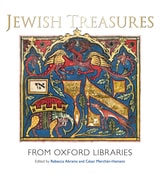
cover of Jewish Treasures from Oxford Libraries

Jewish Treasures from Oxford Libraries

Edited by Rebecca Abrams & César Merchán-Hamann

Bodleian Library Publishing, 2020

Representing four centuries of collecting and a thousand years of Jewish history, this book brings together Hebrew manuscripts and rare books from the Bodleian Library and Oxford colleges. Highlights of the extraordinary collections include a fragment of Maimonides’ autograph draft of the Mishneh Torah, the earliest dated fragment of the Talmud, exquisitely illuminated manuscripts of the Hebrew Bible, stunning festival prayer books, and one of the oldest surviving Jewish seals in England. Lavishly illustrated essays by experts in the field bring these outstanding works to life, exploring the personalities and diverse motivations of their original collectors.
 
Saved for posterity by religious scholarship, intellectual rivalry, and political ambition, these extraordinary collections also detail the consumption and circulation of knowledge across the centuries, forming a social and cultural history of objects moved across borders from person to person. Together, they offer a fascinating journey through Jewish intellectual and social history.
[more]
cover of Jewish Universalisms: Mendelssohn, Cohen, and Humanity’s Highest Good

Jewish Universalisms

Mendelssohn, Cohen, and Humanity’s Highest Good

Jeremy Fogel

Brandeis University Press, 2023

An original and comprehensive comparison of the universalisms of two major modern Jewish philosophers.
 
Any version of universalism relevant to a more attentive, pluralistic, and postcolonial outlook would balance the urgent current need for a universalistic perspective with the desire to maintain the richness of human diversity. The modern Jewish philosophers who sought to partake in the Enlightenment’s universalistic vision while maintaining their distinct identities as members of a religious minority within Europe offer insightful answers.

Jewish Universalisms analyzes how two major figures, Moses Mendelssohn and Hermann Cohen, dealt with the perceived tension between the universal values characteristic of the Enlightenment and aspects of Judaism often depicted as particularistic and parochial. Jeremy Fogel joins this lively debate in modern Jewish philosophy, offering a comparative examination of these thinkers and analyzing their worldviews from an innovative axiological perspective. Fogel writes that to gain a precise understanding of how Mendelssohn and Cohen argued for the concordance of Judaism and universalism, one must first seek out what they delineated as ultimately valuable. Then one can work out how that highest good, and the method of valuation it sustains, are universal.
[more]
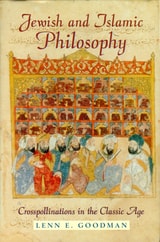
cover of Jewish and Islamic Philosophy: Crosspollinations in the Classic Age

Jewish and Islamic Philosophy

Crosspollinations in the Classic Age

Lenn E. Goodman

Rutgers University Press, 1999
 

[more]
cover of Jewish in America

Jewish in America

Sara Blair and Jonathan Freedman, Editors

University of Michigan Press, 2004

"Jewish culture in America is creating a genuinely new archive---a powerful admixture of texts old and new, Jewish and gentile, sacred and secular, on which our writers and critics offer creative commentary and to which they make compelling response. Shaped in the American crucible of race and ethnicity, pushed and pulled by the American traditions of ahistorical and individualist thinking, empowered by a powerful sacramental and hermeneutic tradition yet challenged by that tradition's stunning variety of inflections, impelled to furious response by world crisis, these writers testify not only to the anguishing and joyous complexity of being Jewish in America, but the creative energies such multiplicity generates."
-From the Introduction


This rare and original work of cultural studies offers uncommon and engaging perspectives-as well as provocative and humorous insights-on what it means to be Jewish in America.

Jewish in America features poetry, art, essays, and stories from an impressive and respected list of contributors, including among others Stephen Greenblatt, Richard Kostelanetz, Jacqueline Osherow, Robert Pinsky, Sharon Pomerantz, Nancy Reisman, Grace Schulman, Louis Simpson, Alisa Solomon, and Stephen J. Whitfield.

In addition to pieces by some of the country's leading writers, the book features a stunning gallery of original photographs that transport the viewer from the crowded Coney Island beaches of the 1940s to the landscapes of Oaxaca, Mexico in the 1990s.
[more]