Results by title
58 books match the query 'Representative government and representation' and 2 start with j
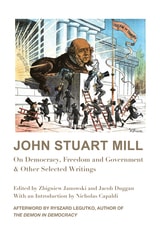
John Stuart Mill
On Democracy, Freedom and Government & Other Selected WritingsJohn Stuart Mill
St. Augustine's Press, 2019
In addition to “On Liberty” and “On Representative Government,” this new selection of Mill’s writings includes, among others, a number of less known of his writings, such as: “Civilization,” “Perfectibility,” “The Negro Question,” “On Education,” “On Aristocracy,” “On Marriage,” “On Free Press,” “Socialism,” Mill’s review of Tocqueville’s “Democracy in America,” his letters to Tocqueville, and several other writings.
If one can use a somewhat exaggerated language, Mill’s writings are to liberal-democracy what Marx and Engels’ writings were to Communism. Both systems gave expression to 19th century man’s longing for equality and justice, both promised to liberate him from the shackles of oppression, authority and tradition. Instead of liberating man, Communism created the most brutal system in human history, and its spectacular fall in 1989 is one of history’s greatest events. Western world today shows that liberal-democracy is no longer a benign doctrine, which advocates free market, minimum state and individual liberties, but, like Communism, is an all-encompassing ideology which forces an individual to abdicate his freedom and soul in favor of a Communist-like collective.
As many critics of real Socialism could see the seeds of totalitarianism in the writings of Marx and Engels, so one can see the seeds of liberal totalitarianism in Mill’s writings. This new edition is intended to help readers to understand why democratic-liberalism came so close to its 19th century ideological rival.
[more]
Just Elections
Creating a Fair Electoral Process in the United StatesDennis F. Thompson
University of Chicago Press, 2002
The 2000 election showed that the mechanics of voting such as ballot design, can make a critical difference in the accuracy and fairness of our elections. But as Dennis F. Thompson shows, even more fundamental issues must be addressed to insure that our electoral system is just.
Thompson argues that three central democratic principles—equal respect, free choice, and popular sovereignty—underlie our electoral institutions, and should inform any assessment of the justice of elections. Although we may all endorse these principles in theory, Thompson shows that in practice we disagree about their meaning and application. He shows how they create conflicts among basic values across a broad spectrum of electoral controversies, from disagreements about term limits and primaries to disputes about recounts and presidential electors.
To create a fair electoral system, Thompson argues, we must deliberate together about these principles and take greater control of the procedures that govern our elections. He demonstrates how applying the principles of justice to electoral practices can help us answer questions that our electoral system poses: Should race count in redistricting? Should the media call elections before the polls close? How should we limit the power of money in elections?
Accessible and wide ranging, Just Elections masterfully weaves together the philosophical, legal, and political aspects of the electoral process. Anyone who wants to understand the deeper issues at stake in American elections and the consequences that follow them will need to read it.
In answering these and other questions, Thompson examines the arguments that citizens and their representatives actually use in political forums, congressional debates and hearings, state legislative proceedings, and meetings of commissions and local councils. In addition, the book draws on a broad range of literature: democratic theory, including writings by Madison, Hamilton, and Tocqueville, and contemporary philosophers, as well as recent studies in political science, and work in election law.
[more]