386 books match the query 'Russia' and 7 start with j
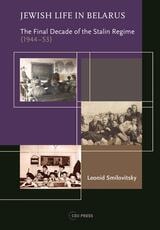
cover of Jewish Life in Belarus: The Final Decade of the Stalin Regime, 1944-1953

Jewish Life in Belarus

The Final Decade of the Stalin Regime, 1944-1953

Leonid Smilovitsky

Central European University Press, 2014
Jewish life in Belarus in the years after World War II was long an enigma. Officially it was held to be as being non-existent, and in the ideological atmosphere of the time research on the matter was impossible. Jewish community life had been wiped out by the Nazis, and information on its revival was suppressed by the communists. For more than half a century the truth about Jewish life during this period was sealed in inaccessible archives. The Jews of Belarus preferred to keep silent rather than expose themselves to the animosity of the authorities. Although the fate of Belarusian Jews before and during the war has now been amply studied, this book is one of the first attempts to study Jewish life in Belarus during the last decade of Stalin's rule. In addition to archival materials, the present research is based on a questionnaire submitted to former residents of Belarus in Israel, as well as information from periodicals, collections of documents, statistical reports and monographs.
[more]
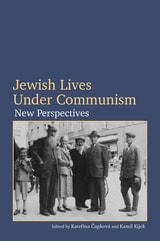
cover of Jewish Lives under Communism: New Perspectives

Jewish Lives under Communism

New Perspectives

Katerina Capková

Rutgers University Press, 2022
This volume provides new, groundbreaking views of Jewish life in various countries of the pro-Soviet bloc from the end of the Second World War until the collapse of Communism in late 1989. The authors, twelve leading historians and anthropologists from Europe, Israel and the United States, look at the experience of Jews under Communism  by digging beyond formal state policy and instead examining the ways in which Jews creatively seized opportunities to develop and express their identities, religious and secular, even under great duress. The volume shifts the focus from Jews being objects of Communist state policy (and from anti-Jewish prejudices in Communist societies) to the agency of Jews and their creativity in Communist Europe after the Holocaust. The examination of Jewish history from a transnational vantage point challenges a dominant strand in history writing today, by showing instead the wide variety of Jewish experiences in law, traditions and institutional frameworks as conceived from one Communist country to another and even within a single country, such as Poland, Czechoslovakia, Hungary, East Germany, and the Soviet Union. By focusing on networks across east-central Europe and beyond and on the forms of identity open to Jews in this important period, the volume begins a crucial rethinking of social and cultural life under Communist regimes.
 
[more]
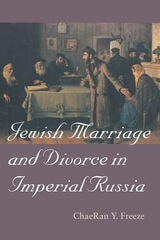
cover of Jewish Marriage and Divorce in Imperial Russia

Jewish Marriage and Divorce in Imperial Russia

ChaeRan Y. Freeze

Brandeis University Press, 2001
ChaeRan Freeze explores the impact of various forces on marriage and divorce among Jews in 19th-century Russia. Challenging romantic views of the Jewish family in the shtetl, she shows that divorce rates among Russian Jews in the first half of the century were astronomical compared to the non-Jewish population. Even more surprising is her conclusion that these divorce rates tended to drop later in the century, in contrast to the rising pattern among populations undergoing modernization. Freeze also studies the growing involvement of the Tsarist state. This occurred partly at the behest of Jewish women contesting patriarchy and parental power and partly because the government felt that Jewish families were in complete anarchy and in need of order and regulation. Extensive research in newly-declassified collections from twelve archives in Russia, Ukraine, and Lithuania enables Freeze to reconstruct Jewish patterns of marriage and divorce and to analyze the often conflicting interests of Jewish husbands and wives, rabbinic authorities, and the Russian state. Balancing archival resources with memoirs and printed sources in Hebrew, Yiddish, and Russian, she offers a tantalizing glimpse of the desires and travails of Jewish spouses, showing how individual life histories reflect the impact of modernization on Jewish matchmaking, gender relations, the "emancipation" of Jewish women, and the incursion of the Tsarist state into the lives of ordinary Jews.
[more]
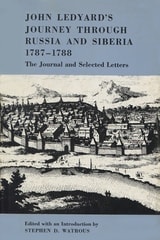
cover of John Ledyard's Journey through Russia and Siberia, 1787–1788: The Journal and Selected Letters

John Ledyard's Journey through Russia and Siberia, 1787–1788

The Journal and Selected Letters

Stephen D. Watrous

University of Wisconsin Press, 1966

Stephen D. Watrous provides a complete volume of pertinent information by and about John Ledyard, one of the most amazing explorers of all time. Including Ledyard’s own journal, letters between him and others, particularly Thomas Jefferson, and biographical information on eighteenth-century Siberia, Watrous offers an exceptional look at history, geography, and travel.
[more]
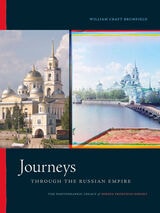
cover of Journeys through the Russian Empire: The Photographic Legacy of Sergey Prokudin-Gorsky

Journeys through the Russian Empire

The Photographic Legacy of Sergey Prokudin-Gorsky

William Craft Brumfield

Duke University Press, 2020

At the turn of the twentieth century, the photographer Sergey Prokudin-Gorsky undertook a quest to document an empire that was undergoing rapid change due to industrialization and the building of railroads. Between 1903 and 1916 Prokudin-Gorsky, who developed a pioneering method of capturing color images on glass plates, scoured the Russian Empire with the patronage of Nicholas II. Intrepidly carrying his cumbersome and awkward camera from the western borderlands over the Volga River to Siberia and central Asia, he created a singular record of Imperial Russia.
In 1918 Prokudin-Gorsky escaped an increasingly chaotic, violent Russia and regained nearly 2,000 of his bulky glass negatives. His subsequent peripatetic existence before settling in Paris makes his collection's survival all the more miraculous. The U.S. Library of Congress acquired Prokudin-Gorsky's collection in 1948, and since then it has become a touchstone for understanding pre-revolutionary Russia. Now digitized and publicly available, his images are a sensation in Russia, where people visit websites dedicated to them.
William Craft Brumfield—photographer, scholar, and the leading authority on Russian architecture in the West—began working with Prokudin-Gorsky's photographs in 1985. He curated the first public exhibition of them in the United States and has annotated the entire collection. In Journeys through the Russian Empire, Brumfield—who has spent decades traversing Russia and photographing buildings and landscapes in their various stages of disintegration or restoration—juxtaposes Prokudin-Gorsky's images against those he took of the same buildings and areas. In examining the intersections between his own photography and that of Prokudin-Gorsky, Brumfield assesses the state of preservation of Russia's architectural heritage and calls into question the nostalgic assumptions of those who see Prokudin-Gorsky's images as the recovery of the lost past of an idyllic, pre-Soviet Russia.
This lavishly illustrated volume—which features some 400 stunning full-color images of ancient churches and mosques, railways and monasteries, towns and remote natural landscapes—is a testament to two brilliant photographers whose work prompts and illuminates, monument by monument, questions of conservation, restoration, and cultural identity and memory.
[more]
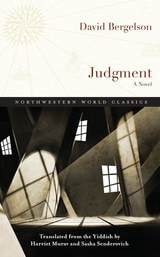
cover of Judgment: A Novel

Judgment

A Novel

David Bergelson, Translated from the Yiddish by Harriet Murav and Sasha Senderovich

Northwestern University Press, 2017

Never before available in English, Judgment is a work of startling power by David Bergelson, the most celebrated Yiddish prose writer of his era.
 
Originally published in 1929 and set in 1920 during the Russian civil war, Judgment traces the death of the shtetl and the birth of the “new, harsher world” created by the 1917 revolution. Jews and non-Jews smuggle people, goods, and anti-Bolshevik literature back and forth across the new political border. Filipov acts as the arbiter of "judgment" to prisoners in a Bolshevik outpost, who include Spivak, a counterrevolutionary; Lemberger, a pious and wealthy Jew; a seductive woman referred to as "the blonde"; and a memorable cast of smugglers and criminals.
 
Ordinary people, depicted in a grotesque and modernist style—comparable to Isaac Babel’s Red Cavalry—confront the overwhelming forces of history, whose ultimate outcome remains unknown.
 
[more]
cover of Just Assassins: The Culture of Terrorism in Russia

Just Assassins

The Culture of Terrorism in Russia

Edited and with an introduction by Anthony Anemone

Northwestern University Press, 2010

Just Assassins examines terrorism as it’s manifested in Russian culture past and present, with essays devoted to Russian literature, film, and theater; historical narrative; and even amateur memoir, songs, and poetry posted on the Internet. Along with editor Anthony Anemone’s introduction, these essays chart the evolution of modern political terrorism in Russia, from the Decembrist uprising to the horrific school siege in Beslan in 2004, showing how Russia’s cultural engagement with its legacy of terrorism speaks to the wider world.


[more]