Results by title
244 books match the query 'Study' and 4 start with j
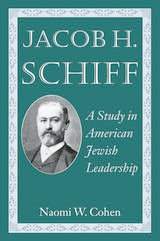
Jacob H. Schiff
A Study in American Jewish LeadershipNaomi W. Cohen
Brandeis University Press, 1999
John Williams Walker
A Study in the Political, Social, and Cultural Life of the Old SouthwestHugh C. Bailey
University of Alabama Press, 1964
A biography of Alabama’s first Senator, this book is also the fascinating story of Southern frontier life as portrayed in contemporary letters and documents. When Madison County, Alabama, was still wilderness, Walker trekked across the mountains from Georgia with his bride, Matilda Pope, his slaves, and all his household possessions, to build a plantation near Huntsville. Here he began his extraordinary political career: member of the first territorial legislature; speaker of the house in the second; U.S. territorial judge; president of Alabama’s Constitutional Convention; and when statehood was won, first U.S. Senator.
José Lezama Lima's Joyful Vision
A Study of Paradiso and Other Prose WorksBy Gustavo Pellón
University of Texas Press, 1989
Cuba’s José Lezama Lima became the most controversial figure in the flowering of the Latin American novel with the 1966 publication of Paradiso. Hailed as a seminal writer of breathtaking originality by Julio Cortázar, Octavio Paz, and Mario Vargas Llosa, Lezama was also attacked by the Castro regime and others for his stylistic obscurity, erotic descriptions, and violation of literary norms. Indeed, his experimental fiction, written on the very boundaries of the novelistic genre, resists classification. José Lezama Lima’s Joyful Vision, a much-needed critical study of Paradiso, Oppiano Licario, and Lezama’s essays, is thus an exploration in reading, one that highlights and preserves the essential and persistent contradictions in Lezama’s theory and practice of literature.
Gustavo Pellón focuses his study on Lezama’s search for equilibrium, clarifying such oppositions in Lezama’s writings as the mystical quest for illumination through obscurity, the calculated cultivation of naïveté, the Proust-like fascination with yet ultimate condemnation of homosexuality, and a modernist (even postmodernist) narrative style that conveys a mystical (essentially medieval) worldview. Above all, Pellón shares his wonder at Lezama who, in an age of pessimism, maintained his joyful vision of art and existence.
Judicial Review in Mexico
A Study of the Amparo SuitBy Richard D. Baker
University of Texas Press, 1971
The amparo suit is a Mexican legal institution similar in its effects to such Anglo-American procedures as habeas corpus, error, and the various forms of injunctive relief. It has undergone a long evolution since it was incorporated into the Constitution of 1857. Today, its principal purpose is to protect private individuals in the enjoyment of the rights guaranteed by the first twenty-nine articles of the Constitution.
Mexico after its independence produced many constitutions. One of the earliest problems was to find an adequate means of defending the Constitution against ill-founded interpretations of its precepts. Like the United States, Mexico has developed a system of constitutional defense in which the judiciary is the supreme interpreter of what this document means. Unlike the United States Supreme Court, however, the Mexican Supreme Court has not been innovative in its decisions or contradicted the administration on major policy decisions. This difference must be attributed to the civil law system of Mexico as well as to the political climate.
The first part of Richard D. Baker’s book describes the historical background of amparo and other methods of constitutional defense in Mexico. The three men most closely associated with creating a judicial form of constitutional defense in Mexico were Manuel Crescencio Rejón, José Fernando Ramírez, and Mariano Otero. Their own writings indicate that the immediate source of amparo must be found in the American institution of judicial review that was transmitted to Mexicans through Alexis de Tocqueville’s Democracy in America.
The second part is an exposition of the workings of the amparo suit in the twentieth century and the constitutional and statutory provisions affecting it. Since 1857, when it was incorporated into article 102 of the Constitution, the amparo suit has evolved into a highly complex institution performing three functions: the defense of the civil liberties enumerated in the first twenty-nine articles of the Constitution, the determination of the constitutionality of federal and state legislation, and cassation. The Supreme Court is primarily limited to defending civil liberties through the amparo suit; it remains less innovative and more restricted than the United States system of judicial review, especially in the effect of its judgments on political agencies.
Baker’s study is the first one in English dealing with this subject and is one of the most extensive in any language. It should be welcome as a valuable tool to all students of Mexican law, history, and political thought.