Results by title
2284 books match the query 'Women' and 27 start with j
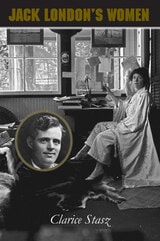
Jack London's Women
Clarice Stasz
University of Massachusetts Press, 2001
Using newly available letters and diaries from private collections, Stasz brings this diverse constellation of women to life. London was the son of freethinking Flora Wellman, yet found more maternal comfort from freed slave Jennie Prentiss and his stepsister Eliza. His early loves included a British-born consumptive, a Jewish socialist, and an African American. His first wife, Bess Maddern, was a teacher and devoted mother to daughters Bess and Joan, while his second wife, Charmian Kittredge, shared his passion for adventure and served as a model for many characters in his writings. Following his death, the various women who survived him both promoted his legacy and suffered the consequences of being constantly identified with a famous man.
In recasting London's life through the eyes of three generations of women, Stasz manages to untangle his seemingly contradictory attitudes and actions. She also reveals the struggle that ensued, after his death, among family members and scholars over how he should be remembered. What emerges from this well-researched book is a new understanding of London and a compelling portrayal of the women who knew him best.
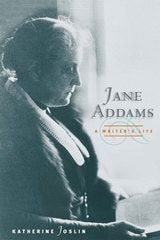
Jane Addams, a Writer's Life
Katherine Joslin
University of Illinois Press, 2003
Jane Addams, a Writer's Life is an expansive, revealing, and refreshing reexamination of the renowned reformer as an imaginative writer. Jane Addams is best known for her groundbreaking social work at Hull-House, the force of her efforts toward Progressive political and social reform, and the bravery of her commitment to pacifism, for which she received the Nobel Peace Prize. Katherine Joslin moves beyond this history to present Addams as a literary figure, one whose writing employed a synthesis of fictional and analytical prose that appealed to a wide audience.
Joslin traces Addams's style from her early works, Philanthropy and Social Progress and her contributions to Hull House Maps and Papers, influenced by Florence Kelley, to her modernist and experimental last books, The Second Twenty Years at Hull-House and My Friend, Julia Lathrop, placing Addams in the context of other Chicago writers including Theodore Dreiser, Upton Sinclair, Harriet Monroe, Frank Norris and James T. Farrell. Joslin's close readings showcase Addams's distinguishing literary devices, such as using stories about people rather than sociological argument to make moral points. As Joslin pursues the argument that Addams's power as a public figure stemmed from the success of her books and essays, Addams herself emerges as a literary woman.
Jane Addams
The Most Dangerous Woman in AmericaMarlene Targ Brill
Ohio University Press, 2024
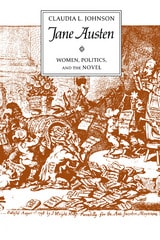
Jane Austen
Women, Politics, and the NovelClaudia L. Johnson
University of Chicago Press, 1990
"By looking at the ways in which Austen domesticates the gothic in Northanger Abbey, examines the conventions of male inheritance and its negative impact on attempts to define the family as a site of care and generosity in Sense and Sensibility, makes claims for the desirability of 'personal happiness as a liberating moral category' in Pride and Prejudice, validates the rights of female authority in Emma, and stresses the benefits of female independence in Persuasion, Johnson offers an original and persuasive reassessment of Jane Austen's thought."—Kate Fullbrook, Times Higher Education Supplement
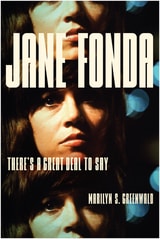
Jane Fonda
There's a Great Deal to SayMarilyn S. Greenwald
Rutgers University Press, 0
Since the late 1960s, Jane Fonda has identified as an activist first and an actor second, using her celebrity as a vehicle to convey her views and her advocacy. Few stars of her stature have been as simultaneously acclaimed and vilified as Fonda. Even as she won two Academy Awards and was a major box office draw of the 1970s and 1980s, she received reams of hate mail for her political activism and antiwar stances. This book explores Fonda’s devotion to movement politics—sometimes at the expense of her career and her personal safety.
Digging deep into rare material from cinema archives and Fonda’s own personal papers, journalist Marilyn Greenwald tells the story of how Fonda came to view acting as a “side gig” that gives her a worldwide platform to convey her personal and political views. Charting the evolution of her activism and the merging of her acting and producing with her advocacy, Greenwald focuses on the years from 1968—when she was jarred out of complacency by the Vietnam War—to 1980, after the release of The China Syndrome and the advent of the Three Mile Island nuclear crisis, which brought to light the possible dangers of nuclear energy. Greenwald details how three of her films—Klute (1971), Coming Home (1978), and The China Syndrome (1979)—were designed to further her personal beliefs. She also considers how Fonda has weathered changes in the entertainment industry and public tastes to produce and star in decades' worth of socially conscious projects. Charting Fonda’s personal and professional growth while offering a candid account of her struggles, this book shows how Fonda viewed movies as an influential storytelling tool that can influence public opinion, change minds, and trigger social change.
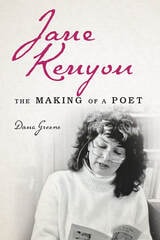
Jane Kenyon
The Making of a PoetDana Greene
University of Illinois Press, 2023
Pleasure-loving, sarcastic, stubborn, determined, erotic, deeply sad--Jane Kenyon’s complexity and contradictions found expression in luminous poems that continue to attract a passionate following. Dana Greene draws on a wealth of personal correspondence and other newly available materials to delve into the origins, achievement, and legacy of Kenyon’s poetry and separate the artist’s life story from that of her husband, the award-winning poet Donald Hall.
Impacted by relatives’ depression during her isolated childhood, Kenyon found poetry at college, where writers like Robert Bly encouraged her development. Her graduate school marriage to the middle-aged Hall and subsequent move to New Hampshire had an enormous impact on her life, moods, and creativity. Immersed in poetry, Kenyon wrote about women’s lives, nature, death, mystical experiences, and melancholy--becoming, in her own words, an “advocate of the inner life.” Her breakthrough in the 1980s brought acclaim as “a born poet” and appearances in the New Yorker and elsewhere. Yet her ongoing success and artistic growth exacerbated strains in her marriage and failed to stave off depressive episodes that sometimes left her non-functional. Refusing to live out the stereotype of the mad woman poet, Kenyon sought treatment and confronted her illness in her work and in public while redoubling her personal dedication to finding pleasure in every fleeting moment. Prestigious fellowships, high-profile events, residencies, and media interviews had propelled her career to new heights when leukemia cut her life short and left her husband the loving but flawed curator of her memory and legacy.
Revelatory and insightful, Jane Kenyon offers the first full-length biography of the elusive poet and the unquiet life that shaped her art.
Javanese Lives
Women and Men in Modern Indonesian SocietyWilliams, Walter L.
Rutgers University Press, 1991
Java is the most populous island of Indonesia, the fifth largest nation in the world. Yet despite its importance, outsiders know little about the country or its people. With the help of Indonesian students and scholars, Walter L. Williams has collected and translated the life histories of twenty-seven Javanese women and men. The people interviewed tell how they have coped with rapid social and economic change, and the transformation of their traditions. Williams has carefully selected the individuals he includes to represent a wide diversity of Java's people. We hear from fascinating men and women of various religions, from the rich and the poor, and from different ethnic backgrounds. Diversity is a constant theme, as evidenced by a poor pedicab driver who can barely scrape along, by a rich businesswoman who explains how she balances her professional and domestic roles, by an educated and respected homosexual school principal, and by an illiterate mother of fourteen children. All of them present in their lives a unique Javanese approach to living.
These oral histories were derived from elderly people, who have a larger perspective on the changes they have seen in their lifetimes. The focus of the first section of the book is the way people have adapted in their daily lives to massive social and economic changes. In the middle section, we hear from the Javanese who represent traditional values in the midst of change. Finally, we hear from educators and parents who tell us of their concerns for Indonesian youth and the future of Indonesia.
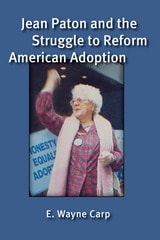
Jean Paton and the Struggle to Reform American Adoption
E. Wayne Carp
University of Michigan Press, 2013
Jean Paton (1908–2002) fought tirelessly to reform American adoption and to overcome prejudice against adult adoptees and women who give birth out of wedlock. Paton wrote widely and passionately about the adoption experience, corresponded with policymakers as well as individual adoptees, promoted the psychological well-being of adoptees, and facilitated reunions between adoptees and their birth parents. E. Wayne Carp's masterful biography brings to light the accomplishments of this neglected civil-rights pioneer, who paved the way for the explosive emergence of the adoption reform movement in the 1970s. Her unflagging efforts over five decades helped reverse harmful policies, practices, and laws concerning adoption and closed records, struggles that continue to this day.
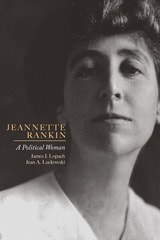
Jeannette Rankin
A Political WomanJames J. Lopach
University Press of Colorado, 2015
—Jeannette Rankin (1880-1973)
Jeannette Rankin, the first woman elected to Congress, stands tall among American icons. The representative from Montana won her seat at a time when women didn't have the right to vote in most states. Her firm stances inspired both admiration and fury across party lines, and she gained nearly canonical status among feminists and pacifists. In Jeannette Rankin: A Political Woman, James Lopach and Jean Luckowski demythologize Rankin, showing her to be a talented, driven, and deeply divided woman.
Until now, no biography has explored Rankin's inconsistencies. The authors extensively consulted the correspondence of her family members and contemporaries, uncovering ties between her politics and her familial and personal relationships. They reveal how she succeeded through her wealthy brother's influence as well as her own extraordinary efforts; how she drew inspiration not from her rural roots but from the radical hotbed of Greenwich Village; and how she championed an independent, woman-centered life while deferring to family.
Revealing her complexities along with her accomplishments, Jeannette Rankin: A Political Woman will be the definitive biography of this path-breaking politician for years to come.
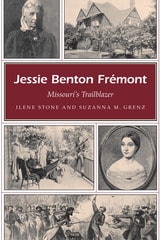
Jessie Benton Frémont
Missouri's TrailblazerIlene Stone & Suzanna M. Grenz
University of Missouri Press, 2005
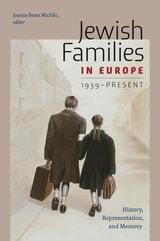
Jewish Families in Europe, 1939-Present
History, Representation, and MemoryEdited by Joanna Beata Michlic
Brandeis University Press, 2017
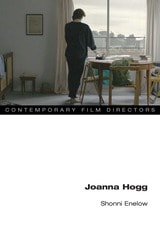
Joanna Hogg
Shonni Enelow
University of Illinois Press, 2024
Films like The Eternal Daughter and the diptych The Souvenir and The Souvenir Part II have cemented Joanna Hogg’s reputation as an original voice in contemporary cinema. Her rigorous and quiet style draws on the histories of film and art to tell stories that weave autobiography with studies in human opacity.
Shonni Enelow analyzes Hogg’s six feature films around the concepts of turning away, the reality effect, and the impossible encounter. Throughout, Enelow explores the tension between absorption, in which characters are immersed in a diegetic fiction, and self-reflexivity, as the filmmaker comments on her techniques of representation. An in-depth interview with Hogg delves into the director’s process, approach to creating character, and use of artistic and literary references.
Sophisticated and innovative, Joanna Hogg illuminates the work of one of today’s most original filmmakers.
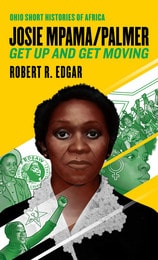
Josie Mpama/Palmer
Get Up and Get MovingRobert R. Edgar
Ohio University Press, 2020
While African National Congress narratives dominate much of the scholarship on South Africa’s freedom struggle, Josie Mpama/Palmer’s political life offers a different perspective. Highly critical of the patriarchal attitudes that hindered black women from actively participating in politics, Mpama/Palmer was an outspoken advocate for women’s social equality and encouraged black women to become more involved in national conversations. The first black woman to join the Communist Party of South Africa and an antiapartheid activist, Josie Mpama/Palmer remained involved in critical issues all her life, especially protests against Bantu Education and other forms of racial and sexist discrimination. She was an integral figure in establishing the Federation of South African Women, an organization open to women of all races. Mpama/Palmer’s activism and political legacy would become an inspiring example for women in South Africa and around the world to get up and get moving.
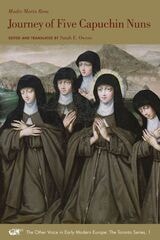
Journey of Five Capuchin Nuns
Madre María Rosa
Iter Press, 2009
Journey of Five Capuchin Nuns contains all the elements of a riveting adventure story. Through the eyes of the Mother Abbess, María Rosa, the reader is taken along on this journey through wars, pirates, disease, travel on the high seas, and treacherous mountain passes in the Andes. Five nuns set out in the early 1700s from their cloistered convent in Madrid, Spain, to travel halfway around the world to Lima, Peru. The journey lasted three years—an odyssey not all of them would complete. Yet, this unique historical document is so much more than a typical travel narrative. It illuminates the eighteenth-century way of life of religious women on both sides of the Atlantic basin. María Rosa’s lively prose attests to the literary connection among women religious writers of Spain and Latin America. This annotated edition and first-ever English translation of the manuscript will be of interest to scholars, students and anyone who wants to learn more about women’s history.
Journey to Autonomy
A MemoirLouise Rosenfield Noun
University of Iowa Press, 1996
Journeys in New Worlds
Early American Women's NarrativesWilliam L. Andrews
University of Wisconsin Press, 1990
Four early American women tell their own stories: Mary Rowlandson on her capture by Indians in 1676, Boston businesswoman Sarah Kemble Knight on her travels in New England, Elizabeth Ashbridge on her personal odyssey from indentured servant to Quaker preacher, and Elizabeth House Trist, correspondent of Thomas Jefferson, on her travels from Philadelphia to Natchez. Accompanied by introductions and extensive notes.
"The writings of four hearty women who braved considerable privation and suffering in a wild, uncultivated 17th- and 18th-century America. Although confined by Old World patriarchy, these women, through their narratives, have endowed the frontier experience with a feminine identity that is generally absent from early American literature."—Publishers Weekly
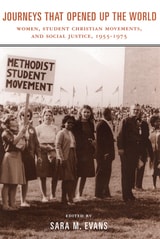
Journeys that Opened up the World
Women, Student Christian Movements, and Social Justice, 1955-1975Evans, Sara M.
Rutgers University Press, 2003
For thousands of young women in the 1950s and 1960s, involvement with the student Christian movement (SCM) changed their worldviews. Religious organizations fostered women’s leadership at a time when secular groups like Students for a Democratic Society, and the Left in general, relegated most female participants to stereotypical roles.
The SCM introduced young women to activism in other parts of the country and around the world. As leaders, thinkers, and organizers, they encountered the social realities of poverty and racial prejudice and worked to combat them. The SCM took women to Selma and Montgomery, to Africa and Latin America, and to a lifelong commitment to work for social justice.
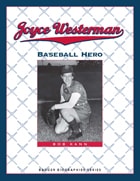
Joyce Westerman
Baseball HeroBob Kann
Wisconsin Historical Society Press, 2012
Joyce Westerman grew up on a farm in Pleasant Prairie, Wisconsin. As a kid, she cleaned the barn, picked vegetables, and helped her father cut down trees. But what she really loved to do was play baseball. Joyce played ball at recess and with friends whenever she could. She even joined her aunt’s adult softball team when she was only twelve.
As Joyce got older, she went to work at a factory in Kenosha. But when World War II broke out, she got a chance to try out for the All American Girls Professional Baseball League. Women from all over the country signed up to show off their skills. Only a few were good enough, and Joyce was one of them. For eight years, Joyce travelled around the United Stated playing ball, winning the league championship in her last season.
This addition to the Badger Biographies series for young readers tells the story of a woman who lived her dream of becoming a professional athlete. In a time when women had few opportunities for careers, and next to none in professional sports, Joyce and her teammates showed that women have what it takes.
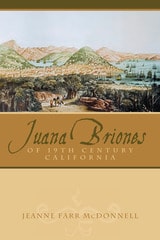
Juana Briones of Nineteenth-Century California
Jeanne Farr McDonnell
University of Arizona Press, 2008
Juana Briones was born in 1802 and spent her early youth in Santa Cruz, a community of retired soldiers who had helped found Spanish California, Native Americans, and settlers from Mexico. In 1820, she married a cavalryman at the San Francisco Presidio, Apolinario Miranda. She raised her seven surviving sons and daughters and adopted an orphaned Native American girl. Drawing on knowledge she gained about herbal medicine and other cures from her family and Native Americans, she became a highly respected curandera, or healer.
Juana set up a second home and dairy at the base of then Loma Alta, now Telegraph Hill, the first house in that area. After gaining a church-sanctioned separation from her abusive husband, she expanded her farming and cattle business in 1844 by purchasing a 4,400-acre ranch, where she built her house, located in the present city of Palo Alto. She successfully managed her extensive business interests until her death in 1889. Juana Briones witnessed extraordinary changes during her lifetime. In this fascinating book, readers will see California’s history in a new and revelatory light.
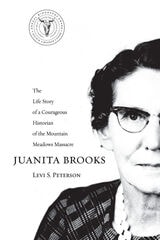
Juanita Brooks
The Life Story of a Courageous Historian of the Mountain Meadows MassacreLevi S Peterson
University of Utah Press, 2011
Born in 1898 in Bunkerville, Nevada, Juanita Brooks led an early life similar to that of many who grew up in isolated, tightly knit, rural Mormon communities. An early marriage suggested her future would follow a predictable course, but the death of her husband, the need to raise a young son, and a passion for knowledge led her along a different path, when at mid-life she became a well-known author after publishing The Mountain Meadows Massacre. In this book she exposed the killing of some 100 California-bound emigrants traveling through southern Utah in 1856 as an atrocity carried out by a Mormon militia with Indian allies and not solely as an Indian massacre, as it had been for so long portrayed.
Juanita Brooks was a faithful and active member of the Mormon Church, and her courage to tell the truth about this dark moment in Mormon history established her reputation as a respected historian. While there was no official church condemnation of the book, there was unofficial disapproval and Brooks was shunned by many in her community. She nevertheless doggedly pursued church authorities to revise their stand on the incidents at Mountain Meadows. The desire to tell the truth as she saw it became her hallmark, and Brooks’s life as wife, mother, teacher, community member, and undaunted historian became an uncommon story of personal stamina and intellectual courage.
Winner of the Evans Biography Award and the Mormon History Association Best Book Award.

Judith Resnik
Unsung AstronautMarlene Targ Brill
Ohio University Press, 0
Judith Resnik didn’t grow up dreaming of space, but when NASA opened its doors to women astronauts in the late 1970s, she stepped forward—and soared. One of the first six women ever accepted into NASA’s space shuttle astronaut-training program, Resnik brought her sharp mind, determination, and creativity to a field that had long been closed to women. Although she wasn’t the first American woman in space, she became one of the most accomplished astronauts of her time.
Resnik’s journey wasn’t easy. She faced challenges at home and in school, but she never let obstacles stop her. A gifted student, she excelled in math, science, and music—she even considered becoming a concert pianist before choosing a career in engineering. Her hard work paid off: She earned multiple degrees and helped design improvements for the space shuttle itself. She proved that astronauts aren’t just pilots—they’re problem solvers, inventors, and explorers.
In 1984, Resnik launched into space for the first time aboard the shuttle Discovery. Two years later, she joined the crew of Challenger. Tragically, that mission ended in disaster, cutting her life short. While the world focused on the loss of teacher Christa McAuliffe, who was a passenger on that flight, Resnik’s story was often overlooked. Yet her contributions to science and space exploration live on through programs, schools, and scholarships that bear her name.
This inspiring biography brings Resnik’s remarkable life to light. Readers will discover how a girl from Ohio became a trailblazer in space and how her courage and brilliance continue to inspire new generations. Her story reminds us that even if you’re not first, you can still make history—and that reaching for the stars starts with believing in yourself.
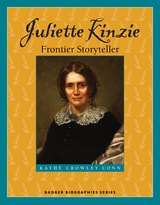
Juliette Kinzie
Frontier StorytellerKathe Crowley Conn
Wisconsin Historical Society Press, 2015
This new biography in the Badger Biographies Series turns the lens on the writer herself, detailing her life as she detailed the lives of those she encountered in the 1830s and 1840s. Juliette Kinzie: Frontier Storyteller details war, hunger, and the rapidly changing times Juliette witnessed on the Midwestern frontier, following the pioneering woman through her own changes from socialite to pioneer to famous writer and even to the work of her granddaughter, Juliette Gordon Low, who founded the Girl Scouts of the USA in 1912.
Junctures in Women’s Leadership
PoliticsJulie Des Jardins
Rutgers University Press, 2027
This collection profiles women in American politics who have demonstrated true leadership over the past 150 years—though this leadership has not always been recognized as such. These women have defied stereotypical caricatures and modeled effective ways to lead, even when they have not enjoyed formal access to voting or party politics, lost campaigns, or suffered scrutiny and harassment as public figures. Many of them have championed people and causes that their male counterparts have neglected, lending their lived experiences as women to fight for political action for underrepresented groups, and showing time and again that the personal really is political. Here we assess their political careers, not in terms of wins and losses, but rather in their ability to negotiate identity politics and shift conventional rules about how politicians lead.
This collection profiles such varied women as Jeannette Rankin, Shirley Chrisholm, Nancy Pelosi, Kamala Harris, Stacy Abrams, and Alexandria Ocasio-Cortez, among others. Whether they have recast gendered meanings around political ambition, broadened access to the political process, privileged principles over party loyalty, or prioritized issues over incumbency, each woman profiled here has wisdom to impart to new generations of American women who aspire to run for office or be involved in American politics.

Just A Temp
Kevin Henson
Temple University Press, 1996
"So this is where the brain starts to shut down and that which we treasure most, our personal identities, begins to slip away....I suppose I should be thankful; it's a paycheck." With this disturbing sentiment, Kevin Henson begins a voyage into the world of "the temp." For several years while a graduate student, Henson logged in thousands of hours as a temporary worker in offices throughout Chicago's Loop. Those experiences, and numerous interviews with other temps and temporary counselors, create a vivid and often disheartening picture of working 9 to 5 behind the receptionist's desk, telephone console, or data-entry terminal.
In their own voices, the temps in this book lament the frequently demeaning and mundane nature of many assignments:
•"You're not paid to think."
•
"Temps don't have names; they are just 'the temp.'"
•
"They always harass me...because I just wear a sweater and slacks."
•
"The worst part is telling people what you do. They always ask 'When are you going to get a real job?'"
Where the temporary service industry is quick to extol the virtues of temp work—mainly its flexibility—Henson and his cast of temps reveal the tacit pressure to persevere through an unpleasant assignment, to accept every assignment offered, and to readjust personal lives to do so. Outsiders to the established office culture and hierarchy, most temps are asked to do low-skill work and leave more detailed or complicated tasks for the return of the permanent employee.
Whether temp life is a preferred choice or grudgingly accepted as the last option when "real" or permanent work is unavailable, all temps must confront issues of gender, identity, and self-esteem. Henson examines these issues, documenting the concerns and interpretations of temp workers about their own work lives.
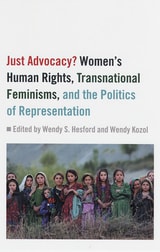
Just Advocacy?
Women's Human Rights, Transnational Feminism, and the Politics of RepresentationHesford, Wendy S
Rutgers University Press, 2005
In humanitarian and political debates about the topic, women and children are frequently considered first. Since the 1990s, human rights have become the most legitimate and legitimizing juridical and cultural claim made on a woman's behalf. But what are the consequences of equating women's rights with human rights? As the eleven essays in this volume show, the impact is often contradictory.
Bringing together some of the most respected scholars in the field, including Inderpal Grewal, Leela Fernandes, Leigh Gilmore, Susan Koshy, Patrice McDermott, and Sidonie Smith, Just Advocacy? sheds light on the often overlooked ways that women and children are further subjugated when political or humanitarian groups represent them solely as victims and portray the individuals that are helping them as paternal saviors.
Drawn from a variety of disciplinary perspectives in the humanities, arts, and social sciences, Just Advocacy? promises to advance a more nuanced and politically responsible understanding of human rights for both scholars and activists.
Just As We Were
A Narrow Slice of Texas WomanhoodBy Prudence Mackintosh
University of Texas Press, 1996
When a Texas debutante bows her forehead to the floor in the famous "Texas dip," society columnists all across the country speculate interminably over what it is that sets Texas women apart. But really, how could they know? Even women born and bred in Texas can't always answer that question.
Prudence Mackintosh comes very close to an answer, though, in this endlessly entertaining book. Writing with both a wry sense of humor and an insider's compassion, she offers us a fascinating look into the world of privileged, educated, well-married, well-connected, and mostly wealthy white Texas women.
What really sets these women apart, Ms. Mackintosh tells us, is the comfortable yet demanding path they follow from their idyllic girlhoods to prominent positions in society. In thirteen essays, some of which originally appeared in Texas Monthly magazine, she charts the way stations that mark this path: summer camps in the Texas Hill Country, exclusive private schools like Dallas' Hockaday, sorority membership, and acceptance into the Junior League.
Prudence Mackintosh has been both an outsider and an insider in this privileged world, and her observations are shot through with wit and real insight. Just As We Were may not be the final word on elite Texas women, but no other book has described their world with greater irony or accuracy.
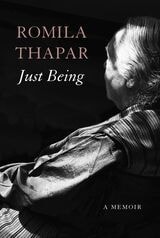
Just Being
A MemoirRomila Thapar
Seagull Books, 2026
In Just Being, historian Romila Thapar invites us into her illustrious world—a rich, extensive memoir from a scholar who has profoundly shaped our understanding of India’s past and present.
From her childhood growing up in British India, through her years of education in London, her extensive travels to archaeological sites across Asia and beyond, and her trailblazing role in shaping the Centre for Historical Studies at Jawaharlal Nehru University, Thapar reflects on a life lived in the service of inquiry and education. Composed over the past few years, Just Being is a testimony to Thapar’s ability to view herself within the larger flow of history, and to illumine it with a scholar’s depth and a storyteller’s sensitivity. It reveals not only an extraordinary, boundary-defying life but a profound conviction that understanding our past in the light of irrefutable evidence is essential to an insight into the present and to shaping a more thoughtful future.