Results by title
272 books match the query 'Work' and 4 start with j

James Wright
The Poetry of a Grown Man; Constancy and Transition in the Work of James WrightKevin Stein
Ohio University Press, 1988
Although some critics have identified two phases in the poetry of James Wright and have isolated particulars of his movement from traditional to more experimental forms, few have noted also the elements of constancy in the evolution of his poetry. In this first comprehensive scholarly introduction to Wright’s work, Stein traces the unified growth of Wright’s poetry, asserting that while stylistic changes are often more apparent than actual, Wright does undergo a continuing personal and aesthetic development throughout his career. Stein examines the entire body of Wright’s poetry, including such previously unpublished materials as the collection Amenities of Stone.
Stein locates Wright in the Emersonian tradition which sees struggle with language as a struggle with the self -- a locating and defining of the self within a world of natural facts. Language, then, becomes a means of self-definition, and to be frivolous or irresponsible with language becomes a negation of the self and the world it inhabits. For Wright, “the poetry of a grown man” issues from this understanding. Because Wright joins the act of language with the act of selfhood, it is not surprising that the mode and tenor of his work would alter as the self redefines its values and goals, its very identity. In fact, Stein divides Wright’s career into three interrelated stages of development: “containment,” in which he relies on traditional religious and rhetorical measures to distance himself from a world of experience; “vulnerability,” in which he enters the experiential world where the self is rewarded and equally threatened; and “integration,” in which he accepts and balances the necessary combination of beauty and horror inherent in being human within a natural world.
Stein shows that throughout his career Wright’s presiding concern is to discover a way of writing and a way of life that might overcome the effects of an individual’s separation from the human community, the natural world, and the spiritual presence in the universe. In Wright’s world, to do less is to betray one’s language -- and one’s self.
[more]
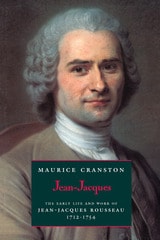
Jean-Jacques
The Early Life and Work of Jean-Jacques Rousseau, 1712-1754Maurice Cranston
University of Chicago Press, 1991
In the first volume of his trilogy, noted political philosopher Maurice Cranston draws from original manuscript sources to trace Rousseau's life from his birth in provincial obscurity in Geneva, through his youthful wanderings, to his return to Geneva in 1754 as a celebrated writer and composer.
"[An] admirable biography which is as meticulous, calm, reasonable, and judicious as its subject is passionate and tumultuous."—Keith Michael Baker, Washington Post Book World
"The definitive biography, as scholarly as it is entertaining."—The Economist
"Exceptionally fresh . . . . [Cranston] seems to know exactly what his readers need to know, and thoughtfully enriches the background—both physical and intellectual—of Rousseau's youthful peregrinations . . . . He makes the first part of Rousseau's life as absorbing as a picaresque novel. His fidelity to Rousseau's ideas and to his life as it was lived is a triumph of poise."—Naomi Bliven, The New Yorker
"The most outstanding achievement of Professor Cranston's own distinguished career."—Robert Wokler, Times Literary Supplement
Maurice Cranston (1920-1993), a distinguished scholar and recipient of the James Tait Black Memorial Prize for his biography of John Locke, was professor of political science at the London School of Economics. His numerous books include The Romantic Movement and Philosophers and Pamphleteers, and translations of Rousseau's The Social Contract and Discourse on the Origins of Inequality.
[more]
Jobless Future
Sci-Tech and the Dogma of WorkStanley Aronowitz
University of Minnesota Press, 1995
Essential reading for those seeking solutions to the new jobless economy.
This widely reviewed and highly successful book examines the job market of tomorrow. Aronowitz and DiFazio take you behind the headlines to challenge the idea that a high-tech economy will provide high-paying jobs for all who want them. Instead, they demonstrate that we're more likely to see continued layoffs and job displacement.
"Imagine a Brave New Work World in which unemployment is so rampant that more than a third of the adult population can't find a job and millions of others have stopped looking. Another third works only part-time, or at temporary or dead-end jobs. Meanwhile, the number of those still holding full-time positions steadily diminishes, their wages depressed because of the premium placed simply on having a job. . . . 'People need to start thinking about a jobless future,' insist [Aronowitz and DeFazio] . . . . Tha authors attribute rising unemployment to economic stagnation coupled with revolutionary technological change that has fostered workplace trends such as downsizing, re-engineering, with part-time jobs, temporary jobs and job-sharing replacing full-time work." --Washington Post
"Looks beyond the shadow play of welfare politics to the real source of that anxiety-the modern workplace. . . . Aronowitz and DiFazio are quite right to look beyond the dismal realities of today's workplace and envision a society that uses the fruits of technology to abolish-or at least diminish-what the left used to call wage slavery." --The Nation
"Replete with such futuristic concepts as cybernetics, technoculture, de-skilling, and informatics, this book is as timely as today's headlines announcing the latest round of layoffs and down-sizing. . . an important and thought-provoking work." --Library Journal
Stanley Aronowitz is professor of sociology at the Graduate Center of the City University of New York. William DiFazio is professor of sociology at St. John's University
[more]
Josef Frank
Life and WorkChristopher Long
University of Chicago Press, 2002
Architect, designer, and theorist Josef Frank (1885-1967) was known throughout Europe in the 1920s as one of the continent's leading modernists. Yet despite his important contributions to the development of modernism, Frank has been largely excluded from histories of the movement. Josef Frank: Life and Work is the first study that comprehensively explores the life, ideas, and designs of this complex and controversial figure.
Educated in Vienna just after the turn of the century, Frank became the leader of the younger generation of architects in Austria after the First World War. But Frank fell from grace when he emerged as a forceful critic of the extremes of modern architecture and design during the early 1930s. Dismissing the demands for a unified modern style, Frank insisted that it was pluralism, not uniformity, that most characterized life in the new machine age. He called instead for a more humane modernism, one that responded to people's everyday needs and left room for sentimentality and historical influences. He was able to put these ideas into practice when, in 1933, he was forced to leave Vienna for Sweden. There his work came to define Swedish (or Scandinavian) modern design. For more than thirty years he was the chief designer for the Stockholm furnishings firm Svenskt Tenn, producing colorful, cozy, and eclectic designs that provided a refreshing alternative to the architectural mainstream of the day and presaged the coming revolt against modernism in the 1960s.
In this sensitive study of one of the twentieth century's seminal architects and thinkers, Christopher Long offers new insight into Josef Frank's work and ideas and provides an important contribution to the understanding of modernist culture and its history.
[more]