Results by title
1441 books match the query 'World' and 15 start with j
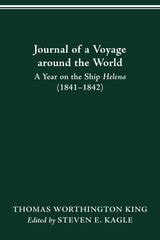
JOURNAL OF A VOYAGE AROUND THE WORLD
A YEAR ON THE SHIP HELENA (1841-1842)THOMAS WORTHINGTON KING
The Ohio State University Press, 2002
In 1841 Thomas Worthington King accepted a position as supercargo on the Helena, a ship some have called “the first American clipper,” as it was about to make its maiden voyage to China. Journal of a Voyage around the World recounts the travel of Thomas Worthington King on the Helena from 1841 to 1842.
In full and well-written entries, King recounts the routines and surprises of life at sea, where storms and calms could be equally threatening, and the next day might bring a stop at St. Helena to see Napoleon’s tomb or an encounter with pirates. King provides details often missing from histories that give a real sense of the period. In his description of Chile and Peru we learn about activities as diverse as cockfighting and courtship. We learn about produce and prisons, mints and monasteries, fruits and fashions. In his account of China, King vividly describes rivers so full of boats that one could “see no water—nothing but the large mat sales” and calm groves of “green lychee, or broad leaved & rustling plantain.”
Perhaps the most important subject of the diary is the diarist himself, whose talent and confidence develop on the pages of his record. Thomas Worthington King was born and raised in Chillicothe, Ohio, and was the grandson of two Ohio Senators: Rufus King and Thomas Worthington.

Jallad
Death Squads and State Terror in South AsiaTasneem Khalil
Pluto Press, 2015
An unsparing indictment of an international system of terror that is fully countenanced by the West, Jallad presents close-up, detailed accounts of incidents of state terror and targeted violence throughout South Asia. Khalil, a reporter who himself endured torture at the hands of agents in Bangladesh, and whose remarkable story was featured in the New York Times, draws on countless hours of on-the-ground reporting and a broad network of activists and human rights advocates to build an undeniable portrait of the domination and repression that lies at the very core of statecraft in South Asia. Shielded by their protectors in the developed world, the perpetrators of these abuses deploy them strategically to silence dissent and crush opposition.
A brave, essential work of reporting and investigation, Jallad brings these horrific acts to prominence in order to make it impossible for Western governments to continue turning a blind eye to the human rights violations of their erstwhile allies.
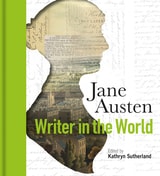
Jane Austen
Writer in the WorldEdited by Kathryn Sutherland
Bodleian Library Publishing, 2017
Brilliantly edited by Kathryn Sutherland, Jane Austen: Writer in the World offers a life story told through the author's personal possessions. In her teenage notebooks, literary jokes give a glimpse of her family’s shared love of reading and satire, which can be seen in the subtler humor of Austen’s published work. Pieces from Austen’s hand-copied collection of sheet music reveal how music was used to create networks far more intricate than the simple pleasures of home recital. A beautiful brown silk pelisse-coat, together with lively letters between Austen and Cassandra, give insight into her views on fashion. All feature in this lavishly illustrated collection, along with homemade booklets in which she composed her novels, portraits made of Austen during her lifetime, and much more. Also included are objects associated with the era in which Austen lived: newspaper articles, naval logbooks, and contemporary political cartoons, shedding light on Austen’s wider social and political worlds.
This collection makes a delightful modern-day keepsake from one of the world’s best-loved writers on the two-hundredth anniversary of her death.

Japan in the World
Masao Miyoshi and H. D. Harootunian, eds.
Duke University Press, 1993
Among the many topics covered are: racism in U.S.-Japanese relations; productivity and workplace discourse; Western cultural hegemony; the constructing of a Japanese cultural history; and the place of the novelist in today's world. Originally published as a special issue of boundary 2 (Fall 1991), this edition includes four new essays on Japanese industrial revolution; the place of English studies in Japan; how American cultural, historical, and political discourse represented Japan and in turn how America's version of Japan became Japan's version of itself; and an "archaeology" of hegemonic relationships between Japan and America and Britain in the first half of the twentieth century.
Contributors. Eqbal Ahmad, Perry Anderson, Bruce Cumings, Arif Dirlik, H.D. Harootunian, Kazuo Ishuro, Fredric Jameson, Kojin Karatani, Oe Kenzaburo, Masao Miyoshi, Tetsuo Najita, Leslie Pincus, Naoki Sakai, Miriam Silverberg, Christena Turner, Rob Wilson, Mitsuhiro Yoshimoto
Japan in the World, the World in Japan
Fifty Years of Japanese Studies at MichiganEdited by the Center for Japanese Studies, University of Michigan
University of Michigan Press, 2001

Japanese Empire in the Tropics
Selected Documents and Reports of the Japanese Period in Sarawak, Northwest Borneo, 1941–1945Ooi Keat Gin
Ohio University Press, 1997
Although the Japanese interregnum was brief, its dramatic commencement and equally dramatic conclusion represented a watershed in the history of the young state of Sarawak.
In recent years, there has been a groundswell of interest in the war years, culminating in an attempt at reassessment of the Japanese occupation in Southeast Asia by Western and Japanese scholars as well as by those from Southeast Asia.
Presented here in a two-volume edition is a history of the Japanese occupation of Sarawak narrated through the compelling testimonies of the actual participants based on their recollections, memoirs, and correspondence.

Jew
Baker, Cynthia M
Rutgers University Press, 2017
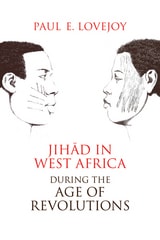
Jihad in West Africa during the Age of Revolutions
Paul E. Lovejoy
Ohio University Press, 2016
In Jihād in West Africa during the Age of Revolutions, a preeminent historian of Africa argues that scholars of the Americas and the Atlantic world have not given Africa its due consideration as part of either the Atlantic world or the age of revolutions. The book examines the jihād movement in the context of the age of revolutions—commonly associated with the American and French revolutions and the erosion of European imperialist powers—and shows how West Africa, too, experienced a period of profound political change in the late eighteenth through the mid-nineteenth centuries. Paul E. Lovejoy argues that West Africa was a vital actor in the Atlantic world and has wrongly been excluded from analyses of the period.
Among its chief contributions, the book reconceptualizes slavery. Lovejoy shows that during the decades in question, slavery expanded extensively not only in the southern United States, Cuba, and Brazil but also in the jihād states of West Africa. In particular, this expansion occurred in the Muslim states of the Sokoto Caliphate, Fuuta Jalon, and Fuuta Toro. At the same time, he offers new information on the role antislavery activity in West Africa played in the Atlantic slave trade and the African diaspora.
Finally, Jihād in West Africa during the Age of Revolutions provides unprecedented context for the political and cultural role of Islam in Africa—and of the concept of jihād in particular—from the eighteenth century into the present. Understanding that there is a long tradition of jihād in West Africa, Lovejoy argues, helps correct the current distortion in understanding the contemporary jihād movement in the Middle East, Afghanistan, Pakistan, and Africa.
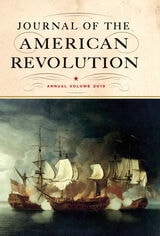
Journal of the American Revolution 2019
Annual VolumeDon N. Hagist
Westholme Publishing, 2019
The Journal of the American Revolution, Annual Volume 2019, presents the journal’s best historical research and writing over the past calendar year. The volume is designed for institutions, scholars, and enthusiasts to provide a convenient overview of the latest research and scholarship in American Revolution and Founding Era studies. The thirty-eight articles in the 2019 edition include:
Join, or Die: Political and Religious Controversy Over Franklin’s Snake Cartoon by Daniel P. Stone
The Connecticut Captivity of William Franklin, Loyalist by Louis Arthur Norton
Revisiting the Prayer at Valley Forge by Blake McGready
John the Painter: Terrorist for America by Lars Hedbor
Who Picked the Committees at the Constitutional Convention? by David O. Stewart
Norfolk, Virginia, Sacked by North Carolina and Virginia Troops by Patrick H. Hannum
Elias Hasket Derby: The Privateer Who Pioneered the Russian Trade by Nick Deluca
Benedict Arnold’s Master Plan (for British) Victory by John Knight
China and the American Revolution by Simon Hill
Moravians in the Middle: The Gnadenhutten Massacre by Eric Sterner
Slavery Through the Eyes of Revolutionary Generals by Gene Procknow
Our Man in Minorca: Lewis Littlepage, American Volunteer with the Spanish Armed Forces by Larrie D. Ferreiro
Patrick Tonyn: Britain’s Most Effective Revolutionary-Era Royal Governor by Jim Piecuch
Jefferson’s Reckoning: The Sage of Monticello’s Haunting Final Years by Geoff Smock
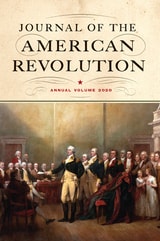
Journal of the American Revolution 2020
Annual VolumeDon N. Hagist
Westholme Publishing, 2020
The Journal of the American Revolution, Annual Volume 2020, presents the journal’s best historical research and writing over the past calendar year. The volume is designed for institutions, scholars, and enthusiasts to provide a convenient overview of the latest research and scholarship in American Revolution and Founding Era studies. The thirty-six articles in the 2020 edition include:
Bernard E. Griffiths: Trumpeter Barney of the Queen’s Rangers, Chelsea Pensioner—and Freed Slave by Todd W. Braisted
The Declaration of Independence: Did John Hancock Really Say that about his Signature?—and Other Signing Stories by J. L. Bell
Les Habitants: Collaboration and Pro-American Violence in Canada, 1774–1776 by Sebastian van Bastelaer
Misadventures in the Countryside: Escape from a British Prison Ship by Katie Turner Getty
The Revolutionary Memories of New York Loyalists: Thomas Jones and William Smith, Jr. by Cho-Chien Feng
The East India Company and Parliament’s “Fateful Decision” of 1767 by Steven Neill
Massachusetts Privateers During the Siege of Boston by Alexander Cain
The Constitution Counted Free Women and Children—And It Mattered by Andrew M. Schocket, with Kinzey M. McLaren-Czerr and Colin J. Spicer
How Magna Carta Influenced the American Revolution by Jason Yonce
Putting a Price on Loyalty: Mary Loring’s List of Losses by John Knight
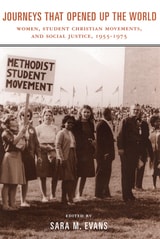
Journeys that Opened up the World
Women, Student Christian Movements, and Social Justice, 1955-1975Evans, Sara M.
Rutgers University Press, 2003
For thousands of young women in the 1950s and 1960s, involvement with the student Christian movement (SCM) changed their worldviews. Religious organizations fostered women’s leadership at a time when secular groups like Students for a Democratic Society, and the Left in general, relegated most female participants to stereotypical roles.
The SCM introduced young women to activism in other parts of the country and around the world. As leaders, thinkers, and organizers, they encountered the social realities of poverty and racial prejudice and worked to combat them. The SCM took women to Selma and Montgomery, to Africa and Latin America, and to a lifelong commitment to work for social justice.
Joy to the World
The Performance of Collective PleasureGary Alan Fine
University of Chicago Press, 2026
A celebration and exploration of the idea of pleasure and the unique role it serves in bringing individuals and communities together.
There are innumerable ways to take pleasure in life: a bite of cake in the late afternoon, a walk in the warm springtime air after a long winter, a listen to the opening chords of your favorite song. But each of these pleasures is transformed by the presence of others. In Joy to the World, sociologist Gary Alan Fine takes up one of the major themes of his lifetime of work: pleasure. Fine gives us the conceptual basis for a sociology of pleasure: a joyous view of the world that, at times, inspires us, through expectations of interaction, shared cultures, and routine practices that make life worth living in community.
Fine focuses on the impact of group relations as the platform for satisfaction, emphasizing the power of communities of practice. While pleasures may be enjoyed alone, the pleasure that occurs in social spaces performs a unique function in our personal and social lives; they help us understand ourselves as individuals who are part of a group. What is pleasurably transgressive in one context might seem inappropriate, cruel, or just plain nonsensical in another, and these shades of difference serve to solidify the bonds of the group.
Joy to the World urges us to understand what draws us together as well as to appreciate what drives us apart. Our joys, as well as our challenges, help us to be a part of a caring, conscientious, committed community.

Judicial Institutions in Nineteenth-Century Latin America
Edited by Eduardo Zimmermann
University of London Press, 1999
Judicial Review in Mexico
A Study of the Amparo SuitBy Richard D. Baker
University of Texas Press, 1971
The amparo suit is a Mexican legal institution similar in its effects to such Anglo-American procedures as habeas corpus, error, and the various forms of injunctive relief. It has undergone a long evolution since it was incorporated into the Constitution of 1857. Today, its principal purpose is to protect private individuals in the enjoyment of the rights guaranteed by the first twenty-nine articles of the Constitution.
Mexico after its independence produced many constitutions. One of the earliest problems was to find an adequate means of defending the Constitution against ill-founded interpretations of its precepts. Like the United States, Mexico has developed a system of constitutional defense in which the judiciary is the supreme interpreter of what this document means. Unlike the United States Supreme Court, however, the Mexican Supreme Court has not been innovative in its decisions or contradicted the administration on major policy decisions. This difference must be attributed to the civil law system of Mexico as well as to the political climate.
The first part of Richard D. Baker’s book describes the historical background of amparo and other methods of constitutional defense in Mexico. The three men most closely associated with creating a judicial form of constitutional defense in Mexico were Manuel Crescencio Rejón, José Fernando Ramírez, and Mariano Otero. Their own writings indicate that the immediate source of amparo must be found in the American institution of judicial review that was transmitted to Mexicans through Alexis de Tocqueville’s Democracy in America.
The second part is an exposition of the workings of the amparo suit in the twentieth century and the constitutional and statutory provisions affecting it. Since 1857, when it was incorporated into article 102 of the Constitution, the amparo suit has evolved into a highly complex institution performing three functions: the defense of the civil liberties enumerated in the first twenty-nine articles of the Constitution, the determination of the constitutionality of federal and state legislation, and cassation. The Supreme Court is primarily limited to defending civil liberties through the amparo suit; it remains less innovative and more restricted than the United States system of judicial review, especially in the effect of its judgments on political agencies.
Baker’s study is the first one in English dealing with this subject and is one of the most extensive in any language. It should be welcome as a valuable tool to all students of Mexican law, history, and political thought.

Just One Vote
From Jim Walding's Nomination to Constitutional DefeatIan Stewart
University of Manitoba Press, 2009