Results by title
5448 books match the query 'History and criticism' and 74 start with j
John le Carré’s Post–Cold War Fiction
Robert Lance Snyder
University of Missouri Press, 2017
This is an analysis of the first 10 post—Cold War novels of one of the most significant ethicists in contemporary fiction.
This book challenges distinctions between “popular” and “serious” literature by recognizing le Carré as one of the most significant ethicists in contemporary fiction, contributing to an overdue reassessment of his literary stature. Le Carré’s ten post–Cold War novels constitute a distinctive subset of his espionage fiction in their response to the momentous changes in geopolitics that began in the 1990s. Through a close reading of these novels, Snyder traces how—amid the “War on Terror” and transnationalism—le Carré weighs what is at stake in this conflict of deeply invested ideologies.
Joining the Conversation
Dialogues by Renaissance WomenJanet Levarie Smarr
University of Michigan Press, 2005
Avoiding the male-authored model of competing orations, French and Italian women of the Renaissance framed their dialogues as informal conversations, as letters with friends that in turn became epistles to a wider audience, and even sometimes as dramas. No other study to date has provided thorough, comparative view of these works across French, Italian, and Latin. Smarr's comprehensive treatment relates these writings to classical, medieval, and Renaissance forms of dialogue, and to other genres including drama, lyric exchange, and humanist invective -- as well as to the real conversations in women's lives -- in order to show how women adapted existing models to their own needs and purposes.
Janet Levarie Smarr is Professor of Theatre and Italian Studies at the University of California, San Diego.
Joinings and Disjoinings
The Significance of Marital Status in LiteratureJoAnna Stephens Mink
University of Wisconsin Press, 1991
Jokes
Philosophical Thoughts on Joking MattersTed Cohen
University of Chicago Press, 1999
Sol sits on the sidewalk bench and waits patiently for nearly half an hour. Finally, Abe reappears.
"Well," asks Sol, "what are they up to? Who are they trying to convert? Why do they care? Did you get the $1,000?"
Indignantly Abe replies, "Money. That's all you people care about."
Ted Cohen thinks that's not a bad joke. But he also doesn't think it's an easy joke. For a listener or reader to laugh at Abe's conversion, a complicated set of conditions must be met. First, a listener has to recognize that Abe and Sol are Jewish names. Second, that listener has to be familiar with the widespread idea that Jews are more interested in money than anything else. And finally, the listener needs to know this information in advance of the joke, and without anyone telling him or her. Jokes, in short, are complicated transactions in which communities are forged, intimacy is offered, and otherwise offensive stereotypes and cliches lose their sting—at least sometimes.
Jokes is a book of jokes and a book about them. Cohen loves a good laugh, but as a philosopher, he is also interested in how jokes work, why they work, and when they don't. The delight at the end of a joke is the result of a complex set of conditions and processes, and Cohen takes us through these conditions in a philosophical exploration of humor. He considers questions of audience, selection of joke topics, the ethnic character of jokes, and their morality, all with plenty of examples that will make you either chuckle or wince. Jokes: more humorous than other philosophy books, more philosophical than other humor books.
"Befitting its subject, this study of jokes is . . . light, funny, and thought-provoking. . . . [T]he method fits the material, allowing the author to pepper the book with a diversity of jokes without flattening their humor as a steamroller theory might. Such a book is only as good as its jokes, and most of his are good. . . . [E]ntertainment and ideas in one gossamer package."—Kirkus Reviews
"One of the many triumphs of Ted Cohen's Jokes-apart from the not incidental fact that the jokes are so good that he doesn't bother to compete with them-is that it never tries to sound more profound than the jokes it tells. . . . [H]e makes you feel he is doing an unusual kind of philosophy. As though he has managed to turn J. L. Austin into one of the Marx Brothers. . . . Reading Jokes makes you feel that being genial is the most profound thing we ever do-which is something jokes also make us feel-and that doing philosophy is as natural as being amused."—Adam Phillips, London Review of Books
"[A] lucid and jargon-free study of the remarkable fact that we divert each other with stories meant to make us laugh. . . . An illuminating study, replete with killer jokes."—Kevin McCardle, The Herald (Glasgow)
"Cohen is an ardent joke-maker, keen to offer us a glimpse of how jokes are crafted and to have us dwell rather longer on their effects."—Barry C. Smith, Times Literary Supplement
"Because Ted Cohen loves jokes, we come to appreciate them more, and perhaps think further about the quality of good humor and the appropriateness of laughter in our lives."—Steve Carlson, Christian Science Monitor
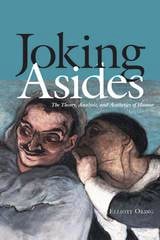
Joking Asides
The Theory, Analysis, and Aesthetics of HumorElliott Oring
Utah State University Press, 2016
A folklorist drawn to the study of humor, Oring developed his formulation of “appropriate incongruity” as a frame to understand what jokes must do to produce humor. He tests appropriate incongruity against other major positions in the field, including the general theory of verbal humor, conceptual integration theory, benign violation theory, and false-belief theory. Oring draws on the work of scholars from several disciplines—anthropology, folklore, philosophy, psychology, linguistics, and literature—to ask basic questions about the construction and evolution of jokes, untangle the matter of who the actual targets of a joke might be, and characterize the artistic qualities of jokes and joke performances.
Although Oring guides the reader through a forest of jokes and joke genres, this is not a joke book. A major work from a major scholar, Joking Asides is a rigorous exploration of theoretical approaches to jokes and their functions and is filled with disquieting questions, penetrating criticisms, and original observations. Written in a clear and accessible style, this book will prove valuable to any scholar or student who takes matters of jokes and joking seriously.
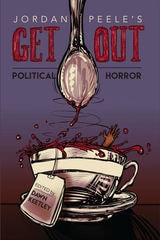
Jordan Peele's Get Out
Political HorrorEdited by Dawn Keetley
The Ohio State University Press, 2020
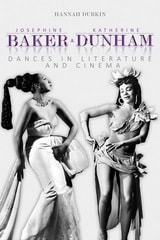
Josephine Baker and Katherine Dunham
Dances in Literature and CinemaHannah Durkin
University of Illinois Press, 2019
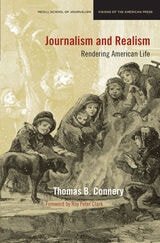
Journalism and Realism
Rendering American LifeThomas B Connery
Northwestern University Press, 2011
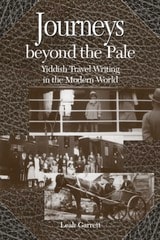
Journeys beyond the Pale
Yiddish Travel Writing in the Modern WorldLeah V. Garrett
University of Wisconsin Press, 2003
Journeys beyond the Pale is the first book to examine how Yiddish writers, from Mendele Moycher Sforim to Der Nister to the famed Sholem Aleichem, used motifs of travel to express their complicated relationship with modernization. The story of the Jews of the Pale of settlement encompasses current-day Russia, the Ukraine, Belarus, and Poland.

Journeys from Scandinavia
Travelogues of Africa, Asia, and South America, 1840—2000Elisabeth Oxfeldt
University of Minnesota Press, 2010
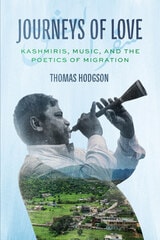
Journeys of Love
Kashmiris, Music, and the Poetics of MigrationThomas Hodgson
University of Chicago Press, 2025
In Journeys of Love, ethnomusicologist Thomas Hodgson offers a sensitive corrective to harmful portrayals of immigrants—specifically, Pakistanis living in England—as a self-segregating group prohibited from making music, a stereotype that has often resulted in violent Islamophobia. He argues that, in practice, these migrants—many of whom come from the Mirpur area of Azad Kashmir—occupy rich musical worlds, full of poetic metaphors, that are central to surviving migration and its attendant losses.
Hodgson shows how Mirpuris in England, as well as those who remain in Pakistan, carry on traditions of reciting a collection of poetry by the nineteenth-century Sufi saint Mian Muhammad Bakhsh, translated by Hodgson here as Journeys of Love. With its themes of remaining true to one’s home, the oppressed being saved, having patience, and keeping faith in God, this work has become the story of movement and displacement in its narrative arc, as well as through the way it provides spiritual and ethical frameworks for settling in new lands. These hidden poetics of migration transform across generations as young Mirpuris develop new expressions of the connections across continents. These poetics reveal the connections between Kashmir’s rural village life and urban centers abroad, offering a sensitive and illuminating portrait of migration and multiculturalism in Britain and beyond.
Joy (Or Something Darker, but Like It)
poetry & parentingNathaniel Perry
University of Michigan Press, 2024
Each of the twelve essays considers a different poet—Edward Thomas, Henry W. Longfellow, George Scarbrough, Elizabeth Bishop, Geoffrey Hill, Primus St. John, Robert Hayden, Elizabeth Coatsworth, Gwendolyn Brooks, Robert Frost, E.A. Robinson, and Belle Randall—and, alongside them, different concerns of parenting and living. Organized in chronological order, they track the growth of Nathaniel Perry’s own children who pop up from time to time in a believable way. Essays consider the idea of devotion and belief, the idea of imperfection, the small details we can focus on as parents, and the conceptions of the world we pass along to our children. Together these essays not only represent the author's personal canon of poets who have been important to him in his life and work, but also present a diverse slice of American poetry, in voice, form, identity, origin, and time period.
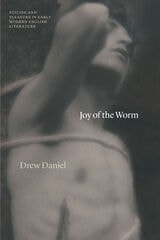
Joy of the Worm
Suicide and Pleasure in Early Modern English LiteratureDrew Daniel
University of Chicago Press, 2022
In this study, Drew Daniel identifies a surprisingly common aesthetic attitude that he calls “joy of the worm,” after Cleopatra’s embrace of the deadly asp in Shakespeare’s play—a pattern where voluntary death is imagined as an occasion for humor, mirth, ecstatic pleasure, even joy and celebration.
Daniel draws both a historical and a conceptual distinction between “self-killing” and “suicide.” Standard intellectual histories of suicide in the early modern period have understandably emphasized attitudes of abhorrence, scorn, and severity toward voluntary death. Daniel reads an archive of literary scenes and passages, dating from 1534 to 1713, that complicate this picture. In their own distinct responses to the surrounding attitude of censure, writers including Shakespeare, Donne, Milton, and Addison imagine death not as sin or sickness, but instead as a heroic gift, sexual release, elemental return, amorous fusion, or political self-rescue. “Joy of the worm” emerges here as an aesthetic mode that shades into schadenfreude, sadistic cruelty, and deliberate “trolling,” but can also underwrite powerful feelings of belonging, devotion, and love.
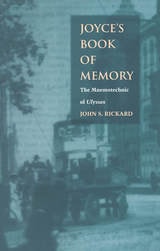
Joyce's Book of Memory
The Mnemotechnic of UlyssesJohn S. Rickard
Duke University Press, 1999
Offering a detailed reading of Joyce and his methods of writing, Rickard investigates the uses of memory in Ulysses and analyzes its role in the formation of personal identity. The importance of forgetting and repression, and the deadliness of nostalgia and habit in Joyce’s paralyzed Dublin are also revealed. Noting the power of spontaneous, involuntary recollection, Rickard locates Joyce’s mnemotechnic within its historical and philosophical contexts. As he examines how Joyce responded to competing intellectual paradigms, Rickard explores Ulysses’ connection to medieval, modern, and (what would become) postmodern worldviews, as well as its display of tensions between notions of subjective and universal memory. Finally, Joyce’s Book of Memory illustrates how Joyce distilled subjectivity, history, and cultural identity into a text that offers a panoramic view of the modern period.
This book will interest students and scholars of Joyce, as well as others engaged in the study of modern and postmodern literature.
Judaism and Christianity in the Age of Constantine
History, Messiah, Israel, and the Initial ConfrontationJacob Neusner
University of Chicago Press, 1987
In a close analysis of texts by the Christian theologians Eusebius, Aphrahat, and Chrysostom on one hand, and of the central Jewish works the Talmud of the Land of Israel, the Genesis Rabbah, and the Leviticus Rabbah on the other, Neusner finds that both religious groups turned to the same corpus of Hebrew scripture to examine the same fundamental issues. Eusebius and Genesis Rabbah both address the issue of history, Chrysostom and the Talmud the issue of the Messiah, and Aphrahat and Leviticus Rabbah the issue of Israel. As Neusner demonstrates, the conclusions drawn shaped the dialogue between the two religions for the rest of their shared history in the West.
Judaism and Disability
Portrayals in Ancient Texts from the Tanach through the BavliJudith Z. Abrams
Gallaudet University Press, 1998
In Judaism and Disability, the archaic portrayals of mentally ill, mentally retarded, physically affected, deaf, blind, and other disabled people reflect the sharp contrast they presented compared to the unchanging Judaic ideal of the “perfect priest.” All of these sources describe this perfection as embodied in a person who is male, free, unblemished, with da’at (cognition that can be communicated), preferably learned, and a priest. The failure to have da’at stigmatized disabled individuals, who were also compromised by the treatment they received from nondisabled people, who were directing and constraining.
As the Judaic ideal transformed from the bodily perfection of the priest in the cult to intellectual prowess in the Diaspora, a parallel change of attitudes toward disabled persons gradually occurred. The reduced emphasis upon physical perfection as a prerequisite for a relationship with God eventually enabled the enfranchisement of some disabled people and other minorities. Scholars, students, and other readers will find the engrossing process disclosed in Judaism and Disability one that they can apply to a variety of other disciplines.
Judaism and Story
The Evidence of The Fathers According to Rabbi NathanJacob Neusner
University of Chicago Press, 1992
Judaism and Story documents a chapter of rabbinic tradition that explored the possibility of historical orientation by means of stories. As Neusner demonstrates, this experiment with narrative went beyond the borders of rabbinic preoccupation with rhetorical argumentation focused on the explication of the Torah. The sage story moved in the direction of biography, but without allowing biography to emerge. This development, in Neusner's account, parallels the movement from epistle to Gospel in early Christianity and thus has broad implications for the history of religions.

Juju
A Social History and Ethnography of an African Popular MusicChristopher Alan Waterman
University of Chicago Press, 1990
Jungle Fever
Exploring Madness and Medicine in Twentieth-Century Tropical NarrativesCharlotte Rogers
Vanderbilt University Press, 2012
The canonical works of authors such as Joseph Conrad, Andre Malraux, Jose Eustasio Rivera, and others present jungles and wildernesses as fundamentally corrupting and dangerous. Rogers explores how the methods these authors use to communicate the physical and psychological maladies that afflict their characters evolved symbiotically with modern medicine. While the wilderness challenges Conrad's and Malraux's European travelers to question their civility and mental stability, Latin American authors such as Alejo Carpentier deftly turn pseudoscientific theories into their greatest asset, as their characters transform madness into an essential creative spark.
Ultimately, Jungle Fever suggests that the greatest horror of the jungle is the unknown regions of the character's own mind.
Just Anger
Representing Women's Anger in Early Modern EnglandGwynne Kennedy
Southern Illinois University Press, 2000
The first scholar to investigate the subject of women’s anger in early modern England, Gwynne Kennedy analyzes portrayals of and attitudes toward women’s anger in printed texts by or purporting to be written by women during the period.
Kennedy draws from recent critical work on emotions by historians, literary scholars, philosophers, and psychologists as well as comparative studies of the emotions by cultural anthropologists. Kennedy also examines a number of male-authored works, including sermons, conduct literature, philosophy, rhetoric, and medicine. The focus of her work, however, is on representations of women’s anger in printed works signed with women’s names in late sixteenth- and early seventeenth-century England. She addresses the ways these writings conform to, conflict with, or appear to reconfigure prevailing beliefs about women’s anger.
Kennedy looks at such literary texts as Mary Wroth’s romance, The Countess of Montgomery’s Urania, the first fiction by an English woman; Elizabeth Cary’s play, The Tragedy of Mariam, the earliest extant play in English by a woman; and Aemilia Lanyer’s verse collection, Salve Deus Rex Judaeorum. She also discusses religious writings by Protestant martyr Anne Askew and Elizabeth Cary’s history of Edward II. Kennedy considers as well defenses of women’s nature authored by women (Rachel Speght and Aemilia Lanyer) or published under female pseudonyms (“Jane Anger,” “Ester Sowernam,” and “Constantia Munda”).
Kennedy demonstrates the importance of class and race as factors affecting anger’s legitimacy and its forms of expression. She shows how early modern assumptions about women’s anger can help to create or exaggerate other differences among women. Her close scrutiny of anger against female inferiority emphasizes the crucial role of emotions in the construction of self-worth and identity.
Just Assassins
The Culture of Terrorism in RussiaEdited and with an introduction by Anthony Anemone
Northwestern University Press, 2010
Just Assassins examines terrorism as it’s manifested in Russian culture past and present, with essays devoted to Russian literature, film, and theater; historical narrative; and even amateur memoir, songs, and poetry posted on the Internet. Along with editor Anthony Anemone’s introduction, these essays chart the evolution of modern political terrorism in Russia, from the Decembrist uprising to the horrific school siege in Beslan in 2004, showing how Russia’s cultural engagement with its legacy of terrorism speaks to the wider world.
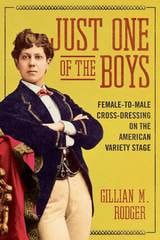
Just One of the Boys
Female-to-Male Cross-Dressing on the American Variety StageGillian Rodger
University of Illinois Press, 2018
Gillian M. Rodger uses the development of male impersonation from the early nineteenth century to the early twentieth century to illuminate the history of the variety show. Exploding notions of high- and lowbrow entertainment, Rodger looks at how both performers and forms consistently expanded upward toward respectable—and richer—audiences. At the same time, she illuminates a lost theatrical world where women made fun of middle-class restrictions even as they bumped up against rules imposed in part by audiences. Onstage, the actresses' changing performance styles reflected gender construction in the working class and shifts in class affiliation by parts of the audiences. Rodger observes how restrictive standards of femininity increasingly bound male impersonators as new gender constructions allowed women greater access to public space while tolerating less independent behavior from them.
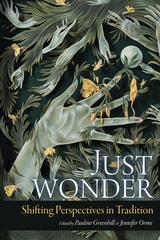
Just Wonder
Shifting Perspectives in TraditionPauline Greenhill
Utah State University Press, 2024
These essays examine fairy tales and other traditional forms of the fantastic and the real to offer alternative expressions of justice relevant to gender, sex, sexuality, environment, Indigeneity, class, ability, race, decolonizing, and human and nonhuman relations. By analyzing fairy tales and wonder texts from various media through an intersectional feminist lens, Pauline Greenhill and Jennifer Orme consider how wonder genres and forms blend with diverse conceptions of seeking and enacting justice. International collaborators—both established and emerging scholars who self-identify with different subjectivities, locations, and generations and come from an impressive range of inter/disciplines—engage with contemporary and historical texts from various languages and cultural contexts, including interventions, counterparts, and comparisons to the fairy tale. Just Wonder offers a critical look at how creative wondering can expand the ability to resist modes of oppression while fostering equity, as well as encourage curiosity and imagination.
In a world that can be overwhelming and precarious, this book presents scholarly, artistic, personal, and collective-action interventions to identify and respond to injustice while centering wonder and, thus, imagination, questioning, and hope. Just Wonder will appeal to fairy-tale scholars; folklorists; students and scholars of film, media studies, and cultural studies; as well as a general audience.
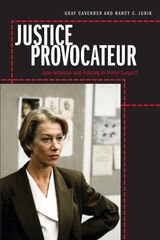
Justice Provocateur
Jane Tennison and Policing in Prime SuspectGray Cavender and Nancy C. Jurik
University of Illinois Press, 2012