Results by title
8128 books match the query 'Literary Criticism' and 125 start with j
Jewish Prince in Moslem Spain
Selected Poems of Samuel Ibn NagrelaSamuel Ibn Nagrela
University of Alabama Press, 2005
Of all the Hebrew poets of the 'Golden Age' in Spain, Samuel Ibn Nagrela (993-1056 A.D.) remains perhaps the most fascinating personality. A leading statesman in the kingdom of Granada, he was as successful in court as on the battlefield, maintaining a position of power for several decades while walking a political tightrope. Endowed with great literary talents, he opened up new paths in Hebrew poetry, and his mastery of its metrical intricacies was as consummate as his political and military skill.
Jewish Rhetorics
History, Theory, PracticeEdited by Michael Bernard-Donals and Janice W. Fernheimer
Brandeis University Press, 2014
Jewish Scholarship and Culture in Nineteenth-Century Germany
Between History and FaithNils Roemer
University of Wisconsin Press, 2005
German Jews were fully assimilated and secularized in the nineteenth century—or so it is commonly assumed. In Jewish Scholarship and Culture in the Nineteenth Century, Nils Roemer challenges this assumption, finding that religious sentiments, concepts, and rhetoric found expression through a newly emerging theological historicism at the center of modern German Jewish culture.
Modern German Jewish identity developed during the struggle for emancipation, debates about religious and cultural renewal, and battles against anti-Semitism. A key component of this identity was historical memory, which Jewish scholars had begun to infuse with theological perspectives beginning in the 1850s. After German reunification in the early 1870s, Jewish intellectuals reevaluated their enthusiastic embrace of liberalism and secularism. Without abandoning the ideal of tolerance, they asserted a right to cultural religious difference for themselves--an ideal they held to even more tightly in the face of growing anti-Semitism. This newly re-theologized Jewish history, Roemer argues, helped German Jews fend off anti-Semitic attacks by strengthening their own sense of their culture and tradition.
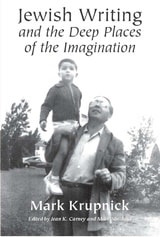
Jewish Writing and the Deep Places of the Imagination
Mark Krupnick
University of Wisconsin Press, 2005
When he learned he had ALS and roughly two years to live, literary critic Mark Krupnick returned to the writers who had been his lifelong conversation partners and asked with renewed intensity: how do you live as a Jew, when, mostly, you live in your head? The evocative and sinuous essays collected here are the products of this inquiry. In his search for durable principles, Krupnick follows Lionel Trilling, Cynthia Ozick, Geoffrey Hartman, Philip Roth, Saul Bellow, and others into the elemental matters of life and death, sex and gender, power and vulnerability.
The editors—Krupnick’s wife, Jean K. Carney, and literary critic Mark Shechner—have also included earlier essays and introductions that link Krupnick’s work with the “deep places” of his own imagination.
Jewish in America
Sara Blair and Jonathan Freedman, Editors
University of Michigan Press, 2004
-From the Introduction
This rare and original work of cultural studies offers uncommon and engaging perspectives-as well as provocative and humorous insights-on what it means to be Jewish in America.
Jewish in America features poetry, art, essays, and stories from an impressive and respected list of contributors, including among others Stephen Greenblatt, Richard Kostelanetz, Jacqueline Osherow, Robert Pinsky, Sharon Pomerantz, Nancy Reisman, Grace Schulman, Louis Simpson, Alisa Solomon, and Stephen J. Whitfield.
In addition to pieces by some of the country's leading writers, the book features a stunning gallery of original photographs that transport the viewer from the crowded Coney Island beaches of the 1940s to the landscapes of Oaxaca, Mexico in the 1990s.
Jews and Ukrainians in Russia's Literary Borderlands
From the Shtetl Fair to the Petersburg BookshopAmelia M. Glaser
Northwestern University Press, 2011
Studies of Eastern European literature have largely confined themselves to a single language, culture, or nationality. In this highly original book, Glaser shows how writers working in Russian, Ukrainian, and Yiddish during much of the nineteenth century and the early part of the twentieth century were in intense conversation with one another. The marketplace was both the literal locale at which members of these different societies and cultures interacted with one another and a rich subject for representation in their art. It is commonplace to note the influence of Gogol on Russian literature, but Glaser shows him to have been a profound influence on Ukrainian and Yiddish literature as well. And she shows how Gogol must be understood not only within the context of his adopted city of St. Petersburg but also that of his native Ukraine. As Ukrainian and Yiddish literatures developed over this period, they were shaped by their geographical and cultural position on the margins of the Russian Empire. As distinctive as these writers may seem from one another, they are further illuminated by an appreciation of their common relationship to Russia. Glaser’s book paints a far more complicated portrait than scholars have traditionally allowed of Jewish (particularly Yiddish) literature in the context of Eastern European and Russian culture.
Jim Crow Networks
African American Periodical CulturesEurie Dahn
University of Massachusetts Press, 2021
As Eurie Dahn demonstrates, authors like James Weldon Johnson, Nella Larsen, William Faulkner, and Jean Toomer wrote in the context of interracial and black periodical networks, which shaped the literature they produced and their concerns about racial violence. This original study also explores the overlooked intersections between the black press and modernist and Harlem Renaissance texts, and highlights key sites where readers and writers worked toward bottom-up sociopolitical changes during a period of legalized segregation.
Jin Ping Mei – A Wild Horse in Chinese Literature
Essays on Texts, Illustrations and Translations of a Late Sixteenth-Century MasterpieceEdited by Vibeke Børdahl and Lintao Qi
National University of Singapore Press, 2022
Joanna Russ
Gwyneth Jones
University of Illinois Press, 2019

John Berryman and the Thirties
A MemoirE. M. Halliday
University of Massachusetts Press, 0
E. M. Halliday's "John Berryman and the Thirties: A Memoir" presents an intimate portrait of the celebrated poet during his formative years. Written by Berryman's Columbia College classmate and lifelong friend, the memoir traces Berryman's intellectual and personal development throughout the 1930s—a transformative decade that shaped his later career as one of America's most innovative poets.
Halliday offers rare firsthand insight into Berryman's early struggles, influences, and relationships during a period preceding his major publications and institutional recognition. The memoir explores the Depression-era intellectual landscape that molded Berryman's consciousness, his engagement with modernist poetry and criticism, and his complex personality navigating academic and artistic ambitions. Through personal anecdotes and literary analysis, Halliday documents Berryman's evolution from promising young poet to serious artist grappling with existential and aesthetic questions.
This work fills a crucial gap in Berryman scholarship, providing contextual understanding of the poet's formative years before his landmark works like "Homage to Mistress Bradstreet" and the Dream Songs. Essential for scholars of twentieth-century American poetry and biography, the memoir preserves irreplaceable memories of a major literary figure.
John Brunner
Jad Smith
University of Illinois Press, 2012
John Cage
Composed in AmericaEdited by Marjorie Perloff and Charles Junkerman
University of Chicago Press, 1994
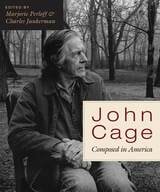
John Cage: Composed in America is the first book-length work to address the "other" John Cage, a revisionist treatment of the way Cage himself has composed and been "composed" in America. Cage, as these original essays testify, is a contradictory figure. A disciple of Duchamp and Schoenberg, Satie and Joyce, he created compositions that undercut some of these artists' central principles and then attributed his own compositional theories to their "tradition." An American in the Emerson-Thoreau mold, he paradoxically won his biggest audience in Europe. A freewheeling, Californian artist, Cage was committed to a severe work ethic and a firm discipline, especially the discipline of Zen Buddhism.
Following the text of Cage's lecture-poem "Overpopulation and Art," delivered at Stanford shortly before his death and published here for the first time, ten critics respond to the challenge of the complexity and contradiction exhibited in his varied work. In keeping with Cage's own interdisciplinarity, the critics approach that work from a variety of disciplines: philosophy (Daniel Herwitz, Gerald L. Bruns), biography and cultural history (Thomas S. Hines), game and chaos theory (N. Katherine Hayles), music culture (Jann Pasler), opera history (Herbert Lindenberger), literary and art criticism (Marjorie Perloff), cultural poetics (Gordana P. Crnkovic, Charles Junkerman), and poetic practice (Joan Retallack). But such labels are themselves confining: each of the essays sets up boundaries only to cross them at key points. The book thus represents, to use Cage's own phrase, a much needed "beginning with ideas."
John Ciardi
Measure of the ManVince Clemente
University of Arkansas Press, 1989
Some men make so indelible a mark on the lives of others that a place in time is reserved for them. In this memorial volume, some whose lives have been touched by such a man share their thoughts and memories of the poet, translator, editor , teacher, student, father, son, and husband they knew as John Ciardi.
X.J. Kennedy and Lewis Turco discuss Lives of X, a neglected American classic, which chronicles the years Ciardi spent growing up in Medford, Massachusetts, studying at Tufts, and serving as a gunner in World War II.
Richard Eberhart remembers Ciardi’s unforgettable presence, while John Holmes and Roy W. Cowden remember him as a brilliant student and poet at Tufts and at Michigan, where he won the Avery Hopwood Award. Others remember him as a teacher at Harvard and Rutgers. Dan Jaffe writes, “If John Ciardi held to any cause, it was the notion of precision, to an uncompromising excellence, to the notion that to strive was in itself not enough that one needed to judge honestly, to assess courageously, and to respond without flinching.”
William Heyden and Norbert Krapf tell how the books I Marry You and How Does a Poem Mean? influenced them as young men. In “john Ciardi: the Many Lives of Poetry,” John Nims claims Ciardi as our Chaucer. John Williams, Maxine Kumin, Diane Wakoski, and John Stone write about the Ciardi they knew at the Bread Loaf Writers’ Conference.
Gay Wilson Allen describes the list of contributors to Measure of the Man as a “Who’s Who” in American literature. Certainly it is an impressive gathering of poets, critics, and friends who have been touched by John Ciardi. “We are all in his debt,” Norman Cousins writes in his essay “Ciardi at The Saturday Review,” “and it is important that we say so.”

John Dickson Carr
A Critical StudyS. T. Joshi
University of Wisconsin Press, 1990
John Donne's Christian Vocation
Robert S. Jackson
Northwestern University Press, 1970
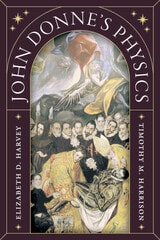
John Donne's Physics
Elizabeth D. Harvey and Timothy M. Harrison
University of Chicago Press, 2024
In 1624, poet and preacher John Donne published Devotions upon Emergent Occasions, a book that recorded his near-death experience during a deadly epidemic in London. Four hundred years later, in the aftermath of our own pandemic, Harvey and Harrison show how Devotions crystalizes the power, beauty, and enduring strangeness of Donne’s thinking. Arguing that Donne saw human life in light of emergent ideas in the study of nature (physics) and the study of the body (physick), John Donne’s Physics reveals Devotions as a culminating achievement, a radically new literary form that uses poetic techniques to depict Donne’s encounter with death in a world transformed by new discoveries and knowledge systems.
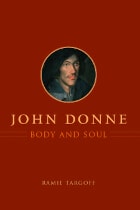
John Donne, Body and Soul
Ramie Targoff
University of Chicago Press, 2008
For centuries readers have struggled to fuse the seemingly scattered pieces of Donne’s works into a complete image of the poet and priest. In John Donne, Body and Soul, Ramie Targoff offers a way to read Donne as a writer who returned again and again to a single great subject, one that connected to his deepest intellectual and emotional concerns.
Reappraising Donne’s oeuvre in pursuit of the struggles and commitments that connect his most disparate works, Targoff convincingly shows that Donne believed throughout his life in the mutual necessity of body and soul. In chapters that range from his earliest letters to his final sermon, Targoff reveals that Donne’s obsessive imagining of both the natural union and the inevitable division between body and soul is the most continuous and abiding subject of his writing.
“Ramie Targoff achieves the rare feat of taking early modern theology seriously, and of explaining why it matters. Her book transforms how we think about Donne.”—Helen Cooper, University of Cambridge

John Donne’s Lyrics
The Eloquence of ActionArnold Stein
University of Minnesota Press, 1962
John Donne's Lyrics was first published in 1962. Minnesota Archive Editions uses digital technology to make long-unavailable books once again accessible, and are published unaltered from the original University of Minnesota Press editions.
Combining modern insight with historical perspective, Professor Stein offers a fresh interpretation of Donne's lyric poems. His method is cumulative; it includes cross references to the religious writing, analysis of individual poems, and their relationship to larger patterns which reflect Donne's poetic mind. Among the specific problems he deals with are those which concern metaphor, symbol, myth, wit, "fictions." "negative theology," consciousness-and-simplicity, "binary" and "ternary" form in poetry, meter and meaning, rationalism and affective language, the visual and the auditory.
Professor Stein demonstrates that to gain insight into the integrity of Donne's poetic mind it is necessary to take seriously two propositions: that Donne is a poetic logician endowed with a talent and love for the unity of imaginative form; and that Donne's poetry, though it is not simple, nevertheless deeply and persistently engages important problems which concern "simplicity." In one of his sermons, Donne wrote: "The eloquence of inferiours is in words, the eloquence of superiours is in action." Professor Stein maintains that in his best poems Donne aspires to the eloquence of action and never to the eloquence of words.
Although the study is focused on Donne's lyrics, the interpretation is based on a long study of all the poems and the prose and on background and foreground materials. In a postscript the author discusses Donne's "modern career."
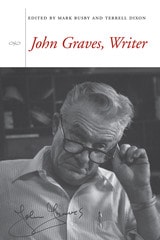
John Graves, Writer
Edited by Mark Busby and Terrell Dixon
University of Texas Press, 2007
Runner-up, Violet Crown Award, Writer's League of Texas, 2008
Renowned for Goodbye to a River, his now-classic meditation on the natural and human history of Texas, as well as for his masterful ability as a prose stylist, John Graves has become the dean of Texas letters for a legion of admiring readers and fellow writers. Yet apart from his own largely autobiographical works, including Hard Scrabble, From a Limestone Ledge, and Myself and Strangers, surprisingly little has been written about Graves's life or his work. John Graves, Writer seeks to fill that gap with interviews, appreciations, and critical essays that offer many new insights into the man himself, as well as the themes and concerns that animate his writing.
The volume opens with the transcript of a revealing, often humorous symposium session in which Graves responds to comments and stories from his old friend Sam Hynes, his former student and contemporary art critic Dave Hickey, and co-editor Mark Busby. Following this is a more formal interview of Graves by Dave Hamrick, who draws the author out on issues relating to each of his major works. John Graves's friends Bill Wittliff, Rick Bass, Bill Broyles, John R. Erickson, Bill Harvey, and James Ward Lee speak to the powerful influence that Graves has had on fellow writers.
In addition to these personal observations, nine scholars analyze essential aspects of Graves's work. These include the place of Goodbye to a River within environmental literature and how its writing was a rite of passage for its author; Graves as a prose stylist and a literary, rather than polemical, writer; the ways in which Graves's major works present different aspects of a single narrative about our relationship to the land; the question of gender in Graves's work; and Graves's sometimes contentious relationship with Texas Monthly magazine. Mark Busby introduces the volume with a critical overview of Graves's life and work, and Don Graham concludes it with a discussion of Graves's reception and literary reputation. A bibliography of works by and about Graves rounds out the book.
John Graves, Writer confirms Graves's stature not only within Texas letters, but also within American environmental writing, where Graves deserves to be more widely known.
John Greenleaf Whittier’s Poetry
An Appraisal and a SelectionRobert Penn Warren
University of Minnesota Press, 1971
John Greenleaf Whittier's Poetry was first published in 1971. Minnesota Archive Editions uses digital technology to make long-unavailable books once again accessible, and are published unaltered from the original University of Minnesota Press editions.
In this volume Robert Warren Penn, the noted critic, poet, and novelist, provides a major new appraisal of the once enormously popular New England port, John Greenleaf Whittier, along with his selection of 36 of Whittier's poems. Through Warren's perceptive and illuminating discussion, the significance of Whittier as a writer for our time becomes clear. In his introduction Warren shows that Whittier's deep commitment to his fellowman, especially his devotion to the cause of abolition, profoundly influenced his writing. In his estimate of Whittier's place in literature, Warren invokes the questions What does the past mean to an American? and in this context he compares Whittier with Cooper, Hawthorne, Melville, and Faulkner. He finds that Whittier's "star belongs in their constellation. If it is less commanding than any of theirs it yet shines with a clear and authentic light."
John Reed and the Writing of Revolution
Daniel W. Lehman
Ohio University Press, 2002
John Reed (1887-1920) is best known as the author of Ten Days That Shook the World and as champion of the communist movement in the United States. Still, Reed remains a writer almost systematically ignored by the literary critical establishment, even if alternately vilified and lionized by historians and by films like Warren Beatty’s Reds.
John Reed and the Writing of Revolution examines Reed’s writing from a different critical perspective—one informed by a theoretical and practical understanding of literary nonfiction. In both politics and writing, John Reed defied fashion. In his short career, Reed transcended the traditional creative arts of fiction, poetry, and drama in favor of deeply researched histories composed with the cadence of fiction and the power of fact. Reed thereby alienated literary critics who had idealized timeless artistry against the rough-and-tumble world of historical details and political implications.
Working from a close investigation of rare articles, manuscripts, and the Reed papers at Harvard as well as from Reed’s published work, Daniel W. Lehman offers the first detailed literary study of the man who followed Pancho Villa into battle; wrote literary profiles of such characters as Henry Ford, William Jennings Bryan, and Billy Sunday; explicated the Byzantine factionalism of Eastern Europe; and witnessed the storming of the Winter Palace and the birth of Soviet Russia.
John Steinbeck Goes to War
The Moon is Down as PropagandaDonald V. Coers
University of Alabama Press, 2005
WINNER OF THE ELIZABETH AGEE PRIZE IN AMERICAN LITERATURE
When words became weapons—Steinbeck’s novel and the underground war for freedom.
In March 1942, a desperate period for the allies in World War II, John Steinbeck published his propaganda novel The Moon is Down—the story of ruthless invaders who overrun a militarily helpless country. Throughout the novel, Steinbeck underscored both the fatal weakness of the “invincible” unnamed aggressors and the inherent power of the human values shard by the “conquered” people.
The Moon is Down created an immediate sensation among American literary critics; fierce debate erupted over Steinbeck’s uncommonly sympathetic portrayal of the enemy and the novel’s power as a vehicle for propaganda. Fifty years later, Coers continues the debate, relying heavily on unpublished letters and personal interviews with the lawyers, book dealers, actors, publishers, and housewives associated with the resistance movements in Western Europe. Clandestine translations of The Moon Is Down quickly appeared and were widely circulated under the noses of the Gestapo. Coers documents the fate of Steinbeck’s novel in the hands of World War II resistance fighters and deepens our appreciation of Steinbeck’s unique ability to express the feelings of oppressed peoples.
John Steinbeck
The Years of Greatness, 1936-1939Tetsumaro Hayashi
University of Alabama Press, 1993
Revisiting the remarkable years that produced Steinbeck's greatest literary achievements.
John Steinbeck: The Years of Greatness, 1936–1939, edited by Tetsumaro Hayashi, offers a compelling scholarly exploration of the brief but extraordinary period during which John Steinbeck produced some of the most influential works in American literary history. Drawn from papers presented at the Third International Steinbeck Congress, this collection of essays examines the creative, intellectual, and social forces that shaped Steinbeck's remarkable achievements during the late 1930s.
The contributors investigate Steinbeck's major works of the period, including In Dubious Battle, Of Mice and Men, and The Grapes of Wrath, situating them within the social and economic realities of the Great Depression and the evolving landscape of twentieth-century American literature. Particular attention is given to Steinbeck's portrayal of labor, migration, community, social justice, and the experiences of working-class Americans. The volume also presents innovative studies of female characters and relationships in Steinbeck's fiction, drawing on newly available research materials and correspondence to illuminate previously overlooked dimensions of his work.
By combining historical context, literary analysis, and fresh critical perspectives, this collection deepens appreciation for Steinbeck's artistry and enduring cultural significance. An essential resource for scholars and students alike, it offers valuable insights into the years that established Steinbeck as one of America's most important and widely studied authors.
John Updike and the Cold War
Drawing the Iron CurtainD. Quentin Miller
University of Missouri Press, 2001
One of the most enduring and prolific American authors of the latter half of the twentieth century, John Updike has long been recognized by critics for his importance as a social commentator. Yet, John Updike and the Cold War is the first work to examine how Updike's views grew out of the defining context of American culture in his time—the Cold War. Quentin Miller argues that because Updike's career began as the Cold War was taking shape in the mid-1950s, the world he creates in his entire literary oeuvre—fiction, poetry, and nonfiction prose—reflects the optimism and the anxiety of that decade.
Miller asserts that Updike's frequent use of Cold War tension as a metaphor for domestic life and as a cultural reality that affects the psychological security of his characters reveals the inherent conflict of his fictional world. Consequently, this conflict helps explain some of the problematic relationships and aimless behavior of Updike's characters, as well as their struggles to attain spiritual meaning.
By examining Updike's entire career in light of the historical events that coincide with it, Miller shows how important the early Cold War mind-set was to Updike's thinking and to the development of his fiction. The changes in Updike's writing after the 1950s confirm the early Cold War era's influence on his ideology and on his celebrated style. By the Cold War's end in the late 1980s, Updike's characters look back fondly to the Eisenhower years, when their national identity seemed so easy to define in contrast to the Soviet Union. This nostalgia begins as early as his writings in the 1960s, when the breakdown of an American consensus disillusions Updike's characters and leaves them yearning for the less divisive 1950s.
While underscoring how essential history is to the study of literature, Miller demonstrates that Updike's writing relies considerably on the growth of the global conflict that defined his time. Cogent and highly readable, John Updike and the Cold War makes an important contribution to Updike scholarship.
John le Carré’s Post–Cold War Fiction
Robert Lance Snyder
University of Missouri Press, 2017
This is an analysis of the first 10 post—Cold War novels of one of the most significant ethicists in contemporary fiction.
This book challenges distinctions between “popular” and “serious” literature by recognizing le Carré as one of the most significant ethicists in contemporary fiction, contributing to an overdue reassessment of his literary stature. Le Carré’s ten post–Cold War novels constitute a distinctive subset of his espionage fiction in their response to the momentous changes in geopolitics that began in the 1990s. Through a close reading of these novels, Snyder traces how—amid the “War on Terror” and transnationalism—le Carré weighs what is at stake in this conflict of deeply invested ideologies.
Johnson in Japan
Kimiyo Ogawa
Bucknell University Press, 2021
Published by Bucknell University Press. Distributed worldwide by Rutgers University Press.
Johnsonian Studies, 1887-1950
A Survey and BibliographyJames L. Clifford
University of Minnesota Press, 1951
Johnsonian Studies, 1887-1950 was first published in 1951. Minnesota Archive Editions uses digital technology to make long-unavailable books once again accessible, and are published unaltered from the original University of Minnesota Press editions.
Joint Enterprises
Collaborative Drama and the Institutionalization of the English Renaissance TheaterHeather Anne Hirschfeld
University of Massachusetts Press, 2004
Drawing on a range of documentary and literary sources as well as recent methodological advances in theater history, the book presents a sequence of case studies designed to accommodate both the larger cultural setting of the early modern theater and the localized, idiosyncratic factors influencing discrete literary productions. Each chapter chronicles the professional setting of a particular joint work and then investigates its rhetorical or linguistic traces in the resultant text. This approach allows Hirschfeld to locate specific links between modes of collaborative production and forms of dramatic representation and then explicate the literary and political implications of these connections.
Hirschfeld's case studies provide a fresh account of the institutionalization—the steady growth, organization, and incorporation—of the professional drama in sixteenth- and seventeenth-century English cultural life. By attending to the changing shapes and stakes of joint enterprises, she shows that dramatists did not unconsciously absorb the practice of collaborative writing from general social discourses, but rather were aware of the material and symbolic significances of their work, meanings structured by the traditions of the developing professional theater and by the cultural pressures and anxieties attendant upon a new and often fragile institution.
Joke Farming
How to Write Comedy and Other NonsenseElliott Kalan
University of Chicago Press, 2025
Philosophers may debate the meaning of comedy (thankfully keeping them too busy to fall into a life of crime), but the rest of us are more likely to wonder how we can make an audience laugh—or at least, how to entertain our friends and followers. According to award-winning comedy writer Elliott Kalan, we need to stop staring out the window, waiting for hilarious bits to stroll into view, fully formed. What we need is a process to plant their premises, tend to their structure and wording, and ultimately harvest them as funny material. In short, a farm. But for jokes.
In Joke Farming, Kalan explains that it’s easier to write jokes when you have a dependable method for doing so. All jokes, he argues, are built from the same elements: structure, premise, voice, tone, wording, and audience—and these elements can be applied to any comedic genre, from stand-up to sitcoms to satire. Kalan analyzes examples from his own career—including jokes that he wrote (and rewrote and rewrote and rewrote . . . ) as head writer for The Daily Show with Jon Stewart—as well as material from a diverse array of comedians, writers, and filmmakers, highlighting the phrasing, rhythm, and precise details that make their work so dang funny.
Drawing on his experiences in professional writers’ rooms as well as episodes from everyday life, Kalan’s guide to jokes will appeal to aspiring writers, their mentors, comedy fans, and anyone who has to speak at a wedding. Joke Farming points the way toward a writing process that lessens stress and agony and yields more reliable rewards: a surprising tagline, a hilarious word choice, and—most importantly—a bigger laugh from the audience, whoever they may be.
Joke Farming
How to Write Comedy and Other NonsenseElliott Kalan
University of Chicago Press, 2025
Philosophers may debate the meaning of comedy (thankfully keeping them too busy to fall into a life of crime), but the rest of us are more likely to wonder how we can make an audience laugh—or at least, how to entertain our friends and followers. According to award-winning comedy writer Elliott Kalan, we need to stop staring out the window, waiting for hilarious bits to stroll into view, fully formed. What we need is a process to plant their premises, tend to their structure and wording, and ultimately harvest them as funny material. In short, a farm. But for jokes.
In Joke Farming, Kalan explains that it’s easier to write jokes when you have a dependable method for doing so. All jokes, he argues, are built from the same elements: structure, premise, voice, tone, wording, and audience—and these elements can be applied to any comedic genre, from stand-up to sitcoms to satire. Kalan analyzes examples from his own career—including jokes that he wrote (and rewrote and rewrote and rewrote . . . ) as head writer for The Daily Show with Jon Stewart—as well as material from a diverse array of comedians, writers, and filmmakers, highlighting the phrasing, rhythm, and precise details that make their work so dang funny.
Drawing on his experiences in professional writers’ rooms as well as episodes from everyday life, Kalan’s guide to jokes will appeal to aspiring writers, their mentors, comedy fans, and anyone who has to speak at a wedding. Joke Farming points the way toward a writing process that lessens stress and agony and yields more reliable rewards: a surprising tagline, a hilarious word choice, and—most importantly—a bigger laugh from the audience, whoever they may be.
Jonathan Edwards and the Gospel of Love
Ronald Story
University of Massachusetts Press, 2012
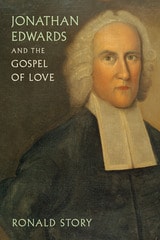
Jonathan Edwards has long epitomized the Puritan preacher as fiery scold, fixated on the inner struggle of the soul and the eternal flames of hell. In this book, Ronald Story offers a fundamentally different view of Edwards, revealing a profoundly social minister who preached a gospel of charity and community bound by love.
The first chapters trace Edwards's life and impact, examine his reputation as an intellectual, Calvinist, and revivalist, and highlight the importance for him of the gentler, more compassionate concepts of light, harmony, beauty, and sweetness. Story then explains what Edwards means by the “Gospel of Love”—a Christian faith that is less individual than interpersonal, and whose central feature is the practice of charity to the poor and the quest for loving community in this world, the chief signs of true salvation. As Edwards preached in his sermon “Heaven Is a World of Love,” the afterlife itself is social in nature because love is social.
Drawing on Edwards's own sermons and notebooks, Story reveals the minister's belief that divine love expressed in the human family should take us beyond tribalism, sectarianism, provincialism, and nationality. Edwards offers hope, in the manner of Walter Rauschenbusch, Karl Barth, Martin Luther King Jr., and other great “improvers,” for the coming of a world without want and war. Gracefully and compellingly written, this book represents a new departure in Edwards studies, revising the long-standing yet misleading stereotype of a man whose lessons of charity, community, and love we need now more than ever.
Jonathan Swift's Word-Book
A Vocabulary Compiled for Esther Johnson and Copied in Her Own HandA. C. Elias
University of Delaware Press, 2017
Published by University of Delaware Press. Distributed worldwide by Rutgers University Press.
Jonathan Swift
Irish Blow-InEugene Hammond
University of Delaware Press, 2016
Jonathan Swift: Irish Blow-in covers the arc of the first half of Jonathan Swift’s life, offering fresh details of the contentment and exuberance of his childhood, of the support he received from his grandmother, of his striking affection for Esther Johnson from the time she was ten years old (his pet name for her in her twenties was “saucebox”), of his precocious entry into English politics with his Contests and Dissensions pamphlet, of his brilliant and much misunderstood Tale of a Tub, and of his naive determination to do well both as a vicar of the small parish of Laracor in Ireland and as a writer for the Tory administration trying to pull England out of debt by ending the war England was engaged in with France.
I do not share with past biographers the sense that Swift had a deprived childhood. I do not share the suspicion that most of Swift’s enmities were politically motivated. I do not feel critical of him because he was often fastidious with his money. I do not think he was insincere about his religious faith. His pride, his sexual interests, his often shocking or uninhibited language, his instinct for revenge – emphasized by many previous biographers – were all fundamental elements of his being, but elements that he either used for rhetorical effect, or that he tried to keep in check, and that he felt that religion helped him to keep in check. Swift had as firm a conviction as did Freud that we are born with wayward tendencies; unlike Freud, though, he saw both religion and civil society as necessary and helpful checks on those wayward tendencies, and he (frequently, but certainly not always) acknowledged that he shared those tendencies with the rest of us.
This biography, in two books, Jonathan Swift: Irish Blow-in and Jonathan Swift: Our Dean, will differ from most literary biographies in that it does not aim to show how Swift’s life illuminates his writings, but rather how and why Swift wrote in order to live the life he wanted to live. I have liberally quoted Swift’s own words in this biography because his inventive expression of ideas, both in his public works and in his private letters, was what has made him a unique and compelling figure in the history of literature. I hope in these two books to come closer than past biographies to capturing how it felt to Swift himself to live his life.
Published by University of Delaware Press. Distributed worldwide by Rutgers University Press.
Jonathan Swift
Our DeanEugene Hammond
University of Delaware Press, 2016
Jonathan Swift: Our Dean details the political climax of his remarkable career—his writing and publication of The Drapier’s Letters (1724), Gulliver’s Travels (1726), and A Modest Proposal (1729)—stressing the relentless political opposition he faced and the numerous ways, including through his sermons, that he worked from his political base as Dean of St. Patrick’s Cathedral, psychologically as well as physically just outside the Dublin city walls, to attempt to rouse the Irish people to awareness of the ways that England was abusing them.
This book faces squarely the likelihood that Swift had a physical affair with Esther Vanhomrigh between 1719 and 1723, and reassesses in the light of that likelihood his conflicting relations with Esther Vanhomrigh and Esther Johnson. It traces the many loving friendships with both men and women in Ireland that sustained Swift during the years when his health gradually failed him, enabling him to continue indefatiguably, both through his writings and his authority as Dean of St. Patrick’s, to contribute to the public welfare in the face of relentless British attempts to squeeze greater and greater profits out of their Irish colony. Finally, it traces how Swift’s political indignation led to his treating many people, friends and enemies, cruelly during the 1730s, even while his humor and his ability to make and attract new friends sustained themselves until his memory finally failed him in 1742.
This biography, in two books, Jonathan Swift: Irish Blow-in and Jonathan Swift:Our Dean, comes closer than past biographies to capturing how it felt to Swift himself to live his life.
Published by University of Delaware Press. Distributed worldwide by Rutgers University Press.
Jonson's Moral Comedy
Alan C. Dessen
Northwestern University Press, 1971
Jordan Peele's Get Out
Political HorrorEdited by Dawn Keetley
The Ohio State University Press, 2020
Jorie Graham
Essays on the PoetryEdited by Thomas Gardner
University of Wisconsin Press, 2005
These essays identify three broad concerns that run through each of her strikingly different volumes of poems: the movement of the mind in action, the role of the body in experiencing the world, and the pressures of material conditions on mind and body alike. Gardner both shows how Graham is being read at the moment and charts new areas of investigation likely to dominate thinking about her over the next decade. This collection is sure to become the crucial first step for all future work on Graham and on American poetry of the last two decades.
José Lezama Lima's Joyful Vision
A Study of Paradiso and Other Prose WorksBy Gustavo Pellón
University of Texas Press, 1989
Cuba’s José Lezama Lima became the most controversial figure in the flowering of the Latin American novel with the 1966 publication of Paradiso. Hailed as a seminal writer of breathtaking originality by Julio Cortázar, Octavio Paz, and Mario Vargas Llosa, Lezama was also attacked by the Castro regime and others for his stylistic obscurity, erotic descriptions, and violation of literary norms. Indeed, his experimental fiction, written on the very boundaries of the novelistic genre, resists classification. José Lezama Lima’s Joyful Vision, a much-needed critical study of Paradiso, Oppiano Licario, and Lezama’s essays, is thus an exploration in reading, one that highlights and preserves the essential and persistent contradictions in Lezama’s theory and practice of literature.
Gustavo Pellón focuses his study on Lezama’s search for equilibrium, clarifying such oppositions in Lezama’s writings as the mystical quest for illumination through obscurity, the calculated cultivation of naïveté, the Proust-like fascination with yet ultimate condemnation of homosexuality, and a modernist (even postmodernist) narrative style that conveys a mystical (essentially medieval) worldview. Above all, Pellón shares his wonder at Lezama who, in an age of pessimism, maintained his joyful vision of art and existence.
José Martí’s Liberative Political Theology
Miguel A. De La Torre
Vanderbilt University Press, 2021
Miguel De La Torre has authored the most comprehensive text written thus far concerning Martí's religious views and how they affected his political thought. The few similar texts that exist are written in Spanish, and most of them romanticize Martí's spirituality in an attempt to portray him as a “Christian believer.” Only a handful provide an academic investigation of Martí's theological thought based solely on his writings, and those concentrate on just one aspect of Martí's religious influences. José Martí's Liberative Political Theology allows for mutual influence between Martí's political and religious views, rather than assuming one had precedence over the other.

José María Arguedas
Reconsiderations for Latin American StudiesCiro A. Sandoval
Ohio University Press, 1997
José María Arguedas (1911–1969) is one of the most important authors to speak to issues of the survival of native cultures. José María Arguedas: Reconsiderations for Latin American Cultural Studies presents his views from multiple perspectives for English-speaking audiences for the first time.
The life and works of José María Arguedas reflect in a seminal way the drama of acculturation and transculturation suffered not only by what we think of as the indigenous and mestizo cultures of Peru, but by other Latin American societies as well. Intricately reflecting his pluricultural and bilingual life experience, Arguedas’s illuminating poetic visions of Andean culture cross multidisciplinary borders to transfigure pedagogical and social practices.
Few texts convey the complexity and contradictions of an Andean cosmopolitanism with the intense accuracy of Arguedas’s anthropological, ethnographic essays and literary writings. The ramifications of Arguedas’s cultural critiques have yet to be assessed, particularly as a response to the disruptive forces of modernity, acculturation, and essential identity.
José María Arguedas was a Peruvian ethnographer, anthropologist, folklorist, poet, and novelist. He based his novels and stories on the life and outlook of the Quechua-speaking Indians and was a pioneer of modern Quechua poetry.
The present anthology brings his work to the attention of broader audiences by pulling together diverse scholarly views on Arguedas’s aesthetic and multicultural contributions to the contemporary and political archipelago. It is a synthesis of his views on cultural change as it impinges upon considerations and theories of Latin American cultural studies.
Journey to the West, Volume 1
Translated by Anthony C. Yu
University of Chicago Press, 1977
Journey to the West, Volume 2
Translated by Anthony C. Yu
University of Chicago Press, 1978
Journey to the West, Volume 3
Translated by Anthony C. Yu
University of Chicago Press, 1980
Journey to the West, Volume 4
Translated by Anthony C. Yu
University of Chicago Press, 1983
Journeys beyond the Pale
Yiddish Travel Writing in the Modern WorldLeah V. Garrett
University of Wisconsin Press, 2003
Journeys beyond the Pale is the first book to examine how Yiddish writers, from Mendele Moycher Sforim to Der Nister to the famed Sholem Aleichem, used motifs of travel to express their complicated relationship with modernization. The story of the Jews of the Pale of settlement encompasses current-day Russia, the Ukraine, Belarus, and Poland.
Journeys from Scandinavia
Travelogues of Africa, Asia, and South America, 1840—2000Elisabeth Oxfeldt
University of Minnesota Press, 2010
Joy (Or Something Darker, but Like It)
poetry & parentingNathaniel Perry
University of Michigan Press, 2024
Each of the twelve essays considers a different poet—Edward Thomas, Henry W. Longfellow, George Scarbrough, Elizabeth Bishop, Geoffrey Hill, Primus St. John, Robert Hayden, Elizabeth Coatsworth, Gwendolyn Brooks, Robert Frost, E.A. Robinson, and Belle Randall—and, alongside them, different concerns of parenting and living. Organized in chronological order, they track the growth of Nathaniel Perry’s own children who pop up from time to time in a believable way. Essays consider the idea of devotion and belief, the idea of imperfection, the small details we can focus on as parents, and the conceptions of the world we pass along to our children. Together these essays not only represent the author's personal canon of poets who have been important to him in his life and work, but also present a diverse slice of American poetry, in voice, form, identity, origin, and time period.
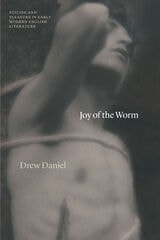
Joy of the Worm
Suicide and Pleasure in Early Modern English LiteratureDrew Daniel
University of Chicago Press, 2022
In this study, Drew Daniel identifies a surprisingly common aesthetic attitude that he calls “joy of the worm,” after Cleopatra’s embrace of the deadly asp in Shakespeare’s play—a pattern where voluntary death is imagined as an occasion for humor, mirth, ecstatic pleasure, even joy and celebration.
Daniel draws both a historical and a conceptual distinction between “self-killing” and “suicide.” Standard intellectual histories of suicide in the early modern period have understandably emphasized attitudes of abhorrence, scorn, and severity toward voluntary death. Daniel reads an archive of literary scenes and passages, dating from 1534 to 1713, that complicate this picture. In their own distinct responses to the surrounding attitude of censure, writers including Shakespeare, Donne, Milton, and Addison imagine death not as sin or sickness, but instead as a heroic gift, sexual release, elemental return, amorous fusion, or political self-rescue. “Joy of the worm” emerges here as an aesthetic mode that shades into schadenfreude, sadistic cruelty, and deliberate “trolling,” but can also underwrite powerful feelings of belonging, devotion, and love.
Joyce and the Two Irelands
By Willard Potts
University of Texas Press, 2001
Uniting Catholic Ireland and Protestant Ireland was a central idea of the "Irish Revival," a literary and cultural manifestation of Irish nationalism that began in the 1890s and continued into the early twentieth century. Yet many of the Revival's Protestant leaders, including W. B. Yeats, Lady Gregory, and John Synge, failed to address the profound cultural differences that made uniting the two Irelands so problematic, while Catholic leaders of the Revival, particularly the journalist D. P. Moran, turned the movement into a struggle for greater Catholic power.
This book fully explores James Joyce's complex response to the Irish Revival and his extensive treatment of the relationship between the "two Irelands" in his letters, essays, book reviews, and fiction up to Finnegans Wake. Willard Potts skillfully demonstrates that, despite his pretense of being an aloof onlooker, Joyce was very much a part of the Revival. He shows how deeply Joyce was steeped in his whole Catholic culture and how, regardless of the harsh way he treats the Catholic characters in his works, he almost always portrays them as superior to any Protestants with whom they appear. This research recovers the historical and cultural roots of a writer who is too often studied in isolation from the Irish world that formed him.
Joyce's Book of Memory
The Mnemotechnic of UlyssesJohn S. Rickard
Duke University Press, 1999
Offering a detailed reading of Joyce and his methods of writing, Rickard investigates the uses of memory in Ulysses and analyzes its role in the formation of personal identity. The importance of forgetting and repression, and the deadliness of nostalgia and habit in Joyce’s paralyzed Dublin are also revealed. Noting the power of spontaneous, involuntary recollection, Rickard locates Joyce’s mnemotechnic within its historical and philosophical contexts. As he examines how Joyce responded to competing intellectual paradigms, Rickard explores Ulysses’ connection to medieval, modern, and (what would become) postmodern worldviews, as well as its display of tensions between notions of subjective and universal memory. Finally, Joyce’s Book of Memory illustrates how Joyce distilled subjectivity, history, and cultural identity into a text that offers a panoramic view of the modern period.
This book will interest students and scholars of Joyce, as well as others engaged in the study of modern and postmodern literature.