Results by title
22279 books match the query 'Social Science' and 299 start with j
Journal of the Society for Social Work and Research, volume 12 number 3 (Fall 2021)
The University of Chicago Press
University of Chicago Press Journals, 2021
Journal of the Society for Social Work and Research, volume 12 number 4 (Winter 2021)
The University of Chicago Press
University of Chicago Press Journals, 2021
Journal of the Society for Social Work and Research, volume 13 number 1 (Spring 2022)
The University of Chicago Press
University of Chicago Press Journals, 2022
Journal of the Society for Social Work and Research, volume 13 number 2 (Summer 2022)
The University of Chicago Press
University of Chicago Press Journals, 2022
Journal of the Society for Social Work and Research, volume 13 number 3 (Fall 2022)
The University of Chicago Press
University of Chicago Press Journals, 2022
Journal of the Society for Social Work and Research, volume 13 number 4 (Winter 2022)
The University of Chicago Press
University of Chicago Press Journals, 2022
Journal of the Society for Social Work and Research, volume 14 number 1 (Spring 2023)
The University of Chicago Press
University of Chicago Press Journals, 2023
Journal of the Society for Social Work and Research, volume 14 number 2 (Summer 2023)
The University of Chicago Press
University of Chicago Press Journals, 2023
Journal of the Society for Social Work and Research, volume 14 number 3 (Fall 2023)
The University of Chicago Press
University of Chicago Press Journals, 2023
Journal of the Society for Social Work and Research, volume 14 number 4 (Winter 2023)
The University of Chicago Press
University of Chicago Press Journals, 2023
Journal of the Society for Social Work and Research, volume 15 number 1 (Spring 2024)
The University of Chicago Press
University of Chicago Press Journals, 2024
Journal of the Society for Social Work and Research, volume 15 number 2 (Summer 2024)
The University of Chicago Press
University of Chicago Press Journals, 2024
Journal of the Society for Social Work and Research, volume 15 number 3 (Fall 2024)
The University of Chicago Press
University of Chicago Press Journals, 2024
Journal of the Society for Social Work and Research, volume 15 number 4 (Winter 2024)
The University of Chicago Press
University of Chicago Press Journals, 2024
Journal of the Society for Social Work and Research, volume 16 number 1 (Spring 2025)
The University of Chicago Press
University of Chicago Press Journals, 2025
Journal of the Society for Social Work and Research, volume 16 number 2 (Summer 2025)
The University of Chicago Press
University of Chicago Press Journals, 2025
Journal of the Society for Social Work and Research, volume 16 number 3 (Fall 2025)
The University of Chicago Press
University of Chicago Press Journals, 2025
Journal of the Society for Social Work and Research, volume 16 number 4 (Winter 2025)
The University of Chicago Press
University of Chicago Press Journals, 2025
Journal of the Society for Social Work and Research, volume 17 number 1 (Spring 2026)
The University of Chicago Press
University of Chicago Press Journals, 2026
Journal of the Society for Social Work and Research, volume 17 number 2 (Summer 2026)
The University of Chicago Press
University of Chicago Press Journals, 2026

Journalism Re-examined
Digital Challenges and Professional Orientations (Lessons from Northern Europe)Edited by Martin Eide, Helle Sjøvaag, and Leif Ove Larsen
Intellect Books, 2016
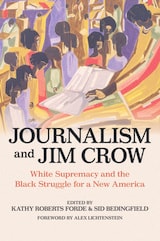
Journalism and Jim Crow
White Supremacy and the Black Struggle for a New AmericaEdited by Kathy Roberts Forde and Sid Bedingfield
University of Illinois Press, 2021
White publishers and editors used their newspapers to build, nurture, and protect white supremacy across the South in the decades after the Civil War. At the same time, a vibrant Black press fought to disrupt these efforts and force the United States to live up to its democratic ideals. Journalism and Jim Crow centers the press as a crucial political actor shaping the rise of the Jim Crow South. The contributors explore the leading role of the white press in constructing an anti-democratic society by promoting and supporting not only lynching and convict labor but also coordinated campaigns of violence and fraud that disenfranchised Black voters. They also examine the Black press’s parallel fight for a multiracial democracy of equality, justice, and opportunity for all—a losing battle with tragic consequences for the American experiment.
Original and revelatory, Journalism and Jim Crow opens up new ways of thinking about the complicated relationship between journalism and power in American democracy.
Contributors: Sid Bedingfield, Bryan Bowman, W. Fitzhugh Brundage, Kathy Roberts Forde, Robert Greene II, Kristin L. Gustafson, D'Weston Haywood, Blair LM Kelley, and Razvan Sibii
Journalism, Society and Politics in the Digital Media Era
Edited by Nael Jebril, Stephen Jukes, Sofia Iordanidou, and Emmanouil Takas
Intellect Books, 2020
Journalistic Autonomy
The Genealogy of a ConceptHenrik Örnebring
University of Missouri Press, 2022
The idea that journalism should be independent is foundational to its contemporary understandings and its role in democracy. But from what, exactly, should journalism be independent? This book traces the genealogy of the idea of journalistic autonomy, from the press freedom debates of the 17th century up to the digital, networked world of the 21st. Using an eclectic and thought-provoking theoretical framework that draws upon Friedrich Nietzsche, feminist philosophy, and theoretical biology, the authors analyze the deeper meanings and uses of the terms independence and autonomy in journalism.
This work tackles, in turn, questions of journalism’s independence from the state, politics, the market, sources, the workplace, the audience, technology, and algorithms. Using broad historical strokes as well as detailed historical case studies, the authors argue that autonomy can only be meaningful if it has a purpose. Unfortunately, for large parts of journalism’s history this purpose has been the maintenance of a societal status quo and the exclusion of large groups of the population from the democratic polity. “Independence,” far from being a shining ideal to which all journalists must aspire, has instead often been used to mask the very dependencies that lie at the heart of journalism. The authors posit, however, that by learning the lessons of history and embracing a purpose fit for the needs of the 21st century world, journalism might reclaim its autonomy and redeem its exclusionary uses of independence.
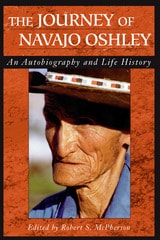
Journey of Navajo Oshley
An Autobiography and Life HistoryRobert McPherson
Utah State University Press, 2000
Ak'é Nýdzin, or Navajo Oshley, was born sometime between 1879 and 1893. His oral memoir is set on the northern frontier of Navajo land, principally the San Juan River basin in southeastern Utah, and tells the story of his early life near Dennehetso and his travels, before there were roads or many towns, from Monument Valley north along Comb Ridge to Blue Mountain. During the late 19th and early 20th centuries, Anglos and Navajos expanded their use and settlement of lands north of the San Juan. Grazing lands and the Anglo wage economy drew many Navajos across the river. Oshley, a sheepherder, was among the first to settle there. He cared for the herds of his extended family, while also taking supplemental jobs with the growing livestock industry in the area.
His narrative is woven with vivid and detailed portraits of Navajo culture: clan relationships, marriages and children, domestic life, the importance of livestock, complex relations with the natural world, ceremonies, trading, and hand trembling.
Journey to Autonomy
A MemoirLouise Rosenfield Noun
University of Iowa Press, 1996
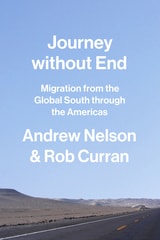
Journey without End
Migration from the Global South through the AmericasRob Curran and Andrew Nelson
Vanderbilt University Press, 2022
The book begins with Kidane, an Eritrean migrant who has left his pregnant wife behind to make the four-year trip to North America; it then picks up the natural disaster–riddled voyage of Roshan and Kamala Dhakal from Nepal to Ecuador; and it continues to the trials of Cameroonian exile Jane Mtebe, who becomes trapped in a bizarre beachside resort town on the edge of the Darién Gap—the gateway from South to Central America.
Journey without End follows these migrants as their fitful voyages put them in a semi-permanent state of legal and existential liminality. Mercurial policy creates profit opportunities that transform migration bottlenecks—Quito's tourist district, a Colombian beachside resort, Panama's Darién Gap, and a Mexican border town—into spontaneous migration-oriented spaces rife with racial, gender, and class exploitation. Throughout this struggle, migrant solidarity allows for occasional glimpses of subaltern cosmopolitanism and the possibility of mobile futures.
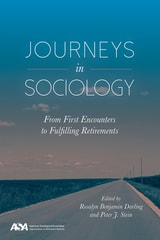
Journeys in Sociology
From First Encounters to Fulfilling RetirementsRosalyn Benjamin Darling and Peter J. Stein
Temple University Press, 2017
For most sociologists, their life’s work does not end with retirement. Many professors and practitioners continue to teach, publish, or explore related activities after leaving academia. They also connect with others in the field to lessen the isolation they sometimes feel outside the ivory tower or an applied work setting.
The editors and twenty contributors to the essential anthology Journeys in Sociology use a life-course perspective to address the role of sociology in their lives. The power of their personal experiences—during the Great Depression, World War II, or the student protests and social movements in the 1960s and ‘70s—magnify how and why social change prompted these men and women to study sociology. Moreover, all of the contributors include a discussion of their activities in retirement.
From Bob Perrucci, Tuck Green, and Wendell Bell, who write about issues of class, to Debra Kaufman and Elinore Lurie, who explain how gender played a role in their careers, the diverse entries in Journeys in Sociology provide a fascinating look at both the influence of their lives on the discipline and the discipline on these sociologists’ lives.
Contributors include: David J. Armor, Wendell Bell, Glen H. Elder, Jr., Henry W. Fischer, Janet Zollinger Giele, Charles S. (Tuck) Green, Peter Mandel Hall, Elizabeth Higginbotham, Debra Renee Kaufman, Corinne Kirchner, Elinore E. Lurie, Gary T. Marx, Robert Perrucci, Fred Pincus, Thomas Scheff, Arthur Shostak, David Simon, Natalie J. Sokoloff, Edward Tiryakian, Joyce E. Williams, and the editors.
Published in collaboration with the American Sociological Association Opportunities in Retirement Network.
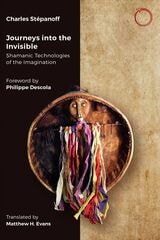
Journeys into the Invisible
Shamanic Technologies of the ImaginationCharles Stépanoff
HAU, 2025
Charles Stépanoff draws on ethnographic literature and his fieldwork in Siberia to reveal the immense contribution to the scope of human imagination made by shamans and the cognitive techniques they developed over the centuries.
Northern Shamans travel in mind in ways that appear mysterious to Westerners, but which rely on the human capacity of imagination. They perceive themselves simultaneously in two types of space—one visible, the other invisible—putting them in contact and establishing links with non-human beings in their surroundings. Shamans share their experience of mind travel with their patients, families, or the wider community, allowing them to participate in their odyssey through the invisible. Stépanoff offers an anthropological reflection on the relationships between our uses of the imagination, our relationships with the environment, and the emergence of social hierarchies.
This work will appeal to anthropologists as well as to anyone interested in learning about the power of imagination from the masters of the invisible, the shamans of the Far North.
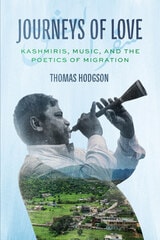
Journeys of Love
Kashmiris, Music, and the Poetics of MigrationThomas Hodgson
University of Chicago Press, 2025
In Journeys of Love, ethnomusicologist Thomas Hodgson offers a sensitive corrective to harmful portrayals of immigrants—specifically, Pakistanis living in England—as a self-segregating group prohibited from making music, a stereotype that has often resulted in violent Islamophobia. He argues that, in practice, these migrants—many of whom come from the Mirpur area of Azad Kashmir—occupy rich musical worlds, full of poetic metaphors, that are central to surviving migration and its attendant losses.
Hodgson shows how Mirpuris in England, as well as those who remain in Pakistan, carry on traditions of reciting a collection of poetry by the nineteenth-century Sufi saint Mian Muhammad Bakhsh, translated by Hodgson here as Journeys of Love. With its themes of remaining true to one’s home, the oppressed being saved, having patience, and keeping faith in God, this work has become the story of movement and displacement in its narrative arc, as well as through the way it provides spiritual and ethical frameworks for settling in new lands. These hidden poetics of migration transform across generations as young Mirpuris develop new expressions of the connections across continents. These poetics reveal the connections between Kashmir’s rural village life and urban centers abroad, offering a sensitive and illuminating portrait of migration and multiculturalism in Britain and beyond.
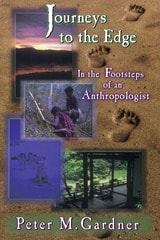
Journeys to the Edge
In the Footsteps of an AnthropologistPeter M. Gardner
University of Missouri Press, 2013
Because Gardner’s primary research since 1962 has been with hunter-gatherers, much of his story transpires either in the equatorial jungle of south India or more than one hundred miles beyond the end of the road in Canada’s Northwest Territories. Other ventures transport readers to Japan and back to India, allowing them to savor ancient sights and sounds. Gardner closes the book with a journey of quite another sort, as he takes us into the world of nature, Taoist philosophy, and the experimental treatment of advanced cancer.
Throughout this fast-moving book, Gardner deftly describes the goals and techniques of his research, as well as his growing understanding of the cultures to which he was exposed. Few personal accounts of fieldwork describe enough of the research to give a complete sense of the experience in the way this book does. Anyone with an interest in travel and adventure, including the student of anthropology as well as the general reader, will be totally intrigued by Gardner’s story, one of a daily existence so very different from our own.

Journeys with Flies
Edwin N. Wilmsen
University of Chicago Press, 1999
Combining biography, poetry, and anthropology, Wilmsen vividly portrays the intense realities of life in the Kalahari and carries the reader across space and time as events in the present trigger emotions and memories. Images of apartheid, for example, evoke memories of Wilmsen's childhood in the segregated South. Poems, journal entries, and moving accounts of deepening personal relationships all intertwine as Wilmsen conveys the experiences he shares with his "subjects" in spite of vast differences in their backgrounds—extreme thirst under the desert sun, grief over the death of a child, and the constant irritation of ubiquitous flies.
"Our understanding of other peoples," he writes, "lies not in themselves or in anything that they do but in our experience of them. Experience that is lived partly in their world and partly in a shell of our world that we wear when we meet them."
Sophisticated, lyrical, and passionately written, Journeys with Flies will inspire all those who travel to places far from home.
Joy to the World
The Performance of Collective PleasureGary Alan Fine
University of Chicago Press, 2026
A celebration and exploration of the idea of pleasure and the unique role it serves in bringing individuals and communities together.
There are innumerable ways to take pleasure in life: a bite of cake in the late afternoon, a walk in the warm springtime air after a long winter, a listen to the opening chords of your favorite song. But each of these pleasures is transformed by the presence of others. In Joy to the World, sociologist Gary Alan Fine takes up one of the major themes of his lifetime of work: pleasure. Fine gives us the conceptual basis for a sociology of pleasure: a joyous view of the world that, at times, inspires us, through expectations of interaction, shared cultures, and routine practices that make life worth living in community.
Fine focuses on the impact of group relations as the platform for satisfaction, emphasizing the power of communities of practice. While pleasures may be enjoyed alone, the pleasure that occurs in social spaces performs a unique function in our personal and social lives; they help us understand ourselves as individuals who are part of a group. What is pleasurably transgressive in one context might seem inappropriate, cruel, or just plain nonsensical in another, and these shades of difference serve to solidify the bonds of the group.
Joy to the World urges us to understand what draws us together as well as to appreciate what drives us apart. Our joys, as well as our challenges, help us to be a part of a caring, conscientious, committed community.
Joyce/Foucault
Sexual ConfessionsWolfgang Streit
University of Michigan Press, 2004
Joyce/Foucault: Sexual Confessions examines instances of sexual confession in works of James Joyce, with a special emphasis on Portrait of the Artist as a Young Man and Ulysses. Using Michel Foucault's historical analysis of Western sexuality as its theoretical underpinning, the book foregrounds the role of the Jesuit order in the spread of a confessional force, and finds this influence inscribed into Joyce's major texts. Wolfgang Streit goes on to argue that the tension between the texts' erotic passages and Joyce's criticism of even his own sexual writing energizes Joyce's narratives-and enables Joyce to develop the radical skepticism of power revealed in his work.
Wolfgang Streit is Lecturer, Ludwig Maximilians University, Munich.
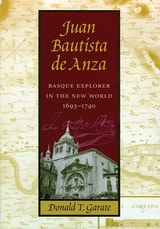
Juan Bautista de Anza
Basque Explorer in the New World, 1693-1740Donald T. Garate
University of Nevada Press, 2005
The first biography of an eighteenth-century Basque immigrant who became a silver miner, a cattle rancher, and commander of the cavalry in Sonora, Mexico. The name of Juan Bautista de Anza the younger is a fairly familiar one in the contemporary Southwest because of the various streets, schools, and other places that bear his name. Few people, however, are familiar with his father, the elder Juan Bautista de Anza, whose activities were crucial to the survival of the tenuous and far-flung settlements of Spain’s northernmost colonial frontier. For this first comprehensive biography of the elder Anza, Donald T. Garate spent more than ten years researching archives in Spain and the Americas. The result is a lively picture of the Spanish borderlands and the hardy, ambitious colonists who peopled them.
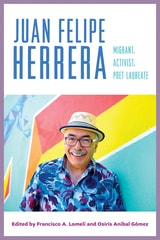
Juan Felipe Herrera
Migrant, Activist, Poet LaureateEdited by Francisco A. Lomelí and Osiris Aníbal Gómez
University of Arizona Press, 2023
For the first time, this book presents the distinguished, prolific, and highly experimental writer Juan Felipe Herrera. This wide-ranging collection of essays by leading experts offers critical approaches on Herrera, who transcends ethnic and mainstream poetics. It expertly demonstrates Herrera’s versatility, resourcefulness, innovations, and infinite creativity.
As a poet Herrera has had an enormous impact within and beyond Chicano poetics. He embodies much of the advancements and innovations found in American and Latin American poetry from the early l970s to the present. His writings have no limits or boundaries, indulging in the quotidian as well as the overarching topics of his era at different periods of his life. Both Herrera and his work are far from being unidimensional. His poetics are eclectic, incessantly diverse, transnational, unorthodox, and distinctive.
Reading Herrera is an act of having to rearrange your perceptions about things, events, historical or intra-historical happenings, and people. The essays in this work delve deeply into Juan Felipe Herrera’s oeuvre and provide critical perspectives on his body of work. They include discussion of Chicanx indigeneity, social justice, environmental imaginaries, Herrera’s knack for challenging theory and poetics, transborder experiences, transgeneric constructions, and children’s and young adult literature.
This book includes an extensive interview with the poet and a voluminous bibliography on everything by, about, and on the author. The chapters in this book offer a deep dive into the life and work of an internationally beloved poet who, along with serving as the poet laureate of California and the U.S. poet laureate, creates work that fosters a deep understanding of and appreciation for people’s humanity.
Contributors
Trevor Boffone
Marina Bernardo-Flórez
Manuel de Jesús Hernández-G.
Whitney DeVos
Michael Dowdy
Osiris Aníbal Gómez
Carmen González Ramos
Cristina Herrera
María Herrera-Sobek
Francisco A. Lomelí
Tom Lutz
Manuel M. Martín-Rodríguez
Marzia Milazzo
Maria Antònia Oliver-Rotger
Rafael Pérez-Torres
Renato Rosaldo
Donaldo W. Urioste
Luis Alberto Urrea
Santiago Vaquera-Vásquez
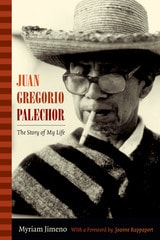
Juan Gregorio Palechor
The Story of My LifeMyriam Jimeno Translated by Andy Klatt
Duke University Press, 2014
Palechor's lively memoir is complemented by Jimeno's reflections on autobiography as an anthropological tool and on the oppressive social and political conditions faced by Colombia's indigenous peoples. A faithful and fluent transcription of Palechor's life story, this work is a uniquely valuable resource for understanding the contemporary indigenous rights movements in Colombia.
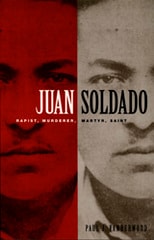
Juan Soldado
Rapist, Murderer, Martyr, SaintPaul J. Vanderwood
Duke University Press, 2004
In addition to conducting extensive archival research, Vanderwood interviewed central actors in the events of 1938, including Olga Camacho’s mother, citizens who rioted to demand Morales’s release to a lynch mob, those who witnessed his execution, and some of the earliest believers in his miraculous powers. Vanderwood also interviewed many present-day visitors to the shrine at Morales’s grave. He describes them, their petitions—for favors such as health, a good marriage, or safe passage into the United States—and how they reconcile their belief in Juan Soldado with their Catholicism. Vanderwood puts the events of 1938 within the context of Depression-era Tijuana and he locates people’s devotion, then and now, within the history of extra-institutional religious activity. In Juan Soldado, a gripping true-crime mystery opens up into a much larger and more elusive mystery of faith and belief.

Judaism and Disability
Portrayals in Ancient Texts from the Tanach through the BavliJudith Z. Abrams
Gallaudet University Press, 1998
In Judaism and Disability, the archaic portrayals of mentally ill, mentally retarded, physically affected, deaf, blind, and other disabled people reflect the sharp contrast they presented compared to the unchanging Judaic ideal of the “perfect priest.” All of these sources describe this perfection as embodied in a person who is male, free, unblemished, with da’at (cognition that can be communicated), preferably learned, and a priest. The failure to have da’at stigmatized disabled individuals, who were also compromised by the treatment they received from nondisabled people, who were directing and constraining.
As the Judaic ideal transformed from the bodily perfection of the priest in the cult to intellectual prowess in the Diaspora, a parallel change of attitudes toward disabled persons gradually occurred. The reduced emphasis upon physical perfection as a prerequisite for a relationship with God eventually enabled the enfranchisement of some disabled people and other minorities. Scholars, students, and other readers will find the engrossing process disclosed in Judaism and Disability one that they can apply to a variety of other disciplines.
Judaism
The Genealogy of a Modern NotionBoyarin, Daniel
Rutgers University Press, 2019
Judges and the Cities
Interpreting Local AutonomyGordon L. Clark
University of Chicago Press, 1985
As concrete examples, Clark analyzes four court disputes in depth, showing that the concept of local autonomy has very different meanings and implications in each of them. These cases—Boston's defense of resident-preference hiring policies, conflict over urban land-use zoning in Toronto, a Chicago's suburb's fight against a sewage treatment plant, and the evolution of the City of Denver's power since 1900—demonstrate that legal reasoning is not impervious to other kinds of reasoning, and the solutions provided by the courts are not unique. To ground his explorations, Clark investigates both liberalism and structuralism, showing that both are inadequate bases for determining social policy. He mounts provocative critiques of the works of de Tocqueville, Nozick, Tiebout, and Posner on the one hand and Castells and Poulantzas on the other.
This ambitious and important work will command the interest of geographers, political scientists, economists, sociologists, and legal scholars.

Judging Children As Children
A Proposal for a Juvenile Justice SystemMichael A. Corriero
Temple University Press, 2007
Judicial Territory
Law, Capital, and the Expansion of American EmpireShaina Potts
Duke University Press, 2024
Jugaad Time
Ecologies of Everyday Hacking in IndiaAmit S. Rai
Duke University Press, 2019

Julia Kristeva
Speaking the UnspeakableAnne-Marie Smith
Pluto Press, 1998

Julia de Burgos
La creación de un ícono puertorriqueñoVanessa Pérez-Rosario. Traducido por Isabel Zapata, en colaboración con la autora
University of Illinois Press, 2021
Disponible por primera vez en español, Julia de Burgos cuenta la destacada historia de la poeta y activista puertorriqueña.
Julian Steward and the Great Basin
The Making of an AnthropologistRichard O Clemmer
University of Utah Press, 1999
Julian Steward and the Great Basin is a critical assessment of Steward’s work, the factors that influenced him, and his deep effect on American anthropology. Steward (1902–1972) was one of the foremost American exponents of cultural ecology, the idea that societies evolve in adaptation to their human and natural environments. He was also central in shaping basic anthropological constructs such as "hunter-gatherer" and "adaptation." But his fieldwork took place almost entirely in the Great Basin.
In one sense, the phases of Steward’s career epitomize the successive schools of anthropological theory and practice. Each chapter explores a different aspect of his work ranging from early efforts at documenting trait distributions to his later role in the development of social transformation theory, area studies, and applied anthropology.
Julian Steward and the Great Basin also corrects long-standing misperceptions that originated with Steward about lifeways of the Indians living between the Great Plains and California. It charts new directions for research, demanding a more exacting study of environmental conditions, material adaptations, and organizational responses, as well as an appreciation of the ideological and humanistic dimensions of Basin Life.
Jumano and Patarabueye
Relations at La Junta de los RiosJ. Charles Kelley with a foreword by John D. Speth
University of Michigan Press, 1986
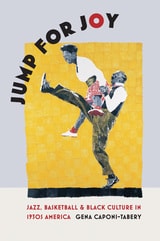
Jump for Joy
Jazz, Basketball, and Black Culture in 1930s AmericaGena Caponi-Tabery
University of Massachusetts Press, 2008
If the 1930s was the Swing Era, then the years from 1937 on might well be called the Jump Era. That summer Count Basie recorded “Jumping at the Woodside,” and suddenly jump tunes seemed to be everywhere. Along with the bouncy beat came a new dance step—the high-flying aerials of the jitterbuggers—and the basketball games that took place in the dance halls of African America became faster, higher, and flashier. Duke Ellington and a cast of hundreds put the buoyant spirit of the era on stage with their 1941 musical revue, Jump for Joy, a title that captured the momentum and direction of the new culture of exuberance.
Several high-profile public victories accompanied this increasing optimism: the spectacular successes of African American athletes at the 1936 Olympics, the 1937 union victory of the Brotherhood of Sleeping Car Porters, and Joe Louis's 1937 and 1938 heavyweight championship fights. For the first time in history, Black Americans emerged as cultural heroes and ambassadors, and many felt a new pride in citizenship.
In this book, Gena Caponi-Tabery chronicles these triumphs and shows how they shaped American music, sports, and dance of the 1930s and beyond. But she also shows how they emboldened ordinary African Americans to push for greater recognition and civil liberties—how cultural change preceded and catalyzed political action.
Tracing the path of one symbolic gesture—the jump—across cultural and disciplinary boundaries, Caponi-Tabery provides a unique political, intellectual, and artistic analysis of the years immediately preceding World War II.