Results by title
22279 books match the query 'Social Science' and 299 start with j

Jump-rope Rhymes
A DictionaryEdited by Roger D. Abrahams
University of Texas Press, 1969
I had a little brother.
His name was Tiny Tim.
I put him in the bathtub
To teach him how to swim.
He drank all the water.
He ate all the soap.
He died last night
With a bubble in his throat.
Jump-rope rhymes, chanted to maintain the rhythm of the game, have other, equally entertaining uses:
- You can dispatch bothersome younger siblings instantly—and temporarily.
- You can learn the name of your boyfriend through the magic words "Ice cream soda, Delaware Punch, Tell me the initials of my honey-bunch."
- You can perform the series of tasks set forth in "Teddy Bear, Teddy Bear, turn around" and find out who, really, is the most nimble.
- You can even, with impunity, "conk your teacher on the bean with a rotten tangerine. "
This collection of over six hundred jump-rope rhymes, originally published in 1969, is an introduction into the world of children—their attitudes, their concerns, their humor. Like other children's folklore, the rhymes are both richly inventive and innocently derivative, ranging from on-the-spot improvisations to old standards like "Bluebells, cockleshells," with a generous sprinkling of borrowings from other play activities—nursery rhymes, counting-out rhymes, and taunts. Even adult attitudes of the time are appropriated, but expressed with the artless candor of the child:
Eeny, meeny, miny, moe.
Catch Castro by the toe.
If he hollers make him say
"I surrender, U.S.A."
Though aware that children's play serves social and psychological functions, folklorists had long neglected analytical study of children's lore because primary data was not available in organized form. Roger Abraham's Dictionary has provided such a bibliographical tool for one category of children's lore and a model for future compendia in other areas. The alphabetically arranged rhymes are accompanied by notes on sources, provenience, variants, and connection with other play activities.
Junctures in Women's Leadership
BusinessHetfield, Lisa
Rutgers University Press, 2016

Junctures in Women's Leadership
Health Care and Public HealthMary E. O'Dowd
Rutgers University Press, 2021
Junctures in Women's Leadership
Higher EducationCarmen Twillie Ambar
Rutgers University Press, 2020
Junctures in Women's Leadership
Social MovementsTrigg, Mary K
Rutgers University Press, 2016
From Eleanor Roosevelt to feminist icon Gloria Steinem to HIV/AIDS activist Dazon Dixon Diallo, women have assumed leadership roles in struggles for social justice. How did these remarkable women ascend to positions of influence? And once in power, what leadership strategies did they use to deal with various challenges?

Junctures in Women's Leadership
The ArtsBrodsky, Judith K
Rutgers University Press, 2018
Amongst the women discussed are Bertha Honoré Palmer, Louise Noun, Samella Lewis, Julia Miles, Miriam Colón, Jaune Quick-To-See Smith, Bernice Steinbaum, Anne d’Harnoncourt, Martha Wilson, Jawole Willa Jo Zollar, Kim Berman, Gilane Tawadros, Joanna Smith, and Veomanee Douangdala.
Junctures in Women’s Leadership
Media and JournalismLinda Steiner
Rutgers University Press, 2025
This book offers profiles of inspiring women in prominent media positions from the nineteenth century to today, beginning with trailblazers like abolitionist publisher Mary Ann Shadd and Memphis Free Speech anti-lynching editor Ida B. Wells. The book takes an in-depth look at the leadership styles of well-known media moguls like Oprah Winfrey and Washington Post publisher Katharine Graham. Other chapters highlight women now emerging as media leaders, such as digital media executive S. Mitra Kalita and Iman Zawahry, a Muslim hijabi filmmaker. Bringing together cases from print, broadcast, public relations, film, and digital media, this book offers useful insights into how to be an effective leader in an ever-changing industry.
Junctures in Women’s Leadership
PoliticsJulie Des Jardins
Rutgers University Press, 2027
This collection profiles women in American politics who have demonstrated true leadership over the past 150 years—though this leadership has not always been recognized as such. These women have defied stereotypical caricatures and modeled effective ways to lead, even when they have not enjoyed formal access to voting or party politics, lost campaigns, or suffered scrutiny and harassment as public figures. Many of them have championed people and causes that their male counterparts have neglected, lending their lived experiences as women to fight for political action for underrepresented groups, and showing time and again that the personal really is political. Here we assess their political careers, not in terms of wins and losses, but rather in their ability to negotiate identity politics and shift conventional rules about how politicians lead.
This collection profiles such varied women as Jeannette Rankin, Shirley Chrisholm, Nancy Pelosi, Kamala Harris, Stacy Abrams, and Alexandria Ocasio-Cortez, among others. Whether they have recast gendered meanings around political ambition, broadened access to the political process, privileged principles over party loyalty, or prioritized issues over incumbency, each woman profiled here has wisdom to impart to new generations of American women who aspire to run for office or be involved in American politics.

Juneteenth Rodeo
Photos and essay by Sarah Bird; Afterword by Demetrius Pearson
University of Texas Press, 2024
Award of Excellence — Communication Arts
Honorable Mention — The International Photography Awards 2024 Book Category
Jury Top 5 Selection — The International Photography Awards 2024 Book Category
Silver Winner in Zines And Photo Book/Culture— 2024 International Film Photography Award, Analog Sparks
Timeless photos offer a rare portrait of the jubilant, vibrant, vital, nearly hidden, and now all-but-vanished world of small-town Black rodeos.
Long before Americans began to officially commemorate Juneteenth, in the heat of East Texas, saddles were being cinched, buckles shined, and lassoes adjusted for a day on the Black rodeo circuit in honor of the holiday. In the late 1970s, as they had been doing for generations, Black communities across the region held local rodeos for the talented cowboys and cowgirls who were segregated from the mainstream circuit. It was to these vibrant community events that bestselling Texas writer Sarah Bird, then a young photojournalist, found herself drawn.
In Juneteenth Rodeo, Bird’s lens celebrates a world that was undervalued at the time, capturing everything, from the moment the pit master fired up his smoker, through the death-defying rides, to the last celebratory dance at a nearby honky-tonk. Essays by Bird and sports historian Demetrius Pearson reclaim the crucial role of Black Americans in the Western US and show modern rodeo riders—who still compete on today’s circuit—as “descendants” in a more than two-hundred-year lineage of Black cowboys. A gorgeous tribute to the ropers and riders—legends like Willie Thomas, Myrtis Dightman, Rufus Green, Bailey’s Prairie Kid, Archie Wycoff, and Calvin Greeley—as well as the secretaries, judges, and pick-up men and even the audience members who were as much family as fans, Juneteenth Rodeo ultimately seeks to put Black cowboys and cowgirls where they have always belonged: in the center of the frame.
Jungle Laboratories
Mexican Peasants, National Projects, and the Making of the PillGabriela Soto Laveaga
Duke University Press, 2009
Soto Laveaga traces the political, economic, and scientific development of the global barbasco industry from its emergence in the 1940s, through its appropriation by a populist Mexican state in 1970, to its obsolescence in the mid-1990s. She focuses primarily on the rural southern region of Tuxtepec, Oaxaca, where the yam grew most freely and where scientists relied on local, indigenous knowledge to cultivate and harvest the plant. Rural Mexicans, at first unaware of the pharmaceutical and financial value of barbasco, later acquired and deployed scientific knowledge to negotiate with pharmaceutical companies, lobby the Mexican government, and ultimately transform how urban Mexicans perceived them. By illuminating how the yam made its way from the jungles of Mexico, to domestic and foreign scientific laboratories where it was transformed into pills, to the medicine cabinets of millions of women across the globe, Jungle Laboratories urges us to recognize the ways that Mexican peasants attained social and political legitimacy in the twentieth century, and positions Latin America as a major producer of scientific knowledge.

Junk Drawer
What We Leave BehindSander Gilman
University of Delaware Press, 2026
Junk Drawer: What We Leave Behind explores the personal objects that were once treasured by their owners yet were ultimately consigned to online “junk drawer” sales. Photographer and coeditor Barbara Von Eckardt acquired these random assortments from estate remnants on eBay and has documented their contents through evocative, sepia-toned images. In doing so, she has breathed new life into items that the world had deemed valueless, but that hint at the stories and identities of those who once owned them.
In addition to the photographs, Von Eckardt and coeditor Sander L. Gilman have gathered essays by scholars across disciplines, each offering a unique perspective on how such everyday objects can carry profound meaning. The result is a “junk drawer” of reflections, as varied and thought-provoking as the artifacts themselves. It is a moving testament to the emotional and cultural resonance of ordinary things—and an invitation to look more deeply at the objects surrounding us.

Junot Díaz and the Decolonial Imagination
Monica Hanna, Jennifer Harford Vargas, José David Saldívar, editors
Duke University Press, 2016

Junot Díaz
On the Half-Life of LoveJosé David Saldívar
Duke University Press, 2022

Jurors' Stories of Death
How America's Death Penalty Invests in InequalityBenjamin Fleury-Steiner
University of Michigan Press, 2004
-David Cole, from the Foreword
"Perhaps the most powerful, routinely enacted civic ritual in American public life is that of capital punishment. This state-sanctioned extirpation of human life in the collective pursuit of justice is a searing act of civic pedagogy, made legitimate only by the deliberative endorsement of a small group of ordinary citizens-the jury. In Jurors' Stories of Death, Benjamin Fleury-Steiner has taken a cold, hard look at how these ordinary citizens come to terms with their extraordinary role, and how they rationalize their irreversible decisions. The result is a chilling portrait of how we---that is, all of us Americans---constitute ourselves as a political community."
-Glenn Loury, Director, Institute on Race and Social Division
"This illuminating and insightful examination of jury deliberations makes a terrific contribution to the study of capital punishment. Fleury-Steiner's synthesis of sociological, legal and theoretical concepts with vivid juror narratives and statistical data, thoughtfully animates and details how race and class consciousness continue to shape America's death penalty."
---Bryan Stevenson, Professor of Clinical Law, NYU School of Law, Executive Director, Equal Justice Initiative of Alabama
Jurors' Stories of Death is more than just another book on the death penalty; it is the first systematic survey of how death penalty decisions are made.
Benjamin Fleury-Steiner draws on real-life accounts of white and black jurors in capital punishment trials to discuss the effect of race on the sentencing process. He finds that race is invariably a factor in sentencing, with jurors relying on accounts that deny the often marginalized defendants their individuality and complexity, while reinforcing the jurors' own identities as superior, moral, and law-abiding citizens-a system that punishes in the name of dominance. This biased story of "us versus them" continues to infuse political rhetoric on crime and punishment in the United States even today.
Jurors' Stories of Death concludes with an original argument for abolition of the death penalty: If America values multiculturalism and cultural diversity, it must do away with institutions such as state-sanctioned capital punishment in order to begin to free itself from the racism and classicism that so insidiously plague social relations today.

Just A Temp
Kevin Henson
Temple University Press, 1996
"So this is where the brain starts to shut down and that which we treasure most, our personal identities, begins to slip away....I suppose I should be thankful; it's a paycheck." With this disturbing sentiment, Kevin Henson begins a voyage into the world of "the temp." For several years while a graduate student, Henson logged in thousands of hours as a temporary worker in offices throughout Chicago's Loop. Those experiences, and numerous interviews with other temps and temporary counselors, create a vivid and often disheartening picture of working 9 to 5 behind the receptionist's desk, telephone console, or data-entry terminal.
In their own voices, the temps in this book lament the frequently demeaning and mundane nature of many assignments:
•"You're not paid to think."
•
"Temps don't have names; they are just 'the temp.'"
•
"They always harass me...because I just wear a sweater and slacks."
•
"The worst part is telling people what you do. They always ask 'When are you going to get a real job?'"
Where the temporary service industry is quick to extol the virtues of temp work—mainly its flexibility—Henson and his cast of temps reveal the tacit pressure to persevere through an unpleasant assignment, to accept every assignment offered, and to readjust personal lives to do so. Outsiders to the established office culture and hierarchy, most temps are asked to do low-skill work and leave more detailed or complicated tasks for the return of the permanent employee.
Whether temp life is a preferred choice or grudgingly accepted as the last option when "real" or permanent work is unavailable, all temps must confront issues of gender, identity, and self-esteem. Henson examines these issues, documenting the concerns and interpretations of temp workers about their own work lives.
Just Advocacy?
Women's Human Rights, Transnational Feminism, and the Politics of RepresentationHesford, Wendy S
Rutgers University Press, 2005
In humanitarian and political debates about the topic, women and children are frequently considered first. Since the 1990s, human rights have become the most legitimate and legitimizing juridical and cultural claim made on a woman's behalf. But what are the consequences of equating women's rights with human rights? As the eleven essays in this volume show, the impact is often contradictory.
Bringing together some of the most respected scholars in the field, including Inderpal Grewal, Leela Fernandes, Leigh Gilmore, Susan Koshy, Patrice McDermott, and Sidonie Smith, Just Advocacy? sheds light on the often overlooked ways that women and children are further subjugated when political or humanitarian groups represent them solely as victims and portray the individuals that are helping them as paternal saviors.
Drawn from a variety of disciplinary perspectives in the humanities, arts, and social sciences, Just Advocacy? promises to advance a more nuanced and politically responsible understanding of human rights for both scholars and activists.
Just Anger
Representing Women's Anger in Early Modern EnglandGwynne Kennedy
Southern Illinois University Press, 2000
The first scholar to investigate the subject of women’s anger in early modern England, Gwynne Kennedy analyzes portrayals of and attitudes toward women’s anger in printed texts by or purporting to be written by women during the period.
Kennedy draws from recent critical work on emotions by historians, literary scholars, philosophers, and psychologists as well as comparative studies of the emotions by cultural anthropologists. Kennedy also examines a number of male-authored works, including sermons, conduct literature, philosophy, rhetoric, and medicine. The focus of her work, however, is on representations of women’s anger in printed works signed with women’s names in late sixteenth- and early seventeenth-century England. She addresses the ways these writings conform to, conflict with, or appear to reconfigure prevailing beliefs about women’s anger.
Kennedy looks at such literary texts as Mary Wroth’s romance, The Countess of Montgomery’s Urania, the first fiction by an English woman; Elizabeth Cary’s play, The Tragedy of Mariam, the earliest extant play in English by a woman; and Aemilia Lanyer’s verse collection, Salve Deus Rex Judaeorum. She also discusses religious writings by Protestant martyr Anne Askew and Elizabeth Cary’s history of Edward II. Kennedy considers as well defenses of women’s nature authored by women (Rachel Speght and Aemilia Lanyer) or published under female pseudonyms (“Jane Anger,” “Ester Sowernam,” and “Constantia Munda”).
Kennedy demonstrates the importance of class and race as factors affecting anger’s legitimacy and its forms of expression. She shows how early modern assumptions about women’s anger can help to create or exaggerate other differences among women. Her close scrutiny of anger against female inferiority emphasizes the crucial role of emotions in the construction of self-worth and identity.
Just As We Were
A Narrow Slice of Texas WomanhoodBy Prudence Mackintosh
University of Texas Press, 1996
When a Texas debutante bows her forehead to the floor in the famous "Texas dip," society columnists all across the country speculate interminably over what it is that sets Texas women apart. But really, how could they know? Even women born and bred in Texas can't always answer that question.
Prudence Mackintosh comes very close to an answer, though, in this endlessly entertaining book. Writing with both a wry sense of humor and an insider's compassion, she offers us a fascinating look into the world of privileged, educated, well-married, well-connected, and mostly wealthy white Texas women.
What really sets these women apart, Ms. Mackintosh tells us, is the comfortable yet demanding path they follow from their idyllic girlhoods to prominent positions in society. In thirteen essays, some of which originally appeared in Texas Monthly magazine, she charts the way stations that mark this path: summer camps in the Texas Hill Country, exclusive private schools like Dallas' Hockaday, sorority membership, and acceptance into the Junior League.
Prudence Mackintosh has been both an outsider and an insider in this privileged world, and her observations are shot through with wit and real insight. Just As We Were may not be the final word on elite Texas women, but no other book has described their world with greater irony or accuracy.
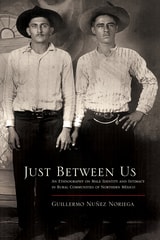
Just Between Us
An Ethnography of Male Identity and Intimacy in Rural Communities of Northern MexicoGuillermo Núñez Noriega
University of Arizona Press, 2014
Using fieldwork from rural Sonora, Mexico, Guillermo Núñez Noriega posits that men accept this intimacy outside gender categories and stereotypes, despite the traditional patriarchal society. This work contests homophobia and the heterosexual ideal of men and attempts to break down the barriers between genders.
The photograph Núñez Noriega uses to explore the shifting attitudes and perceptions of sexuality and gender provokes more questions than answers. Recognizing the societal regulations at play, the author demonstrates the existence in contemporary Mexico of an invisible regime of power that constructs and regulates the field of possibilities for men’s social actions, especially acts of friendship, affection, and eroticism with other men. The work investigates “modes of speaking” about being a man, on being gay, on the implicit meanings of the words homosexual, masculine, trade, fairy, and others—words that construct possibilities for intimacy, particularly affective and erotic intimacy among men.
Multiple variants of homoeroticism fall outside the dominant model, Núñez Noriega argues, a finding that offers many lessons on men and masculine identities. This book challenges patriarchal definitions of sex, gender, and identity; it promotes the unlearning of dominant conventions of masculinity to allow new ways of being.
Just Care
Messy Entanglements of Disability, Dependency, and DesireAkemi Nishida
Temple University Press, 2022
Just Care is Akemi Nishida’s thoughtful examination of care injustice and social justice enabled through care. The current neoliberal political economy has turned care into a business opportunity for the healthcare industrial complex and a mechanism of social oppression and control. Nishida analyzes the challenges people negotiate whether they are situated as caregivers, receivers, or both. Also illuminated is how people with disabilities come together to assemble community care collectives and bed activism (resistance and visions emerging from the space of bed) to reimagine care as a key element for social change.
The structure of care, Nishida writes, is deeply embedded in and embodies the cruel social order—based on disability, race, gender, migration status, and wealth—that determines who survives or deteriorates. Simultaneously, many marginalized communities treat care as the foundation of activism. Using interviews, focus groups, and participant observation with care workers and people with disabilities, Just Care looks into lives unfolding in the assemblage of Medicaid long-term care programs, community-based care collectives, and bed activism. Just Care identifies what care does, and asks: How can we activate care justice or just care where people feel cared affirmatively and care being used for the wellbeing of community and for just world making?

Just Enough to Put Him Away Decent
Death Care, Life Extension, and the Making of a Healthier South, 1900-1955Kristine M. McCusker
University of Illinois Press, 2023
Kristine McCusker charts the dramatic transformation that took place when southerners in particular and Americans in general changed their thinking about when one should die, how that death could occur, and what decent burial really means. As she shows, death care evolved from being a community act to a commercial one where purchasing a purple coffin and hearse ride to the cemetery became a political statement and the norm. That evolution also required interactions between perfect strangers, especially during the world wars as families searched for their missing soldiers. In either case, being put away decent, as southerners called burial, came to mean something fundamentally different in 1955 than it had just fifty years earlier.
Just Kids
Youth Activism and Rhetorical AgencyRisa Applegarth
The Ohio State University Press, 2024

Just Language
Walter Benjamin, German-Jewish Exile, and the Critique of Linguistic ViolenceDennis Johannßen
University of Michigan Press, 2026
Just Language revisits the Weimar period and its representation in the postwar years to explore narratives of linguistic resistance in the works of Walter Benjamin, Theodor W. Adorno, Hannah Arendt, and Paul Celan. How did this generation of exile writers grapple with their experiences of oppression and persecution? How did they create a language of resistance during the decades that prepared the Third Reich and the Shoah?
Facing the devastations of World War I, the book explores how Walter Benjamin analyzed language’s ability to radically break the cyclical violence of war and examines his opposition to expansionism and imperialism in Weimar education and culture. Based on Benjamin’s analysis, Johannßen traces the postwar responses of Hannah Arendt and Paul Celan. While Arendt proposed strategies of metaphorical thinking to counteract the formation of totalitarianism, Celan mobilized silence as a poetic counterforce against oppression and erasure. Just Language argues that every linguistic act and practice, no matter how small or marginalized, entails the ethical task of opposing the normalization and institutionalization of political violence. By tracing how Benjamin and his interlocutors struggled against German fascism, Johannßen presents a memory-based critique of linguistic violence, opening a dialogue between German-Jewish writers and today’s debates on nondiscrimination, propaganda, and social justice.
Just Like Us
Digital Debates on Feminism and FameCaitlin E. Lawson
Rutgers University Press, 2023

Just Neighbors?
Research on African American and Latino Relations in the United StatesEdward Telles
Russell Sage Foundation, 2012
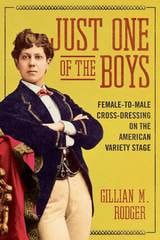
Just One of the Boys
Female-to-Male Cross-Dressing on the American Variety StageGillian Rodger
University of Illinois Press, 2018
Gillian M. Rodger uses the development of male impersonation from the early nineteenth century to the early twentieth century to illuminate the history of the variety show. Exploding notions of high- and lowbrow entertainment, Rodger looks at how both performers and forms consistently expanded upward toward respectable—and richer—audiences. At the same time, she illuminates a lost theatrical world where women made fun of middle-class restrictions even as they bumped up against rules imposed in part by audiences. Onstage, the actresses' changing performance styles reflected gender construction in the working class and shifts in class affiliation by parts of the audiences. Rodger observes how restrictive standards of femininity increasingly bound male impersonators as new gender constructions allowed women greater access to public space while tolerating less independent behavior from them.

Just One of the Guys?
Transgender Men and the Persistence of Gender InequalityKristen Schilt
University of Chicago Press, 2010
The fact that men and women continue to receive unequal treatment at work is a point of contention among politicians, the media, and scholars. Common explanations for this disparity range from biological differences between the sexes to the conscious and unconscious biases that guide hiring and promotion decisions. Just One of the Guys? sheds new light on this phenomenon by analyzing the unique experiences of transgender men—people designated female at birth whose gender identity is male—on the job.
Kristen Schilt draws on in-depth interviews and observational data to show that while individual transmen have varied experiences, overall their stories are a testament to systemic gender inequality. The reactions of coworkers and employers to transmen, Schilt demonstrates, reveal the ways assumptions about innate differences between men and women serve as justification for discrimination. She finds that some transmen gain acceptance—and even privileges—by becoming “just one of the guys,” that some are coerced into working as women or marginalized for being openly transgender, and that other forms of appearance-based discrimination also influence their opportunities. Showcasing the voices of a frequently overlooked group, Just One of the Guys? lays bare the social processes that foster forms of inequality that affect us all.
Just Queer Folks
Gender and Sexuality in Rural AmericaColin R. Johnson
Temple University Press, 2013
Most studies of lesbian and gay history focus on urban environments. Yet gender and sexual diversity were anything but rare in nonmetropolitan areas in the first half of the twentieth century. Just Queer Folks explores the seldom-discussed history of same-sex intimacy and gender nonconformity in rural and small-town America during a period when the now familiar concepts of heterosexuality and homosexuality were just beginning to take shape.
Eschewing the notion that identity is always the best measure of what can be known about gender and sexuality, Colin R. Johnson argues instead for a queer historicist approach. In so doing, he uncovers a startlingly unruly rural past in which small-town eccentrics, "mannish" farm women, and cross-dressing Civilian Conservation Corps enrollees were often just queer folks so far as their neighbors were concerned. Written with wit and verve, Just Queer Folks upsets a whole host of contemporary commonplaces, including the notion that queer history is always urban history.
Just Schools
Pursuing Equality in Societies of DifferenceMartha Minow
Russell Sage Foundation, 2008
Just Vibrations
The Purpose of Sounding GoodWilliam Cheng
University of Michigan Press, 2016
Modern academic criticism bursts with what Eve Kosofsky Sedgwick once termed paranoid readings—interpretative feats that aim to prove a point, persuade an audience, and subtly denigrate anyone who disagrees. Driven by strategies of negation and suspicion, such rhetoric tends to drown out softer-spoken reparative efforts, which forego forceful argument in favor of ruminations on pleasure, love, sentiment, reform, care, and accessibility.
Just Vibrations: The Purpose of Sounding Good calls for a time-out in our serious games of critical exchange. Charting the divergent paths of paranoid and reparative affects through illness narratives, academic work, queer life, noise pollution, sonic torture, and other touchy subjects, William Cheng exposes a host of stubborn norms in our daily orientations toward scholarship, self, and sound. How we choose to think about the perpetration and tolerance of critical and acoustic offenses may ultimately lead us down avenues of ethical ruin—or, if we choose, repair. With recourse to experimental rhetoric, interdisciplinary discretion, and the playful wisdoms of childhood, Cheng contends that reparative attitudes toward music and musicology can serve as barometers of better worlds.
Just Who Loses?
Discrimination in the United States, Volume 2Samuel Lucas
Temple University Press, 2013
In Just Who Loses? Samuel Roundfield Lucas continues his penetrating and comprehensive assessment of sex and race discrimination in the United States that he began in Theorizing Discrimination in an Era of Contested Prejudice.
This new volume demonstrates that the idea of discrimination being a zero-sum game is a fallacy. If discrimination costs women, men do not necessarily reap the gains. Likewise, if discrimination costs blacks, non-blacks do not reap the gains. Lucas examines the legal adjudication of discrimination, as well as wider public debates about policy on the issue, to prove how discrimination actually operates.
He uses analytic methods to show that across the socioeconomic lifecycle—including special education placement, unemployment, occupational attainment, earnings, poverty, and even mortality—both targets and non-targets of discrimination “lose.”
In Just Who Loses? Lucas proposes the construction of a broad-based coalition to combat the pervasive discrimination that affects social relations and law in the United States.
Just Wonder
Shifting Perspectives in TraditionPauline Greenhill
Utah State University Press, 2024
These essays examine fairy tales and other traditional forms of the fantastic and the real to offer alternative expressions of justice relevant to gender, sex, sexuality, environment, Indigeneity, class, ability, race, decolonizing, and human and nonhuman relations. By analyzing fairy tales and wonder texts from various media through an intersectional feminist lens, Pauline Greenhill and Jennifer Orme consider how wonder genres and forms blend with diverse conceptions of seeking and enacting justice. International collaborators—both established and emerging scholars who self-identify with different subjectivities, locations, and generations and come from an impressive range of inter/disciplines—engage with contemporary and historical texts from various languages and cultural contexts, including interventions, counterparts, and comparisons to the fairy tale. Just Wonder offers a critical look at how creative wondering can expand the ability to resist modes of oppression while fostering equity, as well as encourage curiosity and imagination.
In a world that can be overwhelming and precarious, this book presents scholarly, artistic, personal, and collective-action interventions to identify and respond to injustice while centering wonder and, thus, imagination, questioning, and hope. Just Wonder will appeal to fairy-tale scholars; folklorists; students and scholars of film, media studies, and cultural studies; as well as a general audience.
Just Words
Law, Language, and PowerJohn M. Conley and William M. O'Barr
University of Chicago Press, 1998
Conley and O'Barr show how the microdynamics of the legal process and the largest questions of justice can be fruitfully explored through the field of linguistics. Each chapter covers a language-based approach to a different area of the law, from the cross-examinations of victims and witnesses to the inequities of divorce mediation. Combining analysis of common legal events with a broad range of scholarship on language and law, Just Words seeks the reality of power in the everyday practice and application of the law. As the only study of its type, the book is the definitive treatment of the topic that will be welcomed by students and specialists alike.
Just Words
Law, Language, and Power, Third EditionJohn M. Conley, William M. O'Barr, and Robin Conley Riner
University of Chicago Press, 2019
John M. Conley, William M. O'Barr, and Robin Conley Riner show how the microdynamics of the legal process and the largest questions of justice can be fruitfully explored through the field of linguistics. Each chapter covers a language-based approach to a different area of the law, from the cross-examinations of victims and witnesses to the inequities of divorce mediation. Combining analysis of common legal events with a broad range of scholarship on language and law, Just Words seeks the reality of power in the everyday practice and application of the law. As the only study of its type, the book is the definitive treatment of the topic and will be welcomed by students and specialists alike. This third edition brings this essential text up to date with new chapters on nonverbal, or “multimodal,” communication in legal settings and law, language, and race.

Just a Dog
Animal Cruelty, Self, and SocietyArnold Arluke
Temple University Press, 2006
Just and Righteous Causes
Rabbi Ira Sanders and the Fight for Racial and Social Justice in Arkansas, 1926-1963James L. Moses
University of Arkansas Press, 2018
Winner, 2019 Booker Worthen Prize from the Central Arkansas Library System.
A dedicated advocate for social justice long before the term entered everyday usage, Rabbi Ira Sanders began striving against the Jim Crow system soon after he arrived in Little Rock from New York in 1926. Sanders, who led Little Rock’s Temple B’nai Israel for nearly forty years, was a trained social worker as well as a rabbi and his career as a dynamic religious and community leader in Little Rock spanned the traumas of the Great Depression, World War II and the Holocaust, and the social and racial struggles of the 1950s and 1960s.
Just and Righteous Causes—a full biographical study of this bold social-activist rabbi—examines how Sanders expertly navigated the intersections of race, religion, and gender to advocate for a more just society. It joins a growing body of literature about the lives and histories of Southern rabbis, deftly balancing scholarly and narrative tones to provide a personal look into the complicated position of the Southern rabbi and the Jewish community throughout the political struggles of the twentieth-century South.

Justice And School Systems
The Role of the Courts in Education Litigationedited by Barbara Flicker
Temple University Press, 1990
Justice Provocateur
Jane Tennison and Policing in Prime SuspectGray Cavender and Nancy C. Jurik
University of Illinois Press, 2012

Justice and Injustice in Law and Legal Theory
Austin Sarat and Thomas R. Kearns, Editors
University of Michigan Press, 1998

Justice and Reform
The Formative Years of the OEO Legal Services ProgramEarl Johnson
Russell Sage Foundation, 1974

Justice and Science
Trials and Triumphs of DNA EvidenceGeorge "Woody" Clarke
Rutgers University Press, 2007
Databases of both convicted offenders and no-suspect cases demonstrate the power of DNA testing to solve the unsolvable. George “Woody” Clarke is a leading authority in legal circles and among the news media because of his expertise in DNA evidence. In this memoir, Clarke chronicles his experiences in some of the most disturbing and notorious sexual assault and murder court cases in California. He charts the beginnings of DNA testing in police investigations and the fight for its acceptance by courts and juries. He illustrates the power of science in cases he personally prosecuted or in which he assisted, including his work with the prosecution team in the trial of O. J. Simpson.
Clarke also covers cases where DNA evidence was used to exonerate. He directed a special project in San Diego County, proactively examining over six hundred cases of defendants convicted and sentenced to prison before 1993, with the goal of finding instances in which DNA typing might add new evidence and then offered testing to those inmates.
As Clarke tells the story of how he came to understand and use this new form of evidence, readers will develop a new appreciation for the role of science in the legal system.

Justice and the American Metropolis
Clarissa Rile Hayward
University of Minnesota Press, 2011
Today’s American cities and suburbs are the sites of “thick injustice”—unjust power relations that are deeply and densely concentrated as well as opaque and seemingly intractable. Thick injustice is hard to see, to assign responsibility for, and to change.
Identifying these often invisible and intransigent problems, this volume addresses foundational questions about what justice requires in the contemporary metropolis. Essays focus on inequality within and among cities and suburbs; articulate principles for planning, redevelopment, and urban political leadership; and analyze the connection between metropolitan justice and institutional design. In a world that is progressively more urbanized, and yet no clearer on issues of fairness and equality, this book points the way to a metropolis in which social justice figures prominently in any definition of success.
Contributors: Susan S. Fainstein, Harvard U; Richard Thompson Ford, Stanford U; Gerald Frug, Harvard U; Loren King, Wilfrid Laurier U; Margaret Kohn, U of Toronto; Stephen Macedo, Princeton U; Douglas W. Rae, Yale U; Clarence N. Stone, George Washington U; Margaret Weir, U of California, Berkeley; Thad Williamson, U of Richmond.
Justice at Work
The Rise of Economic and Racial Justice Coalitions in CitiesMarc Doussard
University of Minnesota Press, 2022
A pathbreaking look at how progressive policy change for economic justice has swept U.S. cities
In the 2010s cities and counties across the United States witnessed long-overdue change as they engaged more than ever before with questions of social, economic, and racial justice. After decades of urban economic restructuring that intensified class divides and institutional and systemic racism, dozens of local governments countered the conventional wisdom that cities couldn’t address inequality—enacting progressive labor market policies, from $15 minimum wages to paid sick leave.
Justice at Work examines the mutually reinforcing roles of economic and racial justice organizing and policy entrepreneurship in building power and support for policy changes. Bridging urban social movement and urban politics studies, it demonstrates how economic and racial justice coalitions are collectively the critical institution underpinning progressive change. It also shows that urban policy change is driven by “urban policy entrepreneurs” who use public space and the intangible resources of the city to open “agenda windows” for progressive policy proposals incubated through national networks.
Through case studies of organizing and policy change efforts in cities including Chicago, Seattle, and New Orleans around minimum wages, targeted hiring, paid time off, fair scheduling, and anti-austerity, Marc Doussard and Greg Schrock show that the contemporary wave of successful progressive organizing efforts is likely to endure. Yet they caution that success is dependent on skillful organizing that builds and sustains power at the grassroots—and skillful policy work inside City Hall. By promoting justice at—and increasingly beyond—work, these movements hold the potential to unlock a new model for inclusive economic development in cities.

Justice for Girls?
Stability and Change in the Youth Justice Systems of the United States and CanadaJane B. Sprott and Anthony N. Doob
University of Chicago Press, 2009
For over a century, as women have fought for and won greater freedoms, concern over an epidemic of female criminality, especially among young women, has followed. Fear of this crime wave—despite a persistent lack of evidence of its existence—has played a decisive role in the development of the youth justice systems in the United States and Canada. Justice for Girls? is a comprehensive comparative study of the way these countries have responded to the hysteria over “girl crime” and how it has affected the treatment of both girls and boys.
Tackling a century of historical evidence and crime statistics, Jane B. Sprott and Anthony N. Doob carefully trace the evolution of approaches to the treatment of young offenders. Seeking to keep youths out of adult courts, both countries have built their systems around rehabilitation. But, as Sprott and Doob reveal, the myth of the “girl crime wave” led to a punitive system where young people are dragged into court for minor offenses and girls are punished far more severely than boys. Thorough, timely, and persuasive, Justice for Girls? will be vital to anyone working with troubled youths.

Justice in Public Life
Claire Foster-Gilbert, Jane Sinclair, and James Hawkey
Haus Publishing, 2021
The three essays in Justice in Public Life, written by Claire Foster-Gilbert, Jane Sinclair, and James Hawkey, examine the meaning of justice in the twenty-first century, asking how justice can be expressed by our public service institutions and in society more widely. They consider whether justice is tied to truth and whether our idea of justice is skewed when we conflate it with fairness. They also explore how justice as a virtue can help us navigate the complexities of life in economics, in wider society, and in righting wrongs. In addition, their essays consider the threats to a just society, including human nature itself, the inheritance of unjust structures, the wide range of views about what constitutes justice, and the difficulty of establishing it globally and between nation-states. Justice in Public Life brings an often abstract concept to life, calling on public servants to nurture justice as a virtue pursued both individually and communally.
Justice, Gender, and Affirmative Action
Susan D. Clayton and Faye J. Crosby
University of Michigan Press, 1992
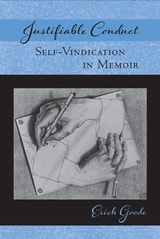
Justifiable Conduct
Self-Vindication in MemoirErich Goode
Temple University Press, 2013
Using a theory of deviance neutralization, Goode assesses the types of behavior exhibited by these memoirists to draw out generic narratives that are most effective in attempting to absolve the actor-author. Despite the highly individualistic and variable lives of these writers, Goode demonstrates that memoirists use a conventional vocabulary for their unconventional behavior.
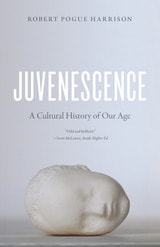
Juvenescence
A Cultural History of Our AgeRobert Pogue Harrison
University of Chicago Press, 2014
Like all of Robert Pogue Harrison's books, Juvenescence ranges brilliantly across cultures and history, tracing the ways that the spirits of youth and age have inflected each other from antiquity to the present. Drawing on the scientific concept of neotony, or the retention of juvenile characteristics through adulthood, and extending it into the cultural realm, Harrison argues that youth is essential for culture’s innovative drive and flashes of genius. At the same time, however, youth—which Harrison sees as more protracted than ever—is a luxury that requires the stability and wisdom of our elders and the institutions. “While genius liberates the novelties of the future,” Harrison writes, “wisdom inherits the legacies of the past, renewing them in the process of handing them down.”
A heady, deeply learned excursion, rich with ideas and insights, Juvenescence could only have been written by Robert Pogue Harrison. No reader who has wondered at our culture's obsession with youth should miss it.
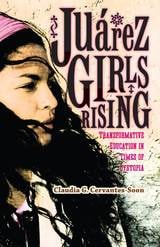
Juárez Girls Rising
Transformative Education in Times of DystopiaClaudia G. Cervantes-Soon
University of Minnesota Press, 2017
Working-class girls in Ciudad Juárez grow up in a context marked by violence against women, the devastating effects of drug cartel wars, unresponsive and abusive authorities, and predatory U.S. capitalism: under constantly precarious conditions, these girls are often struggling to shape their lives and realize their aspirations. Juárez native Claudia G. Cervantes-Soon explores the vital role that transformative secondary education can play in promoting self-empowerment and a spirit of resistance to the violence and social injustice these girls encounter.
Bringing together the voices of ten female students at Preparatoria Altavista, an innovative urban high school founded in 1968 on social justice principles, Cervantes-Soon offers a nuanced analysis of how students and their teachers together enact a transformative educational philosophy that promotes learning, self-authorship, and hope. Altavista’s curriculum is guided by the concept of autogestión, a holistic and dialectical approach to individual and collective identity formation rooted in the students’ experiences and a critical understanding of their social realities. Through its sensitive ethnography, this book shows how female students actively construct their own meaning of autogestión by making choices that they consider liberating and empowering.
Juárez Girls Rising provides an alternative narrative to popular and often simplistic, sensationalizing, and stigmatizing discourses about those living in this urban borderland. By merging the story of Preparatoria Altavista with the voices of its students, this singular book provides a window into the possibilities and complexities of coming of age during a dystopic era in which youth hold on to their critical hope and cultivate their wisdom even as the options for the future appear to crumble before their eyes.