Results by title
209 books match the query 'Alaska' and 5 start with k
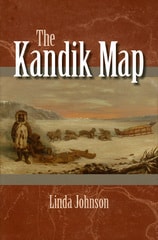
Kandik Map
Linda Johnson
University of Alaska Press, 2009
In 1880, a Native American named Paul Kandik and a French explorer, François Mercier, traveled across northeastern Alaska and western Canada to create the earliest known map of the region. Linda Johnson now delves into the fascinating story behind the Kandik Map, examining the reasons why and how these two men from such different backgrounds combined their extensive knowledge of the country to map the Kandik River region. Drawing on historical letters, geographical analysis, and the original map itself held in the University of California’s Bancroft Library, Johnson produces a groundbreaking study on the history of the Kandik Map and reveals its significant implications for Native American scholarship.
[more]
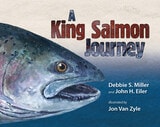
King Salmon Journey
Debbie Miller and John H. Eiler
University of Alaska Press, 2014
Two thousand miles is a staggering distance for any kind of journey. But imagine making it not by car or even foot—but by fin. That’s what faces Chinook, a female king salmon, as she takes a dramatic trip to safely deliver her eggs. From the Bering Sea, up the Yukon River, and on to the Nisutlin River, A King Salmon Journey takes young readers on an engaging ride through the waters of Alaska and Canada, bringing to life the biology—and mystery—of one of the world’s most popular fish. Based on the story of a real-life Chinook, this beautifully illustrated book deftly combines science with a fast-paced tale of survival and perseverance.
[more]
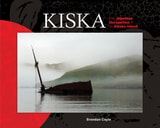
Kiska
The Japanese Occupation of an Alaska IslandBrendan Coyle
University of Alaska Press, 2014
Alaska’s windswept Aleutian Island chain arcs for over a thousand miles toward Asia from the Alaska Peninsula. In this remote and hostile archipelago is Kiska Island, an uninhabited sub-arctic speck in the tempestuous Bering Sea. Few have the opportunity even to visit this island, but in June of 1942 Japanese troops seized Kiska and neighboring Attu in the only occupation of North American territory since the War of 1812.
The bastion of Japan’s possessions in Alaska, Kiska was soon fortified with 7,500 enemy troops, their equipment, and a labyrinth of tunnels. For thirteen months Japanese troops withstood constant bombardment from American forces while retaining a tenuous hold on the island. Finally forced to abandon their position, the Japanese occupiers evacuated without their equipment and personal effects, leaving behind a trail of artifacts.
Brendan Coyle spent fifty-one days on the island searching out the tunnels, the equipment, and the objects, all frozen in time. Kiska brings together the images Coyle amassed during his exploration and his archival research. Accompanying explanations put the images in historical perspective, opening a window on a little-known battlefield and shining a rare light on a shadowy occupation.
[more]
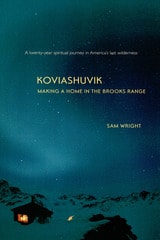
Koviashuvik
Making a Home in the Brooks RangeSam Wright
University of Arizona Press, 1997
On a slope above a mountain lake in Alaska’s Brooks Range, Sam and Billie Wright built a twelve-by-twelve-foot log cabin with hand tools and named it Koviashuvik—an Eskimo word meaning "living in the present moment with quiet joy and happiness." Sam’s account of the twenty years they spent there is both a tale of wilderness survival and an inspiring meditation on the natural world and humanity’s relationship to it.
[more]
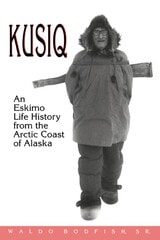
Kusiq
An Eskimo Life History from the Arctic Coast of Alaska.Waldo Bodfish Sr.
University of Alaska Press, 1991
If you are a casual reader who wants an intriguing glimpse into Eskimo life, a novice oral historian who wants to know how it is done right, or a student of Alaska who wants an Inupiat perspective of the changes that swept the western Arctic this century, read Kusiq.
(Journal of the West)
A vivid 'inside' account of an observant Eskimo male who mastered much of the traditional subsistence technology and lore and who lived through the end of commercial whaling, the development and decline of introduced reindeer herding and the fur market, and through World War II and its aftermath. In its scope as well as in the presentation of historical, cultural, and linguistic context,Kusiq is far more extensive than [other] autobiographies.
(American Indian Culture and Research Journal)
Kusiq represents a new wave in literature, the expressions of cultural awakenings among native American cultures, the attempt to redefine the native world in written form, to recast history, a history for too long the domain of the white system.
(ARCTIC)
It would be difficult to find a better, more interesting first-person account of Eskimo life during the first half of this century. [It is] second in an ambitious series of oral histories developed by the University of Alaska Press.
(Scan-A-Book)
The collaborators for this book include William Schneider, curator of oral history at the Elmer E. Rasmuson Library, University of Alaska Fairbanks; Leona Kisautaq Okakok, manager of the Arctic Education Foundation at the Arctic Slope Regional Corporation; and James Mumigana Nageak, coordinator of bilingual and multicultural instruction at the North Slope Borough School District. Schneider recorded and compiled Bodfish's stories, while Okakok and Nageak, both Inupiaq Eskimo language specialists, contributed their skills in interviewing, translating, and clarifying Inupiaq concepts. The book contains twelve chapters of Bodfish's narrative, background and commentary by the collaborators, and information on pronunciation, personal names, genealogical relations, and place names.
[more]