384 books match the query 'Black Studies (Global)' and 6 start with k
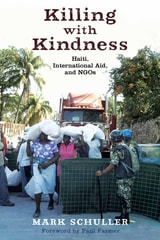
cover of Killing with Kindness: Haiti, International Aid, and NGOs

Killing with Kindness

Haiti, International Aid, and NGOs

Schuller, Mark

Rutgers University Press, 2012

Winner of the 2015 Margaret Mead Award from the American Anthropological Association and the Society for Applied Anthropology

After Haiti’s 2010 earthquake, over half of U.S. households donated to thousands of nongovernmental organizations (NGOs) in that country. Yet we continue to hear stories of misery from Haiti. Why have NGOs failed at their mission?

Set in Haiti during the 2004 coup and aftermath and enhanced by research conducted after the 2010 earthquake, Killing with Kindness analyzes the impact of official development aid on recipient NGOs and their relationships with local communities. Written like a detective story, the book offers rich ethnographic comparisons of two Haitian women’s NGOs working in HIV/AIDS prevention, one with public funding (including USAID), the other with private European NGO partners. Mark Schuller looks at participation and autonomy, analyzing donor policies that inhibit these goals. He focuses on NGOs’ roles as intermediaries in “gluing” the contemporary world system together and shows how power works within the aid system as these intermediaries impose interpretations of unclear mandates down the chain—a process Schuller calls “trickle-down imperialism.”
[more]
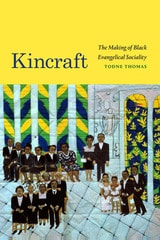
cover of Kincraft: The Making of Black Evangelical Sociality

Kincraft

The Making of Black Evangelical Sociality

Todne Thomas

Duke University Press, 2021
In Kincraft Todne Thomas explores the internal dynamics of community life among black evangelicals, who are often overshadowed by white evangelicals and the common equation of the “Black Church” with an Afro-Protestant mainline. Drawing on fieldwork in an Afro-Caribbean and African American church association in Atlanta, Thomas locates black evangelicals at the center of their own religious story, presenting their determined spiritual relatedness as a form of insurgency. She outlines how church members cocreate themselves as spiritual kin through what she calls kincraft—the construction of one another as brothers and sisters in Christ. Kincraft, which Thomas traces back to the diasporic histories and migration experiences of church members, reflects black evangelicals' understanding of Christian familial connection as transcending racial, ethnic, and denominational boundaries in ways that go beyond the patriarchal nuclear family. Church members also use their spiritual relationships to navigate racial and ethnic discrimination within the majority-white evangelical movement. By charting kincraft's functions and significance, Thomas demonstrates the ways in which black evangelical social life is more varied and multidimensional than standard narratives of evangelicalism would otherwise suggest.
[more]
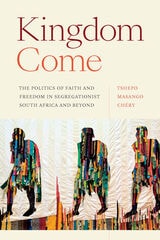
cover of Kingdom Come: The Politics of Faith and Freedom in Segregationist South Africa and Beyond

Kingdom Come

The Politics of Faith and Freedom in Segregationist South Africa and Beyond

Tshepo Masango Chéry

Duke University Press, 2023
In Kingdom Come, Tshepo Masango Chéry charts a new genealogy of early twentieth-century Black Christian activists who challenged racism in South Africa before the solidification of apartheid by using faith as a strategy against global racism. Masango Chéry traces this Black freedom struggle and the ways that South African church leaders defied colonial domination by creating, in solidarity with Black Christians worldwide, Black-controlled religious institutions that were geared toward their liberation. She demonstrates how Black Christians positioned the church as a site of political resistance and centered specifically African visions of freedom in their organizing. Drawing on archival research spanning South Africa, Zimbabwe, Kenya, the United Kingdom, and the United States, Masango Chéry tells a global story of the twentieth century that illuminates the formations of racial identity, state control, and religious belief. Masango Chéry’s recentering of South Africa in the history of worldwide Black liberation changes understandings of spiritual and intellectual routes of dissemination throughout the diaspora.
[more]
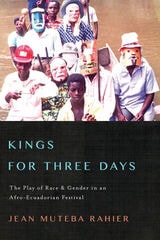
cover of Kings for Three Days: The Play of Race and Gender in an Afro-Ecuadorian Festival

Kings for Three Days

The Play of Race and Gender in an Afro-Ecuadorian Festival

Jean Muteba Rahier

University of Illinois Press, 2013
 
With its rich mix of cultures, European influences, colonial tensions, and migration from bordering nations, Ecuador has long drawn the interest of ethnographers, historians, and political scientists. In this book, Jean Muteba Rahier delivers a highly detailed, thought-provoking examination of the racial, sexual, and social complexities of Afro-Ecuadorian culture, as revealed through the annual Festival of the Kings. During the Festival, the people of various villages and towns of Esmeraldas--Ecuador's province most associated with blackness--engage in celebratory and parodic portrayals, often donning masks, cross-dressing, and disguising themselves as blacks, indigenous people, and whites, in an obvious critique of local, provincial, and national white, white-mestizo, and light-mulatto elites. Rahier shows that this festival, as performed in different locations, reveals each time a specific location's perspective on the larger struggles over identity, class, and gender relations in the racial-spacial order of Esmeraldas, and of the Ecuadorian nation in general.

[more]
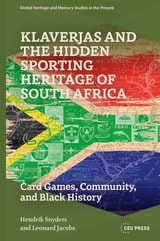
cover of Klaverjas and the Hidden Sporting Heritage of South Africa: Card Games, Community, and Black History

Klaverjas and the Hidden Sporting Heritage of South Africa

Card Games, Community, and Black History

Hendrik Snyders

Central European University Press, 2026
As a collective, klaverjas players form a distinct community of practice with a unique organisational discourse, language, and set of socialisation practices. Given its prevalence within South Africa’s Black communities, klawerjas, as it is locally known, is perceived as both the traditional game of the communities in question and a marker of a particular regional ethnic identity. The history of klaverjas is part of the unmapped sporting heritage of South Africa’s Black communities, whose true extent and meaning have long remained obscured. This book maps the development of klaverjas, its consolidation, its unique local character, and its intersections with broader societal events. It places competitive klaverjas in the mainstream of South Africa’s sports history and claims its place as a part of the country’s national sports identity.
[more]
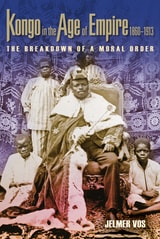
cover of Kongo in the Age of Empire, 1860–1913: The Breakdown of a Moral Order

Kongo in the Age of Empire, 1860–1913

The Breakdown of a Moral Order

Jelmer Vos

University of Wisconsin Press, 2015

This richly documented account of the arrival of rubber traders, new Christian missionaries, and the Portuguese colonial state in the Kongo realm is told from the perspective of the kingdom's inhabitants. Jelmer Vos shows that both Africans and Europeans were able to forward differing social, political, and economic agendas as Kongo's sacred city of São Salvador became a vital site for the expansion of European imperialism in Central Africa. Kongo people, he argues, built on the kingdom's long familiarity with Atlantic commerce and cultures to become avid intermediaries in a new system of colonial trade and mission schools.

Vos underlines that Kongo's incorporation in the European state system also had tragic consequences, including the undermining of local African structures of authority—on which the colonial system actually depended. Kongo in the Age of Empire carefully documents the involvement of Kongo's royal court in the exercise of Portuguese rule in northern Angola and the ways that Kongo citizens experienced colonial rule as an increasingly illegitimate extension of royal power.

[more]