Results by title
3071 books match the query 'Business & Economics' and 10 start with k

Karnali Under Stress
Livelihood Strategies and Seasonal Rhythms in a Changing Nepal HimalayaBarry C. Bishop
University of Chicago Press, 1990
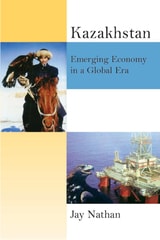
Kazakhstan's New Economy
Post-Soviet, Central Asian Industries in a Global EraJay Nathan
University of Scranton Press, 2013
“An excellent resource on major industries in Kazakhstan.”—Byrganym Aitimova, Minister of Education and Science, the Republic of Kazakhstan
Keeping Faith, Losing Faith
Religious Belief and Political Economy, Volume 40Bradley W. Bateman and H. Spencer Banzhaf, eds.
Duke University Press, 0
Two of the essays examine the antagonism between Christianity and utilitarianism in postrevolutionary French economics and the rising influence of the materialism of the market vis-à-vis the declining authority of the Roman Catholic Church in eighteenth-century Europe. Other topics explored include the work of the great American neoclassicist Frank Knight, the combination of utility analysis and Christian principles among the “clerical economists” in America, and the effect of a crisis of personal faith on the theories of the English philosopher and economist Henry Sidgwick.
Kellogg on China
Strategies for SuccessAnuradha Dayal-Gulati and Angela Y. Lee
Northwestern University Press, 2004
Since 1979, when China emerged from its long isolation and launched the first of its economic reforms, the country has gone from producing low-quality exports to making sophisticated high-technology goods and is now a major player in the world economy. China has become the new engine of global growth.
As China continues to implement its commitments agreed upon with membership into the World Trade Organization (WTO), the environment for multinational corporations is changing rapidly. This book examines some of the changes WTO accession is bringing to the market environment and different sectors of the economy, and the resulting challenges and opportunities for companies doing business in China.
The book draws on extensive field research with Chinese corporate executives, government officials, and representatives of nongovernmental organizations. Based on the findings from these interviews, the authors provide insights and strategies for companies seeking to establish a sustainable competitive advantage in the country's evolving marketplace. Kellogg on China is the outgrowth of a collaborative student-faculty effort through the Global Initiatives in Management program at the Kellogg School of Management.

Kicking Ass in a Corset
Jane Austen’s 6 Principles for Living and Leading from the Inside OutAndrea Kayne
University of Iowa Press, 2021
What can organizational leaders in business, education, government, and most any enterprise learn from an unemployed, unmarried woman who lived in patriarchal, misogynistic rural England more than 200 years ago? As it turns out, a great deal. In identifying the core virtues of Austen’s heroines—confidence, pragmatism, diligence, integrity, playfulness, and humility—Andrea Kayne uncovers the six principles of internally referenced leadership that, taken together, instruct women how to tap into a deep well-spring of personal agency and an internal locus of control no matter what is going on around them. Utilizing practical exercises, real-life case studies, and literary and leadership scholarship, Kicking Ass in a Corset maps out effective leadership that teaches readers how to tune out the external noise and listen to themselves so that they can truly live and lead from the inside out.
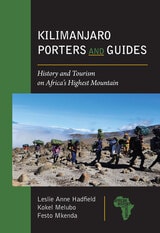
Kilimanjaro Porters and Guides
History and Tourism on Africa's Highest MountainLeslie Anne Hadfield
Michigan State University Press, 2026
Mt. Kilimanjaro, Africa’s tallest mountain, draws tens of thousands of tourists annually. Many attempt to climb its nineteen thousand feet snow-covered peak, an arduous trek that can span several days. Like the climbers who scale Everest, they are aided by local porters, cooks, and guides. But unlike Everest’s Sherpas, who have been extensively documented and profiled, the Chagga people of the Kilimanjaro mountain crews remain nearly anonymous.
The Chagga people, who were the first settlers near Kilimanjaro, have been an essential part of the climbing industry that has developed since the colonial period. Kilimanjaro Porters and Guidesreveals the history of these porters, cooks, and guides. The book takes us from early Chagga settlement, through European colonialism and African independence, to today. It argues that while the Kilimanjaro climbing industry developed in a colonial context, local Tanzanian actors have played an integral role in determining access to and understanding of the mountain. They also have been central to climbers’ successes, mountain crew culture, and the evolution of key industry features—even as they have struggled in the postcolonial period.

Knowledge LTD
Toward a Social Logic of the DerivativeRandy Martin
Temple University Press, 2015
In Knowledge LTD, Martin explores how both the limits of knowledge and the social constructions of culture reflect the way we organize social life in the face of disasters and their aftermath. He examines this crisis of knowledge as well as the social movements that rose up in its wake. Martin not only treats derivatives as financial contracts for pricing risk, but also shows how the derivative works in economic terms, where the very unity of the economy is undone.
Knowledge LTD ultimately points to a more comprehensive reordering of the once separate spheres of economy, polity, and culture. Martin provides a new way of understanding the social significance of the all-pervasive derivative logic.

Knowledge Sovereignty Among African Cattle Herders
Zeremariam Fre
University College London, 2018
In this book, the first to study Beni-Amer practices, Zeremariam Fre argues for the importance of their knowledge, challenging the preconceptions that regard it as untrustworthy when compared to scientific knowledge from more developed regions. Empirical evidence suggests that there is much one could learn from the other, since elements of pastoralist technology, such as those related to animal production and husbandry, make a direct contribution to our knowledge of livestock production. It is this potential for hybridization, as well as the resilience of the herders, at the core of the indigenous knowledge system.
Fre also argues that indigenous knowledge can be viewed as a stand-alone science, and that a community’s rights over ownership should be defended by government officials, development planners and policy makers, making the case for a celebration of the knowledge sovereignty of pastoralist communities
Knowledge and Class
A Marxian Critique of Political EconomyStephen A. Resnick and Richard D. Wolff
University of Chicago Press, 1987
Kuna Crafts, Gender, and the Global Economy
By Karin E. Tice
University of Texas Press, 1995