Results by title
63 books match the query 'Christian Ministry' and 2 start with k
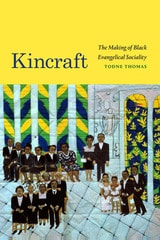
Kincraft
The Making of Black Evangelical SocialityTodne Thomas
Duke University Press, 2021
In Kincraft Todne Thomas explores the internal dynamics of community life among black evangelicals, who are often overshadowed by white evangelicals and the common equation of the “Black Church” with an Afro-Protestant mainline. Drawing on fieldwork in an Afro-Caribbean and African American church association in Atlanta, Thomas locates black evangelicals at the center of their own religious story, presenting their determined spiritual relatedness as a form of insurgency. She outlines how church members cocreate themselves as spiritual kin through what she calls kincraft—the construction of one another as brothers and sisters in Christ. Kincraft, which Thomas traces back to the diasporic histories and migration experiences of church members, reflects black evangelicals' understanding of Christian familial connection as transcending racial, ethnic, and denominational boundaries in ways that go beyond the patriarchal nuclear family. Church members also use their spiritual relationships to navigate racial and ethnic discrimination within the majority-white evangelical movement. By charting kincraft's functions and significance, Thomas demonstrates the ways in which black evangelical social life is more varied and multidimensional than standard narratives of evangelicalism would otherwise suggest.
[more]
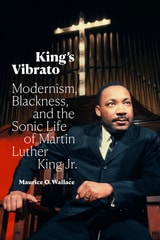
King's Vibrato
Modernism, Blackness, and the Sonic Life of Martin Luther King Jr.Maurice O. Wallace
Duke University Press, 2022
In King’s Vibrato Maurice O. Wallace explores the sonic character of Martin Luther King Jr.’s voice and its power to move the world. Providing a cultural history and critical theory of the black modernist soundscapes that helped inform King’s vocal timbre, Wallace shows how the qualities of King’s voice depended on a mix of ecclesial architecture and acoustics, musical instrumentation and sound technology, audience and song. He examines the acoustical architectures of the African American churches where King spoke and the centrality of the pipe organ in these churches, offers a black feminist critique of the influence of gospel on King, and outlines how variations in natural environments and sound amplifications made each of King’s three deliveries of the “I Have a Dream” speech unique. By mapping the vocal timbre of one of the most important figures of black hope and protest in American history, Wallace presents King as the embodiment of the sound of modern black thought.
[more]