Results by title
90 books match the query 'Civil' and 2 start with k
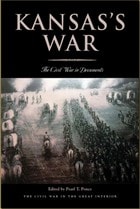
Kansas’s War
The Civil War in DocumentsPearl T. Ponce
Ohio University Press, 2011
When the Civil War broke out in April 1861, Kansas was in a unique position. It had been a state for mere weeks, and already its residents were intimately acquainted with civil strife. Since its organization as a territory in 1854, Kansas had been the focus of a national debate over the place of slavery in the Republic. By 1856, the ideological conflict developed into actual violence, earning the territory the sobriquet “Bleeding Kansas.” Because of this steady escalation in violence, the state’s transition from peace to war was not as abrupt as that of other states.
Kansas’s War illuminates the new state’s main preoccupations: the internal struggle for control of policy and patronage; border security; and issues of race—especially efforts to come to terms with the burgeoning African American population and Native Americans’ coninuing claims to nearly one-fifth of the state’s land. These documents demonstrate how politicians, soldiers, and ordinary Kansans were transformed by the war.
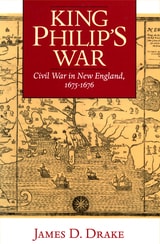
King Philip's War
Civil War in New England, 1675-1676James D. Drake
University of Massachusetts Press, 1999
Sometimes described as “America's deadliest war,” King Philip's War proved a critical turning point in the history of New England, leaving English colonists decisively in command of the region at the expense of native peoples. Although traditionally understood as an inevitable clash of cultures or as a classic example of conflict on the frontier between Indians and whites, in the view of James D. Drake it was neither. Instead, he argues, King Philip's War was a civil war, whose divisions cut across ethnic lines and tore apart a society composed of English colonizers and Native Americans alike. According to Drake, the interdependence that developed between English and Indian in the years leading up to the war helps explain its notorious brutality. Believing they were dealing with an internal rebellion and therefore with an act of treason, the colonists and their native allies often meted out harsh punishments. The end result was nothing less than the decimation of New England's indigenous peoples and the consequent social, political, and cultural reorganization of the region. In short, by waging war among themselves, the English and Indians of New England destroyed the world they had constructed together. In its place a new society emerged, one in which native peoples were marginalized and the culture of the New England Way receded into the past.